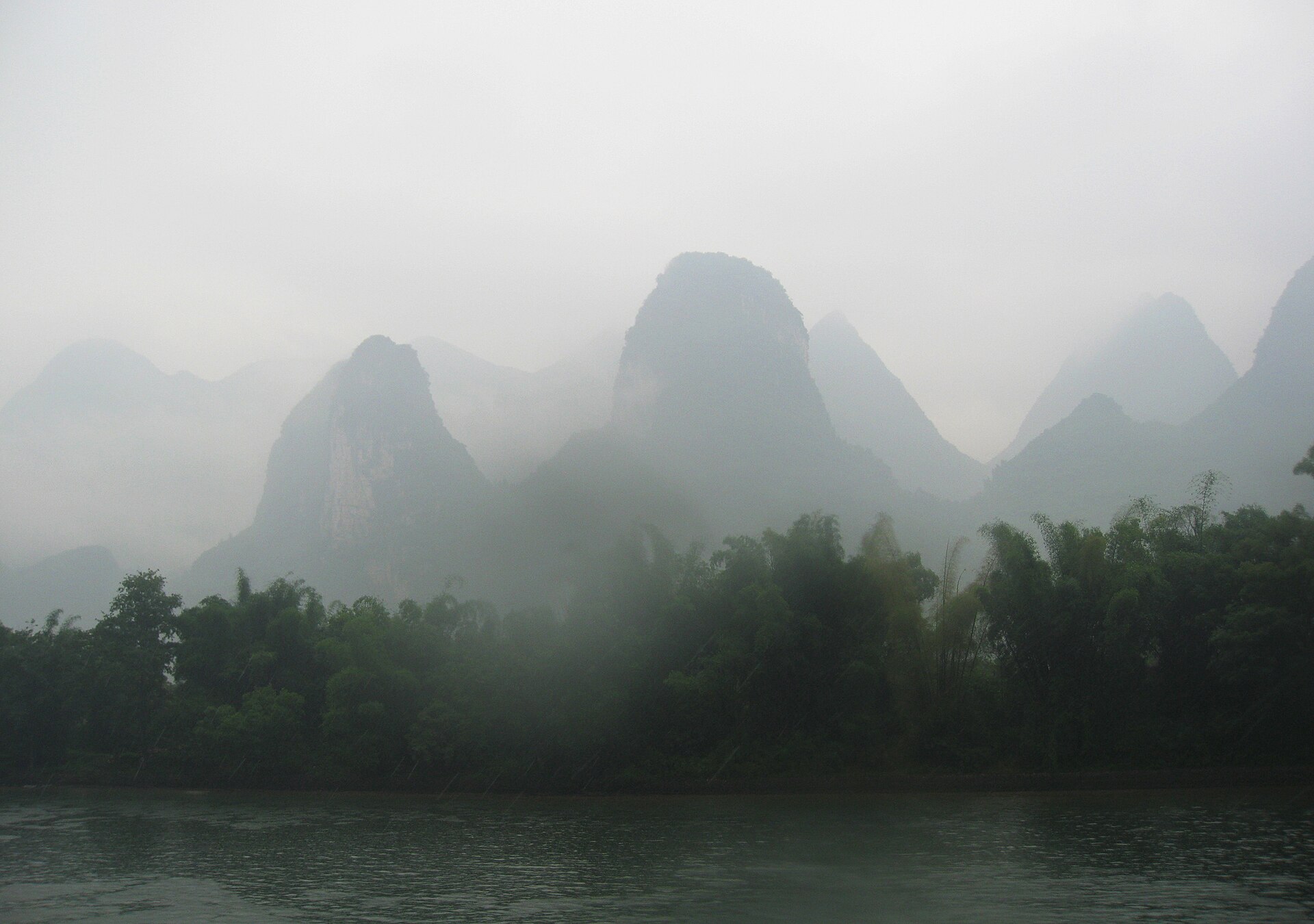
Strangely shaped limestone peaks line a clear, slow river like an ink-wash painting come to life — this is the scene printed on the 20-yuan note, the place the Chinese sum up as "桂林山水甲天下", the finest mountains and waters under heaven. This guide is built from verified facts and real visitor accounts to get you ready before you leave home.
Seen the images of strange green peaks rising straight out of a clear river? That is Guilin — a city in Guangxi province where nature has sculpted thousands of limestone (karst) peaks along the Li River. For centuries the Chinese have said "桂林山水甲天下" — the mountains and waters of Guilin are the finest under heaven. And the stretch of the Li River near Xingping is the very scene printed on the 20-yuan note in your wallet.
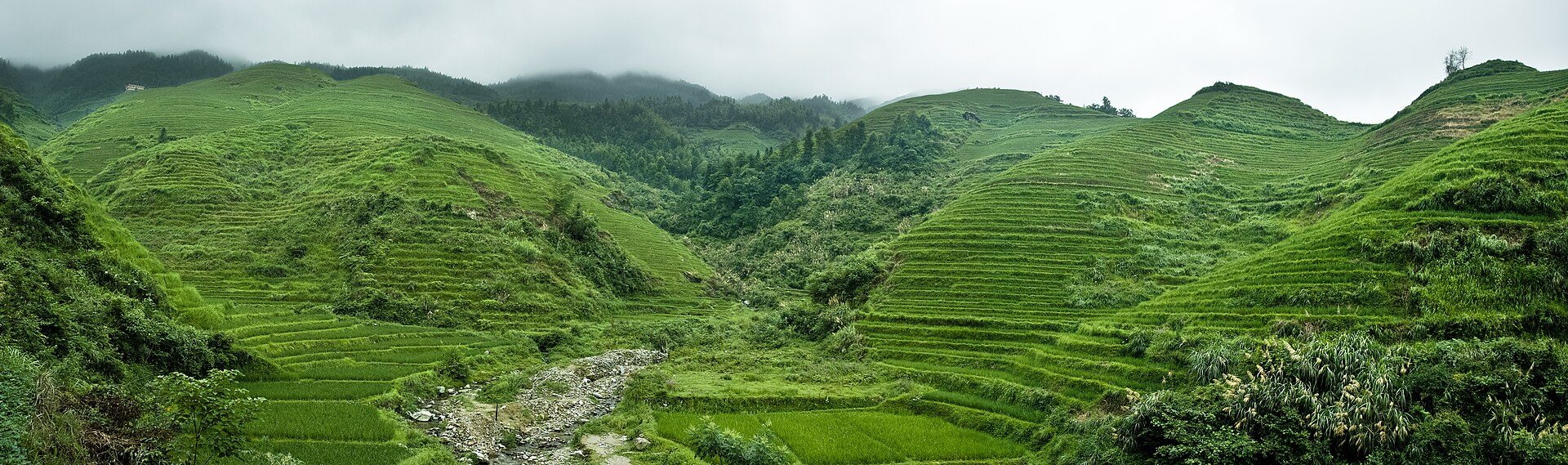
The heart of the trip is three experiences — a Li River cruise from Guilin to Yangshuo through the most beautiful peaks · the Yangshuo countryside, where you cycle past paddy fields and drift on bamboo rafts along the Yulong River · and the Longji rice terraces, stepping up the mountainside like living contour lines. This is a slow city you come to in order to breathe with nature, not a city of skyscrapers — see the full picture in our complete Guilin guide →
The honest answer: two to three days covers the three core experiences — a Li River cruise from Guilin to Yangshuo, cycling the Yangshuo countryside along the Yulong River, and an evening on West Street. With four or five days you have room to stay overnight in the Longji rice terraces and fill in the city highlights.
Day 1: city highlights in Guilin — Elephant Trunk Hill → Two Rivers Four Lakes → the Sun-Moon Pagodas after dark. Day 2: cruise the Li River to Yangshuo → wander West Street. Day 3: cycle the Yulong River countryside + drift on a bamboo raft.
+Day 4: the Longji rice terraces (Ping'an or Dazhai), staying a night to catch sunrise over the paddies. +Day 5: Xingping ancient town, the Reed Flute Cave, or simply explore at your own pace.
There is a plan for every length of trip: 1 day (short visit) · 2 days · 3 days · 4 days · 5 days
April to May and September to October are the best, with green landscapes, full rivers and the scenery at its most photogenic. The Longji rice terraces turn gold at harvest from mid-September to early October, and become mirror-like water after spring planting from late April to June. Summer (Jun–Aug) is hot, humid and the wettest (rivers run high with dramatic mist, but downpours happen). Winter (Dec–Feb) is cool, around 5–12°C, often foggy, and low water on the Li River can shorten the cruise. See month-by-month detail in when to visit →
As of 2026, Thai passport holders enter China visa-free for short tourist stays. The policy can change, however, so check the latest at our China visa-free guide for Thais → before booking your flights.
Direct flights from Bangkok land at Guilin Liangjiang Airport (KWL), about 28 km southwest of the city centre. Guilin has no airport metro — plan your way in before you arrive.
The airport bus (机场大巴) — best value, running into Guilin Railway Station in the centre, ¥20 (about ฿100), around 60 minutes, roughly every 30 minutes from about 07:00 to 22:30. A taxi costs ¥80–100 (about ฿400–500) and takes 40–50 minutes — handy with heavy luggage. DiDi runs ¥70–90 (about ฿350–450) with transparent pricing; many hotels arrange a paid pickup. Heading straight to Yangshuo, there are shuttles and charters of around 1.5 hours.
Guilin's main stations are Guilin (桂林站) in the centre, walkable to the Two Rivers Four Lakes and Zhongshan Road and best if you are staying there; Guilin North (桂林北站), the main bullet-train hub; and Guilin West (桂林西站) on the Guiyang–Guangzhou line. From Guilin North it is just ~24 minutes to Yangshuo station (8+ bullet trains a day, ~¥30, then about 30 minutes onward into Yangshuo town), about 2h45 to Guangzhou South, and 1.5–2.5 hours to Nanning. Book through Trip.com or the 12306 app.
Guilin has no metro or subway. You get around the city by buses at ¥1–2 (scan Alipay or WeChat; many routes pass the lakes and Elephant Trunk Hill) and by cheap taxis and DiDi (flagfall around ¥9–10), the easiest default. For Yangshuo (~65 km) take a bus or the bullet train to Yangshuo station in 24 minutes, and for the Longji terraces a roughly two-hour tour bus or charter. See detail in our getting around Guilin guide →
Most places run on Alipay and WeChat Pay. Hotels and larger venues take Visa and Mastercard, but small noodle shops, market stalls and street carts often accept mobile payment only. Set up the tourist version of Alipay before you leave (it links foreign cards), or keep some yuan from an ATM as backup. See the full guide to paying in China →
In Guilin you can choose your base by the kind of trip you want — the city for walk-everywhere convenience, Yangshuo for countryside and karst peaks, Longji for sunrise over the terraces. Learn the areas first and choosing a hotel gets much easier. See real hotel reviews in our Top 10 Guilin hotels →
The heart of the city, within walking distance of Elephant Trunk Hill and the Zhengyang pedestrian street. After dark, the Two Rivers Four Lakes light up with the glowing Sun-Moon Pagodas. Hotels range from hostels to luxury towers. This is the answer if it is your first visit and you want to make the most of your time.
Stay near Guilin Railway Station or Guilin North if you plan to take the train onward to Yangshuo, Guangzhou or Nanning. It is usually better value than the central tourist core, and you can still reach the sights by a short bus or DiDi ride.
About 65 km south of Guilin, where you wake up surrounded by limestone peaks. West Street buzzes after dark, while the countryside out along the Yulong River is quiet and rural, made for cycling past paddies and drifting on bamboo rafts. This is where luxury resorts like Alila and Banyan Tree cluster.
Stay up in a village on the Longji rice terraces to wake for sunrise over paddies stepping up the mountain. Most stays are local-style timber guesthouses and small hotels run by the Zhuang and Yao communities. Ideal if you want the photos and atmosphere that the city cannot give you.
Guilin has plenty to see, but on a first visit these are the core everyone should experience — see the full list in Guilin attractions → or day trips from the city →
The cruise from Guilin to Yangshuo runs about 4–5 hours through the most beautiful stretch of karst peaks, including the Xingping scene printed on the 20-yuan note. On a clear day you see mountain reflections on the water; on a misty day you get the ink-wash painting effect. Book ahead on Klook.
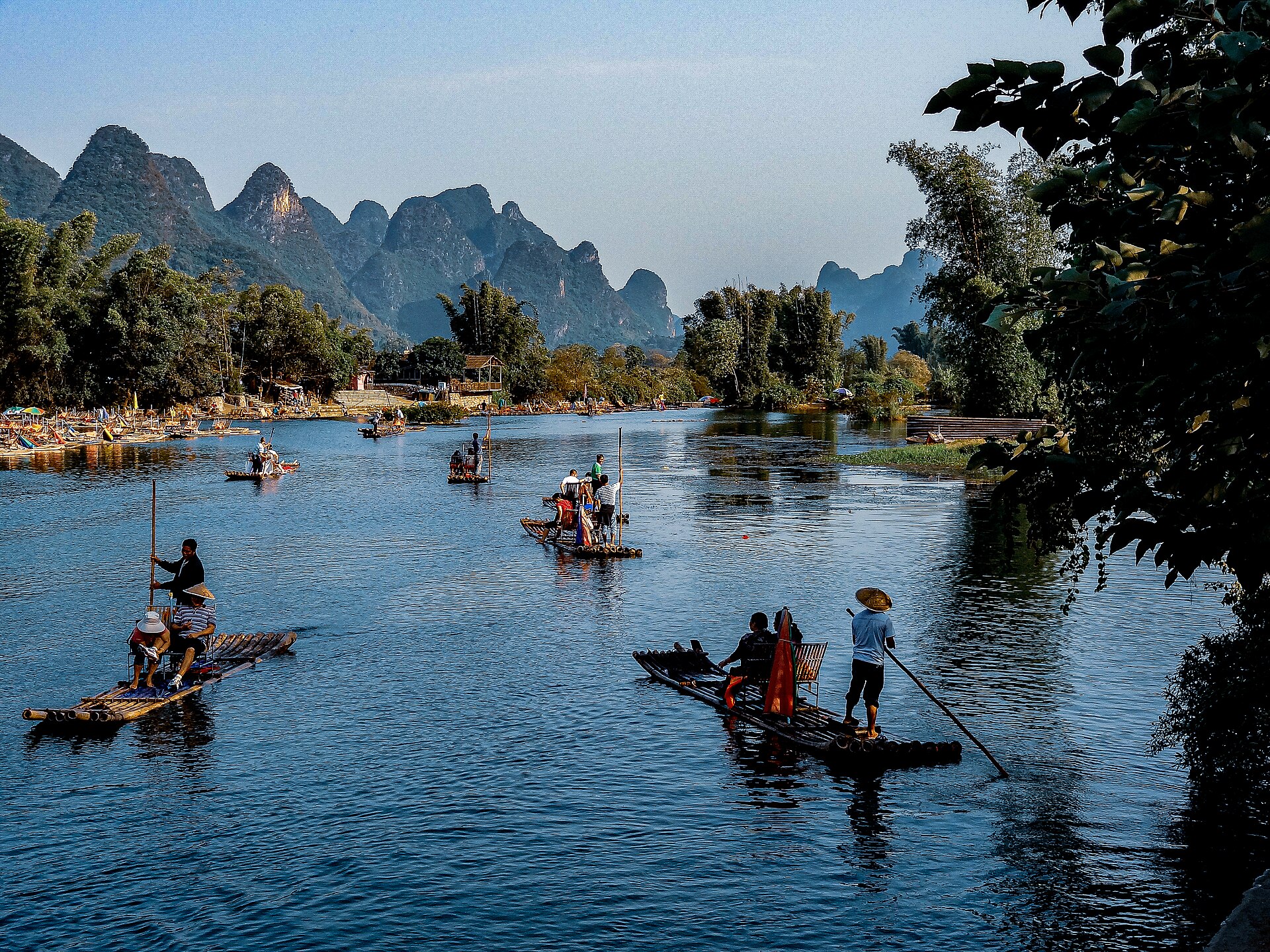
The Yangshuo countryside is the heart of the slow trip — cycle or e-bike past paddies and villages, then drift on a bamboo raft along the Yulong River, clearer and quieter than the Li, with karst peaks wrapping around on every side. The slowest, loveliest day of the trip.
Paddy fields stepping up the mountain like a "dragon's backbone", as the name says. They turn gold at harvest from mid-September to early October, and become mirror-like water after spring planting from late April to June. Ping'an and Dazhai villages offer different viewpoints — staying a night for sunrise is well worth it.
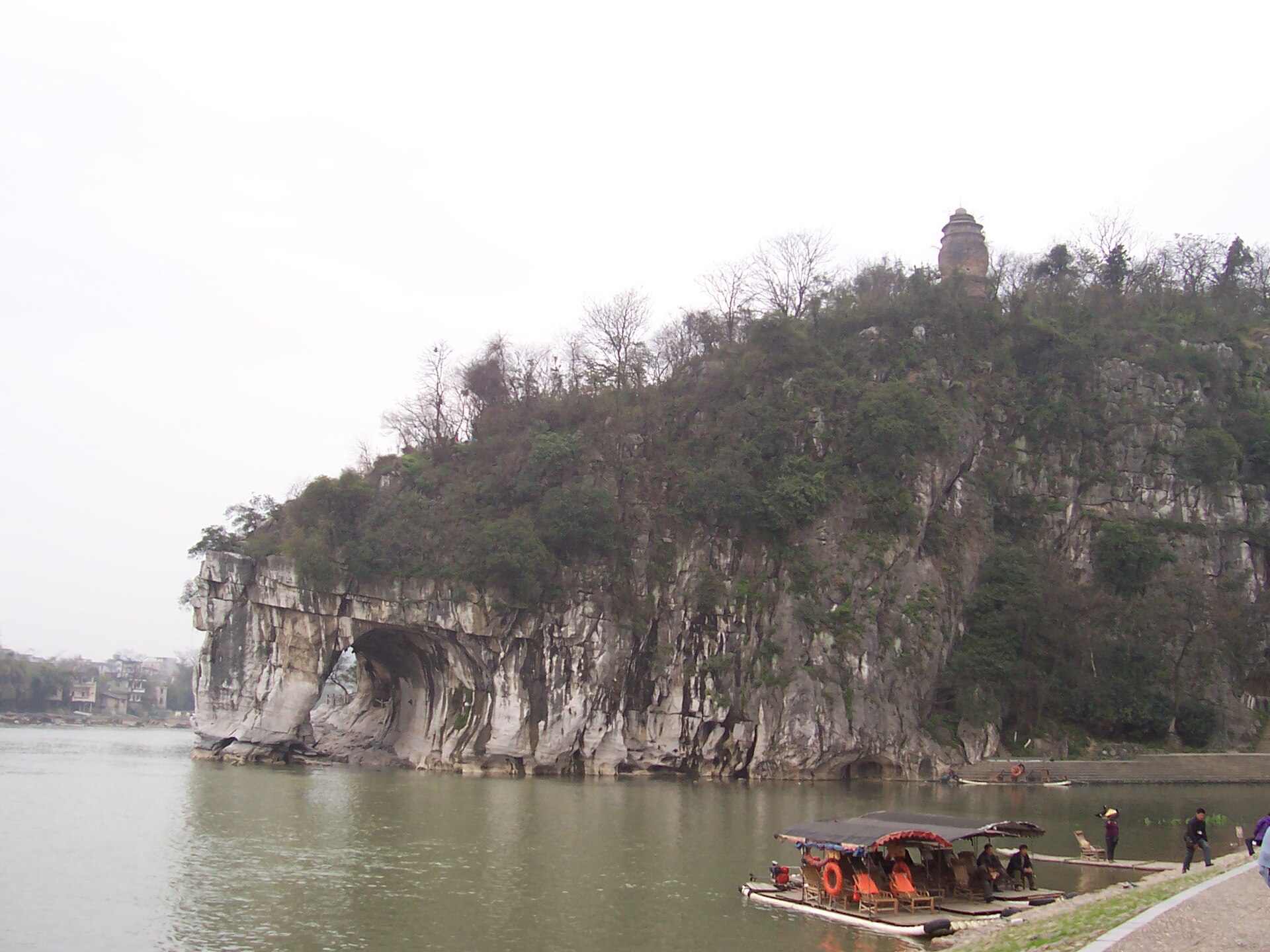
A karst hill shaped like an elephant dipping its trunk into the Li River — the emblem of Guilin that everyone comes to photograph. It sits right in the city, walkable from the central hotel areas. Late afternoon and the illuminated evening are the prettiest times.
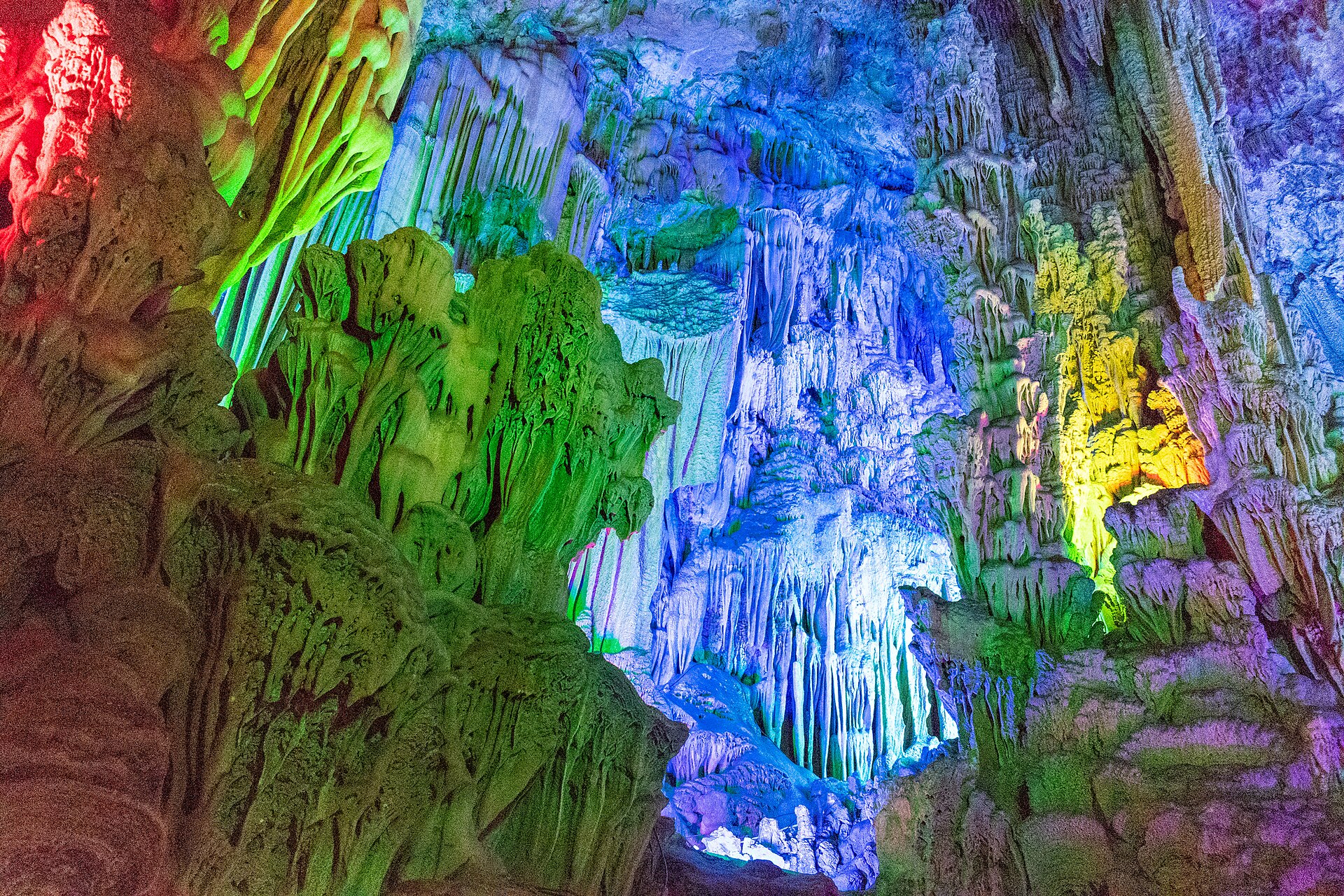
A limestone cave where the stalactites and stalagmites are floodlit in colour to look like an underground palace, with a still pool inside that mirrors the lights beautifully. It is a good indoor sight on a rainy day, not far from the city centre.
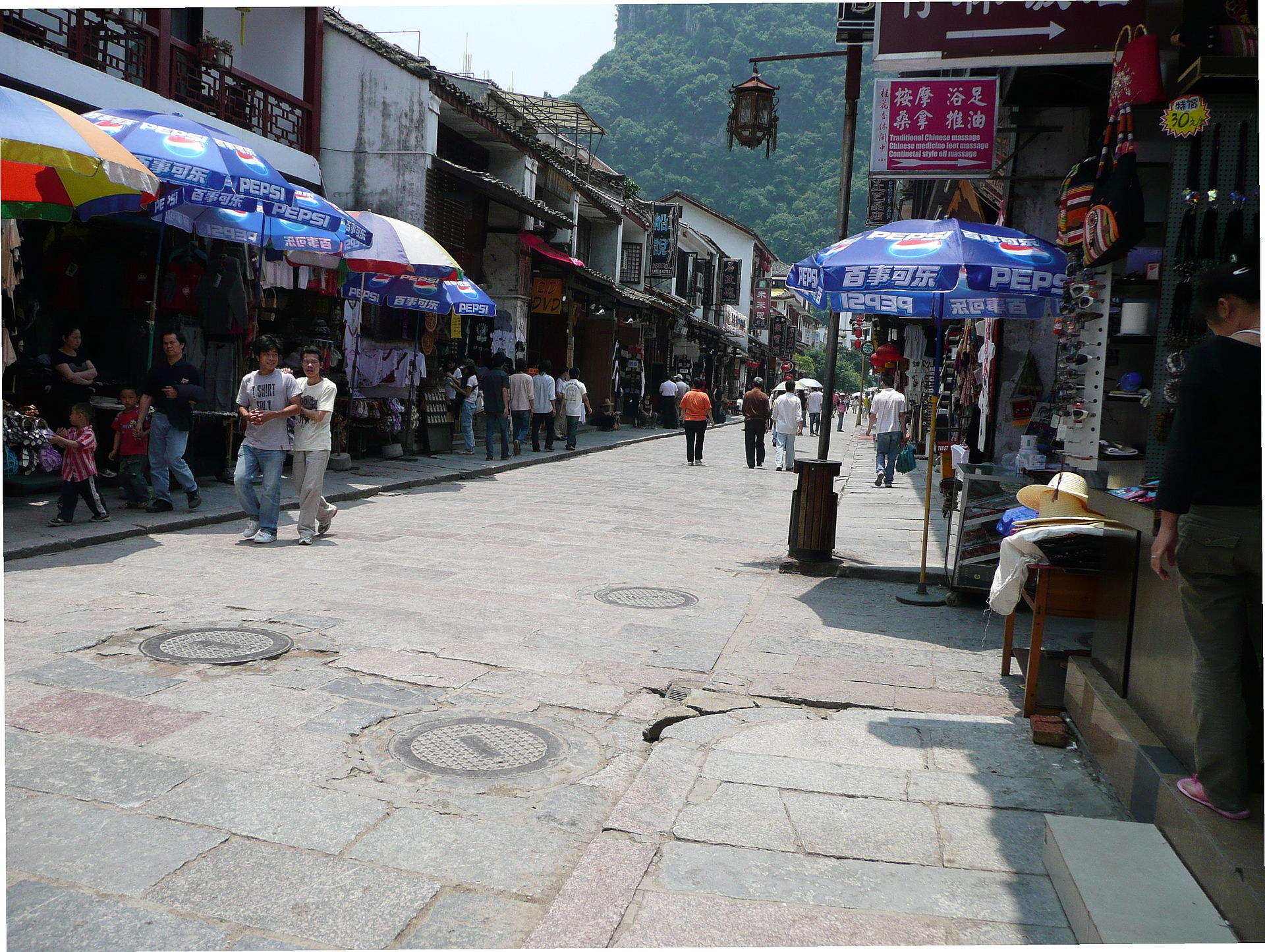
The old pedestrian street at the centre of Yangshuo, lined with restaurants, cafés, bars and souvenir shops. After dark it becomes the social hub of town — the perfect place to find dinner after a day of cycling or cruising.
Guilin food has a gentle mountain-and-river flavour, less fiery than Chongqing or Sichuan, built around its famous rice noodles, Yangshuo beer fish and oil tea. See more in our Guilin food guide →
Rice noodles tossed in a signature braised sauce (卤水) with roasted peanuts, stewed meat and pickled vegetables. Locals eat them for breakfast every day — toss them together before you start, then add chilli and peanuts to taste. Very cheap and on every street corner. More in our Guilin rice noodles guide →
A whole river fish cooked with beer, tomato, chilli and spices into a tangy, sweet, gently spicy balance — the signature dish of Yangshuo that almost every restaurant makes. Eaten with steamed rice after a day of cycling, it hits the spot. More in our Yangshuo beer fish guide →
A local drink from the Gongcheng and Longsheng areas to the north: tea leaves pan-fried with ginger and garlic, then pounded into a rich, savoury brew, served with puffed rice, beans and crunchy snacks. The salty, nutty taste is unusual but moreish — a welcome ritual of the Zhuang and Yao people. More in our Guilin oil tea guide →
Guangxi home cooking leans on fresh ingredients and rounded flavours — signatures include taro-and-pork casserole, river fish and roast duck. The night-market street food runs from snails and sweets to grilled skewers. More in our local cuisine → · street food →
More Guilin food: street food → · cafés →
Guilin works on any budget — there are cheap places to stay, buses are very inexpensive, and food is good value. The bigger costs are admission tickets (the Li River cruise, Reed Flute Cave and Longji terraces all charge entry) and the tours or charters out to Yangshuo and Longji. See the full breakdown in our Guilin trip budget →
| Tier | Stay / night | Food / day | Total / day (rough) |
|---|---|---|---|
| Budget | ¥100–250 (฿500–1,250) hostel or budget hotel | ¥60–120 (฿300–600) | ¥250–500 (~฿1,250–2,500) |
| Mid-range | ¥300–650 (฿1,500–3,250) 3–4 star hotel | ¥150–350 (฿750–1,750) | ¥600–1,300 (~฿3,000–6,500) |
| Luxury | ¥1,200–4,000+ (฿6,000–20,000+) Yangshuo resort / mountain view | ¥400–1,500+ (฿2,000–7,500+) | ¥2,000–6,500+ (~฿10,000–32,500+) |
Buses are ¥1–2 a ride, but budget for the Li River cruise, tickets to the Reed Flute Cave, Elephant Trunk Hill and Longji terraces, and a charter up to Longji. See more in the China travel budget guide →
Unlike other large Chinese cities, Guilin has no metro or subway for visitors. In the city you ride buses at ¥1–2 and take taxis or DiDi, while the main sights are spread out (city ↔ Yangshuo ↔ Longji). The trick is to group your sights into day-by-day clusters by area, then match the train, bus or charter to each.
China blocks all of Google's services (Maps, Gmail, Translate), Facebook, Instagram, LINE, YouTube and WhatsApp. Without a working VPN you are cut off from all of it. Set up a VPN on your phone before you leave, and download Amap (maps) and Baidu Translate. See the VPN + eSIM guide for China →
Local noodle shops, market stalls and street carts mostly take Alipay or WeChat Pay only — there is no card terminal. Set up the tourist version of Alipay (it links foreign Visa and Mastercard), or withdraw some cash from an ATM as backup; ¥500–1,000 should cover small purchases.
The airport and rail stations have English signs, but most taxi and DiDi drivers can't read place names in English. Save your destinations in Chinese characters on your phone, or show the driver the screen in Amap.
The postcard image of peaks floating above the mist comes on overcast or lightly drizzling days, not under blazing sun. If you wake to fog, don't despair — that is Guilin in its ink-wash-painting form. Pack a light rain jacket and shoes with grip.
During Golden Week (1–7 October) the whole country travels at once; the Li River cruise boats and the Longji terraces get packed and hotel prices double or triple. Chinese New Year (Jan/Feb) is also busy, with some places closed. See detail in when to visit →