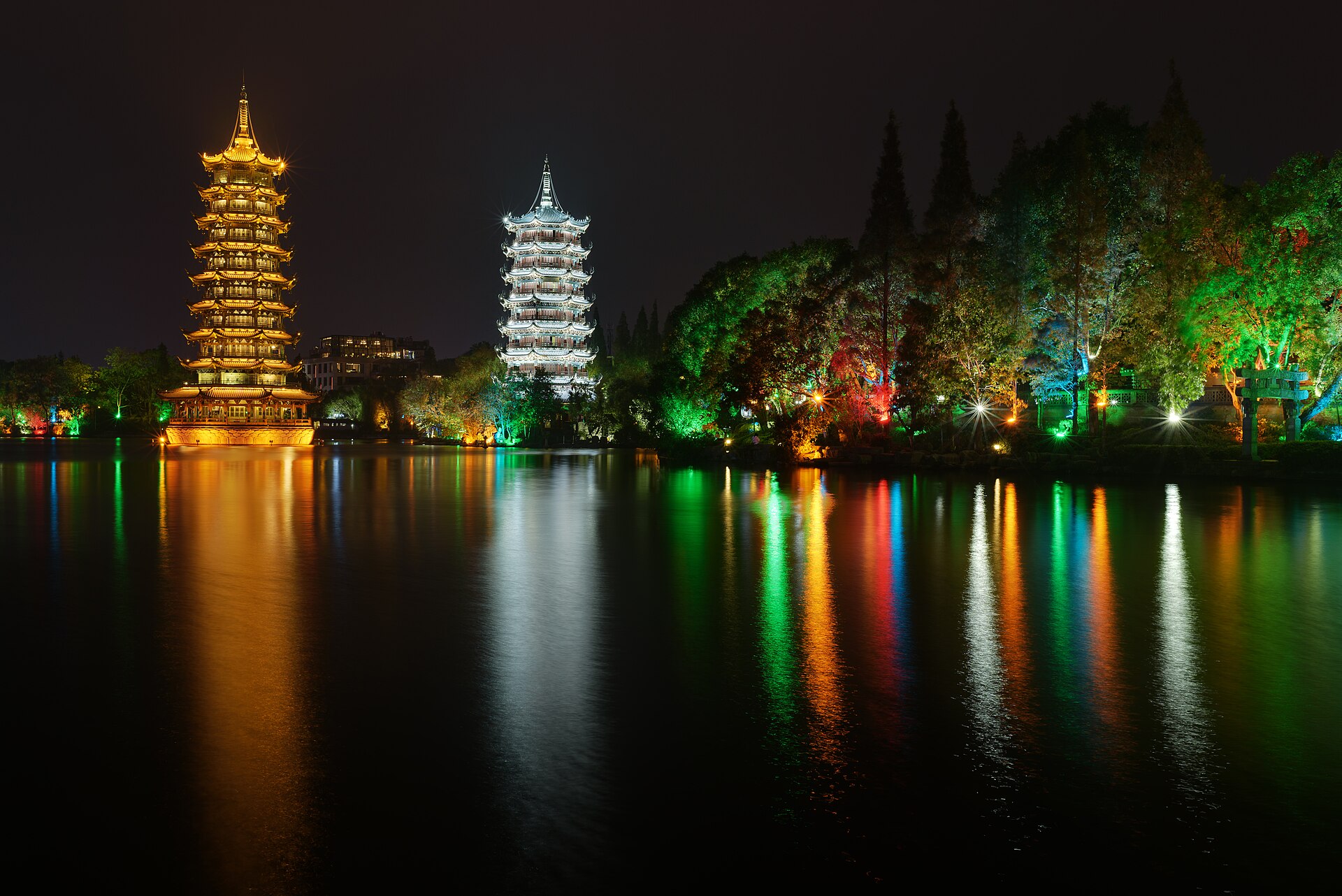
By day it's a free lakeside park to wander beneath the willows; by night it becomes a ribbon of light — a cruise past the Sun and Moon Pagodas, a crystal glass bridge and reflections stretched long across still water.
Picture this: you're standing on the edge of Shan Lake at six in the evening. The water is mirror-still, and out in the middle stand two pagodas, side by side — one washed in gold, the other a tower of silver-tinted glass. There's still a wash of blue in the sky from the sun that has just dropped behind the hills. Then, all at once, the whole district lights up — the pagodas glow gold, the bridges shift colour, the willows along the bank turn warm, and every bit of it doubles in the water below.
That's Two Rivers and Four Lakes (两江四湖) — Guilin's central water system, linking the Li River (漓江) and the Peach Blossom River (桃花江) with four connected lakes: Shan (杉湖, Fir Lake), Rong (榕湖, Banyan Lake), Gui (桂湖, Osmanthus Lake) and Mulong (木龙湖, Wooden Dragon Lake). Together they form a ring of water around the heart of the city that you can walk right around, broken up by some 19 ornamental bridges.
What sets it apart from Guilin's other sights is that it is a genuine city park — by day locals come to exercise, dance and fish, all for free. It only turns into the visitor headline after dark. The only things you pay for are if you want to take the cruise, climb the twin pagodas, or walk across the crystal glass bridge.
Walk a loop of the lakes — each spot has its own story and its own photo angle.
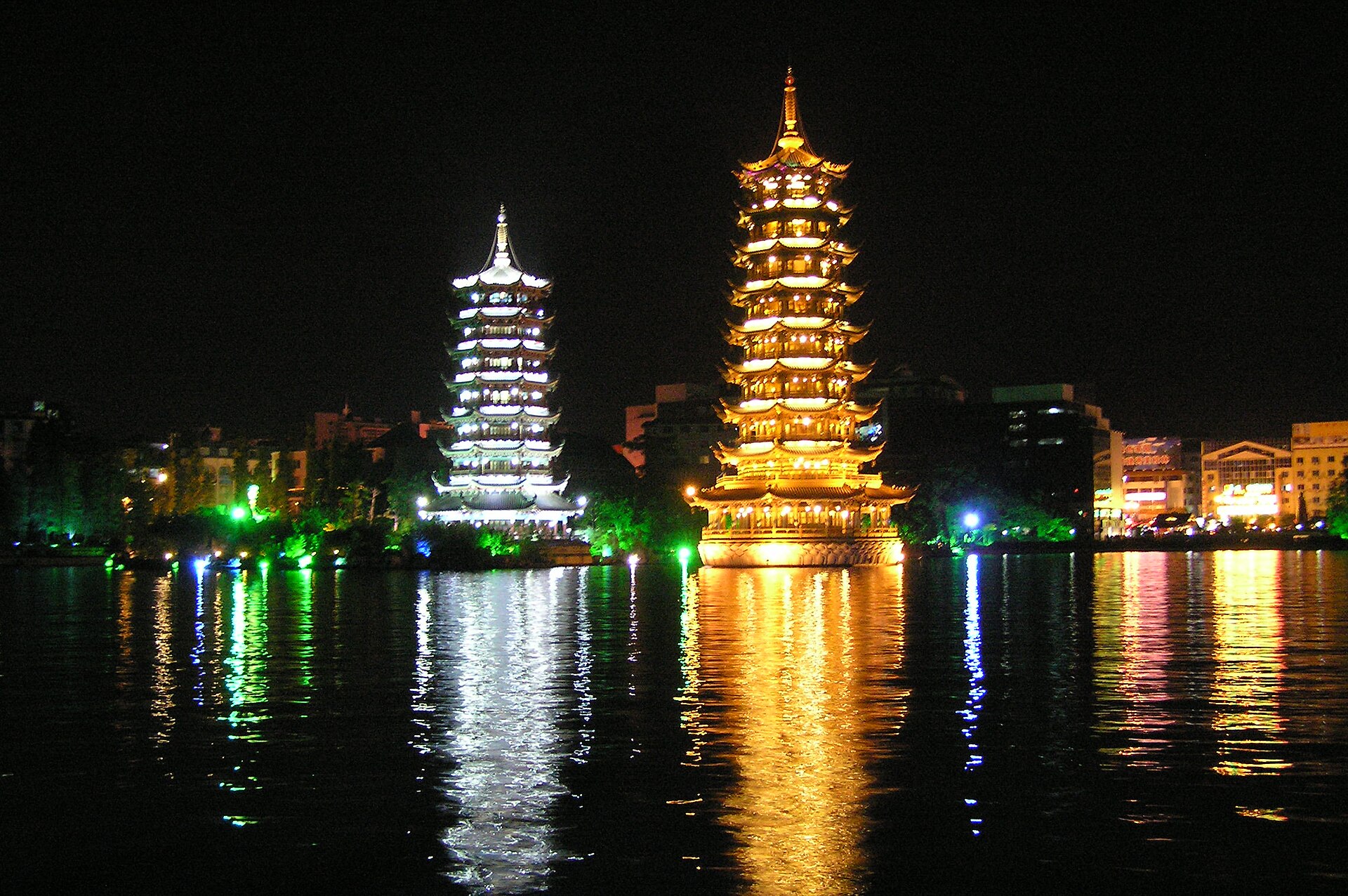
The heart of the district and the postcard image of Guilin at night. The Sun Pagoda is built from around 350 tons of copper, stands 41 m tall, and is the world's tallest copper tower, with a lift to the top. The Moon Pagoda beside it is a seven-storey glass tower, 35 m high and silver-toned. The two are joined by an 18 m underwater tunnel, and after dark the gold and silver lighting reflecting on the lake is the shot everyone comes for.
The crystal glass bridge on Rong Lake (near Yang Bridge) was the first crystal-glass landscape bridge in China — frame and canopy both made of glass. At night it's lit with colour-shifting LEDs, from azure to emerald to magenta, turning it into a glowing ribbon over the water. Along the same shore stands a banyan tree more than 800 years old, the tree that gives the lake its name.
The charm people forget is simply walking. The waterside paths are shaded by drooping willows, dotted with pavilions, sculptures, stone carvings and benches to rest on. Morning and evening, locals come out to exercise and dance — it's an easy, unhurried scene, and you can stroll the whole way round taking photos without paying a thing.
Mulong Lake sits on the side that connects through to the Li River, and feels more old-China than the others — there's the Mulong Pagoda, a section of restored old city wall, and a water gate the boats pass through. This is where the cruise goes through a ship lock to drop from the lake level down into the Li River, an odd and rather memorable part of the ride.
Around the lakes are roughly 19 bridges, alternating between copies of famous bridges from around the world and classical Chinese designs — some arched stone, some European in feel, all of them lit at night. On the cruise you pass beneath them one after another, like an open-air gallery of bridges with every span picked out in light.
If you want to start without spending anything, begin at Shan Lake and Rong Lake, which sit right next to each other — these two are the core of the city park, and you can loop them comfortably in an hour, passing the twin pagodas, the glass bridge, the millennium banyan and the waterside pavilions. By day there are fewer people and the light is open; the willow reflections photograph beautifully. Come in the morning before the heat, or in the late afternoon before sunset.
You can carry on toward Gui Lake and Mulong Lake if you have time, but those first two lakes are the most rewarding short walk in the whole area.
The real headline is the night cruise, which loops through all four lakes and a stretch of the Li River over about 90 minutes, passing under some 19 bridges, by the twin pagodas, within distant view of Elephant Trunk Hill, and through the ship lock that joins the lakes to the river. Tickets run around ¥220–250 per person (~฿1,100–1,250), depending on the time slot and the pier; some packages add roughly ¥50 for an in-city transfer.
Boats depart in waves from about 17:50 until around 21:30. The prettiest slot is roughly 19:30–20:30, when everything is fully lit — buy your ticket ahead and arrive at the pier a little early, as each one runs limited departures.
If you want Guilin from above, buy a ticket up the Sun Pagoda (the gold one) — there's a lift to the top, and from up there you get the lakes, the Li River and the ring of karst peaks around the city in every direction. The Moon Pagoda next to it (silver) you climb by stairs, and the two are joined by an underwater tunnel you can walk straight through. Climbing costs about ¥27–55 per person depending on the season (peak April–October is dearer).
You can go up by day or by night — the evening gives you the city lights, while daytime shows the peaks more clearly. Pick whichever you prefer.
The district is in the centre of Guilin, walkable from most hotel areas, or an easy bus, taxi or DiDi ride. For the cruise there are several piers to choose from, and they're not all the same — check before you buy.
Around Shan and Rong Lakes — walking distance to the twin pagodas and the pedestrian streets, and out for an evening stroll by the water in minutes.