In Guangxi they don't "brew" tea — they "beat" it. Green tea leaves are fried with oil, ginger and garlic, pounded to a pulp in an iron pot, then boiled into a salty green broth and poured over puffed rice, peanuts and scallion. You drink the broth and eat the crunch together. Bitter on the first cup, delicious by the third — this is 恭城油茶, a Yao-people ritual you can drink as a whole meal.
If "oil tea" makes you picture something sweet and iced, forget it. Youcha (油茶) is a warm, cloudy-green tea broth — salty-forward, faintly bitter, faintly smoky from the fried leaves. You sip it hot from a small bowl and eat the puffed rice and peanuts floating on top. People in Guangxi treat it as a real breakfast and lunch, not a dessert, and in its homeland — Gongcheng (恭城) county — almost every household keeps an iron pot and a tea pestle in the kitchen and beats a pot of tea before heading out for the day.
The charm is in how the flavour shifts. The Yao have a saying: "the first cup is bitter, the second astringent, the third is when it tastes good," because once the bitter tea meets the sweet richness of the puffed rice and peanuts, it turns into a lingering sweet aftertaste (hui-gan / 回甘) that grows on you the more you drink. And because Guangxi isn't a chilli-and-numbing region like Sichuan, oil tea is gentle — the whole family drinks it, from small children to grandparents. This guide walks you through how it's made, how to drink it well, and where to try it in Guilin — and why it ended up on the UNESCO heritage list.
The broth is the star, but the crunchy bits floating on top are what turn it into a meal.
1
The cloudy-green broth comes from green tea leaves fried with oil, ginger and garlic, then pounded to a pulp before water is added and boiled. It's salty-forward, gently bitter from the tea, with a fried fragrance, sipped hot from a small bowl. It is a strange flavour on the first sip but sticks by the third. A good broth is clear yet deep and round, never harshly astringent.
Glutinous rice baked or fried until it puffs and crisps, dropped into the bowl before the hot tea is poured over. It's the most important supporting act, because the sweet richness of the puffed rice is what turns the tea's bitterness into sweetness. As the tea soaks in, the rice softens slightly but keeps some crunch — spoon it up with each sip and the flavour rounds out at once.
Roasted or fried peanuts scattered into the bowl for richness and aroma. Some places add crunchy fried dough (sanzi / 馓子) — fine crisp threads — or fried glutinous rice and white sesame too. It all floats on the surface, so every mouthful has broth, crunch and richness at once — which is exactly why oil tea fills you up enough to count as a meal.
Proper oil tea doesn't arrive as a single bowl — it comes with a table of snacks to graze on between sips: green mugwort rice cakes (aiye-ba / 艾叶粑), sticky rice, fried taro, local sausage and assorted fried bites, set in the middle to share. Everyone reaches in, the tea keeps getting topped up, and you eat until you're full. It's a meal that's long, unhurried, and as much about sitting and chatting as it is about eating.
打 literally means "to beat" — the rhythmic knock of wood against the iron pot is the sound of oil tea on the way.
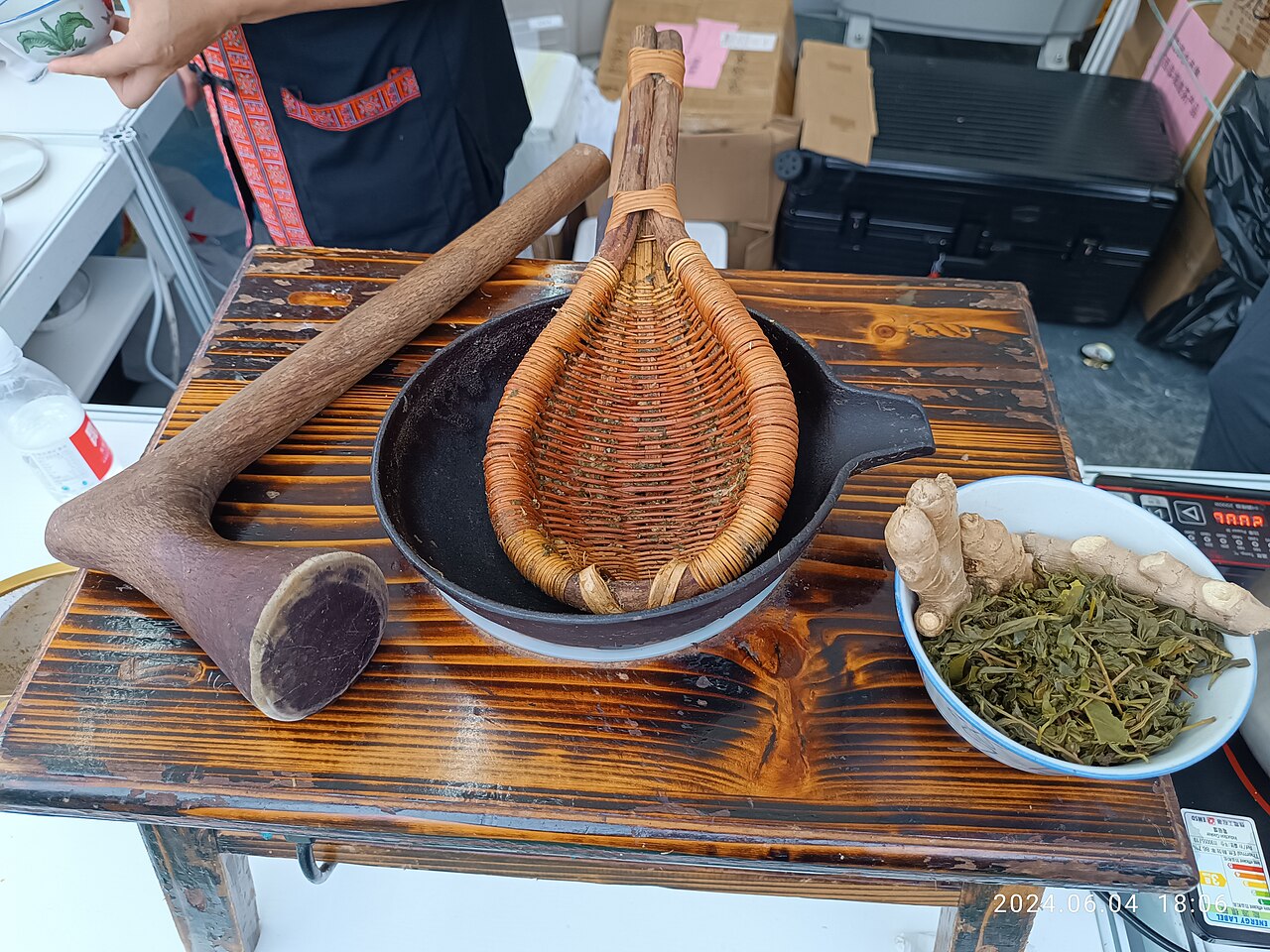
Heat a small iron pot with oil (traditionally tea-seed oil), then add green tea leaves, bruised ginger and garlic — some households fry peanuts in here too. Stir quickly until it turns fragrant and a golden-brown colour.
Take the wooden tea pestle (chachui / 茶槌) and pound the leaves in the pot, again and again in rhythm. The trick is "tap lightly, press hard" until the leaves break down and give up their flavour — this step is what sets the taste apart from steeped tea, and the source of the name "beating the tea".
Add water and bring it to a boil, simmering to draw out the full flavour as the smell of fried tea fills the kitchen. One pot yields several rounds — the first is the strongest, later rounds milder but still fragrant.
Strain out the leaves with a bamboo sieve, leaving a clear, hot broth, and pour it over a bowl already holding puffed rice, peanuts, fried dough and scallion. Serve at once while hot, drink the small bowl and refill. A host will keep beating round after round so guests drink several bowls until full.
You don't have to travel far to try it — but if you want the most authentic version, the source is Gongcheng.
Guilin city has several Yao oil-tea houses, especially around Chuanshan Road in Qixing District. Most charge a flat per-person rate with unlimited free tea refills, with side snacks ordered separately by the plate. It's ideal if you want to try the flavour without taking a trip out of town. The setting is a simple, local spot where Guilin people genuinely come to eat.
For the real thing and a village atmosphere, Gongcheng (Yao Autonomous County) is the home of oil tea — nearly every household drinks it every day, and oil-tea shops line the town, cheaper than in Guilin city. It makes an easy day trip to taste it at the source, and you can pair it with the Gongcheng Confucius Temple and the orchards (Gongcheng is also famous for its persimmons, 月柿) in a single day.
Beyond sit-down houses, some morning markets and food lanes in Guilin have oil-tea stalls where you can buy a single bowl to try, cheaply, and pair it with Guilin rice noodles for a full Guangxi breakfast — a bowl of noodles first, then a bowl of oil tea. Honestly, stalls in the tourist areas may soften the flavour for outsiders; if you want the real, full-strength version, look for the place where the locals are sitting shoulder to shoulder.
On the Yangshuo side, Guangxi restaurants serve oil tea for visitors to try, especially around West Street (西街), the café-and-restaurant strip. It suits you if you're already staying in Yangshuo and want to pair oil tea with bamboo-raft trips on the Li River and a plate of beer fish. Honestly, prices around West Street run higher than at local spots in the city because it's a tourist district — but it's convenient and the menus are in English.
The flavour opens up slowly — but if you know how, the first cup can taste good too, no need to wait for the third.
1. Don't drink the broth on its own — spoon up the bits as you sip. The classic first-timer mistake is to drink only the tea and hit the full force of the bitterness. You're meant to spoon up the puffed rice and peanuts floating in the bowl with every sip — their sweet richness cuts the bitterness at once, and the flavour rounds out from the first mouthful.
2. Drink it hot, refill often. Oil tea has to be drunk hot — as it cools, the flavour turns more astringent. The small bowls go fast, so just refill; don't feel shy about it, because one pot makes several rounds. Guangxi people drink several bowls each until they're full. That's simply the custom.
3. Order sides to the middle of the table. If you want it as a proper meal, order mugwort rice cakes, sticky rice, fried taro or other local fried bites to the centre of the table and eat them between sips of tea. This is the authentic Gongcheng way to do it — the thing that turns oil tea into a long morning meal you can sit and chat over.
4. It's not spicy — the whole family can drink it. Worth repeating: oil tea is not a spicy dish. The ginger and garlic only give it warmth. People who can't handle spice, children and the elderly all drink it comfortably. If the first cup tastes oddly bitter, that's completely normal — follow tip 1 and by the second cup it starts to click.
Guilin food is the light, fresh, rice-noodle school — gentle flavours over chilli heat. Oil tea is only the start.