A city whose name means "forest of osmanthus" — with tea, wine and cake all scented with the flower. And Yangshuo's West Street is the café-and-bar scene where travellers from all over have sat sipping coffee under the karst peaks since the backpacker days.
Picture walking into Guilin in October and catching a sweet scent drifting from somewhere you can't quite place. Along the trees on either side of the road are tiny orange-gold blossoms opening across the whole city all at once — that is osmanthus (桂花), and it is the heart of this city's drinks. Because the name "Guilin" (桂林) literally means "forest of osmanthus"; the city has grown this tree for centuries until it became its emblem.
Guilin's drink culture is unlike anywhere else in China. It doesn't trade on skyline-view coffee or European heritage the way Shanghai does — it trades on flowers in a cup: osmanthus tea (桂花茶) scented with dried blossoms, osmanthus wine (桂花酒) infused into rice wine, and osmanthus cake (桂花糕) that everyone takes home as a souvenir. That sweet, gentle floral note is what you'll meet everywhere, from a tiny tea house to a new-wave café.
The other scene you can't skip is Yangshuo's West Street (西街) — an old street over 1,400 years old that became a magnet for backpackers from all over from the 1980s, until it filled with Italian-coffee cafés and live-music bars. This is where Western-style coffee meets the karst peaks of Guilin. To be straight with you, it is a full-on tourist district and pricier than elsewhere, but sipping coffee on an old street beneath the peaks is something you won't find anywhere else. For the cheap, everyday, genuine thing, look to local tea houses and 油茶 oil tea, a savoury drink you can take as a meal.
A tiny flower that blooms for one month a year, gathered into tea, wine, cake and honey you can enjoy all year round.
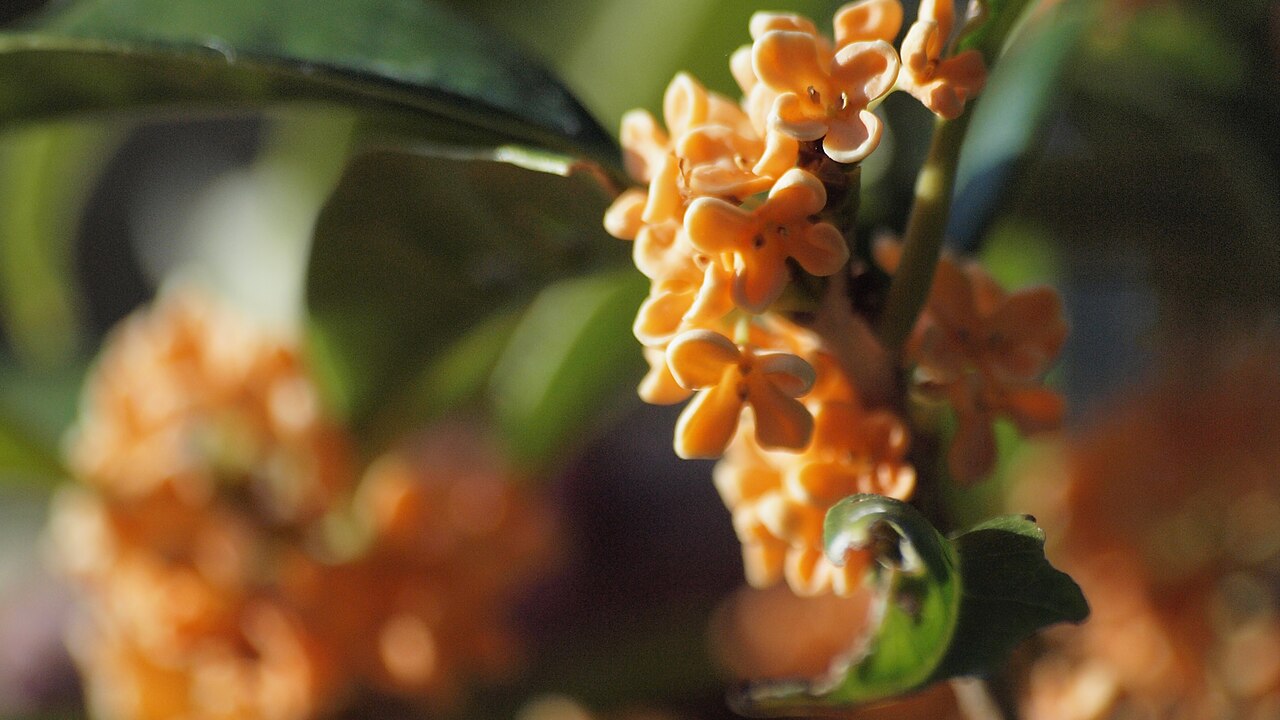
Osmanthus — Guilin's city flower, in bloom in autumn, its sweet scent drifting across the whole city.
Osmanthus reaches full bloom only for a short stretch in autumn, around September to October — which lands right on the Mid-Autumn Festival. The Chinese have tied this flower to the festival for centuries: drinking osmanthus wine and eating osmanthus mooncakes under a full moon. In Guilin at this time the whole city turns fragrant, and shops fill with the freshest osmanthus-scented food and drink of the year.
But you don't have to time it perfectly. Locals dry the flowers, candy them in sugar and steep them into wine to keep all year, so osmanthus tea is available in any season and the wine and cake are sold year-round as souvenirs. Whatever month you come, the flower's sweet scent is waiting to be tasted — only, if you arrive in autumn, you'll catch it fresh on the branch as well.

Get the types straight first, then decide whether today is about a floral note, a Western café mood, or the genuinely local thing.
The drink that represents Guilin best — green or oolong tea scented with dried osmanthus until it soaks up a sweet, gentle aroma, drunk hot all day. Some places brew it as a clear all-flower infusion; others blend it with green tea so a little astringency cuts the sweetness. It's the lightest on the wallet and the easiest to find, at tea houses, souvenir shops and local cafés citywide. Drinking it feels like sipping the scent of a Guilin autumn.
Rice wine (huangjiu) infused or steeped with osmanthus until it carries a soft, sweet aroma and a pale amber colour. It's low in alcohol and far easier to drink than the usual fierce Chinese baijiu. The Chinese have drunk it at the Mid-Autumn Festival for centuries, and in Guilin it is both a drink and a favourite souvenir — pretty bottles to carry home. Sip it slowly and a touch warm and the floral note comes through clearest. A whole city's story in a single glass.
It's a sweet rather than a drink, but osmanthus cake is the inseparable partner to osmanthus tea. It's made from soft glutinous rice flour scattered with real osmanthus, honey and rock sugar — springy, lightly sweet and clearly fragrant, cut into neat bite-sized pieces. Pair it with hot tea and the two are made for each other. You'll find it at souvenir shops and sweet stalls across Guilin; it's a light, mess-free thing to take home.
Yangshuo's West Street (西街) is where Western coffee meets the karst peaks of Guilin. Since backpackers poured in from the 1980s, it has filled with Italian-coffee cafés, live-music bars playing everything from jazz to Chinese opera, and places to nurse a cold beer and watch the crowd. There's even a Starbucks Reserve Roastery — the only one in China with a terrace looking out at the limestone peaks. Honestly, today it is a full-on tourist street, busy and pricier than elsewhere, but the atmosphere of sitting in the middle of an old lane under the peaks has a charm all its own.
Beyond the tourist-focused West Street, Guilin city itself has more independent specialty cafés opening all the time. Small, serious-about-beans places pour a steady pour-over and latte, with a quieter mood and more locals than Yangshuo. Some play with hometown ingredients — dropping osmanthus into a latte or a signature drink. If you take your coffee seriously and want to escape the West Street crush, these in-town cafés are the answer.
It reads as strange but it's the most genuinely local thing of all — 油茶, oil tea, made from tea leaves pounded and fried in a pan, then simmered into a thick, slightly bitter, slightly salty green tea broth poured over puffed rice, fried peanuts, dough bits and scallion. The first sip can surprise you, but it grows on you fast. The Yao and Zhuang people around Gongcheng take it as a social ritual — "beating" the tea (打油茶) — and it's recognised as cultural heritage, filling enough to stand in for a meal. Try a set and you'll see why locals drink it every day.
Three scenes, each a different mood — Western café atmosphere, the local thing in town, and cheap tea houses.
A 1,400-year-old street packed with Italian-coffee cafés, live-music bars and roadside drinking spots, side by side with old Guangxi architecture. It's liveliest at night when the bars strike up their music; by day it's good for a coffee and people-watching. It's a full-on tourist district and pricier than elsewhere, but the atmosphere of sitting in the middle of an old lane beneath the karst peaks is impossible to find anywhere else — this is the café scene that put Yangshuo on the world map.
Around the Zhengyang pedestrian street (正阳) and the East-West Lanes (东西巷) in central Guilin you'll find souvenir shops selling osmanthus tea, wine and cake, new-wave specialty cafés and local sweet stalls. You can shop for souvenirs and sip coffee in the same district, without heading all the way to Yangshuo. It's a starting point for tasting both the local thing and the new coffee, and it feels more like a real city than a tourist quarter.
The area around Shan Lake in the city centre is leafy and planted with plenty of osmanthus, so an autumn stroll along the water comes with the flower's scent in the air. Small cafés and tea houses here let you sit looking at the Sun and Moon Pagodas (日月双塔) reflected in the water — a relaxed spot for an afternoon osmanthus tea or coffee. It's the area that blends city life and a natural view best.
To drink the way Guilin locals do, as cheaply as it gets, look for the small tea houses and oil-tea houses scattered across town. Tea houses serve osmanthus tea and local teas for a few yuan, with free hot-water refills; oil-tea houses serve 油茶, the thick savoury tea you can take as a meal. The setting is plain but it's the real thing, with locals chatting all day. This is Guilin's everyday drink culture — the cheapest and the most genuine of all.
Some are known for atmosphere, some for the genuinely local thing — pick by the day you're having.
It's not one shop but a whole district — the one that put Yangshuo on the world map. This 1,400-year-old street became a magnet for foreign backpackers from the early 1980s, travellers following the Banana Pancake Trail up from Laos and Vietnam, until it earned the nickname the "Mecca of the East". Walk in and you'll find Italian-coffee cafés, live-music bars, English signboards and spots to sit with a beer and watch the crowd, all mixed in with old Ming–Qing Guangxi buildings. Today it's busy and prices have climbed, but sipping coffee under the limestone peaks is still an experience you can't get elsewhere.
If there's one chain café worth a stop even though the brand is familiar, it's this one — the only Starbucks Reserve Roastery in China with a terrace looking out at Yangshuo's limestone peaks. It sits on West Street, with upstairs seats angled to the mountain view. The draw isn't coffee any different from other Starbucks; it's getting to sip with the karst peaks of Guilin filling the window. Come late morning or evening and book a terrace seat for the best view.
Not one shop but a whole souvenir culture — along the Zhengyang pedestrian street and the East-West Lanes in central Guilin, shops selling osmanthus tea, osmanthus wine and osmanthus cake line up to choose from. Many let you taste the tea before buying and cut the cake into bite-sized samples. To be straight with you, this is a tourist district, so it's worth comparing a couple of shops, but it's the one place to find Guilin's whole range of osmanthus-scented souvenirs together.
To try the drink that's truly heritage here, look for the oil-tea houses (油茶) scattered across Guilin, and especially around Gongcheng (恭城), the area best known for it. They pound the tea leaves and fry them in a pan, then simmer it into a thick, slightly bitter, slightly salty green broth, served with puffed rice, peanuts and dough bits to add yourself — filling enough to stand in for a meal. The setting is simple and locals linger over it. It's a cheap drink that gives an experience coffee can't.
Beyond the tourist-focused West Street, Guilin city has more independent specialty cafés opening around Zhengyang Street and Shan Lake. These are serious about their beans and brewing, pouring a steady pour-over and latte in a quieter setting with more locals. Some play with osmanthus, turning it into a latte or a floral signature drink. If you want to escape the Yangshuo crush and just sit with a good coffee in peace, the in-town cafés are the answer.
Guilin at night — when cafés and bars both in town and on Yangshuo's West Street are at their liveliest.
Things you can drink in Guilin but find hard to get elsewhere.
The drink that sums up Guilin in a single cup — green or oolong tea scented with dried osmanthus into a soft, sweet aroma, drunk hot all day. It's the lightest on the wallet and the easiest to find, and the best place to start if you want to know the osmanthus flavour. Order it with osmanthus cake and you'll understand why this city loves the flower so much.
Rice wine infused with osmanthus, sweet and soft and low in alcohol, far easier to drink than the usual Chinese baijiu. It's been the Mid-Autumn Festival drink for centuries. Sip it slowly and a touch warm for the clearest floral note, and the pretty bottles make an easy souvenir to carry home — a whole city's story in a single glass.
A hot, savoury drink made from tea leaves pounded and fried in a pan, simmered into a thick, slightly bitter, slightly salty green broth poured over puffed rice, peanuts, dough bits and scallion. The first sip can surprise you but it grows on you. It's a half-meal drink the Yao and Zhuang take as a ritual — a piece of Guangxi heritage worth trying at least once.
Some of Guilin's new-wave cafés play with the city's signature ingredient, turning osmanthus into a latte, a milk tea or a cold floral drink. It takes the oldest thing in the city and puts it in a modern glass — lightly sweet and fragrant. If you spot it on a menu, give it a cup: it's a way to drink the scent of Guilin in a café version you won't easily find elsewhere.
Guilin and Yangshuo are almost entirely on mobile payment — cafés, tea houses and souvenir shops mostly take WeChat Pay and Alipay first. Small tea houses and street stalls often take WeChat Pay or cash only. Before you travel, set up Alipay and link a Visa/Mastercard through its international mode (it works for visitors · see our China payment guide).
On price, understand first that Yangshuo's West Street is a tourist district, so coffee and drinks run noticeably higher there. If you want to keep it cheap, the local things — osmanthus tea and oil tea at local houses — cost far less and give you a more genuinely Guilin flavour too. For osmanthus souvenirs along Zhengyang Street, compare a couple of shops before buying, as it's a tourist area as well.
To catch osmanthus blooming fresh across the city, the best window is late September to October, around the Mid-Autumn Festival, when the scent fills the streets and osmanthus food and drink are at their freshest. Yangshuo's West Street is liveliest in the evening when the bars strike up their live music. If you need general internet access in China, set up a VPN before you travel — see our China Internet & VPN guide.
The karst peaks around Yangshuo — the backdrop to the West Street cafés and bars that sets the place apart.
Stay central in Guilin to walk to the souvenir shops and cafés, or stay in Yangshuo and step straight out onto West Street.