Home Guilin China Guilin Hotels About
Home  ›  China  ›  Guilin  ›  Guilin Rice Noodles
🍜 Guilin's everyday breakfast · 2026

Guilin Rice Noodles (桂林米粉)
Eat it dry first, add the broth later

Soft round rice noodles dressed in dark braised gravy, topped with crispy fried pork, peanuts and pickled long beans — in Guilin the whole city starts the day with this bowl. Toss it well, sip the free bone broth at the end. Under ten yuan a bowl, and one of the best-value meals in all of China.

Before You Dig In

Guilin rice noodles — the bowl the whole city eats every morning

Ask anyone in Guilin what they had for breakfast and almost the whole city gives the same answer: mifen (米粉 mǐfěn) — a bowl of rice noodles sold on every street corner before the sun is even up. People queue, order in a practised second, eat standing or at a table, and head off to work. This isn't a special dish you have to hunt down. It's the everyday breakfast that's been part of life here for a hundred years, and it's the first thing you should eat when you arrive in Guilin.

Two things make Guilin rice noodles what they are. The first is the fresh rice noodle: rice is fermented for hours, ground, and pressed into smooth, slippery round strands (there's a flat-noodle version called 切粉 too), and it has to be made and eaten the same day. The second is the lou-shui braised gravy (卤水 lǔshuǐ), a dark, deep-brown sauce simmered from more than twenty Chinese spices until it's mellow and savoury. That gravy is what sets Guilin noodles apart from rice noodles anywhere else — you don't eat them as a soup, you eat them dry-tossed so the gravy coats every strand first.

The classic toppings are guocao (锅烧), pork belly fried until the skin crackles and sliced into pieces, and char siu (叉烧), sweet roast pork. Then you walk to the condiment counter and add pickled long beans, pickled radish, roasted peanuts, crunchy fried soybeans, spring onion and chilli — as much as you like. Toss it all, eat the noodles and toppings, then top up with free bone broth (骨头汤) from the dispenser at the end. That sequence is exactly what Guilin locals are quietly proud of.

Anatomy of the Bowl

Noodles, gravy and toppings — what's in the bowl

Get your head around these four before the first toss, and you'll see why a small bowl of noodles can hook an entire city.
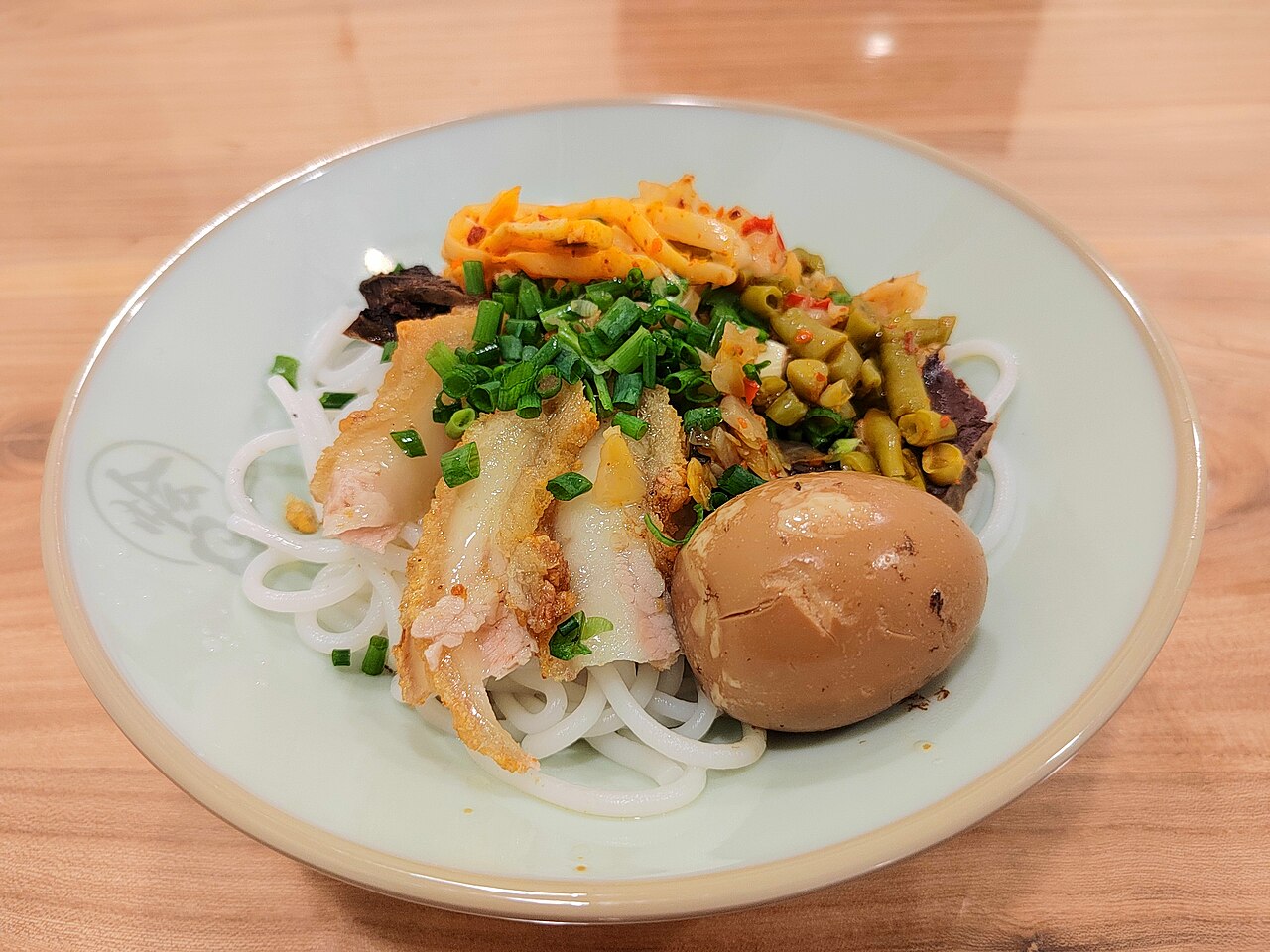
A bowl of Guilin rice noodles — round white rice noodles topped with crispy fried guocao pork, a braised egg, pickled long beans, pickled radish and chopped spring onion 1
Fresh Rice Noodles
米粉 mǐfěn · smooth round strands, made and eaten the same day

The noodle is the base of everything — rice is fermented for several hours to develop a faint sourness, ground into a paste, and pressed into smooth, slippery round strands. Just before serving, the cook blanches them in boiling water for only a few seconds to heat them through (a step called 冒热) and drains them into the bowl. A good noodle is springy and soft without going mushy, and it drinks up the braised gravy beautifully. There's a flat-cut version (切粉) if you prefer a chewier strand.

Texture: smooth round rice noodles (or flat 切粉), made fresh daily
Key point: the rice is fermented for a faint sourness, then flash-blanched
Tip: pick a busy shop — fast turnover means fresher noodles, always
🥢2
The Braised Gravy
卤水 lǔshuǐ · the dark dressing, heart of the flavour

The braised gravy is what makes Guilin rice noodles Guilin rice noodles — a dark, deep-brown sauce simmered from bone, meat and more than twenty Chinese spices (star anise, cassia, clove, dried orange peel, liquorice root and a list each shop keeps secret), cooked long until it's mellow and savoury. Only a few spoonfuls go over the noodles, but it's intense: too much and it's salty, too little and it's bland — a good shop is one that gets the amount just right. Every shop's gravy tastes a little different, which is half the fun.

Core flavour: savoury, deep, mellow with spice — not spicy-hot
How to eat: tossed through the noodles before you add the broth
Tip: the gravy recipe is each shop's signature — try a few, find your favourite
🥓3
Crispy Fried Pork (Guocao)
锅烧 + 叉烧 · crackling pork belly + char siu

The topping you can't skip is guocao (锅烧) — pork belly boiled then fried until the skin puffs and crackles, sliced into pieces. Bite into it and you get a crunch from the skin against the soft noodles and the gravy. It comes with char siu (叉烧), thin slices of sweet roast pork, and some shops add a braised egg or liver too. The cook arranges all this on the noodles before the bowl reaches you, included in the price — that crackle of the guocao is what regulars wait for. If a shop's guocao is fresh and crisp, the shop is the real deal.

Guocao (锅烧): crackling-skin fried pork belly — the star topping
Char siu (叉烧): thin slices of sweet-savoury roast pork
Tip: eat the guocao while it's still crisp — don't let it soak too long
🌶️4
The Self-Serve Pickle Bar
酸豆角 + 黄豆 + 花生 · free toppings, help yourself

This is the best part — almost every shop has a counter lined with stainless-steel trays: pickled long beans (酸豆角), sour and crunchy, plus pickled radish, pickled bamboo shoots, roasted peanuts, crunchy fried soybeans, chopped spring onion, coriander, chilli flakes and chilli oil. Take your bowl over and help yourself to whatever you like. It's all free, included in the price of the bowl. These toppings are what make every bowl taste a little different — the pickled long beans and fried soybeans are the stars, and you can pile them on without holding back.

The stars: sour pickled long beans + crunchy fried soybeans + peanuts
Price: free, help yourself, included in the price of the bowl
Tip: add a little, then taste — the pickled long beans are salty-sour and easy to overdo
It is NOT luosifen (螺蛳粉): a lot of people mix these up — luosifen, the pungent, sour-and-spicy river-snail rice noodle, belongs to Liuzhou (柳州), a different city in Guangxi province. Guilin rice noodles (桂林米粉) are the round noodles tossed in braised gravy, mellow and savoury with no strong smell. When you're in Guilin, eat the Guilin dish.
Which to Order

4 types of mifen you'll see on the menu

Same noodle base, same braised gravy — they differ in the toppings and whether you eat it dry or in soup. New to it? Start with 卤菜粉.

🍜1
Lucaifen
卤菜粉 · noodles tossed in braised gravy with braised meat — the classic

The most popular type and the original — noodles tossed in braised gravy, topped with braised meat and crispy fried guocao pork, eaten dry. If you don't know what to order, order this first: it gives you the full braised-gravy flavour, the soft noodles and the crunch of the guocao all in one bowl. It's the image that comes to mind when anyone says "Guilin rice noodles."

How it's eaten: dry-tossed, then top up with bone broth at the end
Price: ¥8–15 per bowl (~฿40–75)
Good for: first-timers — order this and you can't go wrong
🥩2
Niunanfen
牛腩粉 · topped with slow-braised beef brisket

For the meat lovers — noodles topped with big chunks of beef brisket braised until tender, with a little soft tendon clinging on. The beef simmers in the braised gravy until the flavour soaks right through, melting as you chew. Have it dry-tossed, or ask for the soup version. It's a bit more filling than lucaifen and costs a little more — a good choice when you want serious protein in the bowl, or a proper main meal rather than just breakfast.

Topping: big chunks of slow-braised, tender beef brisket
Price: ¥15–22 per bowl (~฿75–110)
Good for: meat lovers, anyone wanting a filling main meal
🍲3
Yuantangfen
原汤粉 · the clear-soup version, eaten in bone broth

On a day you don't feel like eating it dry, order the soup version — yuantangfen is noodles in a clear, fragrant bone broth, served straight without the braised gravy toss. It's gentler and lighter, perfect for a cool morning or when you just want something warm to sip. You can still help yourself to everything at the pickle counter. It's another face of Guilin rice noodles that locals eat in rotation with the dry style.

How it's eaten: clear soup, sipped as bone broth, not dry-tossed
Price: ¥8–15 per bowl (~฿40–75)
Good for: cool mornings, when you want something light and warm
🍢4
Sanxianfen
三鲜粉 · 'three fresh' — meat, liver and meatballs

Three fresh things in one bowl — usually thin-sliced meat, liver and meatballs (each shop picks its own trio), blanched fresh onto the noodles for a mix of flavours and textures in a single bowl. It's a good choice if you want to try several things or you're tired of the same pork topping. Order it dry-tossed or in soup, whichever you prefer. It's the type that loads the bowl up a notch on toppings and value.

Toppings: three fresh items, usually meat, liver and meatballs
Price: ¥12–20 per bowl (~฿60–100)
Good for: variety of toppings, a change from the usual pork
Sides locals order alongside: many shops have a little case of braised extras to grab yourself — braised eggs (卤蛋), braised chicken wings, braised tofu, braised chicken feet — all simmered in the same braised-gravy pot. Add a piece or two beside your bowl; serious eaters often grab a braised egg or a wing to round the bowl out to just-right.
Eat Like a Local

How to order and eat — without the awkwardness

How to order — just two things to say

Most noodle shops are pay-first. Go to the counter and say two things: the type of noodle (e.g. 卤菜粉 lucaifen) and the number of liang (两) — 两 is the unit for the amount of noodles, one liang being about 50 grams. Most people order 二两 (erliang · two liang, ~100g) as the standard size. Very hungry, ask for 三两 (sanliang); a light eater, 一两 (yiliang). Pay, take your ticket or wait for your bowl at the counter. That's it. If you don't speak Chinese, point at a photo on the menu or hold up fingers for the amount — they'll get it.

The cook blanches the noodles, drains them, ladles over the braised gravy, lays on the guocao and meat, and hands you the bowl. There's no broth yet — that's normal, not an oversight, because Guilin rice noodles are meant to be eaten dry first.

The order of play — toss it dry first, add broth later

Step 1: take your bowl to the pickle counter and add pickled long beans, peanuts, fried soybeans, spring onion and chilli to taste (all free). Step 2: toss it well so the gravy and toppings coat every strand, then eat the noodles and toppings down to nearly the bottom — this is when the flavour is at its most intense. Step 3: when only a little is left at the bottom, head to the free bone-broth (骨头汤) dispenser, pour some into the bowl, stir it through the leftover gravy and bits, and sip it to finish — a meal closed out the Guilin way.

Paying: most shops take WeChat Pay and Alipay; a few small ones still take cash in yuan but rarely foreign cards, so set up Alipay or WeChat in advance. When to go: mifen is a breakfast dish — popular shops are busiest from 7–9am, and many sell out before noon or close in the afternoon. Go early for the freshest noodles and the full local-crowd atmosphere.

Where to Eat

Which place — where locals queue

Spots locals and food lovers have talked about for years — mifen is a breakfast meal, so go early for fresher noodles and no risk of a sell-out. Always check opening hours before you go.

1
Chongshan Mifen (崇善米粉)
A local legend · branches across the city · the Zhongshan Road (中山路) branch is the handiest

Name a mifen shop Guilin locals are fond of and Chongshan is on the list — a long-running place that's become a shared memory for the whole city. Its braised gravy is mellow with a faint sweetness and a long, lingering finish, and there are branches all over town, especially in the centre and near tourist hotels. The Zhongshan Road branch is the easiest to find if you're staying downtown. It's busy in the morning, so arrive before 9am for the freshest noodles and an easy seat.

Where: multiple branches · the central Zhongshan Road (中山路) branch is easiest to find
Hours: morning into the afternoon · Price: ¥8–18/bowl (~฿40–90) · go early for fresher noodles
2
Ritouhuo (日头火米粉)
A popular chain · many branches · clean, well-organised, easy for first-timers

A newer Guilin mifen chain that's hugely popular — it opened after the old-guard shops but expanded fast. The branches are clean and well organised, with clear photo menus and a good range of toppings, which makes it a comfortable choice for travellers trying Guilin rice noodles for the first time without stressing over ordering or hygiene. It was one of the first to pioneer the chain-branch model in Guilin, the quality is consistent, and there's usually a branch near where you're staying.

Where: multiple branches across Guilin · find the nearest on the Dianping app
Hours: morning into afternoon/evening (varies by branch) · Price: ¥10–20/bowl (~฿50–100)
3
Shiji Mifen (石记米粉)
An old-school favourite · open late · good for a late dinner or supper

A long-established mifen shop locals love — the storefront is plain rather than fancy, but the flavour is full-on traditional. Its draw is that it stays open late, unlike most mifen shops that are a breakfast affair, which makes it the go-to when you fancy a bowl in the evening or late at night. It's around the Lequn Market and Weixiaotang area, so if you've been out walking the city centre and get hungry, drop in — the traditional braised gravy won't let you down.

Where: around Lequn (乐群) Market / Weixiaotang, central Guilin
Hours: open late, good for dinner/supper · Price: ¥8–16/bowl (~฿40–80)
4
Noodle shops near your hotel + morning markets
The local tip · the small no-name shops are often the best and cheapest

The truth about Guilin rice noodles is that the best bowls are often tiny no-name shops in the lanes where locals live, not the famous names in the guides. Walk a little out of the tourist zone and look for a shop where locals are queuing in the morning, the noodles turning over fast, the guocao piled fresh — that's the one. They're usually cheaper (¥7–12) and taste more real. Ask your hotel or a driver where they eat mifen nearby; you'll often get a better answer than any online review.

Where: the lanes by your hotel · morning markets · where locals actually live
Hours: early morning to mid-morning · Price: ¥7–12/bowl (~฿35–60), cheapest and most authentic
Frequently Asked

FAQ · what to know before your Guilin rice noodles

How do you eat Guilin rice noodles the right way?
Eat it dry first. The round rice noodles arrive in a bowl already dressed with dark lou-shui braised gravy (卤水), crispy fried pork, char siu and toppings. Take it to the pickle counter and add pickled long beans, pickled radish, peanuts, fried soybeans, spring onion and chilli to taste, then toss everything so the gravy coats every strand. Eat the noodles and toppings down to nearly the bottom, then go to the free bone-broth (骨头汤) dispenser, pour some in and sip it to finish. That's the order locals follow every morning.
How are Guilin rice noodles different from luosifen (螺蛳粉)?
They're completely different dishes from different cities. Guilin rice noodles (桂林米粉) belong to Guilin: fresh round rice noodles eaten dry-tossed in braised gravy, mellow and savoury, with no strong smell. Luosifen (螺蛳粉) belongs to Liuzhou (柳州), a separate city in Guangxi: chewy dried rice noodles in a sour-and-spicy river-snail soup with a famously pungent aroma (from fermented bamboo shoots). Both are recognised intangible cultural heritage of China, but in Guilin the dish to eat is Guilin rice noodles.
What types of Guilin rice noodles are there, and which should I order?
The most popular is 卤菜粉 (lucaifen) — noodles tossed in braised gravy with braised meat and crispy fried pork; order this first if you're new. 牛腩粉 (niunanfen) is topped with big chunks of slow-braised beef brisket. 原汤粉 (yuantangfen) is the soup version, eaten in clear bone broth rather than dry-tossed. 三鲜粉 (sanxianfen) is the 'three fresh' bowl, usually meat, liver and meatballs. Each shop tweaks the toppings a little, but the noodle base and braised gravy are the same.
What is the 二两 (erliang) you have to say when ordering?
两 (liang) is the unit for the amount of noodles — one liang is about 50 grams. Locals order by calling out the number of liang. 二两 (erliang, two liang, ~100 grams) is the standard size most people order. Very hungry? Ask for 三两 (sanliang, three liang). A light eater can ask for 一两 (yiliang, one liang). Go to the counter, say the type of noodle and the number of liang, pay, and wait for your bowl. That's all there is to it.
How does the self-serve pickle bar work — is there an extra charge?
It's free, included in the price of the bowl. Almost every noodle shop has a counter with a row of stainless-steel trays — pickled long beans (酸豆角), pickled radish, pickled bamboo shoots, roasted peanuts, crunchy fried soybeans, chopped spring onion, coriander, chilli flakes and chilli oil. Take your bowl of noodles over and help yourself to whatever you like. These toppings are what make every bowl taste a little different — the pickled long beans and fried soybeans are the stars, and you can pile them on without holding back.
How much do Guilin rice noodles cost, and how do you pay?
Very cheap — a standard 二两 bowl is around ¥8–15 (about ฿40–75), depending on the type and shop. The beef-brisket version (牛腩粉) costs a bit more, around ¥15–22 (about ฿75–110). The bone broth and the pickle bar are free. It's one of the most satisfying-value meals in all of China. Most shops take WeChat Pay and Alipay; a few small ones still take cash in yuan but rarely foreign cards, so set up Alipay or WeChat in advance.
Klook · Food Tour

Guilin Food Tour — track down the best mifen, with someone who knows

A Guilin food tour with a local guide who takes you where locals eat their rice noodles, shows you how to order by the liang, load up at the pickle bar and toss it dry the right way — no language stress, no gambling on which shop to choose.

See Guilin food tours on Klook →
Wherebest is a Klook affiliate partner — we may earn a commission when you book through our links, at no extra cost to you.