Day one in Guilin city, day two cruising the Li River to Yangshuo, day three out in the Yulong River countryside, and a final day up on the Longji rice terraces — this is the Guilin that has room for the whole story: the city, the river and the dragon's-spine fields.
Here's the honest version: Guilin has three scenes the whole world recognises — the karst peaks along the Li River that appear on the ¥20 banknote, the quiet Yangshuo countryside where bamboo rafts drift past the rice fields, and the Longji rice terraces that climb the mountain in steps like the spine of a dragon. A three-day trip catches the first two, but Longji sits in a different direction and needs a whole day of its own.
Four days is where it all clicks into place. Day one covers Elephant Trunk Hill, Reed Flute Cave and a night walk along the Two Rivers Four Lakes in the city. Day two is the Li River cruise down to Yangshuo. Day three is the slow countryside (Yulong River bamboo raft, cycling, Xingping). And day four is the one shorter trips skip — a day trip up to the Longji rice terraces.
Unlike a three-day plan that wraps up in the Yangshuo countryside, this itinerary adds a dedicated day for the Longji terraces. If you would rather take it slower still — sleeping up on the terraces for sunrise and giving Yangshuo a full extra day — see our 5-day plan. This one suits travellers with exactly four days who want all three of Guilin's signature scenes plus one more.
The city's emblem on the Li River · a brightly lit limestone cave · a night walk around the lakes beneath the Sun and Moon Pagodas — day one gets to know Guilin without leaving town.
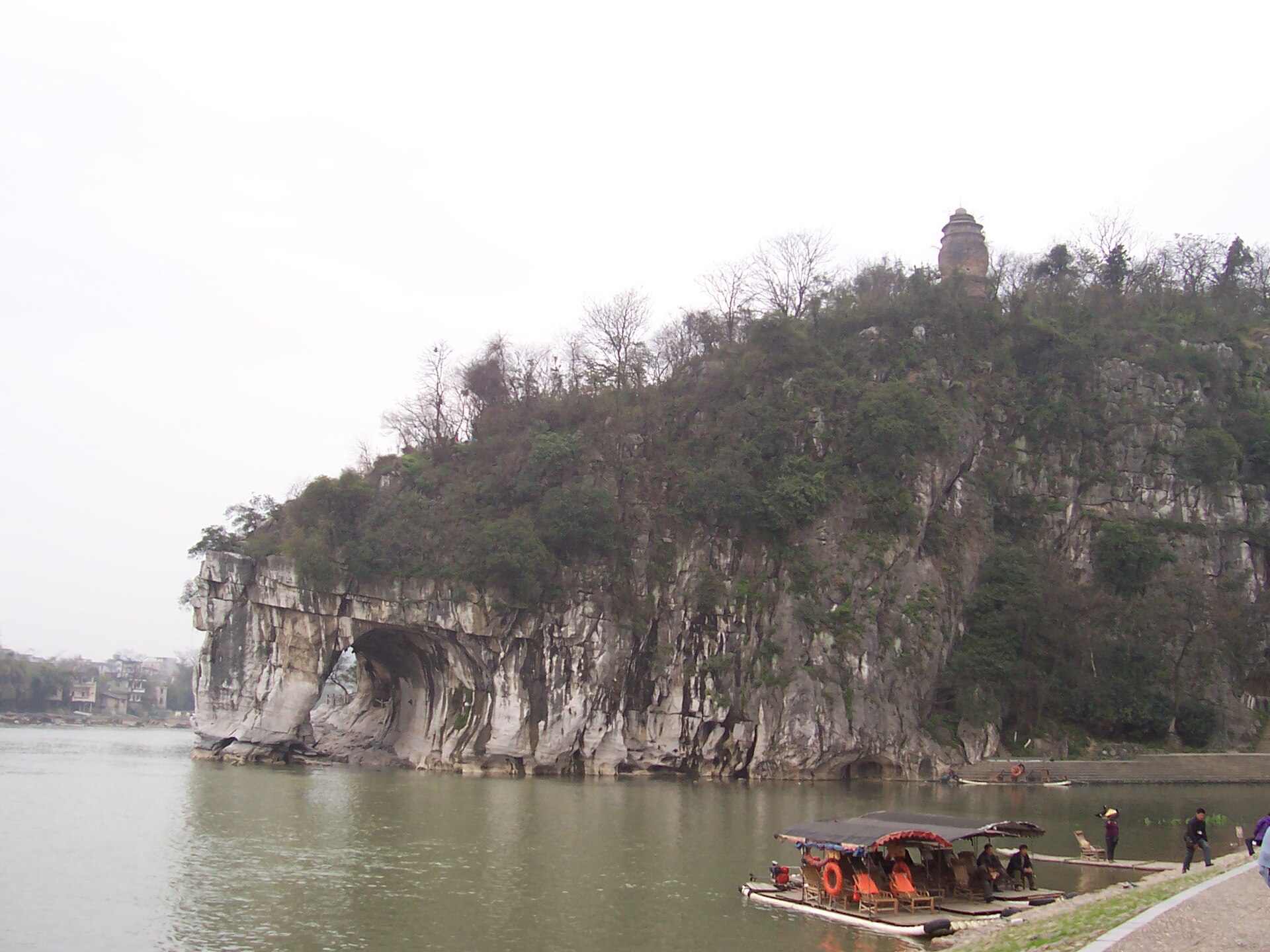
Start at Elephant Trunk Hill — the limestone hill that looks like an elephant dipping its trunk into the Li River, and the symbol of the whole city. Morning light is soft and the crowds are thin; climb to the upper viewpoint to see the old pagoda on the summit and look down on the arch beneath the "trunk" where the water flows through. Allow about 1 to 1.5 hours to walk and take photos.
If you have the energy and time, drop by Fubo Hill (伏波山) nearby on the Li River — a short climb for a panoramic view over the city and the river — before lunch with a bowl of Guilin rice noodles, the city's signature dish.
In the afternoon, head to the north of the city for Reed Flute Cave — a limestone cave more than 240 metres long, packed with stalactites, stalagmites, stone pillars and curtains lit in shifting colours that turn the passage into a fairy-tale set. The highlight is the great chamber, the "Crystal Palace", reflected in a still underground pool. The guided walk takes around an hour.
The cave sits in suburban parkland and stays cool inside all year, which makes it perfect for a hot afternoon. Wrap it up before heading back into town to get ready for an evening by the lakes.
Back in the centre at dusk, walk the Two Rivers Four Lakes — the ring of water through the heart of the city that links the Li River, the Taohua River and four lakes (Shan, Rong, Gui and Mulong). Once the lights come on, the bridges and lakeside trees glow and reflect off the water. The highlight is the Sun and Moon Pagodas (日月双塔) — a golden one and a silver one rising side by side from Shan Lake, lit up after dark.
Walking around the lakes is free, or a night boat around the ring is a different way to see it. Close out day one with a Guilin meal near the Zhengyang pedestrian street; see our guide to Guilin local cuisine.
A thousand karst peaks sliding past one bend at a time · the scene on the ¥20 banknote · stepping off at Yangshuo to walk West Street — the day that is the heart of any Guilin trip.
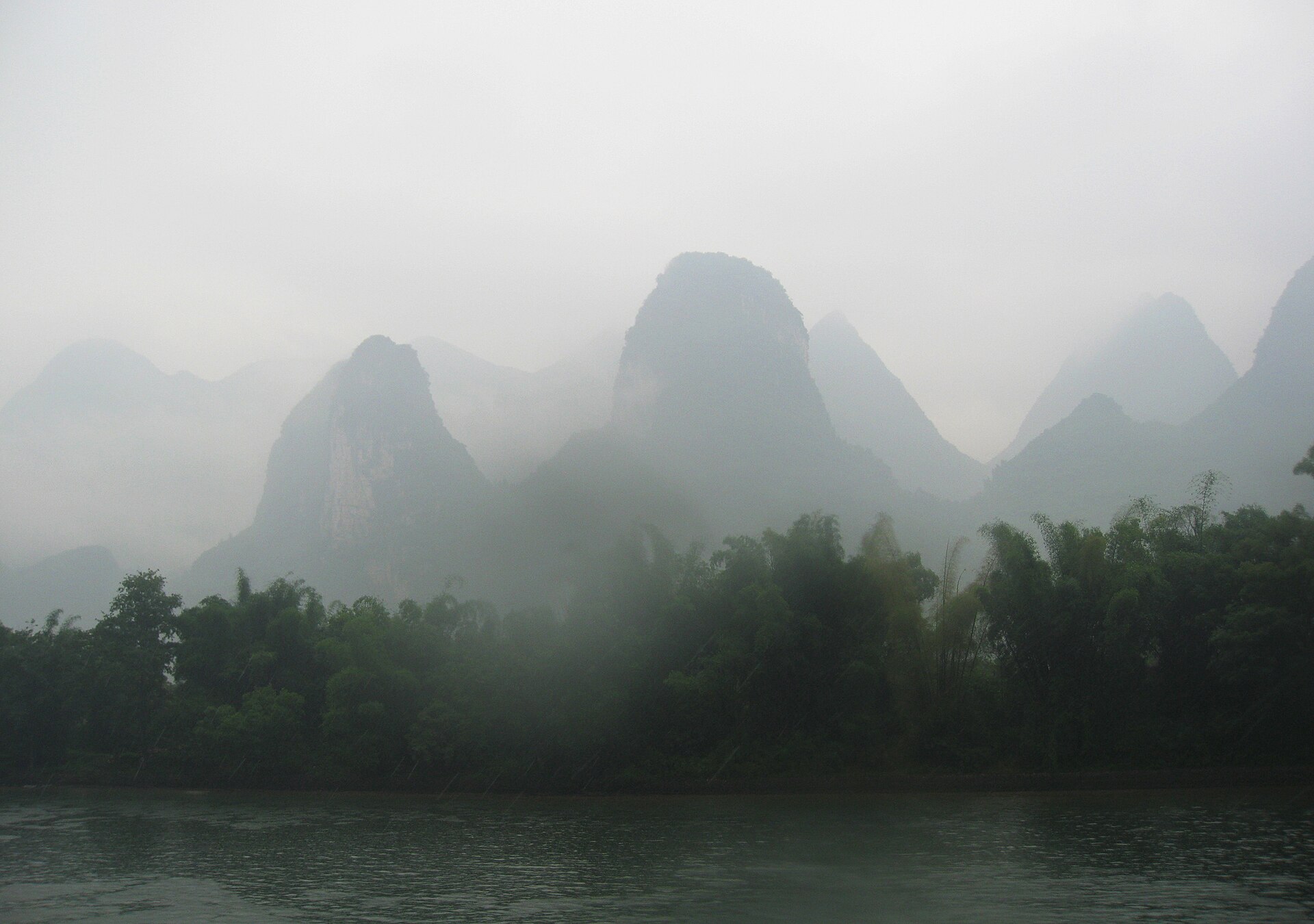
Head straight to Zhujiang pier (竹江) south of Guilin to board a Li River cruise boat — the loveliest stretch runs from Guilin to Yangshuo, about 83 kilometres over roughly 4 to 4.5 hours. The boat drifts past a thousand karst peaks rising from both banks, water buffalo in the paddies, fishermen with cormorants, and the nine-peak scene printed on the ¥20 banknote (near Xingping) — the crew usually point it out as you pass.
Lunch is served on board, and the top deck gives the fullest views, so bring a hat and sunscreen. The route ends right in the middle of Yangshuo town.
Step off at Yangshuo, drop your bags, then wander West Street — a stone-paved pedestrian street more than 1,400 years old that has become a hub for travellers from all over the world, lined with cafés, bars, souvenir shops and both Chinese and Western restaurants. It gets livelier through the evening.
Don't miss Yangshuo beer fish (啤酒鱼) for dinner — Li River fish cooked with beer, chilli and tomato, the town's signature dish. If you still have energy, look for the Impression Liu Sanjie show, an outdoor performance staged on the river using the real karst peaks as a backdrop.
Two options here. Sleep in Yangshuo for two nights (nights two and three) so you can wake up to the countryside the next morning without rushing, then head back to Guilin on the evening of day three to set up for Longji on day four. Or, if your hotel is booked in Guilin for the whole trip, head back to Guilin — a bus from Yangshuo takes about 1.5 hours, or a high-speed train from Yangshuo Station reaches Guilin North in about 24 minutes (though the station is outside Yangshuo town, so add ~30 minutes of transfer).
The slowest, most natural day — a bamboo raft drifting through the paddies, a bike ride along the Yulong River, and the old town of Xingping that's on the banknote.
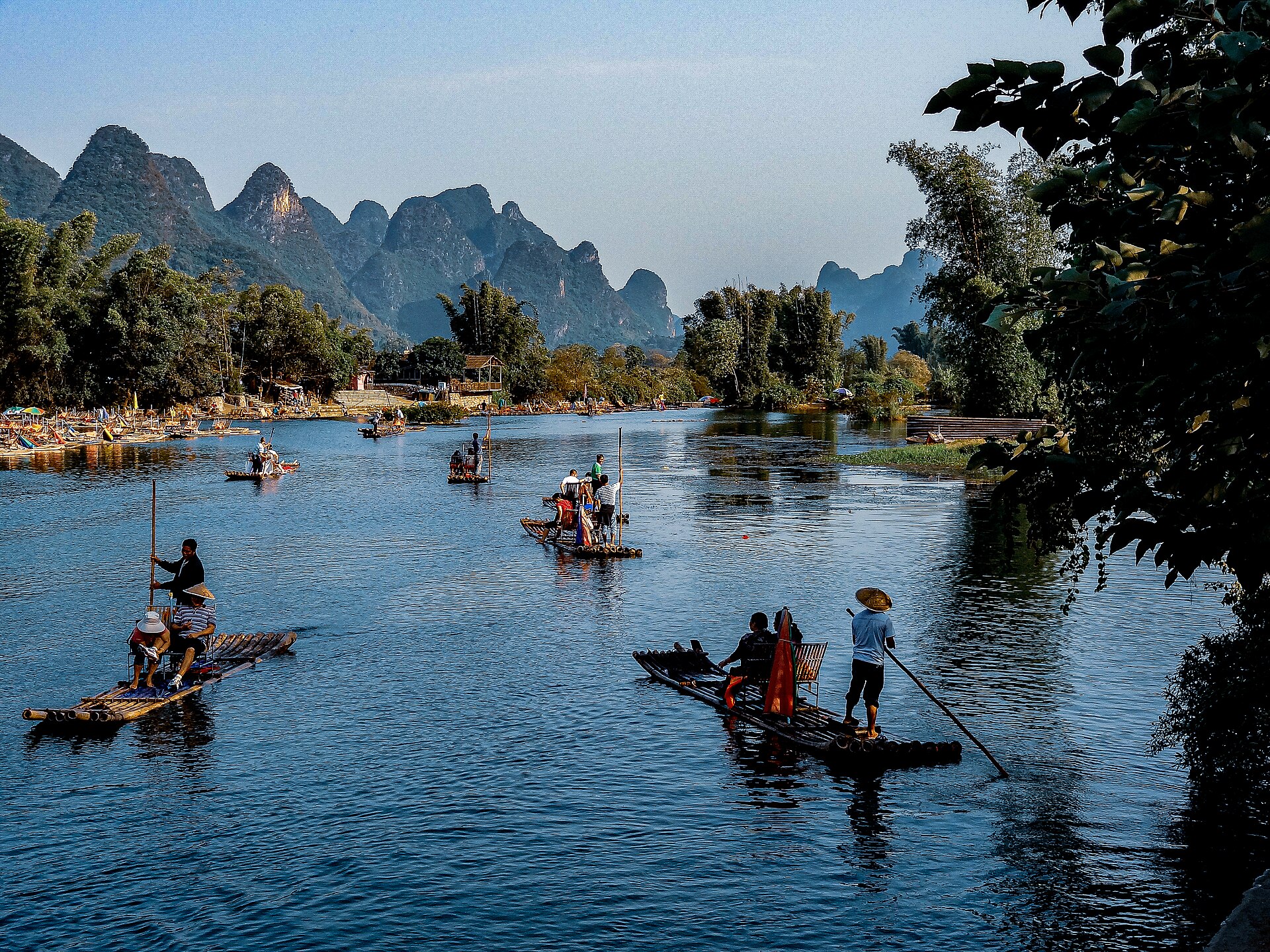
This morning, head to the Yulong River — smaller than the Li River, but many people find it calmer and prettier because there are no big boats, only bamboo rafts poled slowly past green paddies, karst peaks and little weirs the raft slides over like a low waterfall. Take the upper or lower stretch; each runs around 1 to 1.5 hours. The water is stillest and the light softest in the morning.
Nearby is Yulong Bridge (遇龙桥), an old Ming-dynasty stone bridge over 400 years old spanning the river — a classic photo spot in the Yangshuo countryside.
In the afternoon, rent a bicycle or e-bike and ride the Ten-Mile Gallery — a long country route hemmed by karst peaks on both sides, passing farming villages, kumquat orchards and viewpoints such as Moon Hill (月亮山), a peak with a moon-shaped hole through its summit. Riding gently and stopping for photos is the best way to soak up Yangshuo.
If you'd rather not cycle, you can do the same stops by car. Late afternoon, head back into Yangshuo town to rest before heading out to Xingping in the evening — or flip the order and do Xingping first, then cycle the next day, whatever the rhythm suits.
Close the day at Xingping — an old river port on the Li River north of Yangshuo, with old stone lanes, Ming- and Qing-era wooden houses and, crucially, the spot where you can see the real nine-peak scene from the ¥20 banknote. Walk to the riverside viewpoint and hold a ¥20 note up against the view in front of you — it lines up exactly. The golden light and thinning crowds of early evening make it the best time.
The day that sets the 4-day plan apart from the 3-day one — two hours north to see rice fields climbing the mountain in steps, choosing a Zhuang or Yao village, then giving the whole day to the dragon's spine.
Leave early from Guilin. The easiest way for independent travellers is a bus from Qintan bus station (琴潭) to the Longji junction, about 1.5 hours, then a park shuttle up to the Ping'an or Dazhai car park; the combined ticket is around ¥60 (~฿300). The alternative is a bus to Longsheng town first (~1 to 1.5 hours), then onward transport into the villages for about another hour, totalling roughly 2 to 2.5 hours from Guilin to Dazhai.
If you would rather not chain buses together and want to keep the timing tight, booking a day tour or chartering a car is far easier here, because there is no metro and public transport is infrequent — tours with transfers from Guilin are on Klook.
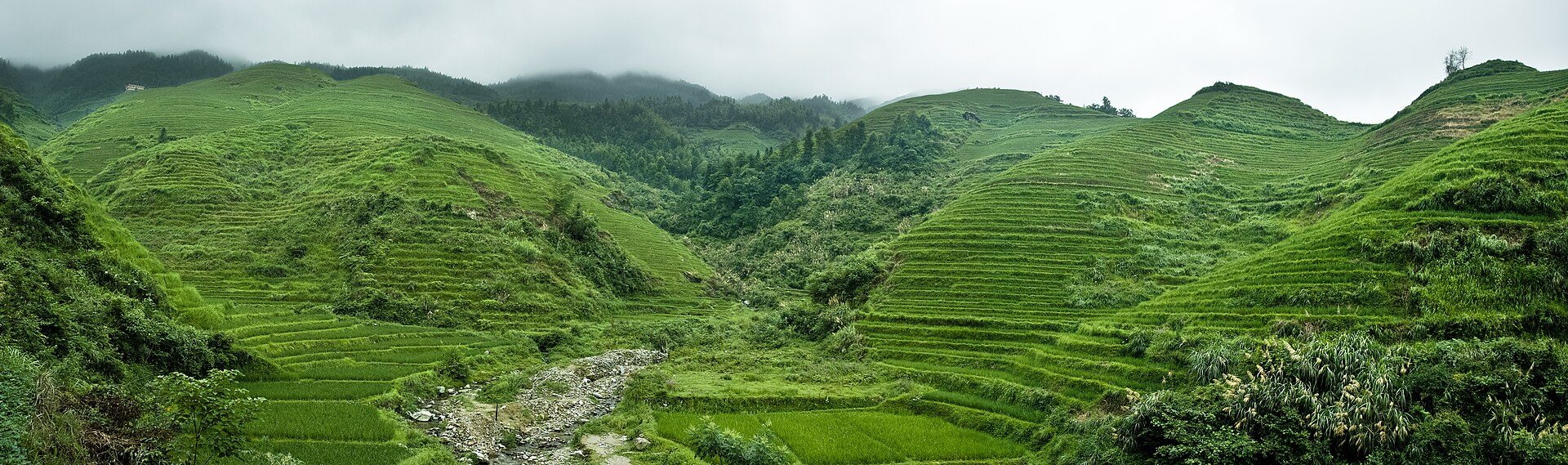
Once you reach the village, spend the day walking the ridge-top viewpoints. If you chose Ping'an, hike up to "Seven Stars Around the Moon" and "Nine Dragons Five Tigers", both close to the village. If you chose Dazhai, take the cable car to Jinfoding peak or hike the trail between the three viewpoints. Each terrace looks different by season — mirror water around Apr–Jun, deep green Jun–Sep, and the gold harvest peaking around mid-Sept to early Oct.
On the way up or down you often pass the Huangluo long-hair village (黄洛瑶寨), a Red Yao village where the women grow their hair extremely long, many past a metre, with a hair-combing and song performance for visitors. Have lunch in the village — bamboo-tube rice and local chicken — then leave time to catch the late-afternoon transport back to Guilin.
The simplest plan is to stay in Guilin city all three nights, since on day four you come back into town to catch transport up to Longji anyway. The best area is around the Two Rivers Four Lakes / Zhengyang pedestrian street, walking distance from Elephant Trunk Hill and the Sun and Moon Pagodas. Or move out to Yangshuo for nights two and three to sleep among the peaks. See our 10 best hotels or luxury hotels.
Guilin has no subway — in the city you rely on local buses at ¥1–2 (scan Alipay/WeChat), plus taxi or DiDi (flagfall ~¥9–10). Between places you use the cruise (day 2), a bus or train to Yangshuo, and a bus or tour up to Longji (day 4). Use Amap or Apple Maps rather than Google Maps, which doesn't work in China.
Link a Visa/Mastercard to Alipay (international mode) before you travel. Most places accept only Alipay/WeChat Pay, and some take no cash at all. Download a VPN before leaving Thailand too (Google Maps, Instagram and LINE are blocked). See our Alipay guide · Thai passport holders enter China visa-free.
| Item | Budget | Mid-range | Comfort |
|---|---|---|---|
| Hotel, 3 nights | ¥240–480 (~฿1,200–2,400) |
¥600–1,200 (~฿3,000–6,000) |
¥1,500–3,300+ (~฿7,500–16,500+) |
| Food, 4 days | ¥260–420 (~฿1,300–2,100) |
¥520–920 (~฿2,600–4,600) |
¥1,100–2,000 (~฿5,500–10,000) |
| City transport, 4 days | ¥50–100 (~฿250–500) |
¥120–220 (~฿600–1,100) |
¥250–450 (~฿1,250–2,250) |
| Days 1–2 (tickets + Li River cruise) | ¥420–600 (hill+cave+cruise) |
¥600–850 (+better boat+show) |
¥900–1,300 (+top-deck+show) |
| Day 3 (Yangshuo countryside) | ¥180–300 (raft+bike+Xingping) |
¥300–480 (+e-bike+transport) |
¥500–800 (+private tour) |
| Day 4 (Longji day trip) | ¥160–250 (bus+entry) |
¥300–450 (+cable car+lunch) |
¥500–800 (+tour with transfers) |
| Whole trip (approx.) | ¥1,310–2,150 (~฿6,550–10,750) |
¥2,440–4,120 (~฿12,200–20,600) |
¥4,750–8,650+ (~฿23,750–43,250+) |
Reference rate ¥1 ≈ ฿5 · costs are approximate and vary by season — check before you go.