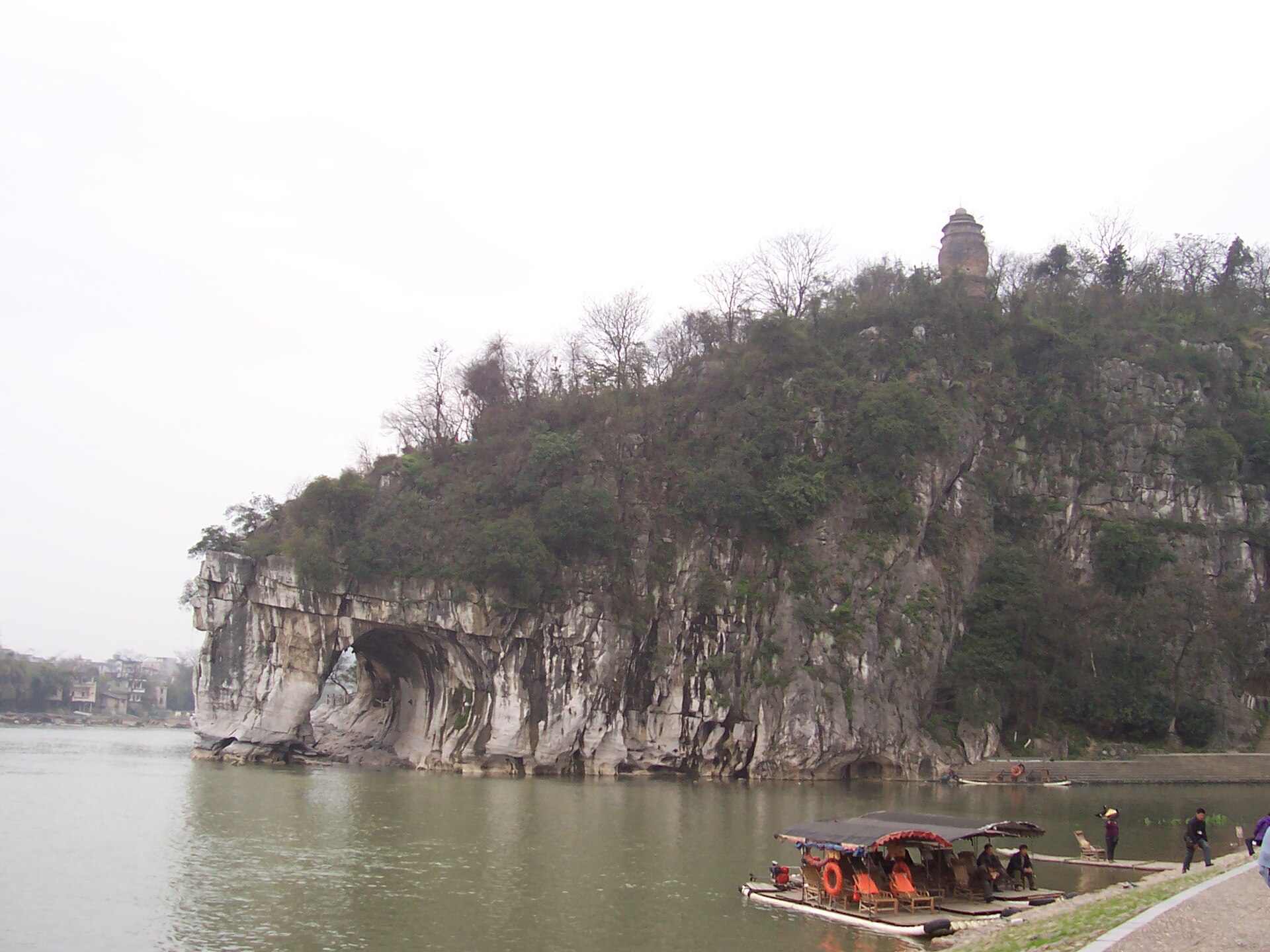
A limestone hill that nature has cut clean through, so it looks for all the world like a giant elephant lowering its trunk to drink from the Li River — lovely from the riverbank, topped by a tiny pagoda you can climb to, and lit up in shifting colour after dark.
Picture this: you are standing by the Li River at first light, the sky still grey, looking across a sheet of still water at a big grey block of stone with an arch punched clean through its foot, the river flowing under it — and then it clicks. It is an elephant. A giant elephant lowering its trunk to drink, the arch the gap between trunk and front legs. This is the image that has been on Guilin's postcards, postmarks and city logo for decades.
Elephant Trunk Hill (象鼻山, often shortened to 象山) sits in the middle of Guilin right at the confluence of the Li River and the Peach Blossom (Taohua) River. It is a karst limestone hill that water and time carved over millions of years into an elephant shape so convincing it is almost uncanny. To the Chinese it is the emblem of the city — what the Eiffel Tower is to Paris. Come to Guilin and miss the elephant, and somehow you have not quite arrived.
What makes the hill more than just an oddly shaped rock is the detail hidden in it: the Water-Moon Cave (水月洞), the arch that forms the elephant's "trunk"; a Ming-dynasty Puxian Pagoda on the summit; and a legend of a heavenly elephant told for hundreds of years. Around the hill is an easy riverside park you can walk in about an hour, which makes it the perfect way to open a Guilin trip before heading out on a river cruise or to Yangshuo.
From the trunk arch to the summit pagoda to the view from across the river — knowing them first makes the visit far better.
This is the star of the show: a semicircular arch about 12 metres high cut clean through the foot of the hill, which is exactly what makes it look like an elephant lowering its trunk to drink. The name "Water-Moon" comes from full-moon nights, when the moon's reflection appears through the arch on the water — so a moon seems to float both in the sky and in the river at once. The cave walls are covered with more than 50 poems and inscriptions from the Tang and Song dynasties, a little open-air museum of calligraphy.
Up on top, on what looks like the elephant's back, stands a small Ming-dynasty brick pagoda named for the bodhisattva Samantabhadra (Puxian). Legend says it is the hilt of a sword left buried in the elephant's back. You can climb the steps to the top for a view over the curving Li River and the karst peaks ringing Guilin — a spot many people miss because they are busy photographing the trunk down below.
For the classic "whole elephant" shot, walk through the park to the riverside terrace near Gate 2, where you face the trunk arch head-on and get the shape, the arch and its reflection all in one frame. Early morning, with still water and few people, is when the picture comes out best — by mid-morning the water starts to ripple and the tour groups arrive.
After dark the riverside hill becomes a giant screen: coloured light and lasers are projected onto the rock face, telling the legend of the elephant and the life of old Guilin, reflected in the water for an effect completely different from the daytime view. You can watch it for free from the riverbanks nearby, or for a closer, fuller look take an evening boat tour that passes in front of the hill (extra cost). Show times shift with the season, so check on the day.
Here is what many people do not realise: you do not have to enter the park to see the elephant well. Walk along the Li River path or stand on the far bank and you get the whole elephant from just the right distance. A few riverside cafés and hotels in town even have rooftops that face the hill — order a single coffee, sit, and watch the elephant change colour as the sun goes down, and you have had your money's worth.
Elephant Trunk Hill is beautiful at two times in the same day. If you like calm and want a clean reflection, come early, around 07:00–09:00 — fewer people, still water, soft light, and the best chance of catching the elephant mirrored in the river. If you prefer colour and a bit of buzz, come in the evening, from just before sunset into the night, when coloured lights play across the rock.
An honest heads-up: late morning to afternoon is when tour groups pour in, the riverside photo terrace gets crowded and you queue to shoot. Skip that window if you can. And in the rainy months (May–August) the Li River runs higher and muddier than usual — at times the water rises right up into the trunk arch, so the scene looks different from the dry-season postcard.
The classic "Guilin postcard" angle is from the riverside terrace near Gate 2 inside the park, facing the trunk arch head-on — you get the shape, the arch and the reflection in a single frame. Come early, when the water is still, for the most symmetrical shot.
The angle many people overlook is from the far bank or the riverside path a little further off — step back and you see the whole elephant with other karst peaks behind it, a wider scene than you get inside the park. For a higher vantage, a few riverside cafés and hotels in town have rooftops aimed straight at the hill, ideal for a coffee while you wait for the elephant to change colour at dusk.
Because Elephant Trunk Hill only takes about an hour and sits in the middle of town on the Li River, most people do not visit it on its own — they pair it with another stop the same day. See the elephant in the morning, then mid-morning carry on with the Li River cruise down to Yangshuo, or stroll Zhengyang pedestrian street.
If you are staying the night, the Two Rivers Four Lakes night cruise around the city — with the gold-and-silver Sun-Moon Pagodas — is a fitting way to close the day at dusk. It is all in the same city, a few minutes apart by taxi or DiDi.
Elephant Trunk Hill is in the centre of the city on the Li River at No. 1 Binjiang Road, Xiangshan District. Guilin does not have a metro or subway, so you get around the city by public bus, taxi or the DiDi ride-hailing app — all of them easy and cheap.
All of these are in Guilin or an easy day out — start with the elephant, then keep going.