Home Guilin China Guilin Hotels About
Home  ›  Asia  ›  China  ›  Guilin  ›  5-Day Itinerary
🗓 Guilin Itinerary · 5 Days 4 Nights · 2026

Guilin Without the Rush —
5 Days for the Li River, Yangshuo and Longji

A Two Rivers Four Lakes night cruise, the Li River drifting past karst peaks to Yangshuo, a slow day cycling the countryside with a cooking class, and an overnight on the Longji rice terraces to wait for sunrise — this is the five-day plan for travellers who don't want to hurry.

Why 5 days?

Guilin is a place that rewards going slow

Here's the honest truth: Guilin is a place you cannot rush. The image of karst peaks reflected in still water — the one printed on the 20-yuan note — does not look its best when you race past it. It looks its best when you're drifting on a bamboo raft, when you're cycling through the rice fields in the late afternoon, or when you wake up and sip tea while the mist lifts off the ridges. The region is really three different worlds: Guilin city, with its Elephant Trunk Hill and lake pagodas lit up at night; the slow, green Yangshuo countryside; and the Longji rice terraces high in the mountains, where the Yao and Zhuang have farmed the slopes for centuries.

This plan is built to feel different from a 3- or 4-day trip — it adds a full slow day in the Yangshuo countryside (a raft, cycling, Moon Hill and a local cooking class) and an overnight on the Longji terraces to catch sunrise over the stepped fields, the one thing a day-tripper never sees. If you have less time, look at our 4-day plan or 3-day plan, which keep things tighter.

Before you book, read our 10 best Guilin hotels to choose where to sleep — this plan splits your nights across three bases: two nights central in Guilin, two nights in Yangshuo, and a final night up on the Longji terraces, so each world gets proper time without backtracking.

5 Days · 4 Nights City + Yangshuo + a Longji overnight Li River cruise + cooking class Budget ¥1,400–2,800/person
1
Day 1
Guilin City — Elephant Trunk Hill, Reed Flute Cave and a Night Cruise
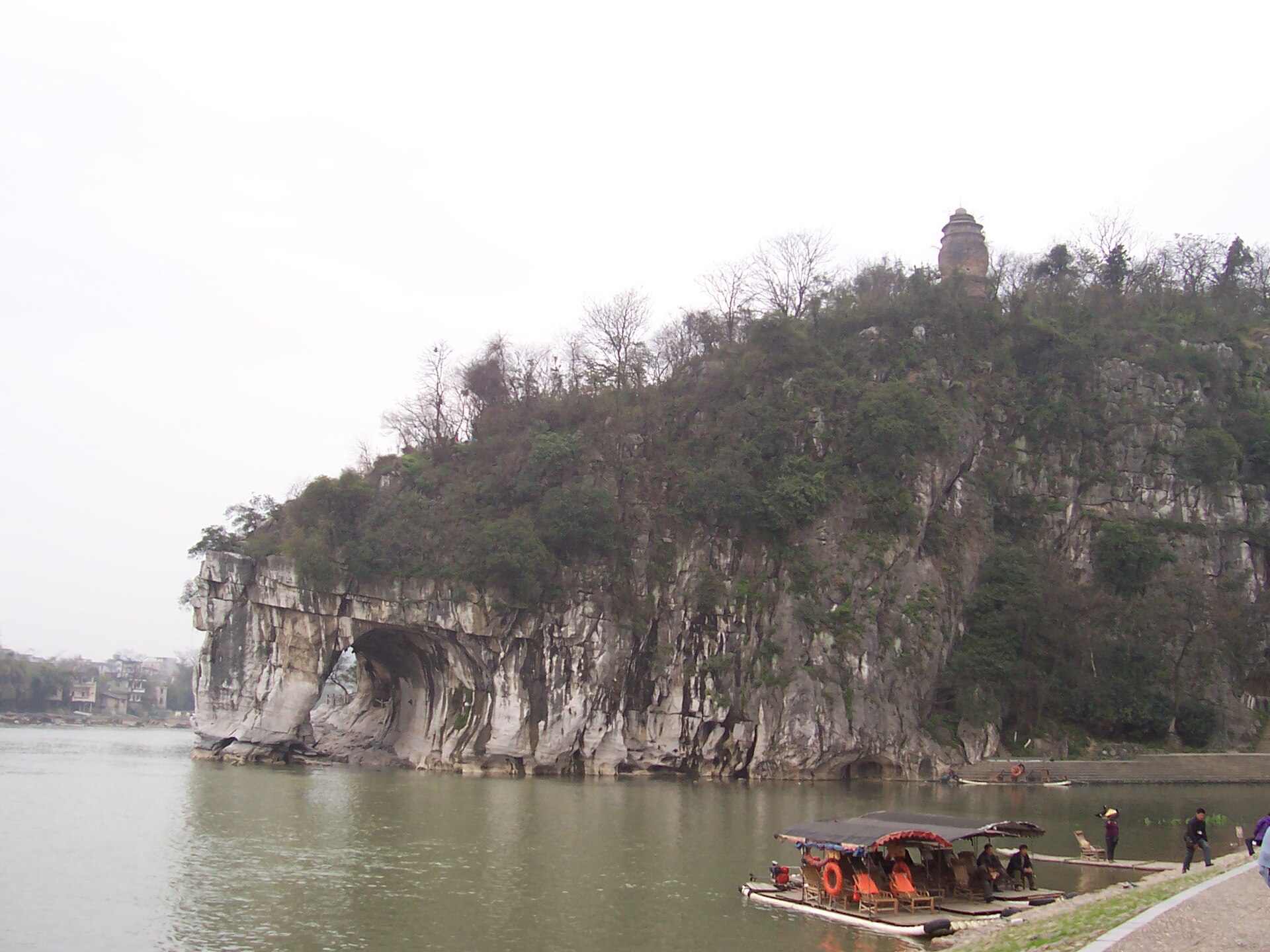
Elephant Trunk Hill on the Li River, the symbol of Guilin city
🌅 Morning
Ease into the trip at the city's symbol — Elephant Trunk Hill (象鼻山), a karst peak on the Li River whose archway looks like an elephant dipping its trunk to drink. It has been Guilin's signature image for generations, and it photographs well from inside the park or from the opposite bank. Go early for soft light and fewer crowds. More in our Guilin attractions guide. For a late breakfast, try a bowl of Guilin rice noodles (桂林米粉) — soft noodles in a rich gravy that locals eat every day.

☀️ Afternoon
In the afternoon, take a DiDi or bus out to Reed Flute Cave (芦笛岩) in the city's north-west — a cavern of stalactites and stalagmites lit in shifting colours that feels almost surreal, and pleasantly cool on a hot day. Allow 45 minutes to an hour. Read our Reed Flute Cave guide. If you still feel like wandering, stroll Zhengyang Pedestrian Street (正阳步行街) in the centre for coffee, souvenirs and a relaxed pre-dinner walk.

🌙 Evening
Close the day with the city's best night out — the Two Rivers Four Lakes cruise (两江四湖), a waterway linking the Li and Taohua rivers with four downtown lakes. The night cruise runs roughly 19:00–21:30 and tickets are about ¥190 (฿950). The highlight is the Sun and Moon Pagodas (日月双塔), one gold and one silver, glowing and reflected in Shanhu Lake. If you'd rather not cruise, walking the lakeside to see the pagodas from the bank is free and just as lovely. Read our Two Rivers Four Lakes guide.
Tip: Tickets for Elephant Trunk Hill, Reed Flute Cave and the Two Rivers Four Lakes cruise are sold separately and rise in peak season — booking ahead via Klook or through your hotel saves both money and time. On a budget, pick the single cruise you most want to do (the night cruise is the better value, since you get the lit pagodas).
2
Day 2
The Li River Cruise to Yangshuo — West Street and the Liu Sanjie Show
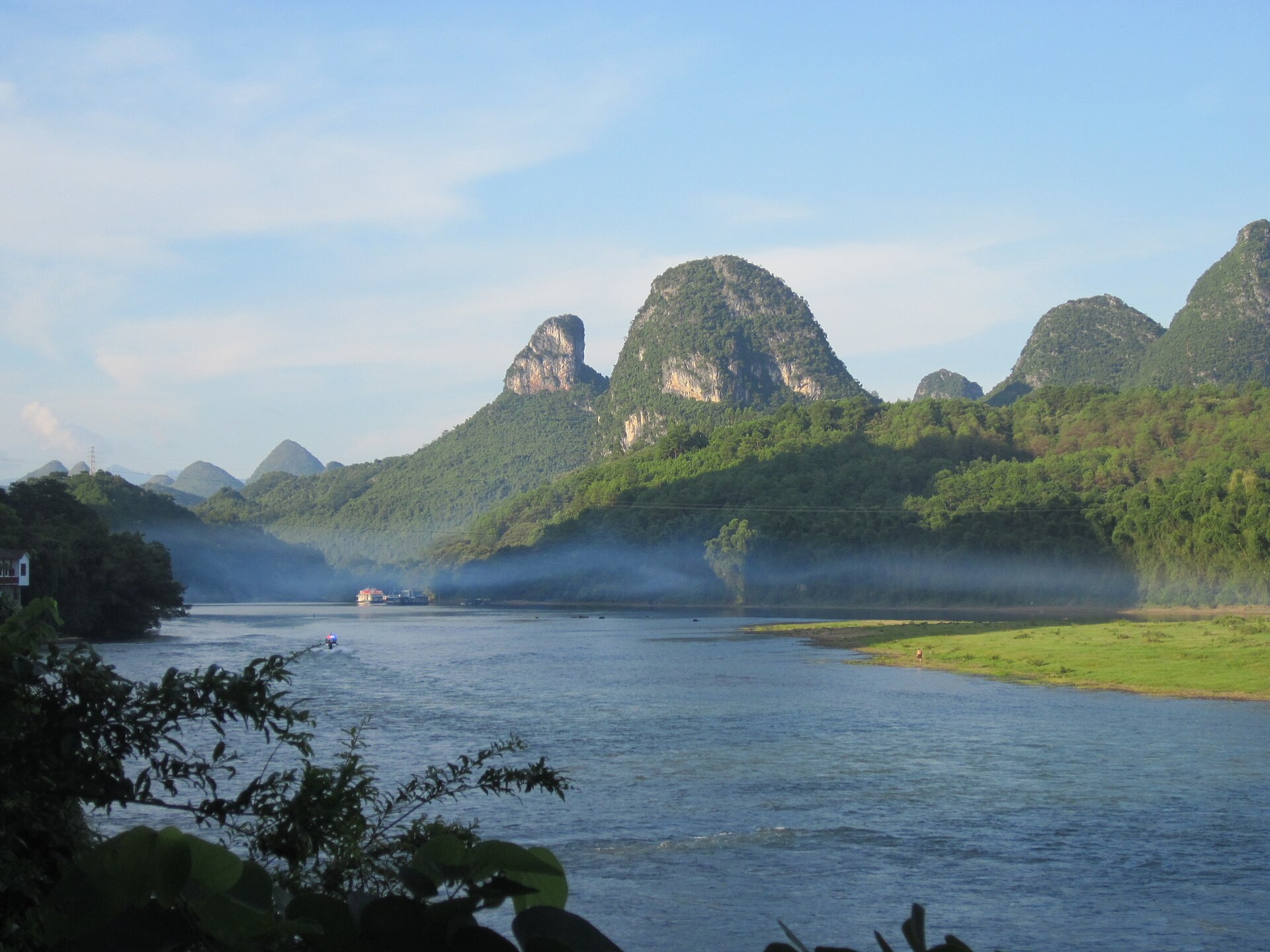
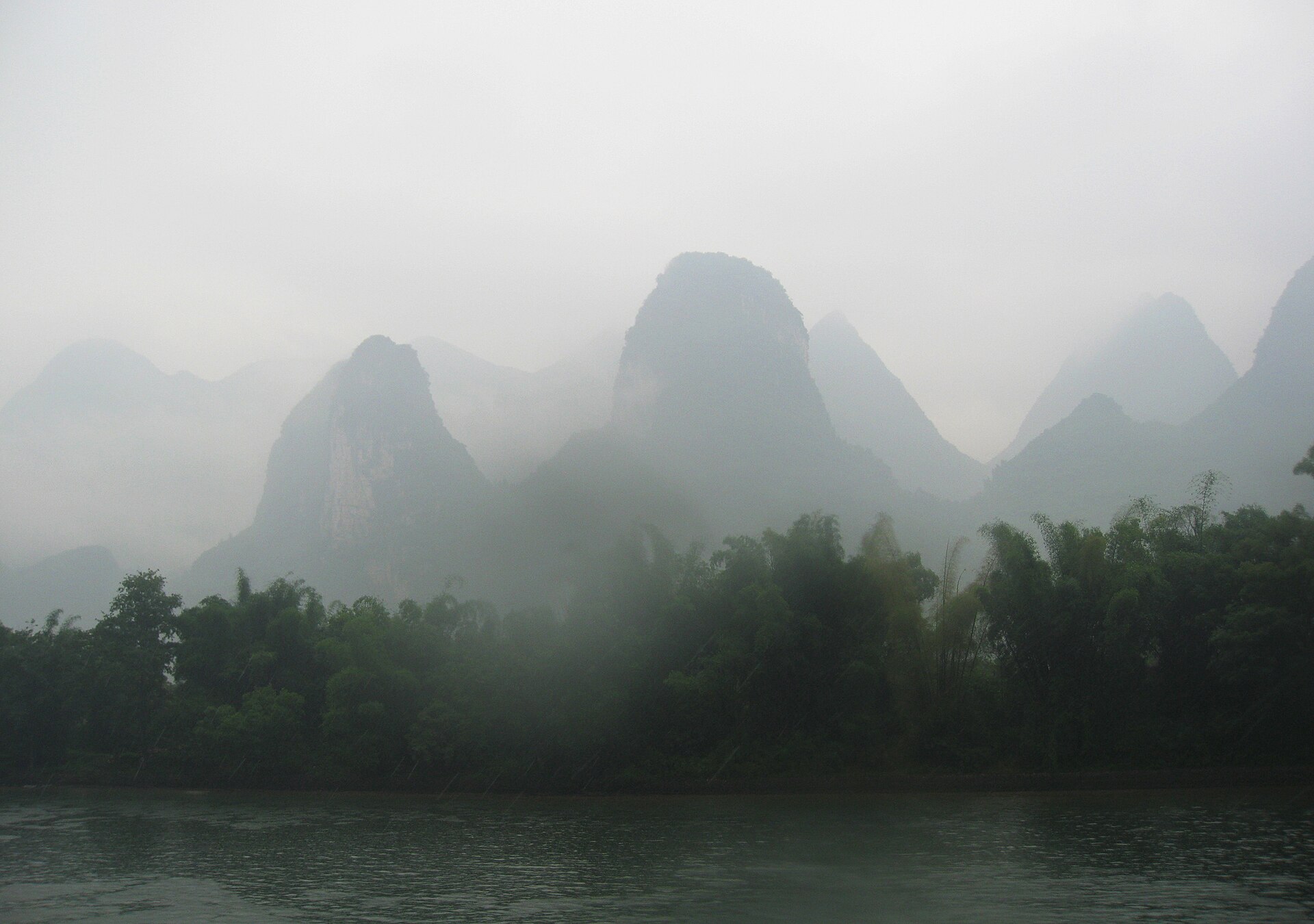
Li River cruise gliding past lines of karst peaks between Guilin and Yangshuo
🚢 Morning — the Li River cruise
Today is the trip's centrepiece — the Li River cruise (漓江). The large boats leave in the morning, around 09:30–10:00, from Zhujiang (竹江) or Mopanshan (磨盘山) pier outside Guilin, sailing roughly 83 km past rank after rank of karst peaks that look lifted from a Chinese ink painting. The journey takes 4–5 hours and reaches Yangshuo around 13:30. A 3-star ticket is about ¥215 (฿1,075) and a 4-star about ¥360 (฿1,800), lunch on board included. Everyone waits for the stretch near Xingping that matches the scene on the 20-yuan note. Read the full Li River cruise guide.

🛶 Afternoon — check in to Yangshuo
The boat docks at Yangshuo. Drop your bags and rest for a while — Yangshuo is your base for the next two nights. If you like a buzz, stay near West Street (西街); if you prefer quiet and rice-field views, choose the Yulong River (遇龙河) side out in the countryside. In the late afternoon, wander West Street, a Song-dynasty stone lane now lined with shops, cafes and bars. Read our Yangshuo West Street guide.

🌙 Evening — the Liu Sanjie show
Tonight, see the famous outdoor show — Impression Liu Sanjie (印象·刘三姐), a light-and-sound spectacle staged on the actual river, directed by Zhang Yimou, with twelve karst peaks as the backdrop and a cast of more than 600 local villagers. It runs about 70 minutes; tickets start around ¥238 (฿1,190) for the back rows and climb past ¥688 for VIP boxes — B-level seats (¥328–398) are the best value, with a clear view and comfortable seating. Book ahead via Klook. Before or after, try the town's signature dish, Yangshuo beer fish (啤酒鱼).
Cruise tip: Boat seats sell out fast in peak season (April–May and September–October) — book at least 2–3 days ahead. If the Li River runs low in winter, the big boats may sail a shorter route or switch to small boats from Xingping, so check the water conditions with your agent before you commit.
3
Day 3 — A Slow Countryside Day
Slow Yangshuo — Yulong River Raft, Cycling, Moon Hill and a Cooking Class
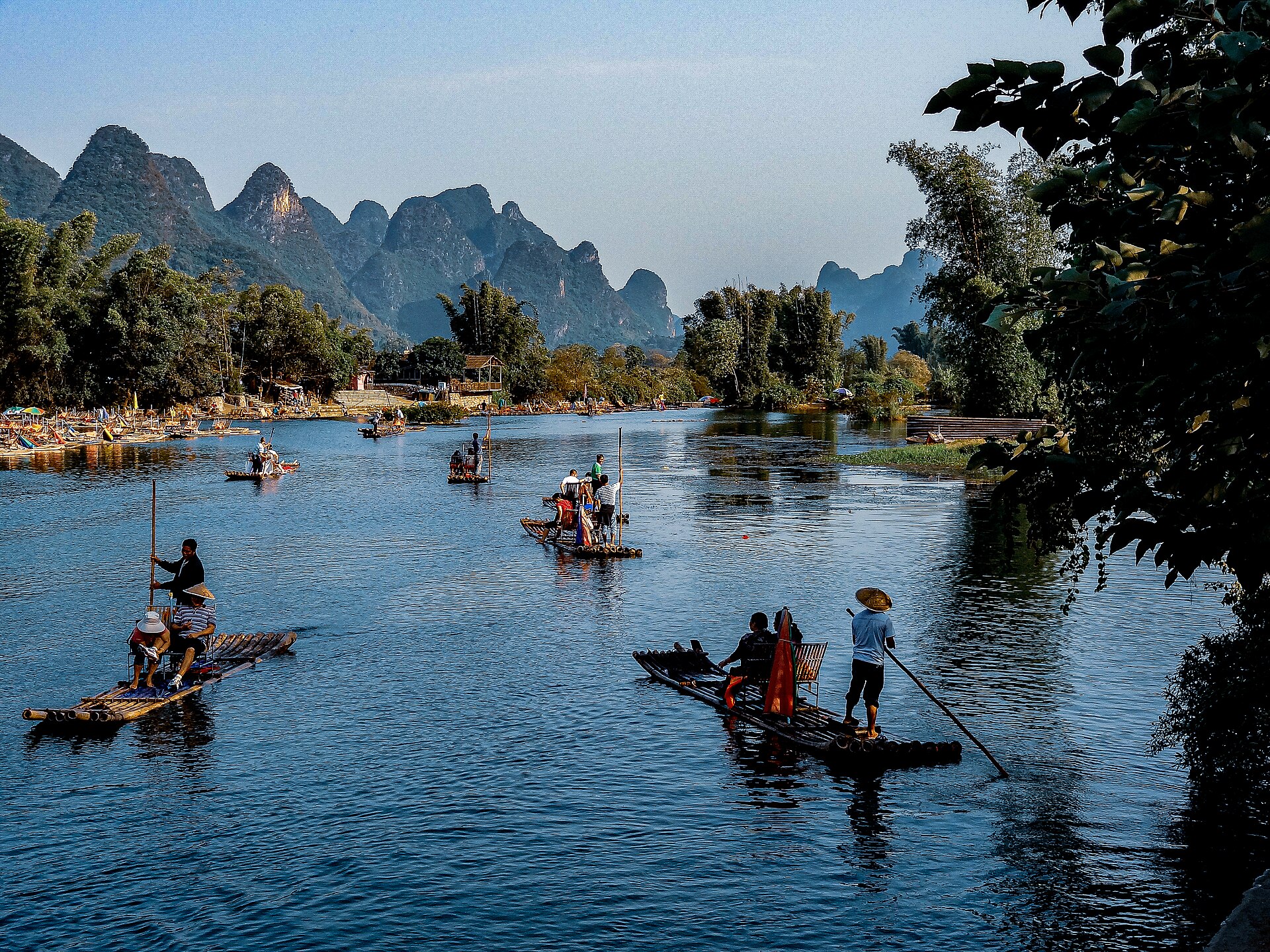
Bamboo raft on the Yulong River among rice fields and karst peaks in the Yangshuo countryside
🌅 Morning — a Yulong River raft
There's no tight schedule today — this is the day to soak up the Yangshuo countryside slowly. Start with a bamboo raft on the Yulong River (遇龙河), a small tributary of the Li that's quieter and clearer. The water is shallow and slow, and the boatman poles you gently past rice fields, karst peaks and low weirs the raft slides over with a fun little drop. A raft costs about ¥320 (seats two), running roughly 1.5 hours from Jima pier down to Gongnong Bridge. Read our Yulong River guide.

🚲 Afternoon — cycling and Moon Hill
In the afternoon, rent a bike or e-scooter (about ¥30–60 a day) and ride along the Yulong River through villages and rice paddies — it's the best way to see Yangshuo, stopping wherever you feel like it. On the way, stop at Moon Hill (月亮山), a karst peak with a crescent-moon arch punched clean through it. If you fancy a climb, the path to the top (about 30–40 minutes) opens up a long view over the paddies; if you'd rather rest, photograph it from below and keep pedalling.

🍳 Evening — a local cooking class
End the slow day with something a shorter trip rarely has time for — a Yangshuo cooking class, about three hours long. It starts with a walk through the local market with your chef to pick vegetables and meat, then you cook regional dishes yourself: beer fish, Guilin dumplings and stir-fried local greens. It's a delicious, hands-on dinner in its own right, costing around ¥150–250 a person including ingredients; book ahead at a Yangshuo cooking school. Prefer to just eat out? Find a good spot in our Guilin local cuisine guide instead.
Slow-day tip: Yangshuo is at its best in the early morning and late afternoon, when the light is low and the crowds are thin. Midday is hot and busy, so put the raft in the morning, rest somewhere shady over lunch, then cycle from about 3–4 pm onwards — it's far more comfortable and the photos are better.
4
Day 4
Xingping — the 20-Yuan View, Laozhai Hill and Back to Guilin
The bend of the Li River at Xingping, the same view printed on the 20-yuan banknote
🛶 Morning — the 20-yuan view at Xingping
This morning, take a car from Yangshuo to Xingping (兴坪古镇), an old town on the Li River about 25 km away (around 40 minutes) — this is exactly where the image on the 20-yuan note was taken, a bend in the Li framed by karst peaks like a painting. Hire a small bamboo raft out onto the water to capture the same angle (hold up the real note and compare), then wander the quiet, characterful old stone lanes of the town. Read our Xingping Ancient Town guide.

⛰️ Afternoon — Laozhai Hill or a slow wander
For a high view, climb Laozhai Hill (老寨山) in Xingping itself — the path is steep but short (about 30–40 minutes), and the summit reveals the whole bend of the Li and the surrounding peaks as a panorama, well worth the sweat. Prefer to rest? Sip tea by the river, photograph the old lanes, and just let the little town set the pace. In the late afternoon, head back to Guilin to set up for the Longji climb tomorrow.

🚄 Evening — back to Guilin
There are two ways back from Yangshuo/Xingping to Guilin — a direct bus of about 1.5 hours, or a bullet train from Yangshuo Station (阳朔站) to Guilin North (桂林北) in about 24 minutes (a ticket is around ¥30 / ฿150, though Yangshuo Station is outside town and needs a transfer). Spend tonight in Guilin so you can set off for Longji early tomorrow. See all the options in our Guilin day-trips guide.
Tip: To save time you could skip the return to Guilin and stay another night in Yangshuo — but reaching Longji is much easier from Guilin (the buses leave from Qintan station in the city), so this plan loops you back for one night in Guilin to keep the last day unhurried.
🚄
China High-Speed Rail
Book your own tickets easily on the 12306 app — board with your passport
Read the full guide →
5
Day 5
The Longji Rice Terraces — an Overnight for Sunrise and the Long-Hair Yao Village
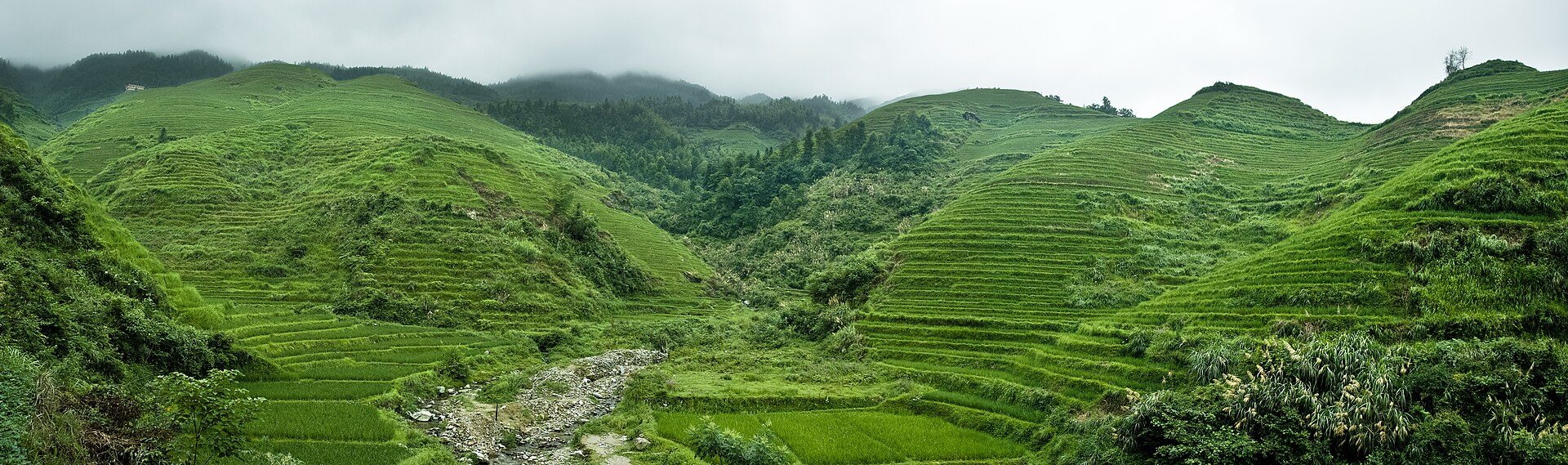
The Longji rice terraces stepping up the hillsides in Longsheng near Guilin
🚌 Morning — up to the terraces
Leave Guilin early and take a bus from Qintan (琴潭) bus station direct to Ping'an (平安) or Dazhai/Jinkeng (大寨/金坑), about 2.5–3 hours for around ¥50 (฿250). The scenic-area ticket is ¥80 (฿400), valid 48 hours and covering both sides. Once there, drop your bags at a guesthouse up on the terraces and walk to the viewpoints — the Dazhai/Jinkeng side has a cable car to the highest lookout, while Ping'an has the "Seven Stars Around the Moon" and "Dragon's Backbone" viewpoints within easy walking distance. Read the full Longji rice terraces guide.

🌾 Afternoon — Yao villages and a terrace walk
Spend the afternoon exploring the villages on the terraces. Dazhai is mostly Red Yao (红瑶), famous for the women's long hair (Huangluo village holds a long-hair combing demonstration), while Ping'an is a Zhuang (壮) village. Walk past old timber houses, fields stacked in steps, and field walls the locals have built over centuries. The terraces look their best with mirror-water reflections (mid-April to June) and at the golden harvest (late September to October). For dinner at your guesthouse, try bamboo-tube rice and a mountain-style herbal chicken.

🌄 Next morning — sunrise
The whole reason to stay overnight is the next morning — wake before dawn, walk up to a viewpoint, and wait for sunrise over the terraces as the first light slides down the stacked fields with thin mist still hanging in the valley. This is the image a day-tripper never gets to see. After sunrise, take a relaxed breakfast, then ride the bus back to Guilin to connect with your flight or train home.
Longji overnight tip: Guesthouses on the terraces usually mean a walk up from the car park (15–40 minutes for some); porters can carry bags, but packing light helps most. Book a room with a balcony facing the fields so you can watch sunrise from bed. It's several degrees cooler up here than in the city, so bring a warm layer even in summer. If you'd rather not juggle the connections, a Klook Longji tour with transport is far simpler.
Plan before you go

Where to Stay, How to Get Around

🏨
Where to stay for these 5 days
This plan splits your nights across three bases so each world gets proper time:

Nights 1–2 · central Guilin — around the Two Rivers Four Lakes / Zhengyang Street, walking distance to Elephant Trunk Hill and the night cruise.
Night 3 · Yangshuo — near West Street for the buzz, or the Yulong River for quiet rice-field views.
Night 4 · back in Guilin — to set off for Longji early on the last day.
Night 5 · up on the Longji terraces — a guesthouse at Ping'an or Dazhai for sunrise.
Luxury: Shangri-La · Sheraton (Guilin) · Alila / Banyan Tree (Yangshuo) Mid-range & budget: city boutiques · Yulong riverside guesthouses · Longji terrace stays See 6 luxury Guilin hotels →
🚌
Getting around — no subway
Guilin has no subway. You'll move around like this:

In Guilin city — buses ¥1–2 (scan Alipay/WeChat) · DiDi/taxi from around ¥9–10
Guilin ↔ Yangshuo (~65 km) — the Li River cruise · a bus (~1.5 h) · a bullet train to Yangshuo Station (~24 min)
In the Yangshuo countryside — bikes / e-scooters + bamboo rafts
Guilin → Longji — bus from Qintan station (~2.5–3 h)
Recommended: book HSR on the 12306 app with your passport · book tours/transfers on Klook Maps app: Amap (高德地图) is more accurate than Google in China
Budget

5-Day Costs — a Realistic Estimate

The figures below are per person, per day, excluding flights and travel insurance. Accommodation assumes a mid-range hotel or guesthouse (¥300–650 per room per night); sharing a room between two cuts it sharply. The Li River cruise and the Liu Sanjie show make Day 2 the priciest, while the Longji day's main costs are the bus and the scenic-area ticket.

Item Day 1
(city)
Day 2
(cruise)
Day 3
(countryside)
Days 4–5
(Xingping + Longji)
Accommodation (1 night/person) ¥300–650
฿1,500–3,250
¥300–650 ¥300–650 ¥250–550
(Longji is cheaper)
Tickets / activities ¥220–290
฿1,100–1,450
¥450–600
(cruise + show)
¥180–320
(raft + class)
¥110–170
(Xingping raft + Longji)
Transport ¥15–50 ¥20–60
(to the pier)
¥30–80
(bike rental)
¥120–200
(bus to Longji)
Food ¥100–220 ¥120–250 ¥120–250
(class = dinner)
¥100–200
Total/person/day ¥635–1,210 ¥890–1,560 ¥630–1,300 ¥580–1,120
5-day total per person (approx): ¥3,400–6,500 (~฿17,000–32,500) covering accommodation, tickets, food and local transport, excluding flights · Budget (guesthouses + cheap eats + picking either the cruise or the show): ¥2,300–3,500 (~฿11,500–17,500) · Luxury (5-star hotels + a 4-star cruise + a guided tour with transport): ¥7,500+ (~฿37,500+).

See every budget level in our 10 best Guilin hotels or 6 luxury Guilin hotels.

Plan further

Read Next Before You Go

Have less time? See our 4-day plan or 3-day plan for a tighter trip, then pick the length that fits your time.
Frequently asked

Before You Visit Guilin for 5 Days

Is 5 days enough for Guilin?
Five days is the sweet spot for an unhurried Guilin trip: the city, the Li River cruise to Yangshuo, a slow countryside day with a cooking class, Xingping's 20-yuan view, and an overnight on the Longji rice terraces for sunrise. If you have less time, look at our 4-day plan or 3-day plan instead.
How long does the Li River cruise from Guilin to Yangshuo take?
The large cruise boats run about 83 km from Zhujiang or Mopanshan pier outside Guilin to Yangshuo, taking roughly 4–5 hours depending on the season and water level. Boats leave in the morning around 09:30–10:00 and reach Yangshuo around 13:30. A 3-star ticket is about ¥215 (฿1,075) and a 4-star ticket about ¥360 (฿1,800). Book ahead via Klook or an agent, as seats sell out fast in peak season. Read the full Li River cruise guide.
How do I get to the Longji rice terraces from Guilin?
Take a bus from Guilin's Qintan (琴潭) bus station direct to Ping'an (平安) or Dazhai/Jinkeng (大寨/金坑), about 2.5–3 hours for around ¥50 (฿250). The scenic-area ticket is ¥80 (฿400), valid 48 hours and covering both Ping'an and Dazhai. From the village you walk up, or take the cable car on the Dazhai side, to the viewpoints. If you would rather not juggle the connections, a Klook tour with transport is far simpler. Read the full Longji rice terraces guide.
What is the best time of year to visit Guilin?
April–May and September–October are best — mild, with full rivers and lush green scenery. The Longji terraces hold mirror-water reflections after the spring planting (mid-April to June) and turn gold at harvest (late September to early October). June–August is the hottest and wettest (though the mist over the karst can be dramatic). December–February is cool and often foggy and drizzly, and low water on the Li River can shorten the cruise. Avoid Golden Week (1–7 October) and Spring Festival.
How do I get around Guilin and Yangshuo?
Guilin has no subway. In the city, use public buses (¥1–2, scan Alipay/WeChat) or cheap DiDi/taxis (flagfall around ¥9–10). To Yangshuo (about 65 km) take a bus or a bullet train from Guilin North to Yangshuo Station (about 24 minutes) then transfer into town. In the Yangshuo countryside, use bikes, e-scooters and bamboo rafts; for Longji, take the bus from Qintan station. Use Amap (高德地图) or Apple Maps — they beat Google in China.
Do I need a VPN for Guilin?
If you rely on Google Maps, Instagram or Facebook, download and test a VPN before you leave home — you cannot download VPN apps inside Mainland China. Amap, Alipay and WeChat all work normally without a VPN. See our guide to internet, VPN and eSIM in China.
Klook · Guilin Activities

Li River cruise tickets, the Liu Sanjie show, Longji terrace tours and Yulong rafting — book on Klook

The Li River cruise and the Longji day both need booking ahead and several transfers — Klook tickets and tours with door-to-door transport bundle it all into one package, far simpler. Klook also has Liu Sanjie show tickets, Yulong bamboo rafts and Reed Flute Cave entry to choose from.

See Guilin activities on Klook →
Wherebest is a Klook affiliate partner — we may earn a commission when you book through our links, at no extra cost to you.