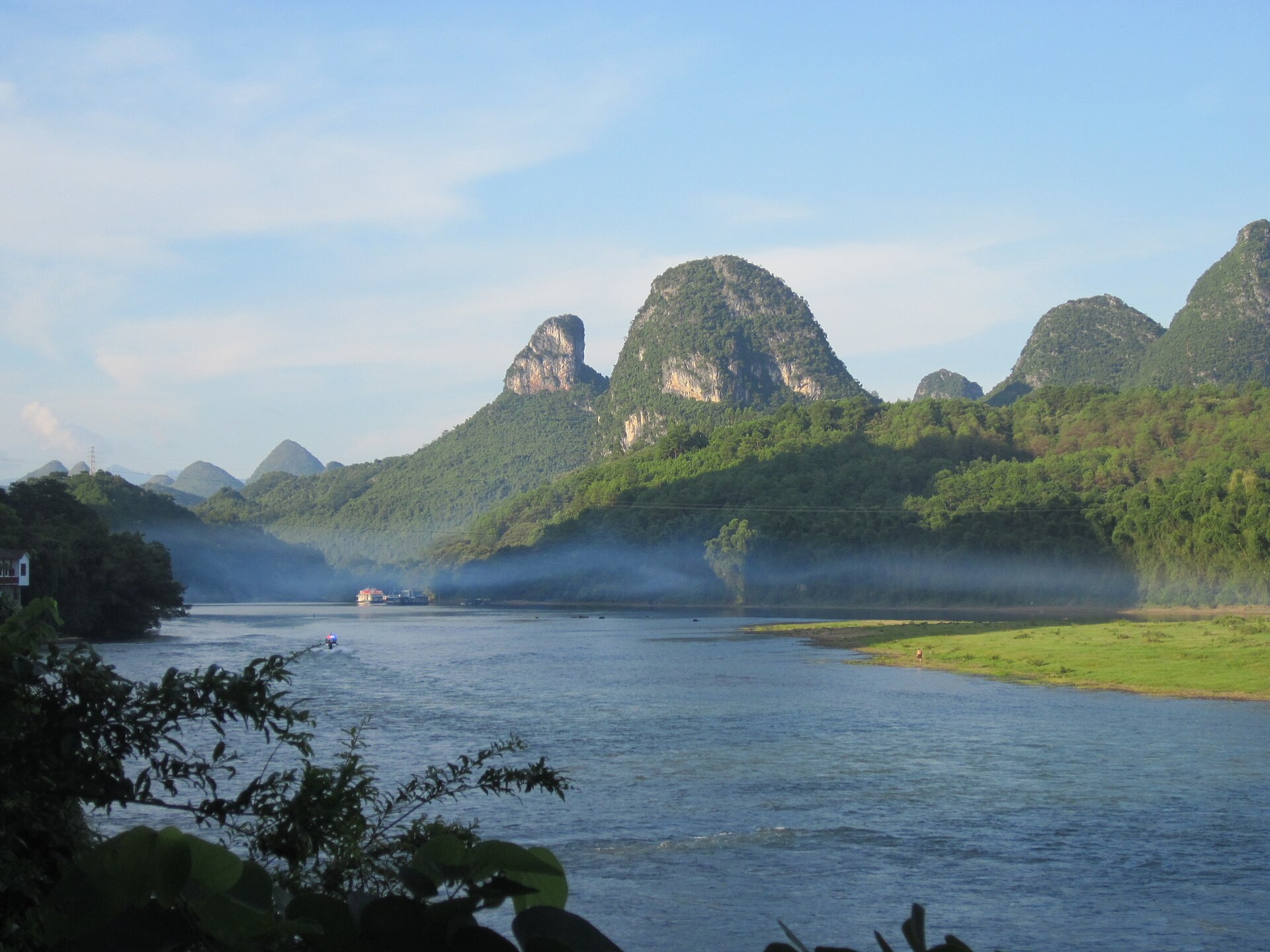
A river that winds past hundreds of limestone peaks, water buffalo cooling off at the bank, leaning bamboo groves — and the exact scene printed on the 20-yuan note at Xingping. This is the experience that earned Guilin the line "the finest mountains and rivers under heaven."
Picture it: the boat eases away from the pier mid-morning, the water so clear you can see pebbles on the bottom. On both banks, limestone peaks rise in odd, beautiful shapes one after another — one like a horse's head, one like an elephant's trunk. Water buffalo stand half-submerged in the cool shallows, and fishermen pole bamboo rafts out the way they have for centuries. Then the guide points ahead and says, "There — the view on the 20-yuan note," and everyone on deck pulls out a banknote to hold up against the real thing.
That is the Li River cruise (漓江) — the classic route from Guilin to Yangshuo, about 83 kilometres, roughly 4 to 4.5 hours on the water, through the most scenic stretch of river in Guangxi. You pass thousands of karst peaks pushing straight up out of the flat valley floor, old fishing villages, bamboo groves, and the river bends that became a national image of China. CNN and National Geographic have both ranked the Li among the world's most beautiful rivers, and it earns it — in a way photographs never quite capture.
What makes the cruise special is that it changes with the season and the weather. On a misty day it feels like stepping into a Chinese ink painting; on a clear day the green peaks mirror perfectly in the still water. No two days look exactly alike — and whether you take a big boat or a bamboo raft, everyone who comes to Guilin ends up here, because this is the centre of the whole trip.
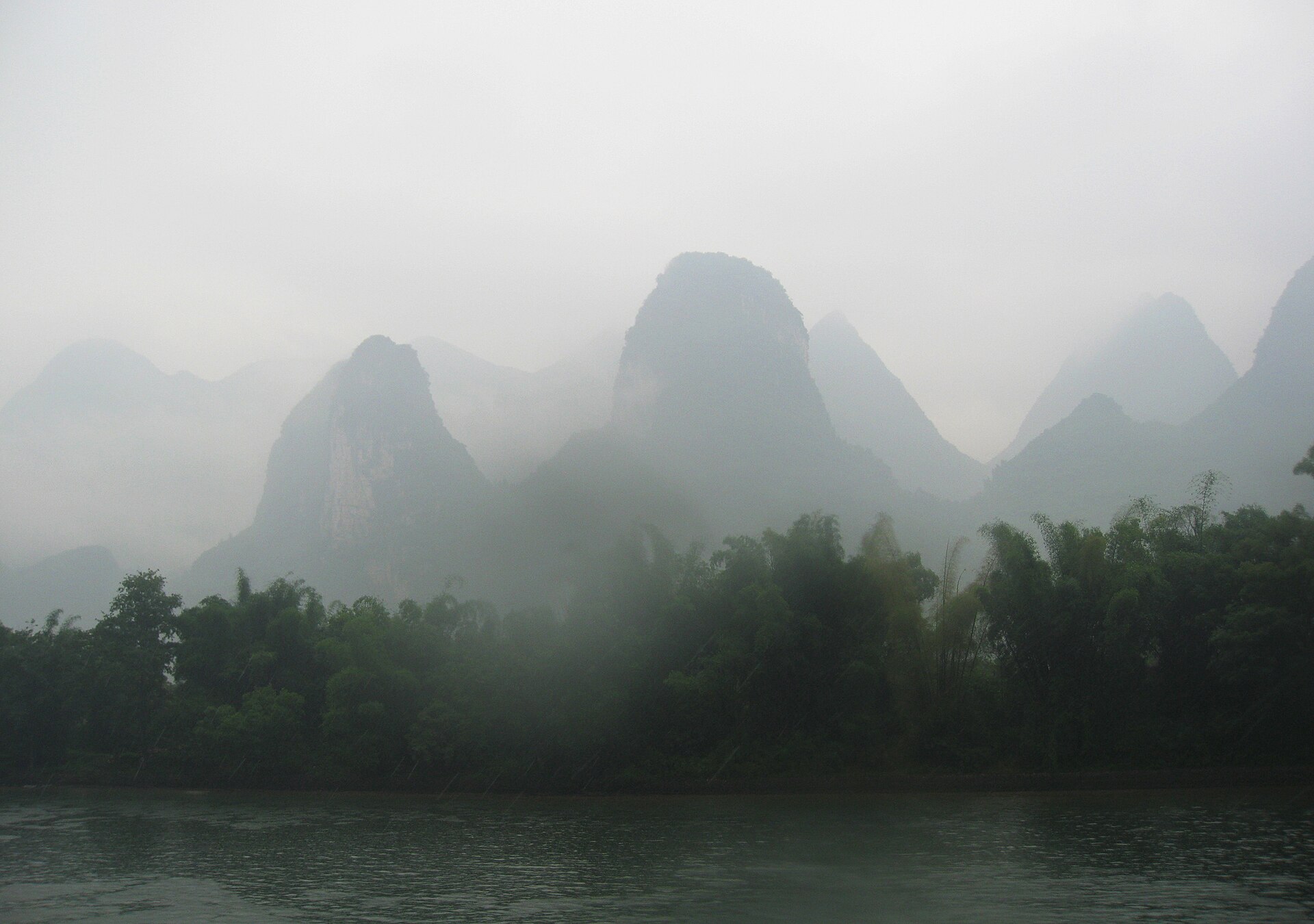
Heading downstream from Guilin to Yangshuo — each is a moment when everyone heads up to the deck at once.
Guilin's emblem — a karst hill shaped like an elephant lowering its trunk to drink from the Li River. Boats leaving from in town pass it at the very start, though most large cruises actually begin from Mopanshan or Zhujiang pier, about 30 km south of the city, where the water level suits the boats better. There is a dedicated Elephant Trunk Hill guide if you want to visit it on its own.
An old town on the Li River that was a busy trading port back in the Ming dynasty. Its cobbled streets, timber shopfronts and stone bridges are still intact. The cruise passes it on the early part of the route — a glimpse of riverside life that contrasts with the pure karst scenery further down.
A steep cliff streaked with mineral colours that form a pattern said to look like nine running horses. Local legend has it that anyone who can spot all nine will have good luck — most people manage three to five. Guides tend to slow down and give everyone time to stare at this one. It is one of the last highlights before Xingping.
A bend in the river near Xingping where seven peaks mirror in the still water — this is exactly the scene printed on the 20-yuan banknote. It is the moment when every passenger holds up a note to compare. For the precise banknote angle, you need a bamboo raft heading a short way upstream from Xingping.
An old riverside town ringed by the densest cluster of karst peaks on the whole route — many people say the stretch around Xingping is the most beautiful of all. Its old streets are quieter than Yangshuo's, and it is the favourite spot for getting on and off a bamboo raft. For more, see the Xingping ancient town guide.
This is the classic version most people picture. The 3-star boat (~¥215 per person) leaves from Mopanshan Pier (磨盘山) and ends at Longtoushan Pier in Yangshuo, while the 4-star boat (~¥360–480 per person) leaves from Zhujiang Pier (竹江) and ends at Shuidongmen Pier. Both include an on-board lunch — a packed lunch on the 3-star, a buffet on the 4-star — and both have indoor seating plus an open top deck for photos.
There is one sailing in the morning, roughly 9 to 10 am. The piers are about 30 km from central Guilin, so you take a transfer out (usually built into a tour package). The cruise runs 4 to 4.5 hours and reaches Yangshuo in the afternoon. It is the right choice if you want to see the river end to end in comfort in a single day.
If you are short on time, already staying in Yangshuo, or you simply want to be closer to the water than a big boat allows, take the tourist bamboo raft on the Yangdi (杨堤) to Xingping (兴坪) section, about ¥140–216 per person (usually including the transfer). This is the most concentrated, most beautiful stretch of the Li, passing both Nine-Horse Fresco Hill and Yellow Cloth Reflection. Rafts seat four, sit low to the water, and put the peaks right at eye level.
For a shorter ride, the rafts that leave Xingping pier toward Nine-Horse Fresco Hill can be negotiated for around ¥80–120 per raft — good if you just want the exact 20-yuan view. The best spot is about 5 minutes upstream from the Xingping pier.
No season is "wrong" for the Li River; each gives a different mood. What is certain is that a clear day just after rain tends to be the most beautiful — and the best for photographs.
Stay in Guilin city before the cruise, or overnight in Yangshuo after it — pick to suit the rhythm of your trip.