A car-free UNESCO island where piano notes drift through century-old colonial lanes, the campus China calls its prettiest, a German cannon on a clifftop, and a seafront road at sunset — Xiamen splits neatly into an island day and a coast day, and forty-eight hours is exactly enough to do both.
Here is the honest truth about Xiamen: it makes you slow down. This is not a city of glass towers and rush — it is a relaxed seaside city in southern China known for its easy pace, its greenery and its calm. The lucky part is that two days plan themselves, because Xiamen divides so clearly. Day 1 goes entirely to Gulangyu Island, the car-free World Heritage island you reach by ferry, where you wander century-old colonial lanes on foot. Day 2 stays on the southern coast of Siming district on the main island, walking the university, a temple, a fortress and a seafront road that line up in a single ribbon. So we make Day 1 the island day and Day 2 the coast day — no zig-zagging across town and no wasted time.
This plan is built for travellers who are short on time — a quick weekend, or anyone wanting a taste of Xiamen before deciding they love it. Day 1 on Gulangyu is on foot only (no cars on the island), while Day 2 in town mixes the metro, city buses and shared bikes. Xiamen's Metro Lines 1–3 are clean and cheap. What this plan leaves out is a day trip to the Fujian tulou earth buildings, the old city of Quanzhou and Jimei School Village — if you want those too, see all the things to do in Xiamen to grow the plan into three days.
Two things matter most: First — book your Gulangyu ferry and your Xiamen University time slot in advance, because both have limited quotas that sell out fast (the university is booked through WeChat three days ahead). Second — pick a base that fits your style: Siming / Zengcuoan if you want to wake up by the sea near the university, or around Zhongshan Road if you want easy access to the ferry and the shopping. See the options in the top 10 Xiamen hotels to match your budget.
Take the ferry to a car-free World Heritage island · climb Sunlight Rock for the whole-island view · Shuzhuang Garden by the sea and the Piano Museum · lose yourself in the old lanes · ferry back to shop Zhongshan Road in the evening.
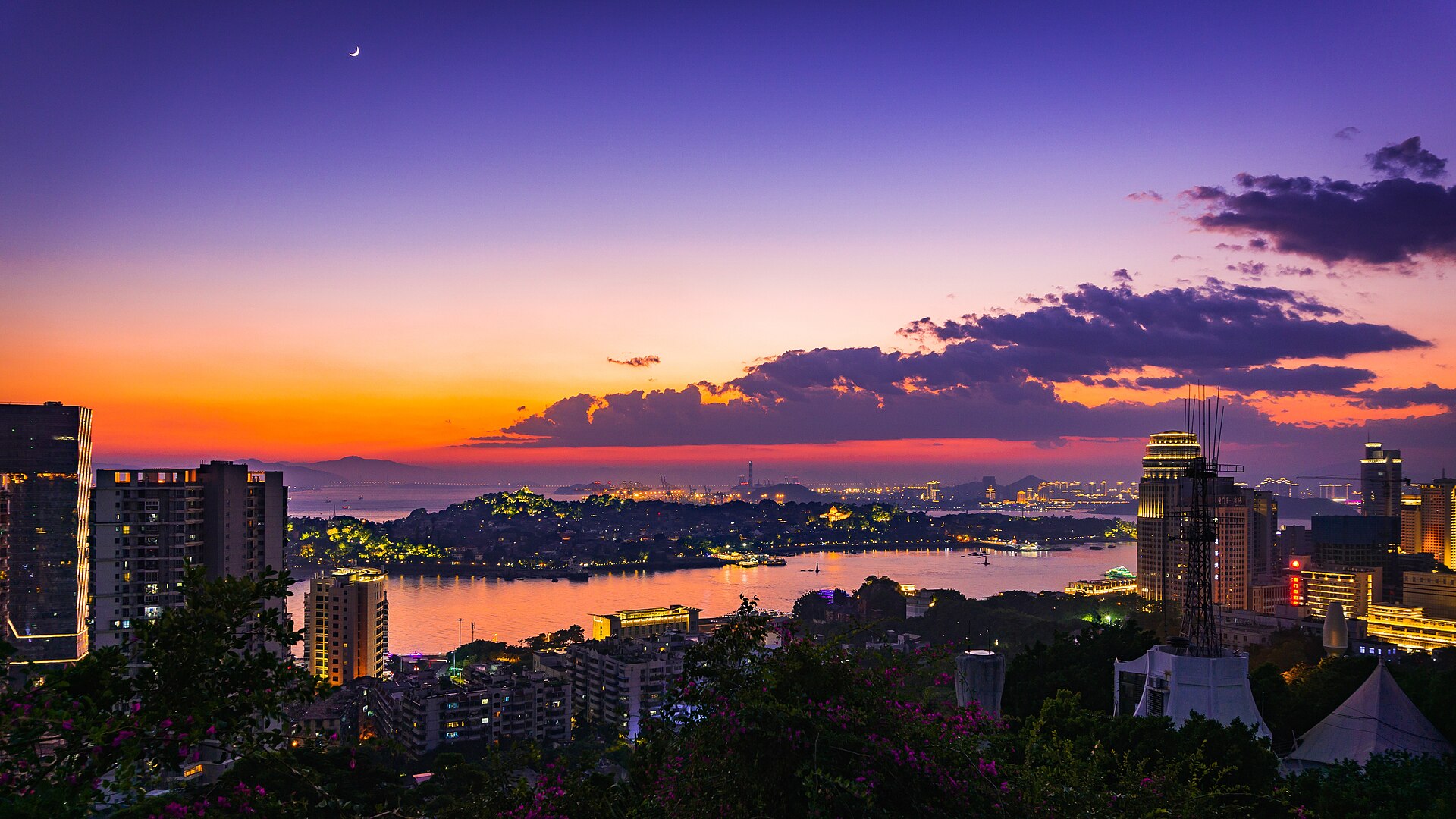
Start Day 1 at the heart of Xiamen — Gulangyu Island (Kulangsu), the small island opposite the city that is inscribed on the UNESCO World Heritage list. There is not a single car here; you travel on foot. It is covered in century-old European villas from the era when foreign nations opened consulates, mixed with old Chinese mansions, shaded by big trees, and so full of piano music drifting through the lanes that it earned the nickname "Piano Island." The ferry crossing from the Cruise Terminal takes about 20 minutes.
Once you land, walk straight to Sunlight Rock (Riguangyan), the highest point on the island at 92.7 metres. A short climb up the steps brings you to a great boulder summit with a 360-degree view over the whole island — rows of red-tiled roofs against the blue sea, with the city of Xiamen across the water. It is one of the prettiest views of the whole trip, and the morning is best, with clear skies before the crowds build.
Have lunch on the island first — Gulangyu's lanes are full of Hokkien restaurants, local snacks and pretty cafés tucked into old buildings. Try fresh seafood or a Xiamen specialty; the Minnan snacks guide pairs well here. Then head to Shuzhuang Garden, a seaside garden a wealthy Chinese family built in 1913, designed to blend artfully with the rocks and the waves, with a zig-zag bridge running out over the water and lovely viewing pavilions.
Inside Shuzhuang Garden is the Gulangyu Piano Museum, which displays more than a hundred rare antique pianos from around the world — fitting for an island that has produced several of China's famous pianists. After that, spend the rest of the afternoon simply getting lost in the island's little lanes, with no need to rush. This is the real charm of Gulangyu: turn down any alley and you find a beautiful old house, a coffee shop and an endless supply of photo corners.
In the late afternoon, take the ferry back to the city (the return ticket works from any pier on the island) and head for Zhongshan Road, the oldest pedestrian street in Xiamen. It is lined with colonnaded qilou (騎樓) colonial arcade buildings with covered walkways, and it runs all the way down to the sea. After dark the whole street lights up, full of food stalls, gift shops and traditional sweet shops — perfect for grazing your way along.
Dinner here is the easy choice — Zhongshan Road and its side lanes are the real heartland of Xiamen food, from oyster omelette to satay noodles to fresh seafood. Try local classics like oyster omelette and shacha satay noodles, or see the full picture in the complete Xiamen food guide. Around ¥60–200 per person.
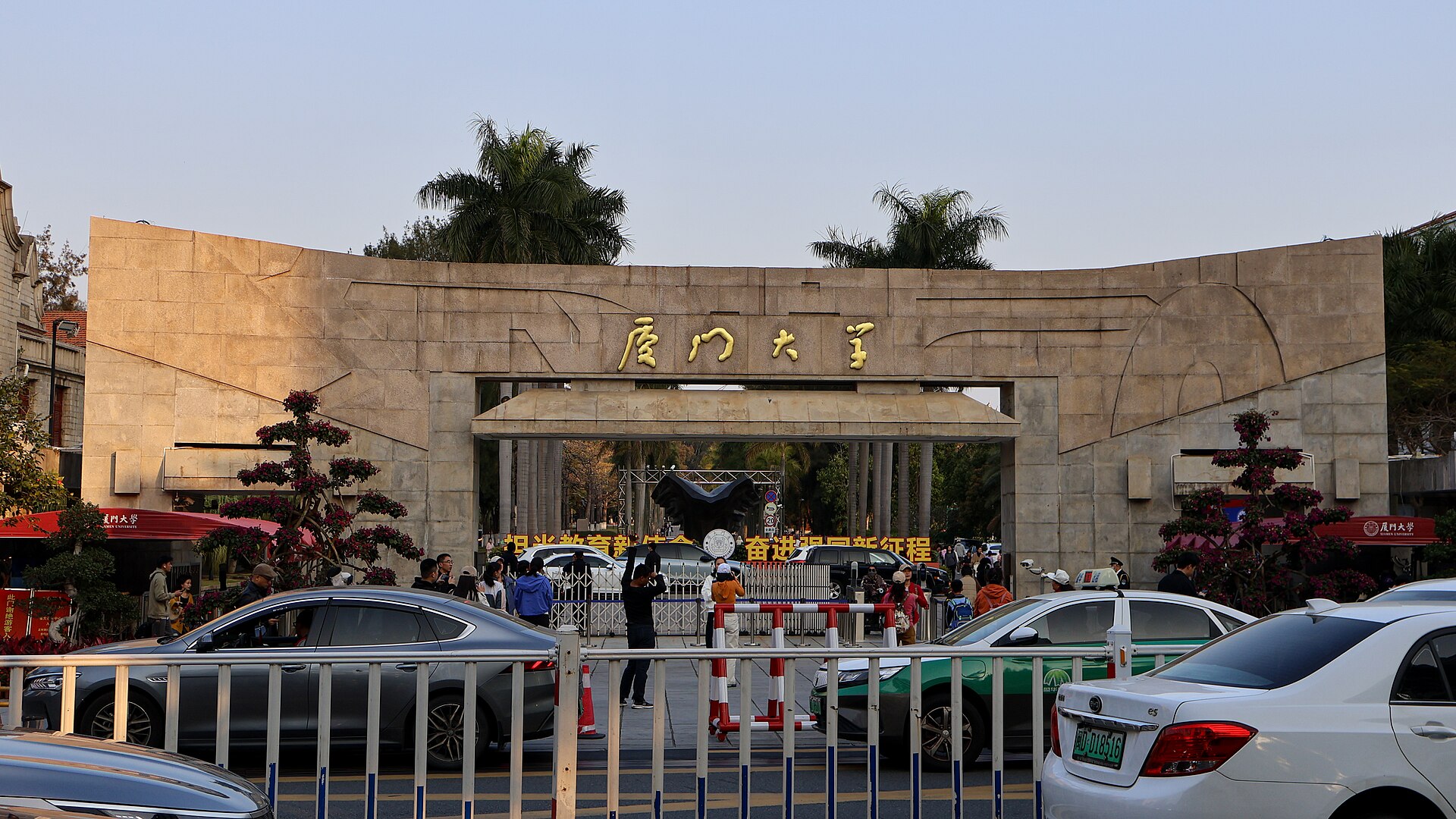
Walk Xiamen University, said to be China's prettiest campus · pray at the hillside Nanputuo Temple · see the German cannon at Hulishan Fortress · cycle the Huandao Road coast at sunset.
Begin Day 2 at Xiamen University, the campus Chinese travellers rank as the most beautiful in the country. Founded in 1921 by Tan Kah Kee, an overseas Chinese businessman, its academic buildings blend Chinese and Western architecture under red-tiled roofs, set right by the sea with a lake, big trees and the Furong art tunnel. It is a lovely place to wander and photograph in the morning. Entry is free but must be booked in advance.
Walk out the university's North Gate and you reach Nanputuo Temple, a Buddhist temple over a thousand years old built against the foot of Wulao Peak — one of the most important temples in southern China. It has tiered halls climbing the hillside, a lotus pond and the character "佛" (Buddha) carved into the cliff. If you have the energy to climb the hill behind the temple, you are rewarded with views of the city and the sea. Free, with no reservation needed.
Have lunch around the university or Zengcuoan first — this area is full of cafés and restaurants. Try fresh seafood, or see the Xiamen seafood guide. Then walk a short way along the coast to Hulishan Fortress, a coastal fort built in 1894, set on a clifftop by the sea guarding the Xiamen strait. The highlight is the 280 mm Krupp cannon, bought from Germany in 1893, listed in the Guinness Book of Records as the oldest and largest 19th-century coastal artillery piece in the world.
Inside the fort there are tunnels, an ammunition store and a viewpoint over the strait that looks out toward Taiwan's Kinmen island on a clear day. Time your visit well and you can catch the costumed-guard performance held twice a day, at about 10:00 and 16:00 — fun to watch and great for photos. Allow about 1.5 hours at the fort.
Close the trip with the thing Xiamen does best — Huandao Road (the Island Ring Road), a coastal road that runs around the island with a walking path and a cycle lane hugging the sea the whole way, stretches of sandy beach, rows of palm trees and wide-open ocean views. It picks up right where Hulishan Fortress leaves off. Rent a bike and ride the seafront in the cool breeze — it is something Xiamen locals still do every evening.
The highlight is the sunset over the sea — golden light spread across the water and the sand. Find a spot by the shore and wait for the last light of the day. Nearby is the old fishing village of Zengcuoan (曾厝垵), now a much-loved street-food and café quarter, perfect for grazing on something to eat to end the trip. Take a look at Xiamen street food or settle into a Xiamen café. Dinner runs ¥60–180 per person.
Two good bases — Siming / Zengcuoan on the southern coast, close to the university, Nanputuo Temple, Hulishan Fortress and the seafront road, ideal if you want to wake up by the sea and do Day 2 without long travel; or around Zhongshan Road, close to the Gulangyu ferry and the shopping, ideal if Day 1 on the island is your focus. Mid-range 3-star and 4-star hotels run ¥350–650 per night. See the top 10 hotels or the 6 luxury hotels.
Xiamen has Metro Lines 1–3, clean and cheap at ¥2–7 a ride — Line 1 has a famous elevated stretch that runs over the sea. Pay with Alipay / WeChat Pay (scan a QR) or a transit card. Add the BRT bus rapid transit, city buses and shared bikes (Hellobike / Meituan ~¥1.5/30 min). Day 1 on Gulangyu is on foot only (no cars on the island); Day 2 along the southern coast is easiest by coastal bus and bike.
Set up Alipay (the international version, linked to a Visa/Mastercard) before you travel. Most shops take only Alipay or WeChat Pay, and WeChat is also required to book entry to Xiamen University. See the Alipay & WeChat Pay setup guide and the visa-free entry guide for Thai passport holders (around 30 days in China).
| Item | Budget | Mid-range | Comfortable |
|---|---|---|---|
| Hotel (1 night) | ¥130–280 (~฿650–1,400) |
¥350–650 (~฿1,750–3,250) |
¥750–2,000+ (~฿3,750–10,000+) |
| 3 meals/day | ¥70–120 (~฿350–600) |
¥120–230 (~฿600–1,150) |
¥280–550 (~฿1,400–2,750) |
| Metro + Gulangyu ferry (2 days) | ¥45–70 (incl. the ferry) |
¥60–90 | ¥90–180 (+ some taxis) |
| Admission tickets (both days) | ¥0 (free stops only — university + temple + Gulangyu lanes + Zhongshan Road + Huandao Road) |
¥75–100 (+ Sunlight Rock ¥50 + Hulishan ¥25 + Shuzhuang Garden ¥30) |
¥130–200 (+ extra museums / activities) |
| 2-day total (approx.) | ¥480–840 (~฿2,400–4,200) |
¥1,135–1,840 (~฿5,675–9,200) |
¥2,610–5,830+ (~฿13,050–29,150+) |
Reference rate ¥1 ≈ ฿5 · prices are approximate and vary by season · avoid Chinese New Year and the October Golden Week (1–7 Oct), when hotel prices spike and Gulangyu gets very crowded · July–September is typhoon season and ferries can be suspended — check the forecast · hotel cost is for 1 night · the Gulangyu ferry cost is included in the metro row.