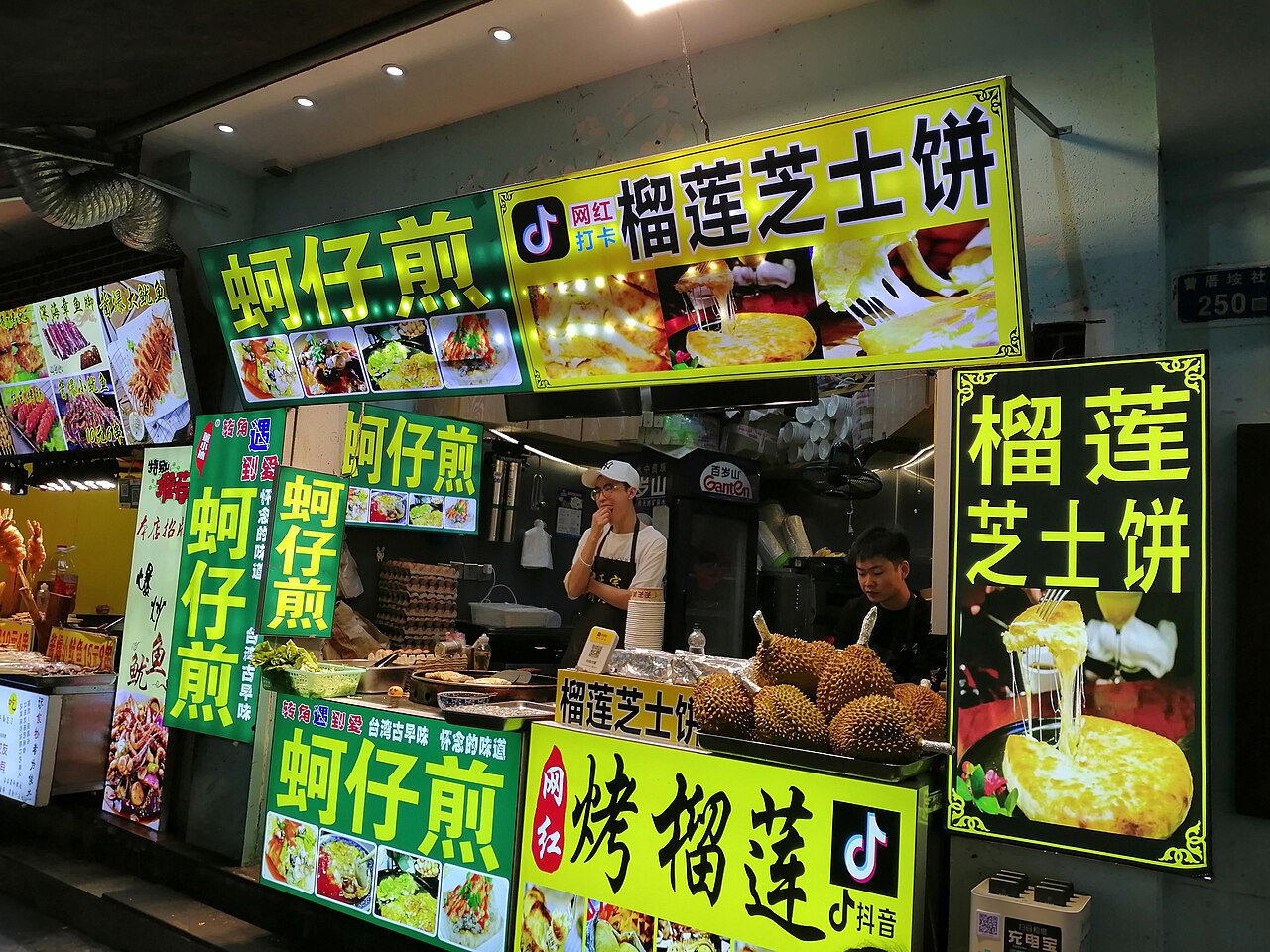
Small fresh oysters tossed with sweet-potato starch and egg, pan-fried in hot oil until the edges crisp and the centre stays soft and gooey, with juicy oysters hidden inside. This is the Hokkien oyster omelette — the same family as the 蚵仔煎 known from Taiwan's night markets. You'll find it all over Xiamen, best around Bashi market and the Zhongshan Road lanes.
Walk into a food lane in Xiamen's old town in the morning and the strongest smell drifting out is usually egg and oysters frying in hot oil. That's hailijian (海蛎煎 hǎilì jiān) — the oyster omelette that's an everyday street snack across the Minnan region. "Haili" means oyster and "jian" means to pan-fry, so the name is simply "fried oysters." In Hokkien it's pronounced ô-á-tsian — sound familiar? This is the same dish as 蚵仔煎 (o-a-jian) that travellers know from the Shilin night market in Taipei, because Xiamen and Taiwan share the same Hokkien food culture, just on opposite sides of the strait.
The heart of the dish is just three things — small fresh oysters, sweet-potato starch (地瓜粉) and egg. The oysters are tossed in a loose starch batter, tipped into a pan slicked with oil or lard, then egg is cracked over and the lot is fried into a sheet: crisp and golden at the edges, still soft and translucent in the centre, with oysters scattered through like juicy little jewels. The magic is in the freshness of the oysters, which give up their own salty-sweet flavour without much seasoning. That's why Xiamen locals say a good oyster omelette is one with fresh oysters — not one drowned in sauce.
What sets Xiamen's version apart is its simplicity, with the oysters as the star. There's less starch than Taiwan's version and no thick orange sauce poured over the top — instead you get a light sweet-chilli sauce (甜辣酱) on the side to cut the richness. Some places fry it so the oysters stay loose rather than bound into a tight cake, and the cook will proudly tell you that's the true Xiamen home style. That's exactly why this plain-looking plate has been sold on every lane for decades without ever falling out of fashion.
Before you order, get to know these four parts and you'll understand why a plate of just oysters and egg is something Xiamen locals never tire of.
The oysters in Xiamen's omelette are the small coastal oysters of the Minnan region — not big Western-style oysters, but tiny, sweet, juicy ones farmed along the Fujian coast. The whole plate rises or falls on them: a fresh morning batch is sweet-salty and bouncy, never fishy. Stalls near a wet market like Bashi have the edge because their oysters come in fresh every day. A good oyster omelette is generous with them, with the little oysters clearly visible across the egg — not a treasure hunt to find one.
What stops this being just an oyster scramble is the sweet-potato starch (地瓜粉) — mixed with water into a loose batter and tossed with the oysters before frying. Hit with heat, the starch sets into a soft, chewy, semi-translucent, jelly-like texture, the signature mouthfeel that wheat or corn flour can't replicate. Xiamen's version uses just enough to bind, not so much that it becomes a thick pancake (unlike some Taiwanese recipes with more starch). That keeps the oyster flavour up front and gives you that crisp-edge-and-gooey-middle contrast in a single bite.
Once the oysters and starch hit the pan, the cook cracks egg over the whole sheet and fries it in hot oil or lard — lard being the secret to the old-school stalls' aroma, giving that craveable smell and a nicely crisp edge. The egg should be set but not dry and tough, binding the oysters and starch into one sheet. Many cooks scatter spring onion in for fragrance, some add a few greens, then flip it so both sides go golden. Getting a sheet that's crisp at the edge and gooey in the middle takes good heat control and timing — that's what separates a great stall from an ordinary one.
The real charm of the oyster omelette is two textures in one sheet — the edges that meet the hot oil longest turn crisp and golden (酥), crackling when you bite, while the centre, where the sweet-potato starch stays soft, is tender, slippery and gooey (软/Q) with juicy oysters tucked in. Crisp fans and gooey fans can argue all day about which stall is best. If you love crunch, just ask for 煎酥一点 (jiān sū yīdiǎn, fry it a bit crispier). The best stalls deliver both crisp edges and a gooey middle at once — and that's an oyster omelette cooked to the proper standard.
Same base — oysters, sweet-potato starch and egg — the difference is the fry style and what gets added. First-timers: start with the traditional market version.
The version closest to the original — generous with fresh oysters, just enough sweet-potato starch to bind, fried in lard for crisp edges, with no sauce poured over but a sweet-chilli sauce (甜辣酱) on the side to dip. Some stalls fry it so the oysters stay loose rather than bound into a tight cake, which the cook is proud to call the real Xiamen home style. If it's your first time and you're not sure what to order, get this at a stall in Bashi market or a Zhongshan Road lane first — it's full-on Minnan oyster flavour.
For the crunch lovers — some stalls fry it longer and with a touch more oil so the whole sheet comes out crisp and golden, the edges almost cracker-like, snapping when you bite, set against the juicy oysters inside. It's a style travellers tend to love because it looks great and eats easily. Ask for it with 煎酥一点 (fry it a bit crispier). A stall that does this well gets it crisp while the inside stays moist and the oysters stay plump — not crisp because the oysters were fried hard.
Some places (especially the tourist-facing ones) make it Taiwan-style (蚵仔煎) — more sweet-potato starch, greens like spinach or cabbage, and a thick orange-red, sweet-leaning sauce poured over the whole plate. The texture leans more gooey than crisp, and the flavour is rounder and sweeter than Xiamen's. It's the same dish many people have had at the Shilin night market. Try it next to the Xiamen version and the difference is clear — Taiwan leads with sauce, Xiamen leads with oysters. Pick whichever you like; there's no wrong answer.
Not a new style, but how locals in Xiamen actually eat it — order one plate of oyster omelette with a bowl of mianxian hu (面线糊), superfine rice vermicelli thin as hair simmered in a silky starch broth with oysters or pork intestine, finished with white pepper and spring onion, and tear in a fried dough stick (油条, youtiao) for dipping. The omelette brings crisp richness, the mianxian hu brings warm, soft comfort — the two are sold side by side at market stalls. Eat the full set and you're starting the day the Xiamen way.
The oyster omelette is about as easy to order as it gets — most stalls fry it fresh to order. Out front you'll see a tray of fresh oysters and a bowl of starch batter. Just say you want one oyster omelette (一份海蛎煎 yī fèn hǎilì jiān). If you don't speak Chinese, point at the photo on the menu or at the oysters in the case and you'll be understood. It's a single-serve plate that's plenty as a snack for one, or order several to share when there's a group. Want it extra crisp? Say 煎酥一点 (jiān sū yīdiǎn). You can ask for more or less sauce too.
The oysters are freshest in the morning batch — stalls in Bashi market fry from early, so go morning to midday for the freshest. Tourist-area stalls stay open into the evening, so it's easy to grab one as a snack while wandering Zhongshan Road.
Eat it hot, straight away, because the omelette is best while the edges are still crisp — leave it too long and the starch softens · dip lightly in the sweet-chilli sauce (甜辣酱) the stall gives you, just enough to cut the richness, not so much it drowns the oysters · the most natural pairing is a bowl of mianxian hu (面线糊) alongside — crisp, rich omelette and warm, soft vermicelli, with a fried dough stick (油条, youtiao) torn in for dipping, the complete Minnan breakfast · finish with hot Fujian-style oolong tea to cleanse the palate.
Paying: most stalls take WeChat Pay and Alipay; a few small market stalls still take cash yuan, but rarely foreign cards, so set up Alipay or WeChat in advance · Getting there: Bashi market and Zhongshan Road are in the old town in Siming district — ride Metro Line 1 to Zhongshan Road (中山路) station and walk into the lanes · When to go: morning to midday for the freshest oysters; tourist-area stalls run into the evening.
The well-known stalls are in the old town around Bashi market and Zhongshan Road — fresh oysters, honest prices. The ones on Gulangyu and in the tourist areas cost more. Check opening hours and reviews on the Dianping app before you go.
One of the names that comes up most when people ask where to find a great oyster omelette in Xiamen — it's on Juko Street (局口街), a food lane just off Zhongshan Road, and has been going for years. The signature is that it's fried with the oysters sitting loose rather than bound into a tight cake — the owner says that's the real Xiamen home style. Plenty of fresh oysters, a good sweet-chilli sauce, around ¥20–30 a plate. Right in the Zhongshan Road walking area, easy to drop into while exploring the old town. Busy at weekends.
Bashi market (八市) is the legendary wet market of Xiamen's old town and the source of the freshest oysters and seafood in the city. In and around it, little stalls fry oyster omelettes fresh from early — the oysters come straight from the market stalls each day, so they win on freshness and on prices that are friendlier than the tourist areas. Many sell it alongside mianxian hu as breakfast. Look for the stall where locals are queuing — that's the good one. Remember, the market versions lead with oyster flavour and don't drown it in sauce.
Another name Xiamen locals know when they're after an old-school oyster omelette — Old Huang's stall (黄老伯) on Kangtai Road (康泰路) near Huijingyuan, a place more locals than tourists go. It's fried by one pair of hands the old-fashioned way, with that home-cook touch — fresh oysters, the starch just right, crisp edges and a gooey middle. Being outside the main tourist zone, prices are friendly and you don't fight much of a queue. Good if you want a genuinely homely oyster omelette. Check hours on the Dianping app before you go, since old-school stalls keep their own particular schedule.
There's plenty of oyster omelette on Gulangyu island (鼓浪屿) and in tourist areas like Zengcuo'an (曾厝垵), and if you're there it's worth a stop — but honestly, it costs more than the old town (¥25–35 a plate) and some stalls go lighter on oysters or cook for the tourist crowd. To eat the omelette at its best and freshest, you're better off at Bashi market or a Zhongshan Road lane in the old town. On the island, save your appetite for things like Gulangyu pies or fish balls instead — those are the better-value island eats, and let the oyster omelette be a city pleasure.