Stand beside a giant German Krupp cannon with a barrel almost 14 metres long that guarded the mouth of Xiamen harbour for over a century — the gun Guinness recognises as the largest 19th-century coastal cannon still in its original place. Add a Qing-soldier firing show twice a day and an open sea view stretching to Jinmen Island.
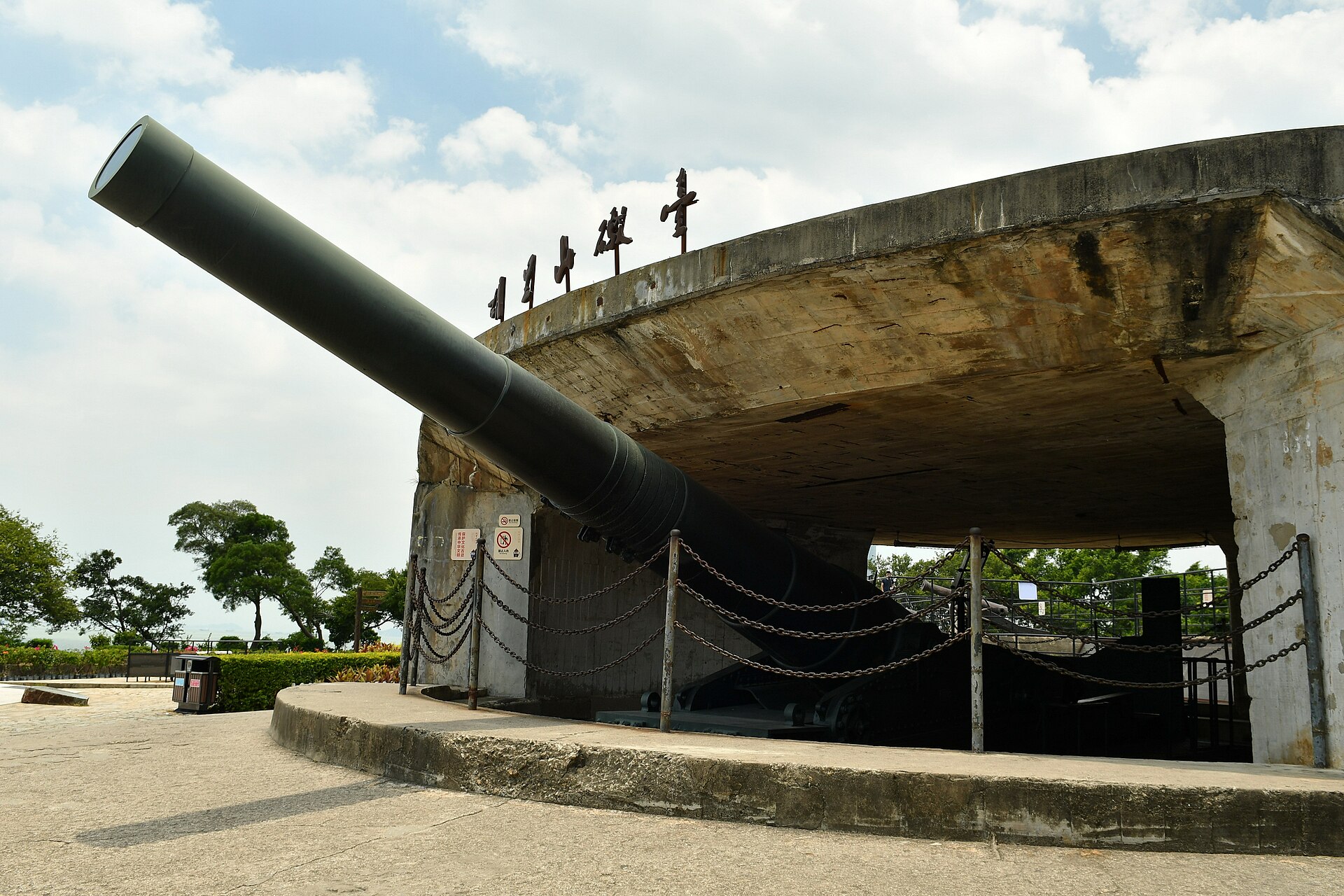
Picture this: you're walking along an old stone wall by the sea on the south shore of Xiamen Island, the sea wind tugging at you, when you round a corner and meet a huge black cannon — a long barrel angled out over the water, mounted on a thick concrete emplacement, with the Chinese characters 胡里山炮台 carved into the curved wall behind it. This is the Krupp cannon that has guarded the strait since the late Qing dynasty, and it's still sitting exactly where it was placed.
Hulishan Fortress (胡里山炮台) was built between 1891 and 1896, in the closing decades of the Qing dynasty, as a coastal artillery fort to protect the mouth of Xiamen harbour from foreign warships. It sits on a rocky headland at the southern tip of the island, facing the strait that separates the mainland from Jinmen Island (金门). The big draw is the German Krupp cannon, which Guinness World Records listed in 2000 as the largest and oldest 19th-century coastal gun still standing in its original location.
Why it's more fun than you'd expect: this isn't just an empty fort to wander around. There's a twice-daily show in which costumed Qing soldiers demonstrate firing the cannon, a museum of antique weapons and guns from several eras, and a seaside setting right beside Xiamen University and Huandao Road. So one stop gives you history, sea views, and an easy walk on to the beach, all in half a day.
From the record-holding Krupp cannon to the Qing-soldier show, the weapons museum and the view across the strait — know these before you go.
This is the star. The Qing court ordered the Krupp cannon from Germany in 1893 to defend the coast. It has a 280mm bore, a barrel about 13.9 metres long, weighs around 87 tonnes, rotates a full 360 degrees, and once had a firing range of roughly 19,760 metres. In 2000, Guinness World Records listed it as the largest and oldest 19th-century coastal gun still standing in its original location. What makes it special is that it was never tucked into a glass display case, it still sits on its real open-air emplacement.
This is what sets Hulishan apart from an ordinary old fort. Performers in full Qing-dynasty military dress demonstrate loading and firing the antique cannon, complete with a satisfyingly loud bang. It runs twice a day at around 10:00 and 16:00, with a morning welcome ceremony at about 8:30 (all weather-dependent, and cancelled if it rains). Check the exact times on site and turn up 15–20 minutes early, as it draws a crowd. Plan well and the afternoon slot lets you catch both the show and the sunset light in one trip.
The fort faces the sea for a reason — it was built to guard this strait directly. From the walls you look out over open water, and on a clear day you can make out Jinmen Island (金门, known in Taiwan as Kinmen) as a line on the horizon just a few kilometres away. There are coin-operated telescopes on site for a closer look. With the strong sea breeze and the wide view, it's a favourite photo spot to pair with the Krupp cannon, and it feels a world away from the city sights.
Beyond the star Krupp cannon, the fort keeps much of its original military structure: thick stone walls, connecting tunnels, underground ammunition stores, and secondary gun positions. There's also a museum gathering antique cannons and weapons from various eras and countries. It's great for anyone into military history or for bringing kids along to learn. Walk a full loop of the fort and you'll see why it was once called the 'Maginot Line' of Xiamen.
Hulishan sits in a spot that pairs beautifully with other stops. The fort's west gate is only about 500 metres along the coast from the Baicheng gate of Xiamen University, and it sits on the Huandao Road (环岛路) coastal route that runs past long beaches. Many people see the fort in the morning, then walk on to Baicheng Beach, cycle the seafront, or head to the food lanes of Zengcuo'an village in the afternoon — history and the sea in a single day.
Plan this one first — the heart of a Hulishan visit is the Qing-soldier cannon-firing show, held twice a day at around 10:00 and 16:00, with a morning welcome ceremony at about 8:30. Turn up at the wrong time and you'll only see a static cannon, missing the boom. Double-check the latest times at the entrance or on the notice board, as they can shift with the season and the weather (heavy rain usually means it's off).
Insider tip: pick the 16:00 afternoon slot and you get two things at once — after the show you can wander the Krupp cannon and the sea view in soft evening light. The window from about 16:00 to 17:00 has the prettiest light and the most open water, and the cannon photographs far better than under harsh midday sun.
An adult ticket is around ¥25 (~฿125) in peak season and about ¥20 in low season. Students with a card and seniors pay roughly ¥12, while children under 18 enter free with ID. There are a few optional paid extras inside, such as a 'cannon fund' of about ¥10 for those who want to go up and touch the Krupp cannon — not compulsory, only for those who want to.
Payment in China is now almost entirely by WeChat Pay or Alipay QR scan, so it's easiest to link a card beforehand. Carry your passport, as you'll need it for discounted tickets and the odd ID check. The fort opens around 08:00–18:00 (in summer, Jun–Sep, until 18:00; the rest of the year it closes around 17:30).
The fort is right by the sea, so it's windy and sunny — a hat, sunglasses and sunscreen make it more comfortable. There are some slopes and steps, so comfortable walking shoes help, and shade is limited, so the heat around midday can be strong. If you'd rather not bake, the morning or late-afternoon slots are the easier times to visit.
Since the fort only takes about 1.5–2.5 hours, most people pair it with nearby sights in one day: walk on to Xiamen University and Nanputuo Temple right next door, or follow Huandao Road to Baicheng Beach and Zengcuo'an village. It all adds up to a neat day on the island's south side.
Good news: Xiamen has a metro, and Hulishan is easy to reach by connecting bus. The most convenient route for visitors is to take Metro Line 1 to Zhongshan Park station, then transfer to bus 48 or 96 at the stop beside the station and get off at the Hulishan stop. It takes about 20 minutes and costs only around ¥2.
A gorgeous seaside campus, an old hillside temple and a long beachfront road — all easy to continue on to from the fort in one day.