Home Xiamen Must-Eat Dishes China About
Home  ›  Asia  ›  China  ›  Xiamen  ›  Street Food
China · Xiamen Food Guide · 2026

Xiamen Street Food
Where Locals Actually Eat — and What to Order

Xiamen is the city where the smell of peanut-satay broth and sizzling oyster omelette drifts out of the old market from first light. This guide walks you through five food areas, tells you straight which ones locals actually eat on and which are made for tourists, and lists the Minnan snacks you shouldn't leave without — with real prices.

Before You Go

The honest version of where to eat

Picture this: 8 am in the Eighth Market (八市) in Xiamen's old town. You walk past stalls of live fish, crabs and mantis shrimp, then turn down a narrow lane where a woman is ladling out vermicelli paste — superfine rice vermicelli in a silky, thickened broth, topped with small oysters and braised offal, finished with spring onion and white pepper. Next to her, a pan of oyster omelette sizzles, egg and starch frying until the edges crisp. Locals have been eating here since dawn — this is the meal Xiamen eats every day, and it's the best place to start eating your way through the city.

Xiamen is the heart of Minnan (闽南, Hokkien) cooking, so its food is light, fresh and seafood-forward, gently sweet-savoury, threaded with the satay (沙茶 shāchá) that overseas Chinese carried home from Southeast Asia. It's not the fiery heat of Sichuan or Hunan, and it isn't rich or heavy. The street food revolves around shacha noodles, oyster omelette, vermicelli paste, popiah, and fresh seafood from the market. We take you to five food areas that are genuinely alive, with honest notes on which are worth your time and which are mostly for tourists. For the dishes themselves, read our Xiamen must-eat dishes guide alongside this.

5 Food Areas

Walk and eat — area by area

Ordered from where locals actually eat out to the touristy seaside streets
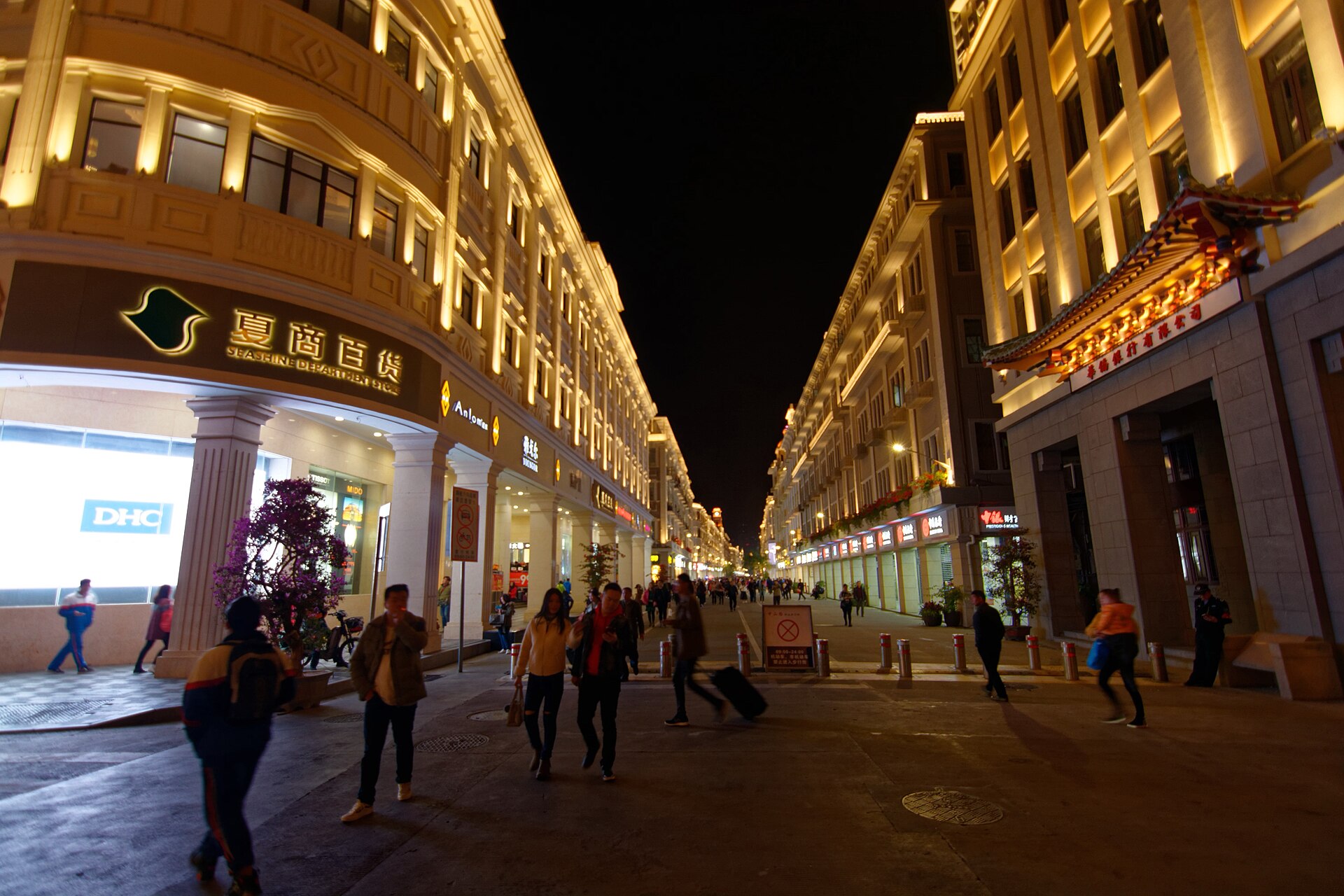
Zhongshan Road (中山路) in Xiamen's old town — old colonial-style shophouses with shops lining both sides and people browsing; a street scene near the nearby Eighth Market, not any single eatery 1
The real, cheap heart of it
Eighth Market (八市) + Zhongshan Road old lanes
第八市场 / 八市 · Siming District · by Zhongshan Road (中山路), old town

If you want to eat Xiamen street food for real and cheap, start and stay here. The Eighth Market (第八市场, locals just say 八市, Bāshì) is the oldest fresh market in the old town, where Xiamen people buy seafood and everyday eats. The market and the surrounding lanes off Zhongshan Road are packed with traditional stalls, genuine local flavours, and local prices.

What to try: oyster omelette (海蛎煎), small oysters bound with sweet-potato starch and egg, fried crisp · vermicelli paste (面线糊), the city's classic breakfast · shacha noodles (沙茶面), noodles in satay broth · popiah (薄饼), fresh spring rolls · tǔsǔndòng (土笋冻), the local sandworm-jelly oddity · and fresh seafood you buy then have cooked for you.

Where: Old town, Siming District · ~5 min into the lanes off Zhongshan Road
Price: ¥8–25 / item (฿40–125) · ¥40–60 to eat your fill
Best time: 6 am–noon — famous stalls close by afternoon
Pay: WeChat Pay / Alipay / cash
Why we send you here: while Zengcuo'an and Gulangyu cook for tourists, the Eighth Market is still genuinely Xiamen's — fresh produce, real prices, real flavours. The trade-offs are no English signs, crowds, and seafood you should ask the price of and watch get weighed before you order it cooked, so you don't get overcharged.
Xiamen's seafront skyline at dusk, towers reflected in the water — a coastal-city scene near the old Shapowei harbour quarter, a cityscape rather than any single eatery 2
Hip old harbour · cafés + waterside snacks
Shapowei
沙坡尾 · old harbour, Siming District · near Xiamen University

Shapowei is Xiamen's old fishing harbour reborn as an arts-and-youth-culture quarter — wooden boats still moored in a little inlet, surrounded by brightly painted old buildings, graffiti, a container market, cafés, bars and small snack shops. It's where young people and artists hang out, and it's best wandered from late afternoon into the evening.

What to try: easy-grazing Minnan snacks like satay skewers, fried fish balls and small plates of oyster omelette · coffee and milk tea — Xiamen is a serious café city with plenty of good roasters · cold desserts like sì-guǒ-tāng (四果汤) to beat the heat. If you're serious about coffee, see our Xiamen café guide.
Where: Old harbour, Siming District · next to Xiamen University and the sea
Price: snacks ¥10–30 · coffee ¥25–45 (฿125–225)
Best time: late afternoon–evening, lovely at sunset by the water
Pay: WeChat Pay / Alipay / cash
Know before you go: Shapowei is about atmosphere — come to wander, take photos and sip coffee by the water more than to eat a big meal. There are snacks to graze, but not the range of the Eighth Market, and café and snack prices sit a little above ordinary markets, as you'd expect in a hip quarter.
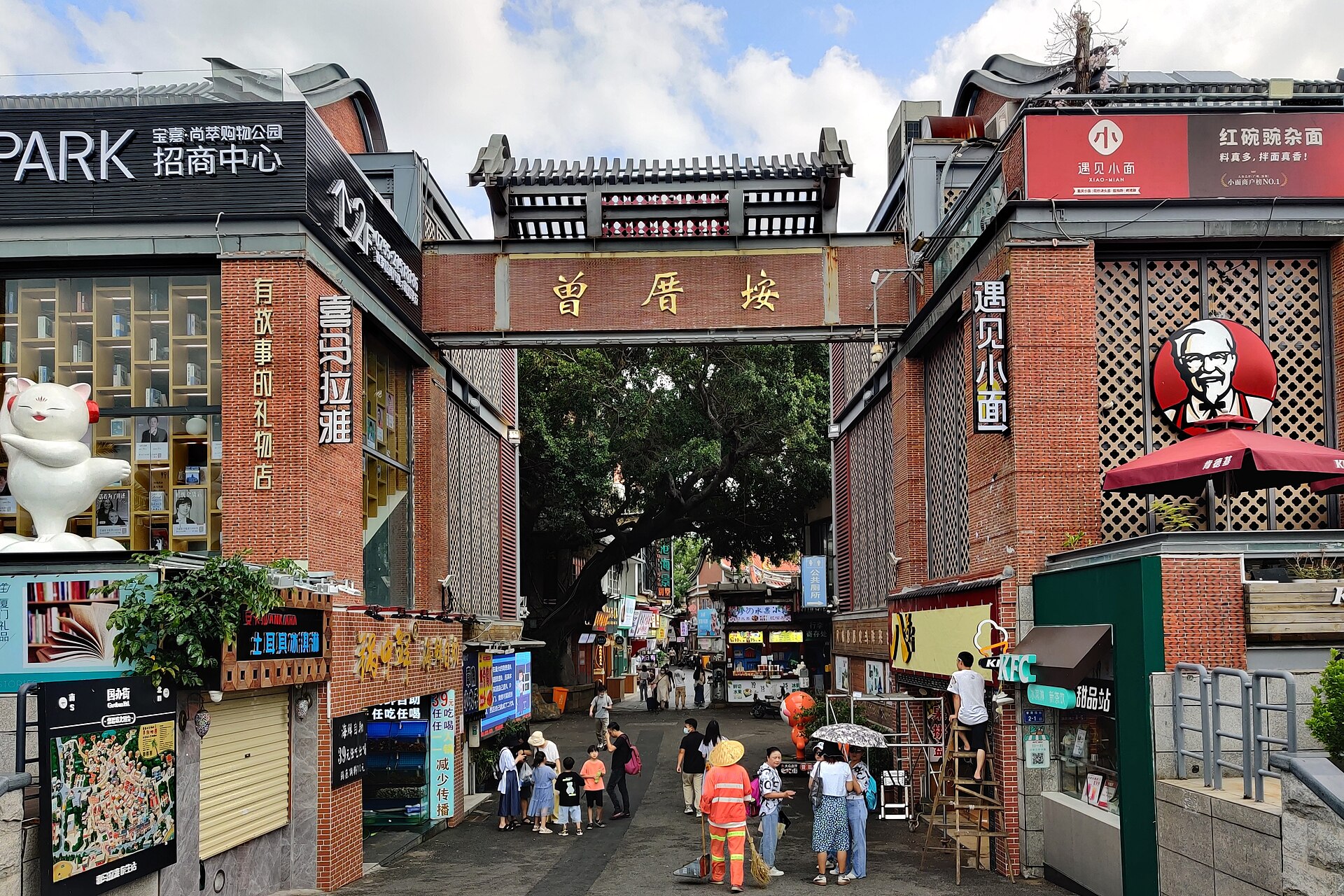
Zengcuo'an (曾厝垵) by the sea in Xiamen — narrow lanes lined with shops, restaurants and colourful signs, with visitors strolling; a tourist-village scene rather than any single eatery 3
Seaside village · very touristy, pricier
Zengcuo'an
曾厝垵 · south coast, Siming District · near the beach and Xiamen University

Zengcuo'an was once a quiet fishing village by the sea; today it's a long, winding tourist snack street, a warren of lanes packed with restaurants, snack stalls, cafés, souvenir shops and hostels. It's fun and easy to walk, with plenty to nibble — a buzzing, seaside-promenade kind of place.

What you'll find: skewers and grills of every kind · seafood skewers and fried snacks · ice cream, milk tea, photogenic desserts · the youth-travel snacks you see on tourist streets all over China — tasty enough, but tuned for visitors rather than authentic Minnan cooking.

Where: South coast · near the beach and Xiamen University
Price: snacks ¥15–40 / item (฿75–200) · higher than in town
Best time: afternoon–evening · avoid public holidays, it's packed
Pay: WeChat Pay / Alipay / cash
Honest note: Zengcuo'an is fun but a full tourist zone — most of the food is made for visitors, per-item prices run 30–50% above town, and it's not where Xiamen people actually eat. Skip the seafood on the main lane especially; for the real thing and cheaper, come back to the Eighth Market. Treat Zengcuo'an as a place to stroll and snack lightly.
Gulangyu (鼓浪屿) in Xiamen — old European-style villas on a green hillside by the sea on the car-free island; a tourist-island landscape rather than any single eatery 4
Car-free island · tasty, island prices
Gulangyu
鼓浪屿 · car-free UNESCO island · ferry from the city ~5–20 min

Gulangyu is the small car-free island just off Xiamen, full of old European villas, gardens and walking lanes — one of the city's top sights, reached by a short ferry. As you explore, there are island snacks to try, especially along Longtou Road (龙头路), the main food street.

Island specialities: Gulangyu fish balls (鱼丸), soft fish balls in a clear broth, the island's signature · Gulangyu pies (馅饼), soft pastry with sweet mung-bean or meat filling, a classic edible souvenir · máchí (麻糍), mochi rolled in peanut and sesame · dried seafood and island sweets.

Getting there: ferry across from a city pier (book tickets ahead)
Price: snacks ¥15–40 (฿75–200) · higher than the mainland side
Best time: morning, to beat the crowds · head back before dark
Pay: WeChat Pay / Alipay / cash
Honest note: come to Gulangyu for the island atmosphere and the old villas first; the food is a bonus. The fish balls and pies are genuinely good, but at tourist-island prices, higher than the mainland side. Don't plan a big meal here — snack lightly as you wander, and save your appetite for the Eighth Market.
Nanputuo Temple (南普陀寺) in Xiamen — colourful curved Chinese temple roofs at the foot of a green hill; a scene of the temple and the adjacent Xiamen University area, not any single eatery 5
Cheap student eats · famous temple vegetarian
Xiamen University + Nanputuo Temple area
厦门大学 + 南普陀寺 · Siming District · side by side on the south coast

Xiamen University (厦门大学) is reckoned one of China's prettiest campuses, and it sits right beside Nanputuo Temple (南普陀寺), an old hillside temple by the sea. The streets around the campus have cheap, real student eats — this is where locals and students eat every day.

What to try: shacha noodles (沙茶面), several well-known shops are around here at student prices · Nanputuo Temple vegetarian food, the temple's dining hall is famous citywide for skilfully made, affordable vegetarian dishes · Minnan snacks and cheap rice-and-toppings shops around campus — this is the easiest shortcut to real food at the lowest prices after the Eighth Market.
Where: South coast · next to Shapowei and Zengcuo'an
Price: shacha noodles ¥12–25 · vegetarian ¥20–50 per person (฿100–250)
Best time: lunch–afternoon · check campus entry rules first
Pay: WeChat Pay / Alipay / cash
Why we like it: the campus area is a cheap-and-real food spot most tourists overlook — shacha noodles here are tasty and cost less than the tourist streets, and Nanputuo's vegetarian food is good even if you don't normally eat vegetarian. Just check the opening hours and the campus entry rules ahead, as Xiamen University sometimes requires booking or has queues.
Know Your Snacks

Xiamen snacks you shouldn't miss

Found across all 5 areas above — point at the photo and order

🍜
Shacha Noodles
沙茶面 · Shacha Satay Noodles
Yellow noodles in a peanut-satay (shacha) broth with dried seafood and spices, with your own pick of toppings — shrimp, squid, pork offal, tofu. The city's signature, brought home by overseas Chinese. ¥12–30 a bowl. Read more →
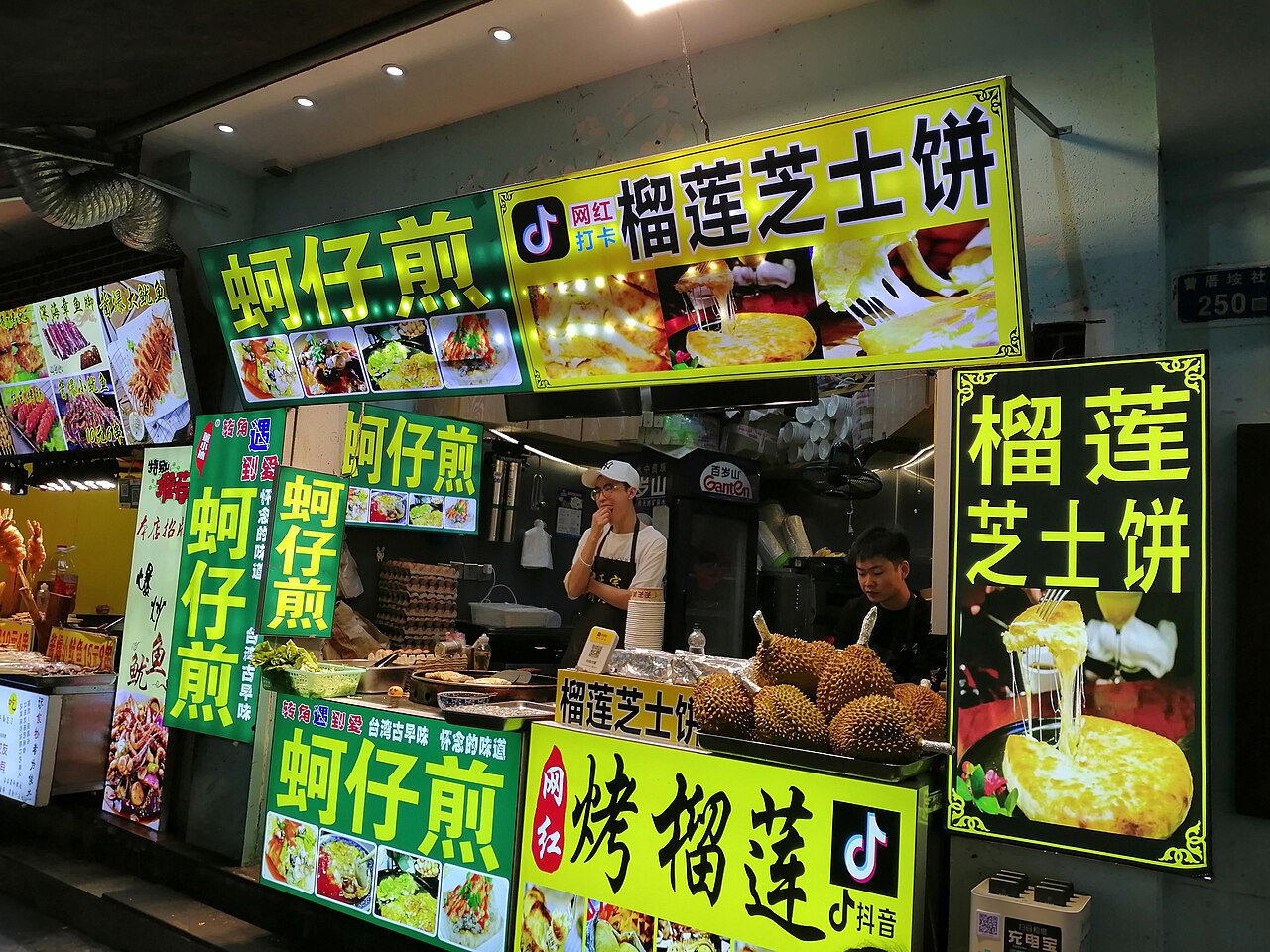
An oyster omelette (蚵仔煎) street stall in Xiamen, with Chinese signage clearly naming the dish — a real street-food stall
Oyster Omelette
海蛎煎 · Oyster Omelette
Small oysters bound with sweet-potato starch and egg, fried until the edges crisp and the centre stays gooey. A Minnan classic shared with Taiwan, eaten with a sweet-spicy sauce. All over the Eighth Market and Zhongshan Road. ¥12–25 a plate. Read more →
🍢
Satay Skewers & Grills
沙茶串 / 烧烤 · Satay Skewers & Grills
Meat, vegetables and fish balls on skewers, grilled or blanched and dressed with fragrant satay (shacha) sauce. The star of grazing through the markets and harbour quarter — smoky and fun to eat. ¥3–8 a skewer · ¥15–30 a set.
🌯
Popiah
薄饼 / 润饼 · Xiamen Popiah
A fresh, un-fried spring roll: a thin wheat wrapper around stewed vegetables, ground peanut, seaweed and crispy bits, balanced sweet and savoury. A Xiamen Qingming-festival tradition you can find year-round. ¥6–12 a roll.
🐟
Fish Balls
鱼丸 · Fish Balls
Bouncy, soft fish balls, some with a minced-pork filling, served in a clear broth dusted with white pepper. The signature snack of Gulangyu, found all over the city — the real ones are smooth and refined. ¥10–20 a bowl.
🌽
Fresh Sugar-Cane Juice
甘蔗汁 · Fresh Sugar-Cane Juice
Sugar cane pressed fresh at the stall, cold and refreshing, naturally sweet — the perfect cool-down in Xiamen's warm, humid climate almost year-round. Found at markets and snack streets. ¥5–10 a cup.
🥜
Sweet Peanut Soup
花生汤 · Sweet Peanut Soup
Peanuts simmered until they melt in your mouth in a clear sweet soup — a classic Minnan dessert. The institution is Huang Zehe (黄则和) on Zhongshan Road; have it with a fried dough stick or an egg. ¥5–10 a bowl.
🪱
Sandworm Jelly
土笋冻 · Sandworm Jelly
The Minnan oddity — a cold savoury jelly set from a coastal sea worm, lightly salty and clear-bouncy, eaten cold with garlic-and-scallion sauce. Honestly adventurous, but locals love it. ¥10–20 a bowl.
🥧
Gulangyu Pies
馅饼 · Gulangyu Pies
Soft pastry with sweet mung-bean or meat filling — the classic edible souvenir from Gulangyu island, mellow and buttery. Eat one fresh or carry a box home; several famous makers are on the island. ¥5–30 per piece/box.
A One-Day Eating Route

Eat your way across Xiamen in a day

A sample route from morning to night — adjust to your appetite

1
Morning · the Eighth Market (八市)
Start the way Xiamen does: head into the Eighth Market in the old town, order a hot bowl of vermicelli paste and a plate of oyster omelette, walk past the fresh fish, crabs and shellfish, then try popiah or, if you're brave, tǔsǔndòng. Go before noon while it's all still there. Budget ~¥30–40
2
Late morning · Zhongshan Road + peanut soup
Walk out of the market onto Zhongshan Road, the city's oldest pedestrian street. Stop at Huang Zehe (黄则和) for sweet peanut soup, photograph the old colonial shophouses, and pick up a few small souvenirs. Budget ~¥15
3
Afternoon · Xiamen University + Shapowei
Head over to the south coast: try a bowl of student-priced shacha noodles near the university, or the Nanputuo Temple vegetarian, then wander Shapowei for coffee by the water, the old wooden boats and the graffiti. Budget ~¥40
4
Evening · Zengcuo'an, or seafood back in town
Finish your choice of two: stroll and snack along the Zengcuo'an seaside for the atmosphere, or, for the real thing, go back and buy clams, crab and mantis shrimp in the Eighth Market and have a stall cook them — better value and fresher. Budget ~¥60–120
Tips Before You Go

Know this and eat well, not lost

📱
Set up WeChat Pay first
Since 2023 foreign visitors can link Visa/MC to WeChat Pay or Alipay. Do it before you head out — many small stalls in the Eighth Market are QR-only and don't take cards.
🦪
Market morning food sells out
Vermicelli paste and oyster omelette in the Eighth Market are morning food; many famous stalls close by afternoon. To catch it all, go before noon — earlier means fresher and more of everything.
🌶️
Xiamen isn't fiery
Minnan food is light, fresh and gently sweet-savoury — not the numbing heat of Sichuan or Hunan. You can ask for a spicy dip, but the base dishes lead with the freshness of the ingredients.
⚖️
Ask the price, watch it weighed
Buying seafood in the Eighth Market, ask the price per kilo and watch the scale before you agree to have it cooked. The produce is good value, but settle the price first to avoid being overcharged, especially on big crabs and prawns.
🗺️
Download a China map app
Google Maps barely works in China; use Amap or Baidu Maps to find market stalls and the shacha-noodle shops down side lanes — far more accurate. English signage at the stalls is rare.
⛴️
Book the Gulangyu ferry
Gulangyu is reached by ferry, and tickets usually need booking online ahead. Check the pier and the sailing times before you go; head over early to beat the crowds and back before dark.
Frequently Asked

FAQ · what people ask before heading out to eat

How much does Xiamen street food cost?
Cheaper than you'd think if you eat in the Eighth Market (八市) and the Zhongshan Road old lanes. An oyster omelette (海蛎煎) runs about ¥12–25 (about ฿60–125); vermicelli paste (面线糊) is ¥8–15 a bowl (฿40–75); popiah (薄饼) is ¥6–12 a roll; shacha noodles (沙茶面) are ¥12–30 a bowl; sweet peanut soup from the institution Huang Zehe (黄则和) is ¥5–10 a bowl. Grazing through the Eighth Market comes to around ¥40–60 per person and leaves you full. Zengcuo'an and Gulangyu are tourist zones, with per-item prices roughly 30–50% higher than ordinary markets.
What is the Eighth Market (八市) and why go?
The Eighth Market, or Dìbā Shìchǎng (第八市场), which locals just call 八市 (Bāshì), is Xiamen's oldest fresh market, in the old town of Siming District near Zhongshan Road. It's where Xiamen people buy fresh seafood and real everyday eats: oyster omelette, vermicelli paste, popiah, and seafood stalls where you buy it fresh and have it cooked. It's far cheaper and more authentic than the tourist streets. It opens early, around 6 am, and many of the famous food stalls close by mid-afternoon, so go in the morning or before noon.
Do I need cash in Xiamen or does WeChat Pay work?
Most places run on WeChat Pay and Alipay, especially the market and old-lane stalls. Foreign visitors have been able to link Visa/Mastercard to both apps since 2023, so set them up and test them before you leave your hotel. Cash (RMB) still works everywhere, but some small stalls inside the Eighth Market are QR-only with no card machine.
When is the best time to eat street food in Xiamen?
Vermicelli paste and oyster omelette in the Eighth Market are morning food: the famous stalls open early and sell out, so go before noon to catch them all. Shapowei, Zengcuo'an and Gulangyu are busiest from afternoon into the early evening; Shapowei's waterfront is lovely at sunset, and Gulangyu needs a ferry across, so go early to beat the crowds. Xiamen is warm almost year-round, and in summer (Jun–Aug) it's hot and humid, so fresh sugar-cane juice and cold sì-guǒ-tāng really help.
What Xiamen snacks shouldn't I miss?
Start with shacha noodles (沙茶面), yellow noodles in a peanut-satay broth — the city's signature dish, brought home by overseas Chinese. Then oyster omelette (海蛎煎), small oysters bound with sweet-potato starch and egg and pan-fried crisp; vermicelli paste (面线糊), superfine rice vermicelli in a silky broth with oysters; popiah (薄饼), fresh un-fried spring rolls of stewed vegetables; tǔsǔndòng (土笋冻), the local sandworm-jelly oddity; sweet peanut soup (花生汤) from Huang Zehe; and satay skewers and fish balls. Minnan flavours are light, fresh and gently sweet-savoury — not the fiery heat of Sichuan or Hunan.
Zengcuo'an or Gulangyu — where's better to eat?
Honestly, both are full tourist zones. Zengcuo'an (曾厝垵) is an old fishing village turned into a long, winding snack street — fun and easy to wander, but the food is made for tourists and pricier than in town. Gulangyu (鼓浪屿) is known for fish balls and pies along Longtou Road, but it's a tourist island where everything costs more than on the mainland side. For the real thing, and cheaper, come back to the Eighth Market (八市) and the Zhongshan Road old lanes — that's where Xiamen people actually eat. Treat Zengcuo'an and Gulangyu as places to stroll and snack lightly.
Klook

A Xiamen food walk with a local guide
into the Eighth Market and the lanes the guidebooks miss

A Xiamen food walking tour — taste oyster omelette and shacha noodles at local stalls, walk the Eighth Market with someone who knows it, try Minnan snacks with no English signs, or book the ferry across to Gulangyu island.

See Xiamen food tours on Klook →
Wherebest is a Klook affiliate partner — we may earn a commission when you book through our links, at no extra cost to you.