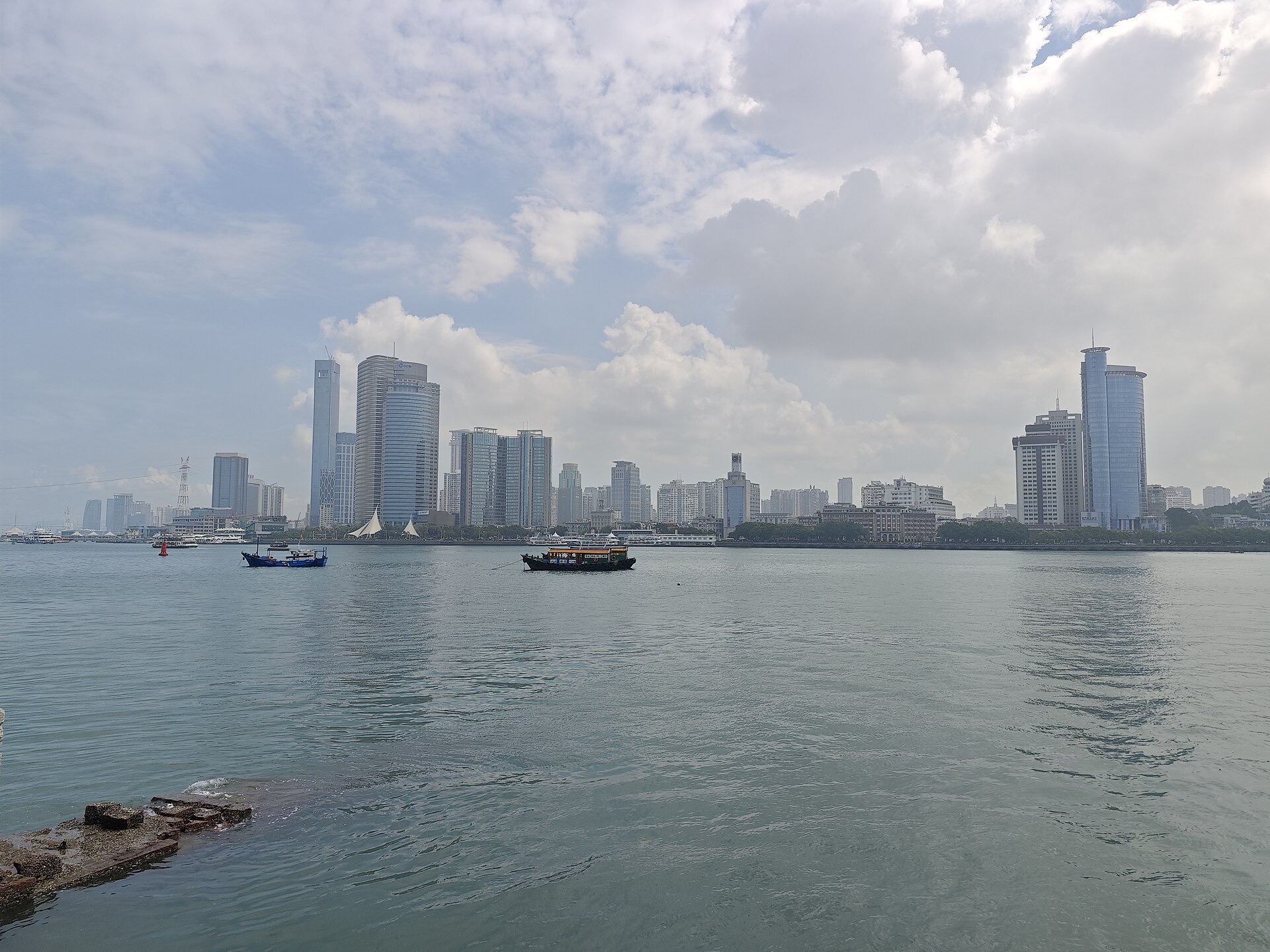
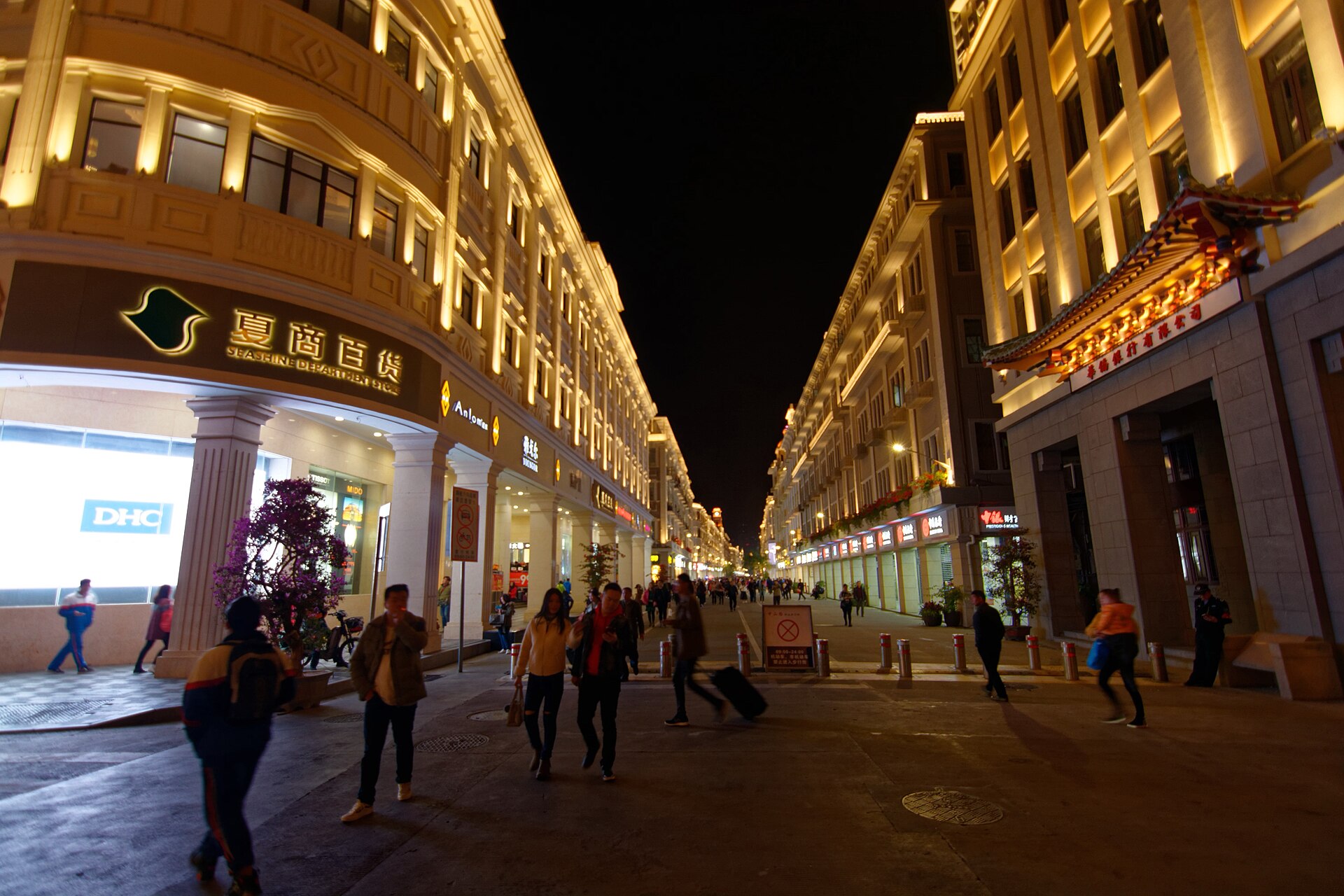
The beating heart of old-town Xiamen — 1920s arcade shophouses on both sides, a western end that opens onto the harbour facing Gulangyu, and behind it the Bashi market lanes where locals still shop and eat every single day.
Picture this: you have just come back from Gulangyu in the afternoon, stepped off the ferry onto the Xiamen side, and you are not quite ready to head back to the hotel. A local will tell you to walk up to Zhongshan Road — it is only a few minutes from the pier, and it is old Xiamen with the lights still on. Not a museum, but a street where residents still come to shop and eat.
Zhongshan Road (中山路 Zhōngshān Lù) is a pedestrian street roughly 1.2 kilometres long in Siming District, in the centre of the old town. It was built in 1925 and completed around 1930, when Xiamen was a busy treaty port. Its signature is the qilou (骑楼) arcade shophouses that line both sides — the ground floors set back into covered walkways that keep you out of the sun and rain year-round. The design was carried home by overseas Chinese returning from Europe and Southeast Asia, which is why the facades read as European above a very southern-Chinese street life below.
Today Zhongshan Road is on China's list of "Historic Cultural Streets" and draws more than eight million visitors a year. What makes it worth more than an ordinary shopping street is this: it is free to walk, and from here you can reach both the Gulangyu-facing harbour and the Bashi market lanes on foot. In one compact area you get architecture, street food, and a view across the water.
Know the three pieces of this area before you set off, so you pace it right and don't miss the good stuff.
This is what sets Zhongshan Road apart from any ordinary shopping street. The buildings on both sides set their ground floors back into arcade walkways, so you can stroll all day out of the sun and rain. Above them are stucco facades that mix European detail with southern-Chinese trade — the style overseas Chinese brought home. After dark the warm lights wash over the whole row, which is the best time for photos. The ground floors today hold brand shops, snack stores, and Xiamen souvenir specialists selling things like flaky pastry pies and dried seafood.
Walk Zhongshan Road to its western end and you come out on the waterfront at Lujiang Road, with a clear view across the strait to Gulangyu. It is a favourite spot for harbour photos, especially in the golden light of late afternoon. There is an old ferry pier (轮渡) here, but to be straight with you: tourists cannot board the island ferry from this pier during the daytime — the old pier is reserved for Xiamen residents in daylight hours. Visitors use the Cruise Terminal (邮轮中心码头) instead. Full ferry details are in our Gulangyu guide.
If Zhongshan Road is the shopfront, Bashi market is the kitchen behind it. Bashi (八市) literally means "Eighth Market", an old wet market tucked into the lanes behind the main street, a few minutes' walk in. Here you'll find fresh seafood laid out in rows, dried goods, and small Minnan snack stalls that have been going for decades — oyster omelette, satay noodles, fish balls, and other dishes locals queue for. This is where the real local food is, far more so than the shops on the main street, and just watching the morning market is worth the detour.
If you want the version of Zhongshan Road you'll remember, come after sunset, when the lights along the old arcades come on all at once — soft amber on the stucco and the covered walkways, with people out for an evening stroll. Walk slowly from the Siming Road end toward the harbour; it's about 20–30 minutes if you don't stop, but the whole point is to stop — for a snack store, for a corner photo, for a bite of something warm.
The charm here is that nobody is in a hurry. There are buskers along the way, pastry shops baking fresh, and you can carry on to the waterfront for a night view of Gulangyu on the same trip.
The flip side of the main street: the Bashi market lanes are busiest from morning to late morning, when the seafood is freshest and every snack stall is open. To make a single day flow nicely, walk the Bashi market in the morning, eat a late breakfast nearby, then come back to Zhongshan Road in the evening when the lights are on — two completely different moods in one day.
The main street is full of Xiamen gifts — fresh-baked pastry pies (馅饼), dried seafood, southern-Chinese sweets. But the genuinely local food is in the Bashi market lanes behind. Try the oyster omelette (a Minnan classic), satay noodles (沙茶面) in fragrant peanut-satay broth, and Xiamen fish balls. For more ideas on what to eat and where, see our Xiamen street food guide and the full Xiamen food guide.
One tip: the shops in the prime spots on the main street tend to charge more and cater to tourists. If you want better value and food that tastes more local, step into the Bashi lanes or the side alleys — cheaper and fresher.
Xiamen has a metro, which makes the old town easy to reach. Zhongshan Road itself sits in an old district with narrow streets, so the best approach is to take the metro or a bus and walk in from there.
Plenty of visitors walk to the end of Zhongshan Road at the harbour and assume they can just hop on a ferry to Gulangyu — during the day, you can't. The old pier here (轮渡) is reserved for Xiamen residents in daytime hours. Tourists must board at the Cruise Terminal (邮轮中心码头), which is a separate location, and you need to book a timed ticket in advance and bring your passport. If you're planning the island, read the full ferry how-to in our Gulangyu guide before you set out.
Long holidays mean big crowds: during National Day Golden Week (1–7 October) and Labour Day (1 May), Zhongshan Road gets shoulder-to-shoulder. If you have a choice, come on a weekday or a normal weekend.
Compare gift prices before buying: pastry pies and souvenirs on the main street come from many sellers at different prices. Browse a few shops first, or buy in the side lanes, where you'll often pay less.
Be ready to pay by QR: most shops take Alipay/WeChat Pay first; link a foreign card in the app before your trip and it's seamless. Cash still works, but some small stalls can't make change.
Wear comfortable shoes: this area links several stops — the main street, the market lanes, the waterfront — and you'll cover more ground than you expect.
Stay in the old-town waterfront area — walk to Zhongshan Road and the Bashi market, and catch the ferry to Gulangyu with ease.