Step a few metres out of the gate of China's most beautiful seaside university and the golden temple roofs appear above the treetops, the green slopes of Wulao Peak behind them and the sea just ahead — this is where people in Xiamen come to pray, eat legendary vegetarian food, then climb the hill to the giant carved character "佛" and a view over the whole city.
Picture a temple with a green rocky hill rising behind it, the sea only a few hundred metres in front, and over the wall the seaside campus people call the prettiest in China — that is exactly where Nanputuo Temple (南普陀寺) sits. It stands at the foot of Wulao Peak (五老峰, the "Five Old Men Peaks") in Siming District, in the heart of Xiamen, and it is one of the most important Buddhist temples in southern Fujian. Best of all, it is free to enter.
The name "Nanputuo" means South Putuo, because the temple is dedicated to Guanyin, the Bodhisattva of Compassion, just like Mount Putuo (普陀山) far to the north in Zhejiang. Sailors and locals came to call it "the Putuo of the south." The temple's roots reach back more than a thousand years to the Tang dynasty, and it has been rebuilt several times; most of what you see today dates from a major Qing-dynasty restoration. It is still a working monastery where monks live and ceremonies are held — not a museum piece for photos.
Three things make visitors love this place. First, it is free to enter, and you collect a free stick of incense at the gate. Second, the vegetarian restaurant (南普陀素菜) is reckoned to be the best in Fujian. Third, the climb up the hill behind the temple takes you to a giant carved character "佛" on the cliff, with views over the campus, the city and the sea, with Gulangyu Island in the distance. Pair it with a walk around Xiamen University next door and you have a perfect half-day.
Work your way in from the east gate, then climb the hill to finish — allow two to three hours to do it comfortably.
1
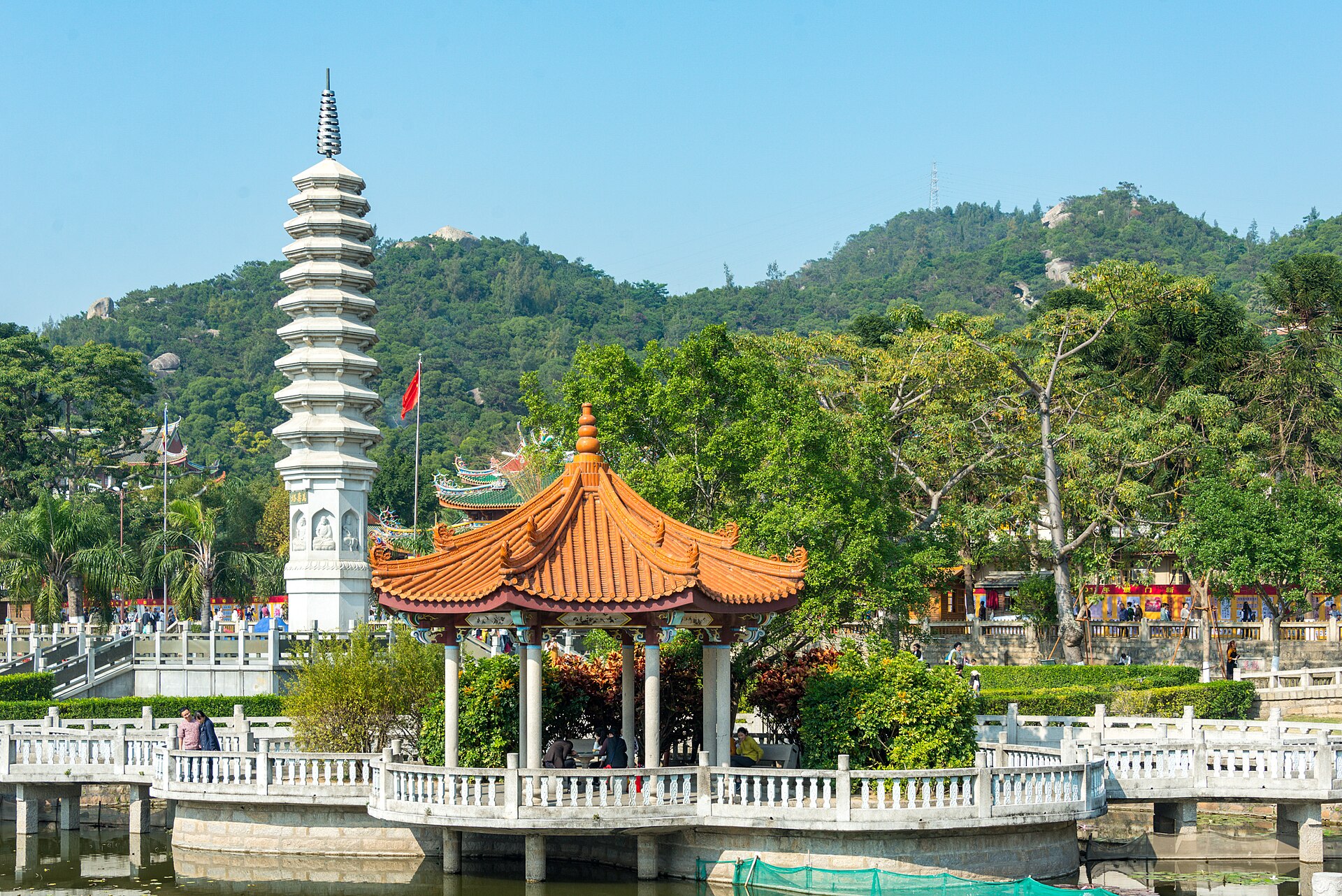
Walk in through the east gate and you reach a big pond full of lotus flowers, turtles and fish — the pond where Buddhists release animals to set them free. An orange-roofed pavilion and a stone bridge cross the water, with twin stone pagodas and the green slopes of Wulao Peak behind. It is the most photographed corner of the whole temple. Take your time strolling along the pond before you reach the main halls.
The hall people queue to pray at is the Great Compassion Hall, an elegant octagonal building with three stacked roofs that looks striking from every angle. Inside sits a thousand-armed Guanyin (the Bodhisattva Avalokiteshvara), carved to face several directions, with incense drifting over the chanting all day. This is the reason for the temple's name — it honours Guanyin in the same way as Mount Putuo. Locals come to pray for health and family here.
A short way up the hill behind the temple you reach the carved character 佛 (pronounced "fó", meaning Buddha), cut deep into a red cliff face about 4.6 metres tall and over 3 metres wide. It is a favourite photo spot, where people stand beside it to show just how big it is. Scattered around are more old inscriptions and poems carved into the rocks — traces left by poets and officials who visited over the centuries.
If you have the energy, keep climbing the stone steps up Wulao Peak — about 30 to 45 minutes to the viewpoints. The trail is shaded by big trees and oddly shaped boulders, and at the top the view opens right up: the temple roofs below, the whole campus of Xiamen University, the city, and the sea with Gulangyu Island floating in the distance. Late afternoon light is especially soft and beautiful — the reward for those who make the climb.
No visit is complete without the vegetarian food — the Nanputuo vegetarian restaurant has been famous across China for decades. The dishes are made entirely from mushrooms, tofu and vegetables, yet cooked and plated so beautifully that many of them barely seem meat-free. The fun part is that the menu gives dishes poetic names rather than listing ingredients. A small set starts around ¥59 (about ฿295) per person, and you can order individual plates too. It is packed at lunch, so arrive before 11am for an easier table.
6
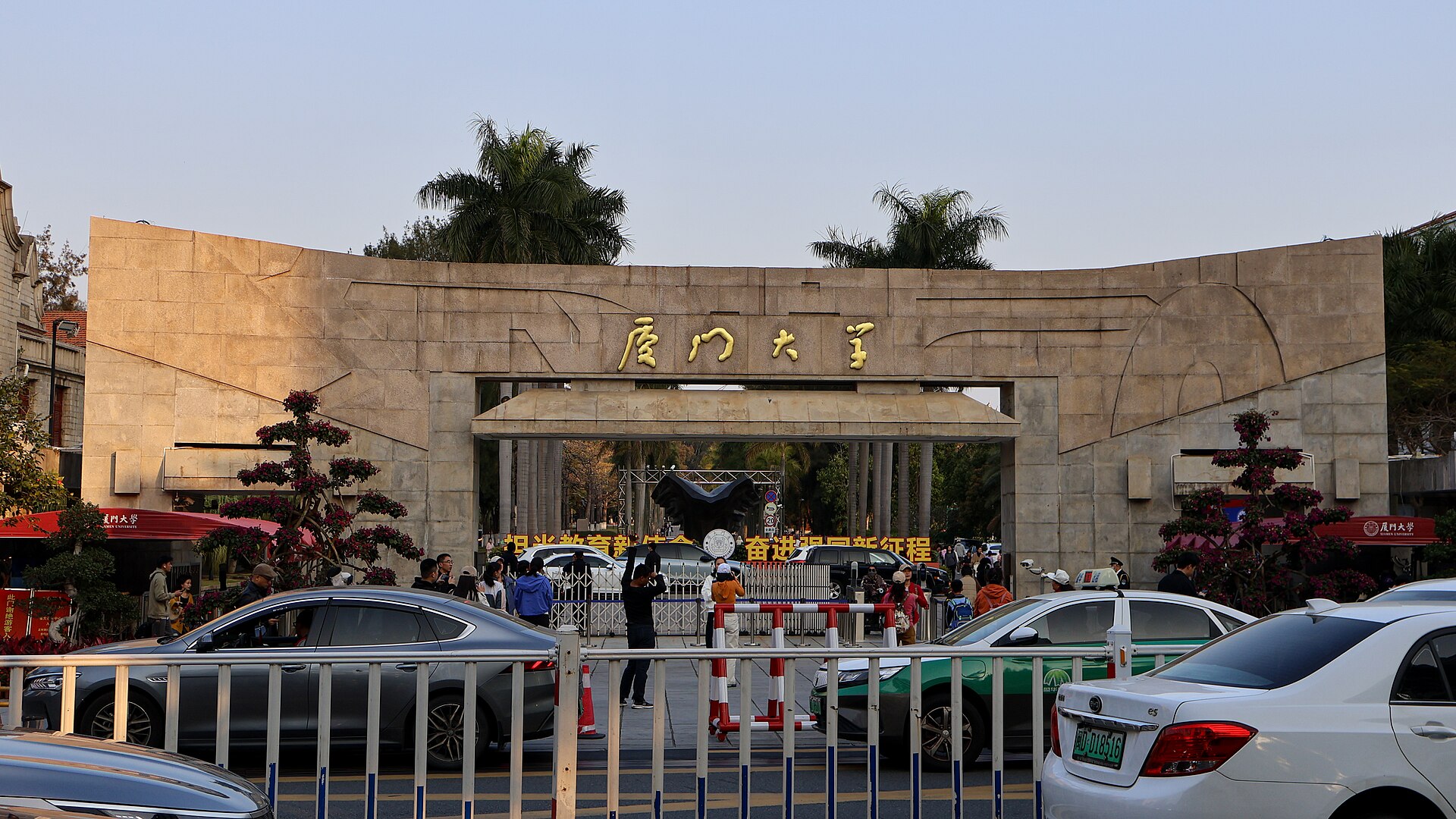
This photo shows the gate of Xiamen University, which sits directly beside the temple — almost everyone who comes to Nanputuo walks straight on to see the campus people call the prettiest in China, with its Jiageng-style buildings, mural tunnel, lotus pond and Baicheng beach behind. Entry requires advance registration with your passport and is capped per day, especially in term time. The policy changes often, so check the latest in our guide before you go.
Everything you need on one page (do check again before you go, as the booking system and hours can shift).
Nanputuo Temple is in Siming District, on the south-eastern corner of Xiamen island, right beside Xiamen University. There are several easy ways to reach it:
Xiamen has a metro — take Line 1 to its terminus at Zhenhai Road (镇海路), close to the old town and the ferry side, then transfer to a taxi, DiDi or bus for another 10 to 15 minutes. You can pay your metro fare by scanning an Alipay or WeChat QR code.
The most direct option is the bus. Many routes pass the 厦大西村 (Xiada West Village) stop, including routes 2, 20, 47 and 48, among others. Get off there and it is a short walk to the temple's east gate. Pay by scanning a QR code or with cash.
If you are in a group or would rather not change vehicles, a taxi or DiDi straight there is simpler. Tell the driver 南普陀寺 (Nán Pǔtuó Sì) — every driver knows it — and they will drop you near the east gate. It takes roughly 15 to 25 minutes from the city centre depending on traffic.
Arrive in the morning → pray in the temple, see the Lotus Release Pond and the Guanyin hall → climb the hill to the 佛 carving and the sea view → come down for a vegetarian lunch → walk out the west gate into Xiamen University (booked ahead) → finish with Baicheng beach or the Huandao Road coastal drive at dusk. A very satisfying day.
Nanputuo sits in the south-east corner of the island, next to the university and close to the sea, so it pairs easily with other sights in a single day:
Most people stay around the old town and Zhongshan Road, or by the sea near the university, then take the metro or a bus to the temple in the morning. Here are the hotels we have reviewed and compared for you: