Home Xiamen China Xiamen Hotels About
Home  ›  China  ›  Xiamen  ›  Day Trips
🏯 Day Trips from Xiamen · 2026

Day trips from Xiamen
tulou, Quanzhou and Zhangzhou

Done with Gulangyu and Xiamen University? Hop on the high-speed train a little further — the round earthen tulou of the Hakka, the UNESCO old city of Quanzhou at the start of the maritime Silk Road, the water village of Yunshuiyao under thousand-year banyans, and old-town Zhangzhou. We tell you plainly which are an easy rail there-and-back and which are best done on a tour.

Why leave the island at all

The island is the star, but the Fujian around it has things you can't see elsewhere

Most people come to Xiamen (厦门) for Gulangyu, the sea views and the easy seaside-city mood — and those are what to see first. Our full Xiamen attractions guide covers them all. But if you have a spare day or two, the country around Xiamen holds World Heritage sights you won't find anywhere else: the round earthen tulou fortresses of the Hakka, deep in the mountains, and Quanzhou, once the largest port on earth in the Song and Yuan dynasties. Both add a whole extra layer to a Xiamen trip.

The good news: Xiamen has a metro, a BRT and high-speed rail stations, which makes the rest of Fujian very reachable. Quanzhou and Zhangzhou are about 30–40 minutes away by high-speed train, while the tulou, set deep in the hills, are easiest on a day tour. Below are the four day trips we think earn their place, ordered by popularity — with how to get there, how long it takes, the fares, and which to pick if you have just one spare day.

🚄
Plan first
Want the most unusual sight? Take a tulou tour. Want an easy, low-key trip? Quanzhou is 30 minutes by train
How to book China high-speed rail →
4 day trips

Ranked by popularity — off the island to the real Fujian

Ordered by how popular they are, with an honest note on which is best done on a tour, which you can train to yourself, which is half a day or a full day, and whether it fits a single spare day.
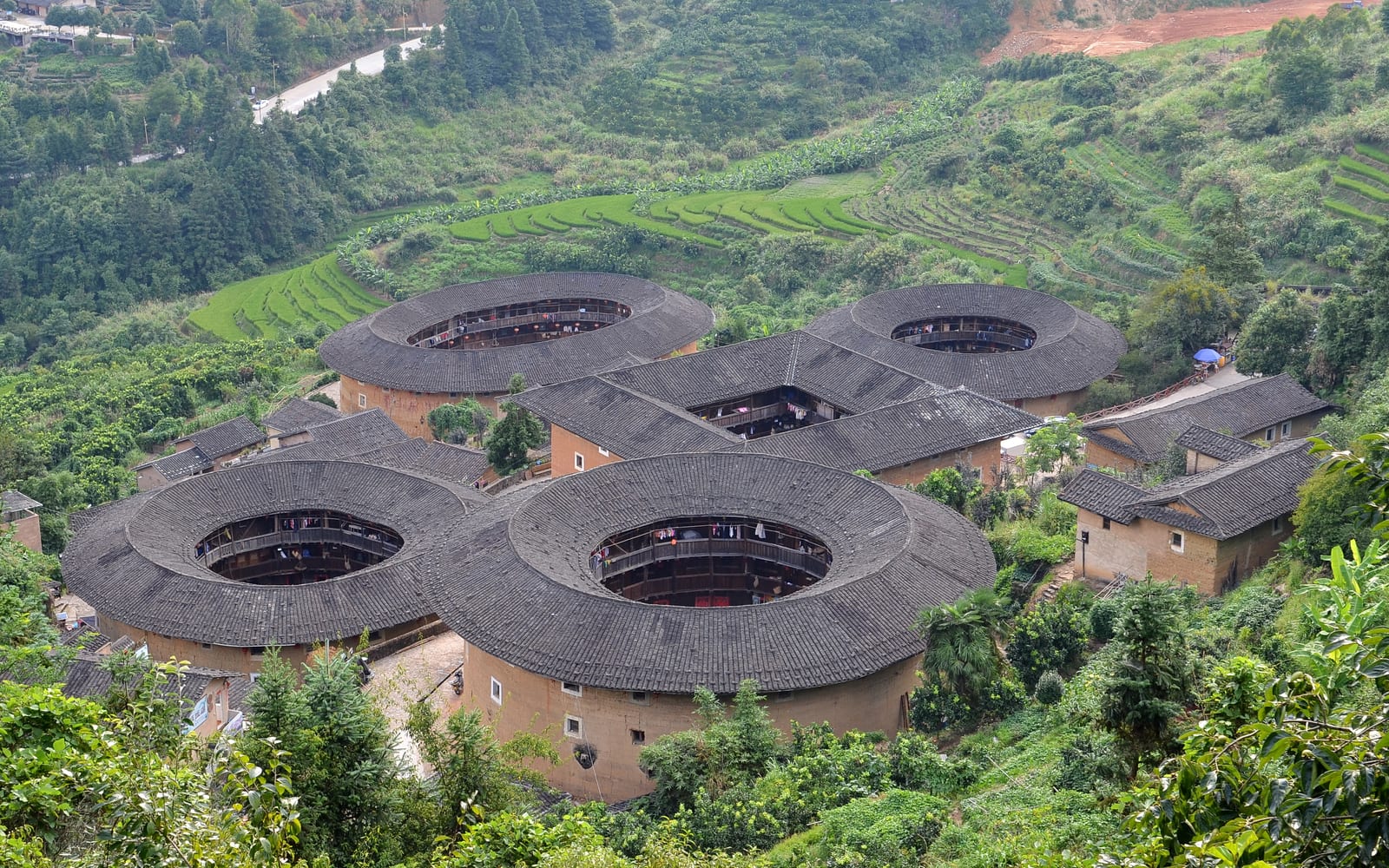
The Tianluokeng tulou cluster in Nanjing county, Fujian — four round and one square earthen fortress houses with grey tiled roofs, set among green terraced fields 1
Fujian Tulou (福建土楼)
UNESCO earthen roundhouses · Nanjing/Yongding · best on a day tour

If you leave the island for just one place, make it the tulou. These are the giant earthen homes of the Hakka, built as round (and square) fortresses three to five storeys high, with rammed-earth walls a metre thick, each one housing a whole clan as a single community — architecture that has been a World Heritage site since 2008 and exists nowhere else on earth. The iconic photo spot is the Tianluokeng (田螺坑) cluster, nicknamed 'four dishes and a soup' because, seen from the hillside, it looks like four round buildings around one square in the middle.

The catch — and the thing to plan for — is that they're deep in the mountains, 2.5–3.5 hours from Xiamen, on public transport with several changes and shaky timetables. So this is the one trip on the list we genuinely suggest doing on a day tour: hotel pick-up, entry tickets and a guide in one vehicle, out in the morning and back at night, nothing to figure out.

Getting there: A day tour with transfers (leaving ~7–8 am) is easiest · independently, train/bus to Nanjing station ~1 hr, then a local bus/hired car into the cluster ~1 hr
Entry: Nanjing tulou zone ~¥90–100 (~฿450–500 / ~US$13–14) depending on route A or B · tours usually include it
Top clusters: Tianluokeng ('four dishes and a soup') · Taxia village · Yuchang Building (Nanjing) · Hongkeng cluster (Yongding)
Time needed: A full day (~6 hr of travel there and back)
Tip: Wear comfortable shoes · pair it with Yunshuiyao water village in the same zone on one day
Best time: Spring and autumn (Mar–May / Sep–Nov) for the kindest weather and green fields · summer is hot and humid · avoid the long Chinese public holidays, when it's packed
🛕2
Quanzhou old city (泉州)
UNESCO maritime Silk Road · old temples + ancient mosque · 30 min by train

This is the easiest day trip on the list, because the high-speed train from Xiamen to Quanzhou takes only about 30 minutes. Quanzhou was the largest port on earth in the Song and Yuan dynasties, and was inscribed as a World Heritage site in 2021 as the start of the maritime Silk Road. It's often called 'a museum of the world's religions', because a Buddhist temple, a mosque and Chinese shrines all stand in one city.

The highlights are Kaiyuan Temple (开元寺), a Tang-dynasty Buddhist temple from 686 with China's tallest pair of stone pagodas; Qingjing Mosque (清净寺) from 1009, modelled on the prayer hall in Damascus; and a wander down West Street (西街), which keeps its old layout, stopping for local snacks and Minnan noodles. Honestly, Quanzhou is the most rewarding culture trip out of Xiamen, and an easy there-and-back.

Getting there: High-speed train from Xiamen / Xiamen North → Quanzhou ~30 min (80+ pairs a day), then a bus/taxi into the old city
Train fare: Second class ~¥25–35 (~฿125–175 / ~US$3.5–5)
Entry: Kaiyuan Temple is free · Qingjing Mosque has a small fee · West Street is free to walk
Time needed: A full day (the old city has plenty to see and is easy to walk)
Tip: Start at Kaiyuan Temple → West Street → Qingjing Mosque, all walkable · try the local oyster omelette and Minnan noodles
Best time: Autumn to early winter (Oct–Dec), dry and comfortable for walking all day · summer is hot and humid, so avoid the midday sun · avoid the long Chinese holidays
🌳3
Yunshuiyao water village (云水谣)
Old village by a stream · thousand-year banyans · paired with the tulou

If the tulou are Nanjing's stern side, Yunshuiyao is its gentle one — an old village with a clear stream running through the middle, more than ten thousand-year-old banyan trees lined along the banks, and long old stone paths following the water. It's been the set for several Chinese films. The mood is slow: a place to sip tea by the stream and watch an old farmer cross a wooden bridge.

Because Yunshuiyao sits in the same zone as the Nanjing tulou clusters, people like to pair the two on one trip — walk the earthen fortresses in the morning, then stroll the streamside under the banyans in the afternoon. Most tulou tours from Xiamen already include Yunshuiyao; or, for a slower day, pick a tour focused on Yunshuiyao plus old-town Zhangzhou. There are also a few tulou inside the village itself to step into.

Getting there: In Nanjing county, the same zone as the tulou · a day tour is easiest, or train to Nanjing station then bus No. 6 to the Yunshuiyao scenic area
Entry: There is a village entry fee (check the current price on site · some tulou charge separately)
Time needed: Half a day (pair with the tulou or old-town Zhangzhou for a full day)
Tip: Wear comfortable shoes, the stone paths are long · late morning light is best for photographing the streamside banyans
Best time: Spring and autumn, with mild weather and lush green banyans · after rain the stream runs clear and pretty · avoid the long Chinese holidays, as the narrow paths get crowded
🏮4
Zhangzhou old town (漳州)
Qilou arcade old town · not yet touristy · 30–40 min by train

Not every trip has to be a World Heritage site — if you've already done Quanzhou and want somewhere new and less busy, Zhangzhou (漳州), Xiamen's neighbour to the southwest, is a pleasant alternative, about 30–40 minutes away by high-speed train. The popular bit is the old-town district full of qilou (騎樓) arcade shophouses with covered walkways in the southern-Chinese style, an old pedestrian street, old temples and Minnan snack shops.

Honestly, Zhangzhou hasn't gone fully touristy yet — it's cheaper and far less crowded than Quanzhou. It suits anyone after a quiet southern-Chinese old town to wander and snack through for half a day, or you can use Zhangzhou as a stop on the way to the tulou and Yunshuiyao, since they're on the same route — which is why some tours pair Yunshuiyao with old-town Zhangzhou in one day.

Getting there: High-speed train from Xiamen → Zhangzhou ~30–40 min, then a bus/taxi into the old town · or a stop en route to the tulou
Entry: The old town is free to walk (some temples/museums have small fees)
Time needed: Half a day (walk the old town + eat local snacks)
Tip: Go for a low-key trip or pair it with Yunshuiyao · try local sweets and Minnan noodles along the qilou arcades
Before you go

What to know before you leave the hotel

Xiamen has a metro, a BRT and high-speed rail stations — the Quanzhou and Zhangzhou trips leave from the high-speed rail stations, with most trains departing from Xiamen North (厦门北站), reachable on metro Line 1; some leave from Xiamen station (厦门站) in the centre, so allow time to get there. Book train tickets ahead through an app (Trip.com or Railway 12306), as popular departures sell out in high season, and use Amap (高德地图) rather than Google Maps — it's far more accurate for bus stops and times.

Plan around your spare days: with one day and a wish for something unusual, take a Fujian Tulou tour — a World Heritage site found nowhere else, though it means an early start and a long drive, so a tour with transfers is easiest. If you'd rather have a low-key, easy trip, choose Quanzhou old city — 30 minutes by train for an easy there-and-back, with old temples, an ancient mosque and local food. For a slower riverside-village mood, pair Yunshuiyao with the tulou. And if you want somewhere new and less busy, old-town Zhangzhou is a pleasant half-day.

Paying: most shops, stations and sights accept only Alipay and WeChat Pay — download and link a foreign card (Visa/Mastercard) via international mode before you travel. For the longer trip to the tulou, if you'd rather not change vehicles several times, a tour with door-to-door transfers is far more comfortable, especially with family or older travellers. Plan your time in Xiamen first with our Xiamen travel guide.

Frequently asked questions

FAQ · Day trips from Xiamen

How do I get to the Fujian Tulou from Xiamen, and do I need a tour?
The most famous Hakka tulou clusters are in Nanjing (南靖) and Yongding (永定) counties, about 2.5–3.5 hours from Xiamen by road and deep in the mountains. Public transport involves several changes and unreliable timetables, so this is the one trip on the list we genuinely suggest doing on a day tour: it bundles hotel pick-up, the village entry ticket and a guide into one vehicle, leaving around 7–8 am and back in Xiamen by evening. If you want to go independently, take a train or bus to Nanjing station first (~1 hour), then a local bus or hired car into the tulou cluster for another ~1 hour. Entry to the Nanjing tulou zone is about ¥90–100 (about ฿450–500) depending on whether you pick route A or B. The iconic photo spot is the Tianluokeng (田螺坑) cluster, nicknamed 'four dishes and a soup'.
What is there to see in Quanzhou, and can I do it as a day trip?
Quanzhou (泉州) was inscribed on the UNESCO World Heritage List in 2021 as the start of the maritime Silk Road in the Song and Yuan dynasties, and is often called 'a museum of the world's religions' for holding a Buddhist temple, a mosque and Chinese shrines in one city. Highlights are Kaiyuan Temple (开元寺), a Tang-dynasty Buddhist temple from 686 with China's tallest pair of stone pagodas; Qingjing Mosque (清净寺) from 1009, modelled on the prayer hall in Damascus; and Guanyue Temple. Wander West Street (西街), which keeps its old layout, and try local snacks. It's an easy there-and-back day trip, because the high-speed train from Xiamen to Quanzhou takes only about 30 minutes, with more than 80 pairs of trains a day from morning to night; a second-class ticket is about ¥25–35 (about ฿125–175).
What is Yunshuiyao water village, and how is it different from the tulou?
Yunshuiyao (云水谣) is an old village in Nanjing county, in the same zone as the tulou clusters. Its draw is a clear stream running through the middle of the village, with more than ten thousand-year-old banyan trees lined along the banks and long old stone paths — it's been the set for several Chinese films. The mood is much slower than the fortress-like tulou, so people like to pair the two on one trip: walk the earthen roundhouses in the morning, then sip tea by the stream under the banyans in the afternoon. Most tulou tours from Xiamen already include Yunshuiyao, or you can pick a tour focused on Yunshuiyao plus old-town Zhangzhou. There are also a few tulou inside the village to visit.
Is old-town Zhangzhou worth a stop, and how do I get there?
Zhangzhou (漳州) is Xiamen's neighbour to the southwest, about 30–40 minutes away by high-speed train. The popular bit is the old-town district of qilou (騎樓) arcade shophouses with covered walkways, an old pedestrian street, old temples and Minnan snack shops. It feels like a southern Chinese city that hasn't gone fully touristy yet — cheaper and far less crowded than Quanzhou. It suits anyone who wants a low-key old town for half a day, or you can use Zhangzhou as a stop on the way to the tulou clusters, since they're on the same route; some tours pair Yunshuiyao with old-town Zhangzhou in one day.
With one spare day, which trip should I pick from Xiamen?
With a full spare day and a wish to see something you can't see anywhere else, take a Fujian Tulou (福建土楼) tour — it's a World Heritage site found nowhere else, though you'll need an early start and a long drive, so a tour with transfers is easiest. If you'd rather have a low-key, easy-to-reach trip, choose Quanzhou old city — just ~30 minutes by high-speed train, an easy there-and-back with old temples, an ancient mosque and local food. For a slower riverside-village mood, pair Yunshuiyao with the tulou. And if you've already done Quanzhou and want somewhere new and less busy, old-town Zhangzhou is a pleasant half-day. See the full picture in our Xiamen attractions guide.
Klook · Day Trips

Tours from Xiamen — tulou, Yunshuiyao and Quanzhou, with a guide

Don't want to juggle a bus and a taxi up into the hills? Klook has Hakka tulou tours, Yunshuiyao water-village and old-town Zhangzhou tours, and tickets for sights around Quanzhou — transfers and tickets included, out in the morning and back in the evening, nothing to figure out.

See tulou and Xiamen day tours on Klook →
Wherebest is a Klook affiliate partner — we may earn a commission when you book through our links, at no extra cost to you.