On your first morning you stand under the golden spires of the Grand Palace; by evening you're on a ฿5 ferry watching the light fade behind Wat Arun. This plan lines Bangkok up properly — temples, markets, the river and a rooftop — then lets you choose your finale: the ruins of Ayutthaya or a green island in the middle of the city.
Bangkok isn't hard because there's too much to see — it's hard because the city splits into two halves. Nearly all the temples and palaces sit in the old town along the Chao Phraya River, while the malls, cafés and rooftop bars follow the Skytrain lines through the new city. Zigzag between the two and you'll spend your trip stuck on some of Asia's most congested roads, instead of standing in the morning light as it hits the spires of the Grand Palace before the tour groups arrive.
This plan is built for a first visit to Bangkok. Day one stays on the royal island all day — three major temples within walking distance of each other, connected by a cross-river ferry. Day two runs along the BTS line, from a morning market to a rooftop at night. Day three is your choice, depending on how much energy is left: a train to Ayutthaya, or an easy ride around Bang Krachao followed by a Yaowarat finale. Every leg runs on the BTS, MRT and boats, so traffic never gets a vote. For the full list of sights, see our Bangkok attractions guide.
Less time? See the 1-day plan or the 2-day plan. More time? The 4-day plan fits everything in. Still picking your month? Check the best time to visit Bangkok, and put numbers on the whole trip with our Bangkok trip budget.
Turning up at the Grand Palace in shorts, or staring at a ticket machine in rush hour — both are avoidable. Sort these three before you land and the trip starts without a stumble.
The Grand Palace enforces the strictest dress code in Thailand — sleeved tops, knees covered, nothing tight or see-through. It opens around 8:30 am; arriving at opening beats both the heat and the tour groups. No advance booking needed. First-timers, read the full list of things to know in our Bangkok first-timer guide.
The BTS uses a Rabbit card or single-ride tickets, while the MRT takes a contactless credit card straight at the gate. Fares run about ฿17–62 per ride; the orange-flag express boat is ~฿16 and cross-river ferries ~฿5. See our BTS & MRT guide, and get in from the airport with the Suvarnabhumi / Don Mueang transfer guide.
Street stalls, boats and motorbike taxis still run on cash — keep small notes on you (see what's worth eating curbside in our street-food guide). Grab handles car rides at about ฿80–200 within the city, with prices rising in rain and rush hour. Google Maps works normally everywhere.
Golden spires you'll recognise on sight, a 46-metre reclining Buddha, and a riverside prang at last light — a day where nearly everything is within walking distance, stitched together by a ฿5 ferry.
Start where every first trip should — the Grand Palace and Wat Phra Kaew (Temple of the Emerald Buddha). Be at the gate before 8:30 am: the first hour has the best light, bearable heat and no tour groups yet. Walk from the ordination hall of the Emerald Buddha past the golden Phra Si Rattana Chedi and the Royal Pantheon, finishing at the Chakri Maha Prasat throne hall. Allow a comfortable 2.5 to 3 hours. The full walking route and photo spots are in our Grand Palace & Wat Phra Kaew guide.
From the palace, walk south about 10 minutes to Tha Tien — a row of old riverside shophouses now filled with small restaurants and cafés. Eat lunch here or at the Tha Maharaj complex, then enter Wat Pho for the 46-metre reclining Buddha, its soles inlaid with 108 auspicious mother-of-pearl scenes. Wander the courtyard of the four royal chedis, far quieter than the main hall, and if the morning's walking has caught up with you — this temple is the birthplace of Thai massage. The full story is in our Wat Pho guide.
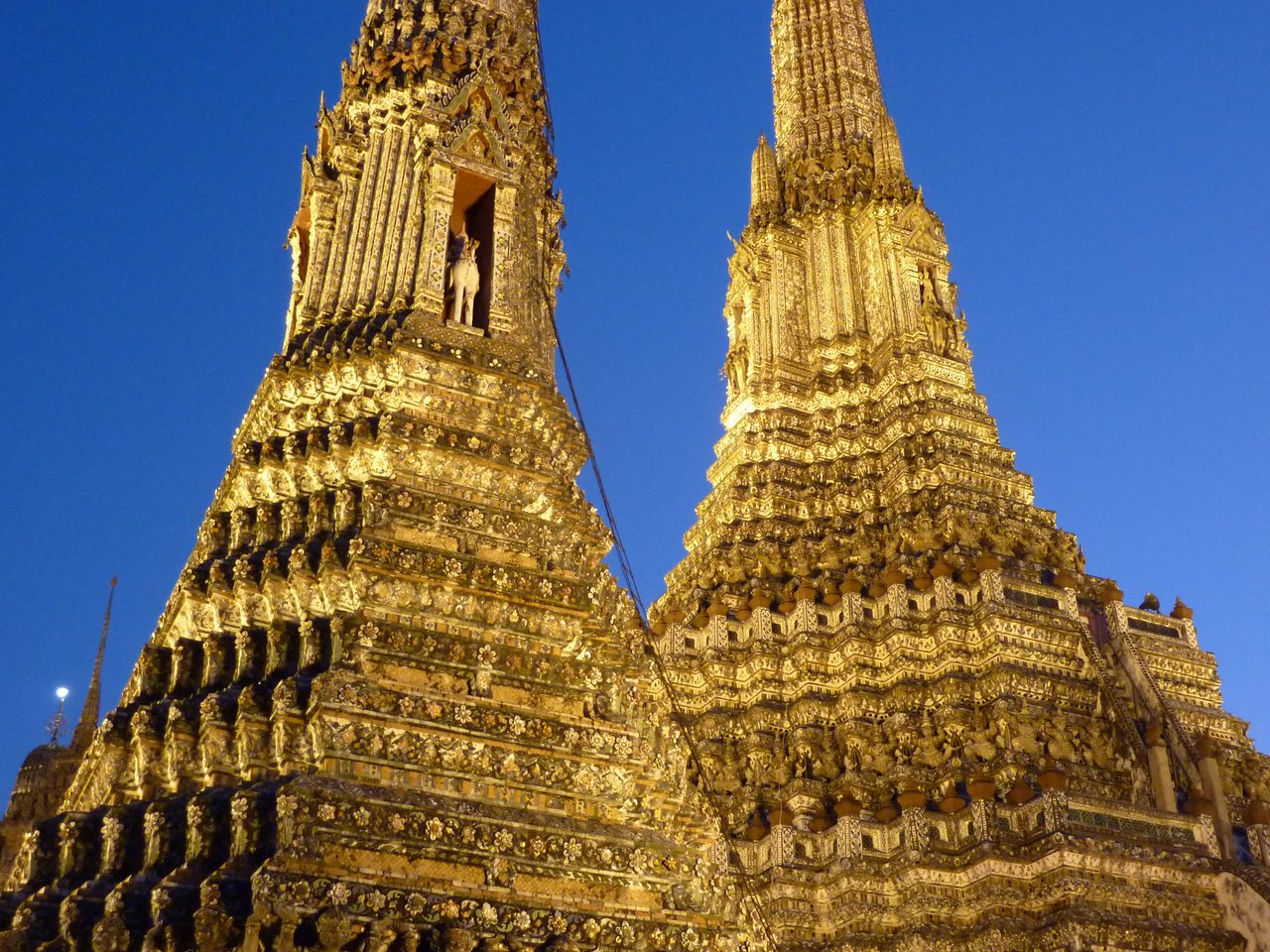
Around 4:30 pm, walk to Tha Tien pier and take the cross-river ferry (~฿5) — three minutes to the Thonburi bank and Wat Arun, the Temple of Dawn. As the light turns gold, this is the postcard you came for. You can climb the prang's steep steps to the middle terrace for a long view over the river's bend. After sunset, ferry back to Tha Tien: the best photos of the lit-up prang are from this side, and the small riverside terraces here make an easy dinner spot. Light timings and camera angles are in our Wat Arun guide, and every boat on the river is explained in the Chao Phraya boat guide.
Energy left? From Tha Tien it's a 20–30 minute Grab or boat-and-walk to Khao San Road — finish night one among backpackers from everywhere on earth. See how the strip has changed in our Khao San Road guide.
A fifteen-thousand-stall market or noodles sold from a paddled boat, the teak house of an American who vanished, coffee in Siam, and the skyline from above — a day the BTS handles end to end.
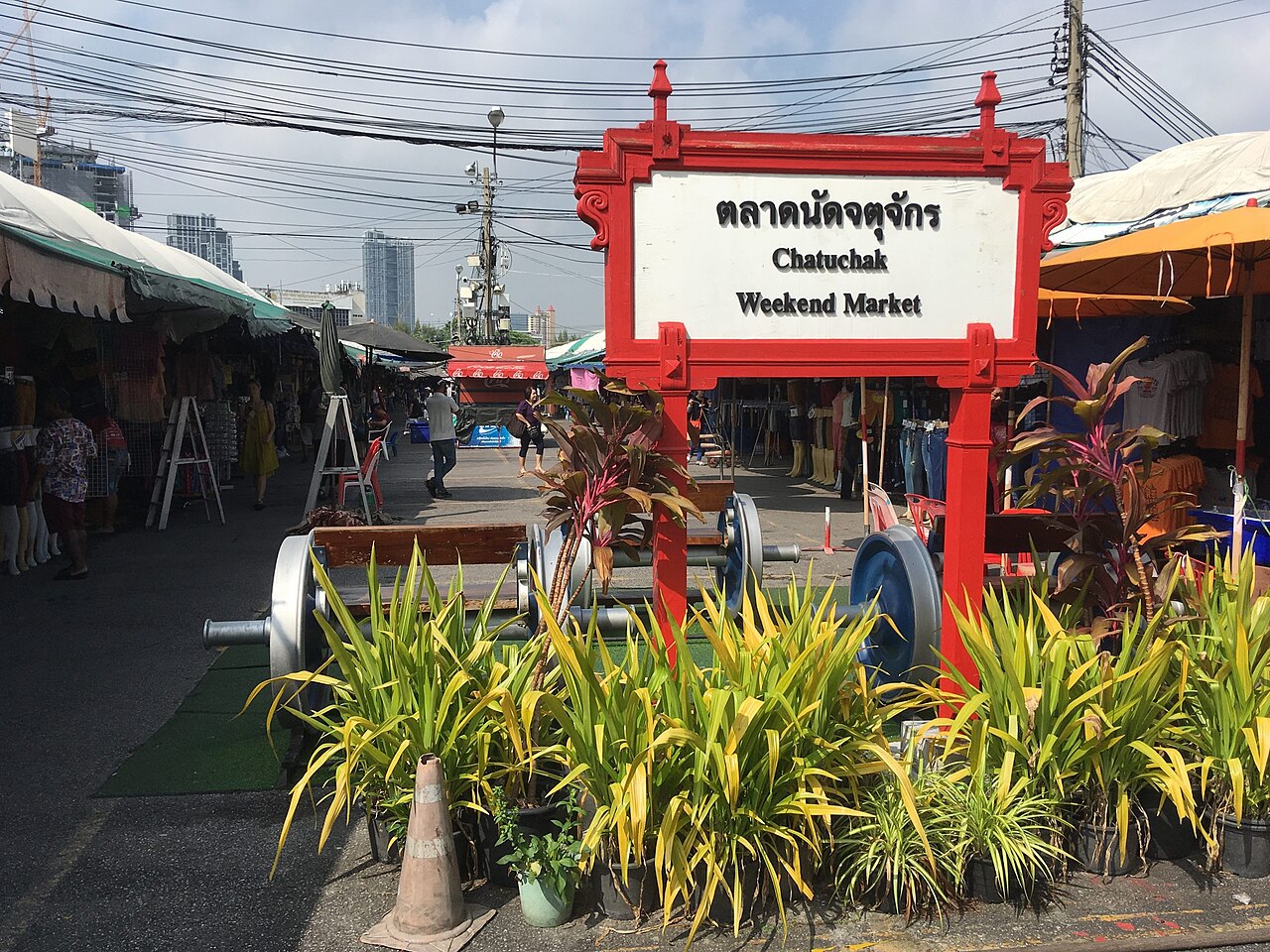
If today lands on a Saturday or Sunday, there's no decision to make — Chatuchak Weekend Market is one of the largest weekend markets in the world, around fifteen thousand stalls across 27 sections. Arrive about 9 am, when the stalls are open but the crowds haven't peaked. Follow whatever you're into: vintage clothes, homeware, crafts — or just eat your way through, from coconut ice cream to giant-pan paella. Map your sections first with our Chatuchak Market guide.
Trip misses the weekend? Swap this morning for a floating market — Damnoen Saduak paired with the Maeklong Railway Market (half-day tours leave early and have you back by mid-afternoon), or for somewhere more local, Amphawa runs weekend afternoons in Samut Songkhram. Compare them all in our floating markets guide. The simplest fallback: Or Tor Kor market across the road from Chatuchak, open daily, with the best produce and prepared food in the city.
Head back down the BTS line to National Stadium station, a few minutes' walk from Jim Thompson House — six teak houses on the Saen Saep canal, assembled by the American who revived Thai silk for the world before vanishing without a trace in the Malaysian jungle in 1967. Visits run as guided tours of about 45 minutes, and the shaded garden is one of the better places in Bangkok to wait out the afternoon heat. The full story is in our Jim Thompson House guide.
Then walk or ride one BTS stop into Siam. Take your pick of recovery stops: the ever-rotating cafés of Siam Square (scout one first in our Bangkok café guide) or a properly cheap, properly good late lunch at the MBK and Paragon food courts (which floors earn it — see the food court guide). For a slice of working Bangkok, hop a Saen Saep canal boat from Hua Chang pier to Pratunam.
Bangkok from street level and Bangkok from the 60th floor are two different cities, and tonight you see the second one. For the observation-deck version, Mahanakhon SkyWalk tops the pixelated tower that looks half-deleted — the glass floor on level 78 delivers exactly the right amount of dread (about ฿800+; book a sunset slot ahead). For the slower version, pick a rooftop bar and pay only for your drink — about ฿300–600 a glass for the same skyline. Nearly all enforce smart casual and no flip-flops. Compare the city's rooftops in our Bangkok rooftop bars guide.
Dinner before or after — and if tonight is your big food night, several of the city's Michelin-listed shophouse restaurants are a short ride away. The list, and how the queues work, is in our Michelin street-food guide.
Ride a train ~1.5 hours to a World Heritage city of ruins, or stay close and cycle shaded paths before a riverside mall — either way, the last night ends on Thailand's most famous street-food strip.
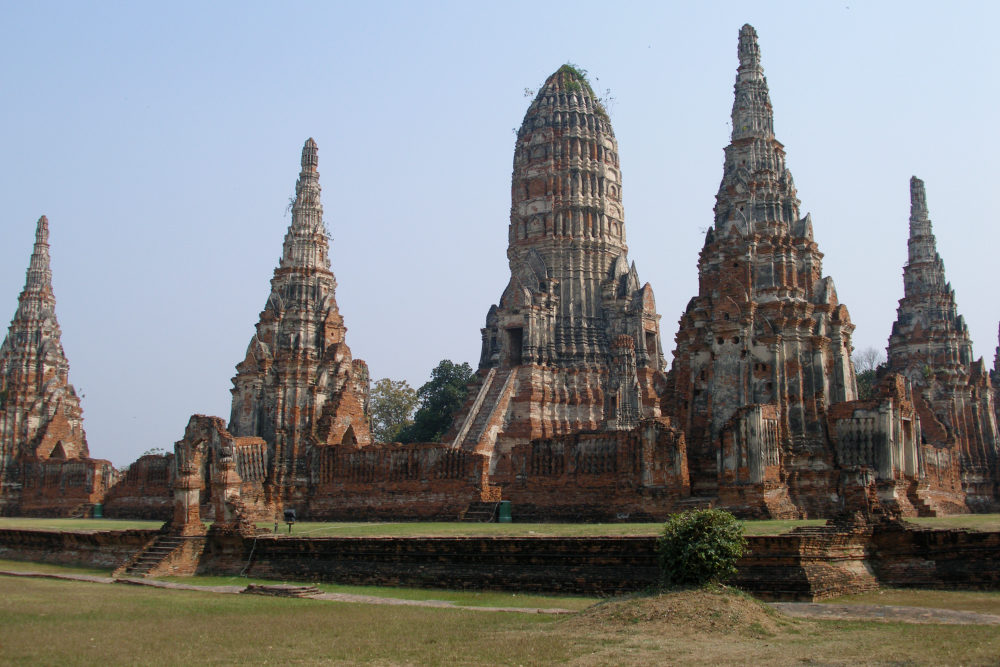
The classic last-day move: ride an ordinary train north for about 1.5–2 hours — a third-class ticket costs less than a coffee — to Ayutthaya, the ruined former capital. Rent a bicycle or charter a tuk-tuk around the island: the Buddha head wrapped in tree roots at Wat Mahathat, the three aligned chedis of Wat Phra Si Sanphet, and the riverside prangs of Wat Chaiwatthanaram, best as the sun drops. You're back in Bangkok around 6 pm — perfectly timed for Yaowarat. The full route and other ways to go are in our Bangkok day trips guide, with the old city covered in depth in the Ayutthaya guide.
If the first two days have used up your legs, Option B stays much closer to home. Take the ~฿10 ferry from the Khlong Toei side over to Bang Krachao, the river bend nicknamed Bangkok's green lung, where the whole island is nearly car-free. Rent a bike for ~฿50–100 and ride the raised concrete paths between coconut groves and stilt houses, stopping at Sri Nakhon Khuean Khan park — and, on weekends, the Bang Nam Phueng local market. The air genuinely feels cooler than the city across the water.
In the afternoon, cross back and head for ICONSIAM, the riverside mall with its own free shuttle boat from Sathorn Pier. Floor G is Sook Siam, a floating market reassembled indoors with air-conditioning, and the river-front terrace makes a good slow walk before the last big meal. Details and every way to arrive are in our ICONSIAM guide.
Whichever option you chose, the last night converges on one place — Yaowarat, Bangkok's Chinatown, after 6 pm, when the Chinese signs light up the whole street and woks start smoking on every corner. Eat in rounds: peppery kuay jab noodle soup, the famous ice-cold bread with Thai tea, roasted chestnuts, and an old-school shaved-ice dessert to finish. Between rounds, duck into Wat Traimit (home of the solid-gold Buddha) or the old alleys off the main strip. The eating route and the area's history are in our Yaowarat Chinatown guide, with a stall-by-stall hit list in the Yaowarat food guide — and the city-wide picture in our Bangkok food guide.
This plan runs on rail and water, and Silom–Sathorn fits it best: full BTS/MRT coverage plus Sathorn Pier nearby for the express boats and the free ICONSIAM shuttle. The riverside trades convenience for views; Sukhumvit (Asok–Thonglor) wins on restaurants and bars; the Khao San–old town side puts the temples within a morning walk. Compare them in where to stay for a first trip and pick a room from the top 10 Bangkok hotels.
Build days around the BTS and MRT (~฿17–62 per ride), adding the orange-flag express boat (~฿16), the ฿5 cross-river ferries and the Saen Saep canal boats near Pratunam. Roads genuinely jam 7:00–9:00 and 16:30–19:30 — in those windows, rail and water beat any car. The systems are explained in our BTS & MRT guide and Chao Phraya boat guide.
Bangkok is hot and walk-heavy — start early, retreat to a mall or café through the worst of the afternoon, then head out again at dusk. Kids tend to love the ferries and express boats more than any temple. On day three, Option B (Bang Krachao + ICONSIAM) is far gentler than Ayutthaya. And if you can pick your month, skip April's peak heat — see the best time to visit Bangkok.
| Category | Budget | Mid-range | Comfortable |
|---|---|---|---|
| Hotel (per night) | ฿400–800 (hostel / guesthouse) |
฿1,500–3,000 (3–4 star) |
฿4,000–10,000+ (riverside / 5 star) |
| Food (3 meals) | ฿150–300 (street food + food courts) |
฿500–1,200 (well-known spots + cafés) |
฿1,500–3,000+ (hotel dining + rooftops) |
| Transport | ฿50–120 (BTS/MRT/boats) |
฿150–300 (+ some Grab) |
฿300–700 (mostly Grab) |
| Admissions / activities | ฿250–400 (the big temples) |
฿350–700 (+ Jim Thompson) |
฿700–1,500 (+ Mahanakhon / cruise) |
| Total per day (est.) | ฿850–1,600 | ฿2,500–5,200 | ฿6,500–15,200+ |
Prices are estimates and shift with the seasons — check before you go · day 1 carries most of the admissions: Grand Palace ฿500 + Wat Pho ~฿300 + Wat Arun ~฿200 · the Ayutthaya day adds train or tour costs on top of this table. Full trip numbers are in our Bangkok trip budget.