Home Bangkok Thailand Bangkok Hotels About
Wherebest  ›  🌏 Asia  ›  🇹🇭 Thailand  ›  Bangkok  ›  Yaowarat Chinatown
🇹🇭 Bangkok · Attraction Guide

Yaowarat (เยาวราช)
Bangkok's Chinatown — gold by day, street food after dark

A 240-year-old Chinese quarter built along a road that curves like a dragon's body. Gold shops, shrines and wholesale lanes through the daylight hours; one of Asia's great street-food strips after sunset — with an MRT station that surfaces right inside the neighbourhood.

What it is

Two neighbourhoods in one street — how Yaowarat works

Around six in the evening, Yaowarat Road changes shifts. The gold shops roll down their steel shutters, the red-and-gold Chinese signs light up one by one, and carts roll out along both kerbs. Charcoal braziers get going, the smell of grilled pork and five-spice duck arrives before the plastic stools have even been unfolded — and within an hour, Bangkok's gold-trading street has turned into its busiest open-air dining room.

This is Yaowarat, Bangkok's Chinatown and one of the oldest Chinatowns anywhere. The Chinese community settled this stretch of riverbank in 1782, when King Rama I moved them from the land where the Grand Palace was about to be built to the Sampeng area just downriver. Yaowarat Road itself came later, cut through the quarter under King Rama V in the 1890s — about 1.5 kilometres long and so full of bends that the Chinese community nicknamed it the "Dragon Road," its head resting at the ceremonial gate on Odeon Circle.

What makes the district unusual is that it runs on two completely different timetables. By day it is a genuine working neighbourhood — gold dealers, dried goods, Chinese medicine, the Sampeng wholesale lane. By night it is a food street where locals and travellers queue side by side at the same carts. And since the MRT Blue Line opened Wat Mangkon station in 2019, getting here is the easy part. For what to actually eat, our separate Yaowarat food guide goes stall by stall.
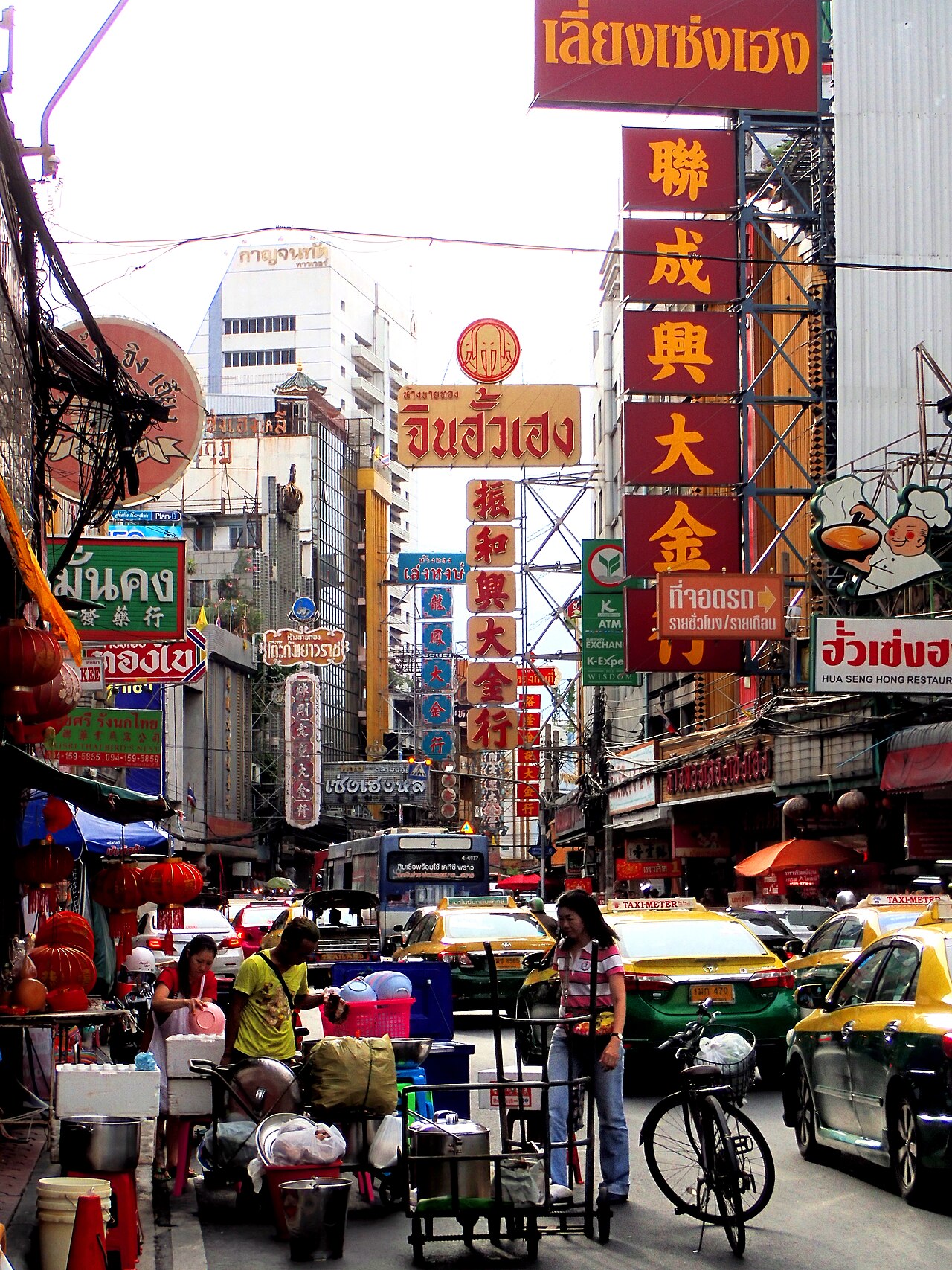
Yaowarat Road by day — red and gold Chinese gold-shop signs, taxis and street-food carts in Bangkok's Chinatown
Daytime Yaowarat — gold-shop signs stacked down the length of the road, carts and everyday neighbourhood life below
🎫
Entry
Free to wander
Wat Traimit charges foreigners about ฿100
🕖
Best time
5–9 pm
Stalls set up at dusk · busiest Fri–Sat
🚇
MRT
Wat Mangkon station
Blue Line · Exit 1 surfaces inside the district
🐉
Age
240+ years
Chinese community here since 1782
📏
Length
About 1.5 kilometres
30–45 min end to end — if you resist the food
⚠️
Mondays
Many carts take the day off
Shophouses, gold shops and temples stay open
Stops to make

5 stops that tell 240 years of Thai-Chinese history

Start at Odeon Circle and work your way into the district — each stop is a few minutes from the last.

Day vs night

Two versions of Yaowarat — pick one, or do both

🌞 Yaowarat by day — gold, markets and lanes

Morning to mid-afternoon is the district's working shift. The old gold houses open their shutters and the red-and-gold signs catch the sun down the whole road; shops sell dried goods, Chinese medicine and bird's nest much as they did fifty years ago. Trok Itsaranuphap — the fresh-market lane locals call the New Market — trades in everything from shiitake mushrooms to complete shrine-offering sets, and Sampeng Lane is at full speed by mid-morning. All of it winds down before 5 pm, so the daytime version has a deadline.

Keep walking a few minutes toward the river and you reach Talat Noi, a pocket of old Chinese shophouses now dotted with street art and quiet cafés tucked into the alleys — a good place to escape the heat before coming back for the evening round.

🌙 Yaowarat by night — the street becomes a dining room

From around 6 pm, carts line up along the full length of the road. The corner of Soi Phadung Dao turns into a cluster of open-air seafood tables, the famous stalls have queues before the neon is even fully on, and the range runs from second- and third-generation family carts to stalls listed in the Michelin Guide and old Chinese desserts that are hard to find anywhere else. It peaks between 7 and 9 pm, and on Friday and Saturday nights the pavement is so full that everyone simply walks on the road. This is also the classic Yaowarat photograph: stand on the central reservation or an opposite corner and shoot the layers of lit Chinese signs receding down the street.

For which stalls to actually queue at, our full Yaowarat food guide has done the picking. If you want a drink afterwards, walk over to Soi Nana on the Charoen Krung side (no relation to the Sukhumvit Nana) where small cocktail bars hide inside old Chinese shophouses. One thing to remember: many of the carts close on Mondays — plan around it if eating is the point.

Tip: If you would rather have someone order for you, evening Chinatown food tours come with a local guide who knows which lane leads where, tells the neighbourhood's story and handles the menu. Browse Yaowarat food tours on Klook →
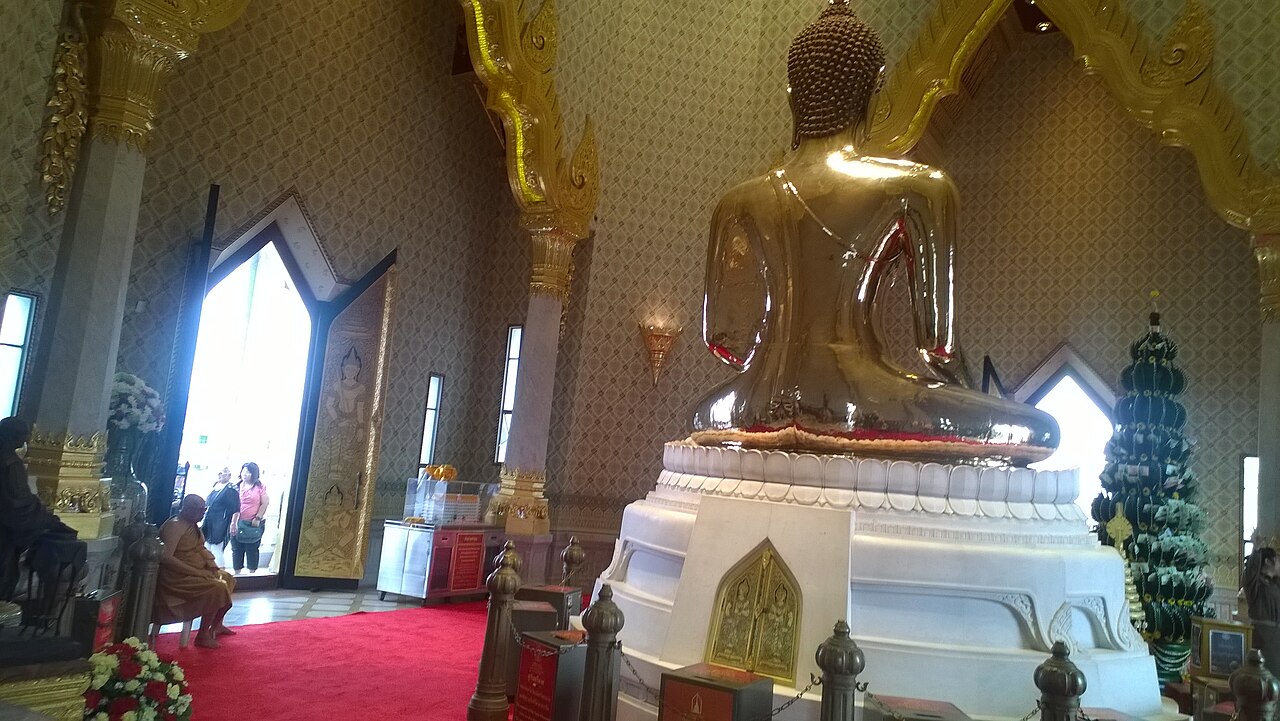
The Golden Buddha (Phra Phuttha Maha Suwanna Patimakon) inside Wat Traimit, Bangkok — a solid-gold statue weighing about 5.5 tonnes
The Golden Buddha inside Wat Traimit's Phra Maha Mondop — solid gold, about 5.5 tonnes, hidden under plaster for centuries

🛕 Shrine-hopping — a half-day merit route

If temples and shrines are your angle, the walk takes two to three hours: start at Wat Traimit with the Golden Buddha, cross past Odeon Circle to the Kuan Yim Shrine at Thian Fa to pray for good health, then follow Charoen Krung Road to finish at Wat Mangkon Kamalawat — about 1.5 kilometres in total, with food the whole way. Dress as for any Thai temple: shoulders and knees covered is the safe default. The Chinese shrines are less strict than the Grand Palace, but respectful dress is never wrong.

Come during a festival and everything doubles in intensity: Chinese New Year (late January–February, dates shift) closes the road for lion dances and genuinely enormous crowds, and the Vegetarian Festival (roughly September–October) raises yellow flags down the whole street while nearly every kitchen switches to a vegetarian menu. These two windows are Yaowarat at full power.

Getting there

How to reach Yaowarat

Since Wat Mangkon station opened, reaching Chinatown has never been simpler — the station exit surfaces inside the district itself.

🚇
MRT Blue Line
Wat Mangkon station, Exit 1
Surfaces on Charoen Krung Road in the middle of the district — about 3 minutes' walk to Yaowarat Road. Fares roughly ฿17–62
⛴️
Chao Phraya Express Boat
Ratchawong pier (N5)
Roughly ฿16–33 — walk up Ratchawong Road about 5 minutes to Yaowarat. Handy coming from Tha Tien or Tha Chang
🚇
MRT Hua Lamphong
Closest to Wat Traimit
Exit 1, then about 5 minutes on foot to Wat Traimit and Odeon Circle — start at the dragon's head and walk in
Timing plan we like best: Start at Wat Traimit around 3 pm (MRT Hua Lamphong), see the Golden Buddha, stop at the Thian Fa shrine, cover Sampeng Lane and Trok Itsaranuphap before the shops close at five — then come back up to Yaowarat Road just as the carts are setting up. Coming from the Grand Palace or Wat Pho? It is only 2 stops on the MRT from Sanam Chai to Wat Mangkon. And in the evening, do not drive: traffic barely moves and parking is close to impossible.
Where to stay

Hotels and guides for your Bangkok trip

Yaowarat sits between the old royal island and the riverside — most central neighbourhoods reach it easily.

Frequently asked

FAQ · Yaowarat practical

Is Yaowarat better by day or at night?
If you only have one shot, go in the evening (roughly 5–9 pm), when the street-food stalls line the road and every neon sign is on. Daytime is a different neighbourhood — the gold shops, shrines, fresh-market lanes and the Sampeng wholesale lane only operate during the day. The best plan is to arrive mid-afternoon, cover the temples and alleys, then stay for dinner. Our Yaowarat food guide covers what to eat.
How much does Wat Traimit (the Golden Buddha) cost, and when is it open?
Wat Traimit opens daily, roughly 8 am–5 pm. Foreign visitors pay about ฿100 to see the Golden Buddha, with a small extra fee for the Chinatown heritage museum on the lower floors of the same building. Fees do drift, so check before you go. Dress as you would for any Thai temple — shoulders and knees covered.
How do I get to Yaowarat by MRT?
Take the MRT Blue Line to Wat Mangkon station and use Exit 1 — you surface in the middle of the neighbourhood, about a 3-minute walk from Yaowarat Road (fares roughly ฿17–62). Starting at Wat Traimit instead? Hua Lamphong station is closer, about 5 minutes on foot. By river, the Chao Phraya Express Boat stops at Ratchawong pier (roughly ฿16–33), a 5-minute walk away. In the evening, skip taxis — traffic crawls and parking is close to impossible.
What is the difference between Sampeng Lane and Yaowarat Road?
Yaowarat Road is the main artery — gold shops, bird's-nest and shark-fin restaurants, and the evening street food. Sampeng Lane (Soi Wanit 1) is the narrow lane running parallel behind it: a daytime wholesale market for fabric, accessories, toys and trinkets, open roughly 9 am–5 pm. It is also where Bangkok's Chinese community first settled in 1782, decades before Yaowarat Road was built. The two are a 2–3 minute walk apart.
Is Bangkok Chinatown really closed on Mondays?
Partly true. Many street carts and pavement stalls take Mondays off (it lines up with the city's street-cleaning day), so the road feels noticeably quieter. Shophouse restaurants, gold shops, the temples and the shrines stay open as usual. If street food is your main reason for coming, pick any other night.
Klook · Bangkok food & walking tours

Evening Yaowarat food tours with a local guide — into the lanes you would not find alone

Night-time Chinatown food walks, old-town history tours and activities across Bangkok — book ahead on Klook, pick your date, and cancel under the listed conditions.

Browse Yaowarat tours on Klook →
Wherebest is an affiliate partner of Klook — we may earn a commission when you book through our links, at no extra cost to you.