Home Bangkok Thailand Bangkok Hotels About
Home  ›  Asia  ›  Thailand  ›  Bangkok  ›  Wat Arun
Bangkok · Attraction Guide

Wat Arun, the Temple of Dawn
The porcelain prang on the Chao Phraya — and Bangkok's best sunset

The spire on the ten-baht coin and on every Bangkok postcard ever printed. Cross the river on a ~฿5 ferry, haul yourself up steps closer to a ladder than a staircase, then come back to the Tha Tien side at dusk and watch the prang turn to silhouette against an orange sky.

What it is

Why Wat Arun is the face of Bangkok

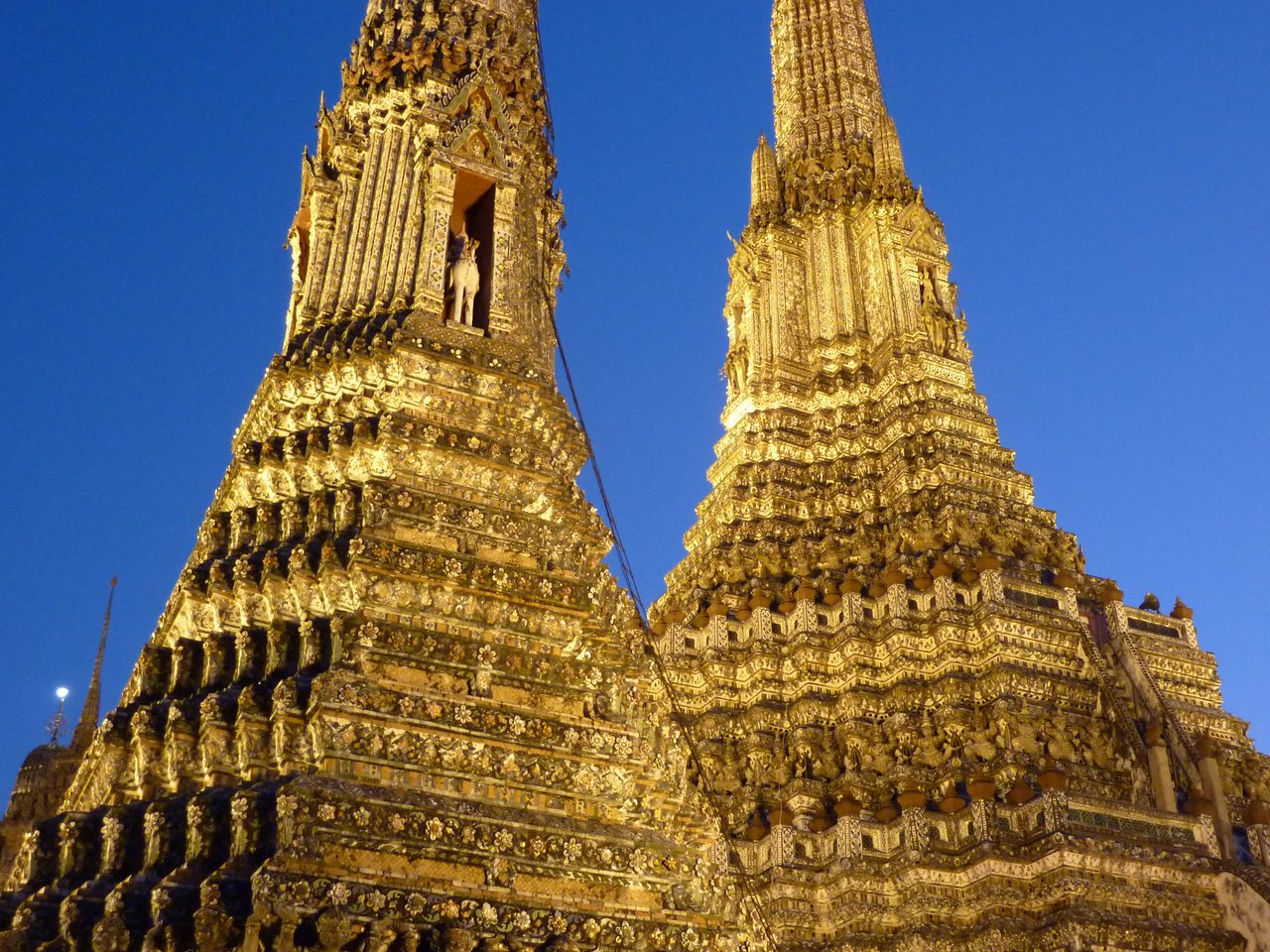
There is a moment, standing on the riverbank at Tha Tien around six in the evening, when the great spire across the Chao Phraya slowly turns from cream to black silhouette against an orange-purple sky. Then the floodlights come on, and the whole tower glows gold, mirrored in a long streak on the water. That is Wat Arun, the Temple of Dawn — the image on the cover of nearly every Bangkok guidebook in print.

The name comes from Aruna, the Hindu god of dawn, and the temple sits at a hinge point of Thai history. The story goes that King Taksin arrived here by boat at first light after the fall of Ayutthaya, and during the Thonburi era this temple housed the Emerald Buddha before it moved across the river to Wat Phra Kaew. The huge Khmer-style prang you see today was raised to its full height in the early 19th century, under Rama II and Rama III. It stands roughly 70–80 metres tall — official figures vary — making it one of the tallest prangs in Thailand.

What sets Wat Arun apart from every other temple is the surface of the prang itself. The entire tower is encrusted with broken Chinese porcelain, fragments of bowls and seashells — easily a hundred thousand pieces — arranged by hand into floral patterns. The closer you walk, the more detail appears, none of it visible from the far bank. And you can climb the steep steps of the base for a closer look. One temple gives you history, craftsmanship, a river view and a small workout you will remember.
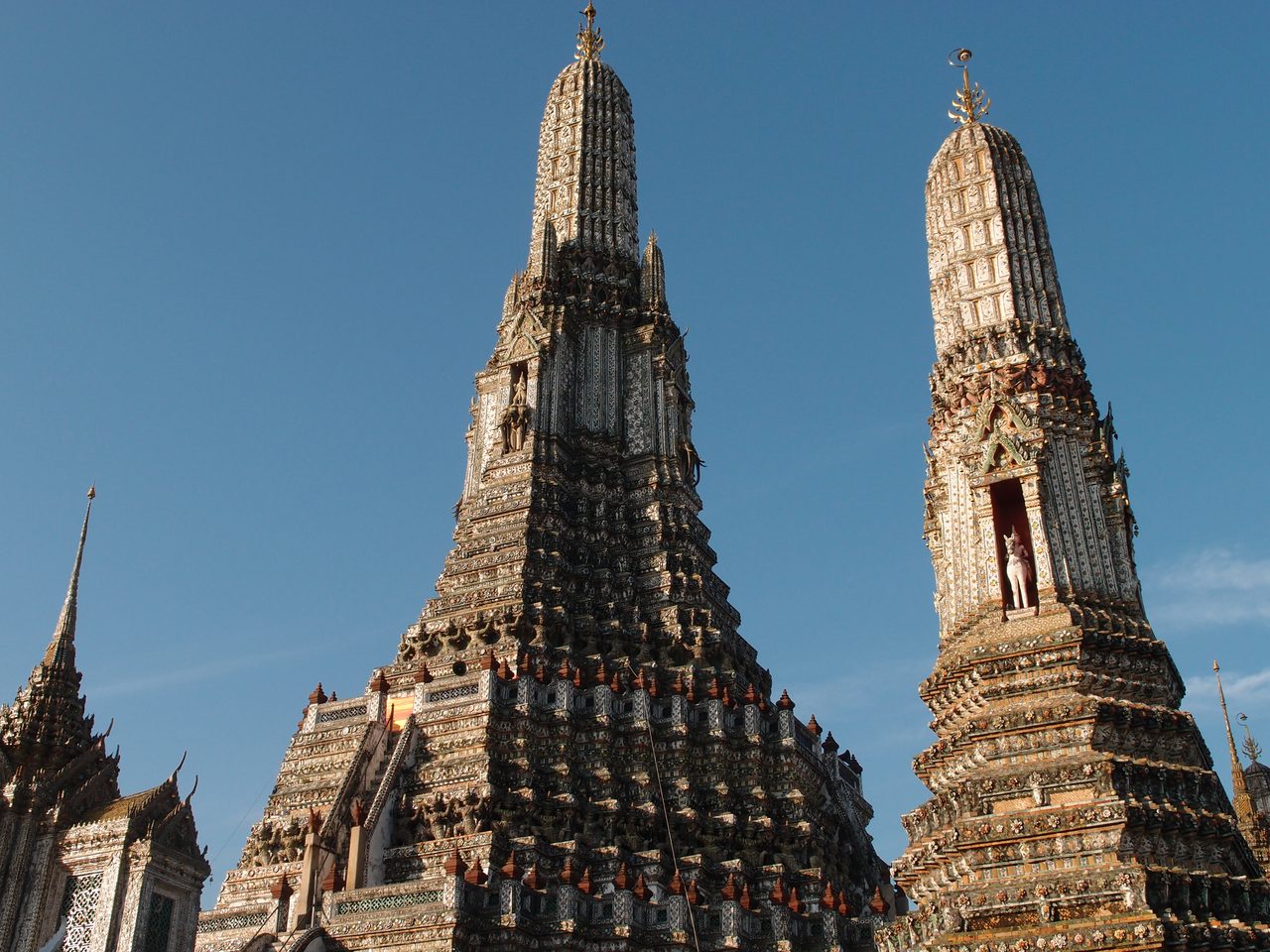
Wat Arun, Bangkok — the Khmer-style central prang encrusted with porcelain, seen from the temple courtyard by day
The prang of Wat Arun — a hundred thousand pieces of porcelain and seashell, more detailed the closer you get
🎫
Entry
About ฿200 (foreigners)
Thai nationals free · fee changes, check before you go
🕗
Opening hours
~08:00–18:00 daily
Prang floodlit in the evening
⛴️
River ferry
Tha Tien → Wat Arun
~฿5 each way · a few minutes across
🛕
The prang
Roughly 70–80 m tall
Khmer style · climbable to the middle terrace
🚇
Metro
MRT Sanam Chai
~10-minute walk to Tha Tien, then the ferry
🌇
Best time
Morning, or dusk
Visit early · watch sunset from across the river
On the ground

5 things to know before you go

From the porcelain on the prang to the genuinely steep steps — know these and the visit gets much better.

Doing it justice: the ~฿200 ticket and 1–1.5 hours is plenty for a self-guided visit. If you want the full historical story, a guided three-temple tour (Wat Pho, Wat Arun and the Grand Palace) is the better format. Browse Wat Arun and temple tours on Klook →
Visiting tips

When to go — and where the best photos are

🌅 Timing the visit

For walking the grounds, the best window is opening time at 8 am — the light is soft, the tour groups have not landed yet, and you can climb the steps without queuing. The courtyard is open ground with almost no shade, and midday through mid-afternoon gets brutally hot: bring water, a hat and sunscreen.

Save the evening for the second show. Leave the temple, ferry back to the Tha Tien side, and settle in by the river for the sun setting behind the prang, roughly 6 to 6.45 pm depending on the season. After dark, do not rush off — the floodlit prang is a different picture entirely.

📸 Where to photograph Wat Arun

The classic "Bangkok postcard" angle is from the Tha Tien riverside, directly opposite the temple — from the public riverbank near the pier, or from one of the rooftop restaurants and cafés whose terraces face the prang. At sunset the riverside seats are the most contested real estate in the old town; book ahead or arrive early.

Two more angles worth having: from the middle of the ferry crossing, with the prang filling the frame and nothing in the way — and the looking-up shot inside the temple, standing close against the base with the porcelain patterns running up into the sky. If you have rented a Thai costume, this is where it earns its fee.

Wat Arun after sunset — the prang floodlit gold against a deep blue evening sky over the Chao Phraya
Wat Arun after sundown — floodlights turn the whole prang gold, free to watch from the Tha Tien riverside

🍜 Eat, drink and keep going

The temple side has drink stands, ice cream and a few small cafés near the entrance, but the real eating is across the water at Tha Tien — the lanes by the pier hold noodle shops, rice-and-curry counters and riverfront restaurants at every price, all with the prang for a backdrop.

Moving on is easy. The ferry drops you a few minutes' walk from Wat Pho and its 46-metre Reclining Buddha, with the Grand Palace a short walk beyond. Those three make the classic old-town temple circuit, very doable in a single day — pace yourself, it is a lot of walking in the heat.

Getting there

How to reach Wat Arun

The temple stands on the Thonburi bank, with no rail station at its gate — but the river route is half the fun, and easier than it sounds.

⛴️
Cross-river ferry
Tha Tien → Wat Arun pier
~฿5 each way, departures all day, a few minutes across — the classic route
🚇
MRT Blue Line
Sanam Chai station
Exit by Wat Pho, walk ~10 minutes to Tha Tien, then take the ferry
🚤
Chao Phraya Express Boat
To Tha Tien (~฿16–33)
From Sathorn pier (BTS Saphan Taksin) heading upriver · some blue-flag Tourist Boats stop at the Wat Arun pier itself
The one-day route that works: MRT to Sanam Chai → the Grand Palace at its 8.30 opening → walk to Wat Pho late morning → ferry across to Wat Arun in the afternoon → back to the Tha Tien side for a riverside table at sunset. One honest warning: if a friendly stranger near the gates tells you "the temple is closed today" and offers a tuk-tuk to somewhere better, walk on and check the gate yourself — the temples almost never close mid-day, and that detour ends at a gem shop. Boat lines, flags and fares are all explained in our Chao Phraya boat guide.
Nearby

Pair Wat Arun with what's close by

All along the Chao Phraya in the old royal quarter — easy to combine in one day.

Frequently asked

FAQ · Wat Arun practical

How much does Wat Arun cost?
Entry for foreign visitors is around ฿200 per person; Thai nationals enter free. The fee has been raised more than once in recent years, so check the current price before you go. The temple is open roughly 08:00–18:00 daily.
Can you climb Wat Arun, and how steep are the steps?
Yes — you can climb to the middle terrace of the central prang's base, though not to the top. The steps are genuinely steep, closer to a ladder than a staircase, and you will want both hands on the rail. Coming down is harder than going up: turn sideways or descend backwards, slowly, in shoes with decent grip. It is not a climb for bad knees or anyone uneasy with heights, and sections sometimes close for restoration — check on the day.
How do you get to Wat Arun?
The classic way is the cross-river ferry from Tha Tien pier — about ฿5 each way, and the crossing takes only a few minutes. By rail, take the MRT Blue Line to Sanam Chai and walk roughly 10 minutes to Tha Tien. The Chao Phraya Express Boat (~฿16–33) also stops at Tha Tien, and some blue-flag Tourist Boat services call directly at the Wat Arun pier on the temple side. More in our Chao Phraya boat guide.
Where is the best place to watch the sunset at Wat Arun?
Not inside the temple — the best view is from the opposite bank of the river. The Tha Tien side has several riverside restaurants and rooftop cafés that face the prang directly, and the sun sets behind the temple. Arrive half an hour before sunset and you get both the golden-hour silhouette and the floodlit prang after dark. Riverside seats go fast, so book ahead or come early. An evening Chao Phraya cruise, which passes right in front of the temple, is the other good option.
What should you wear to Wat Arun?
It is a major royal temple, so dress respectfully: sleeves that cover the shoulders and trousers or a skirt covering the knees. Avoid tank tops, sleeveless shirts, short shorts and tight leggings. The rules are enforced slightly more gently than at the Grand Palace, but they are enforced — cover-up wraps can be rented near the entrance for a small fee. Remove hats and shoes before entering the ordination hall, and do not climb or sit on any part of the prang that is closed off.
Klook · Bangkok

Guided temple tours and Chao Phraya dinner cruises past Wat Arun

Book a guided Wat Arun–Wat Pho–Grand Palace circuit, or a dinner cruise that glides past the floodlit prang after dark — reserved through Klook in advance, no haggling at the pier.

Browse Bangkok activities on Klook →
Wherebest is an affiliate partner of Klook — we may earn a commission when you book through our links, at no extra cost to you.