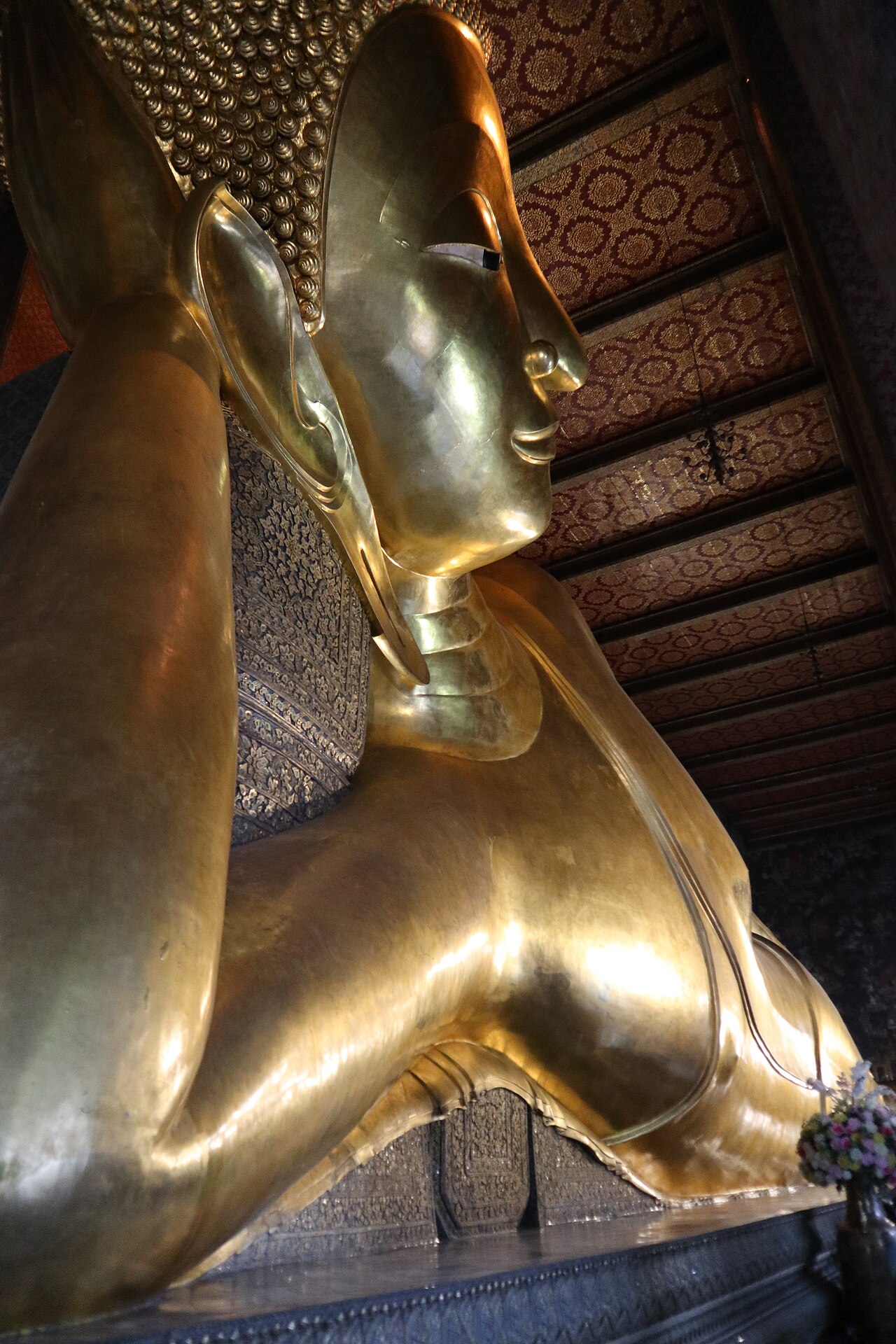
The old temple next door to the Grand Palace, where a gold-plated Buddha stretches the full length of its hall — study the mother-of-pearl feet, drop coins into 108 bronze bowls, then finish with a massage from the oldest massage school in Thailand.
There is a moment, just past eight in the morning, when you slip off your shoes, step over the temple threshold and meet it: a gold figure 46 metres long, reclining the entire length of the hall, morning light catching the face while the slow chime of coins dropping into bronze bowls carries from the far side. That is most people's first minute at Wat Pho — and it explains, instantly, why this temple sits on travel lists the world over.
Wat Pho — formally Wat Phra Chetuphon — is older than Bangkok itself. The temple predates the capital and was grandly rebuilt by Rama I when the city was founded, which is why it sits a ten-minute walk from the Grand Palace. The giant Reclining Buddha came later, built under Rama III around 1832. Inside the walls you will find more than a thousand Buddha images, 91 chedis of every size, and big stone Chinese guardian figures that arrived as ship's ballast in the junk-trade era.
What lifts Wat Pho above "another beautiful temple" is its claim to be Thailand's first university. Rama III had treatises on medicine, massage and literature carved onto stone tablets set around the pavilions, free for anyone to come and study — and that legacy is still alive. The Wat Pho Thai Traditional Massage School teaches to this day, and its pavilion inside the temple will take your name for a real massage any afternoon. This is a temple you can sightsee and then actually use.
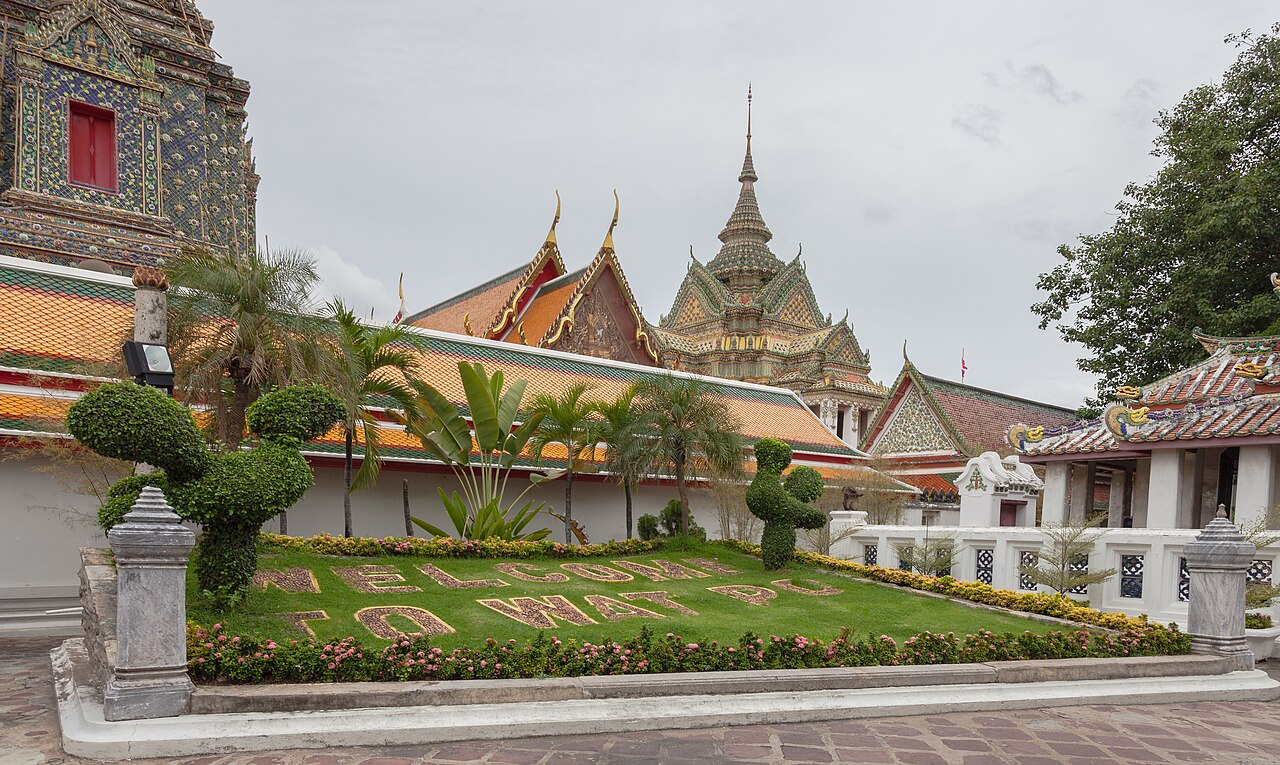
From the Reclining Buddha hall to the massage pavilion — the temple takes a relaxed 1.5–2 hours, and this order works on the ground.
Brick and plaster under gold leaf, 46 metres long and 15 metres high, the Buddha fills its hall so completely that you walk it column by column. The shot everyone queues for is the diagonal from near the feet, which fits the whole figure in one frame. But do not stop at the face — the soles of the feet, inlaid with mother-of-pearl in 108 auspicious symbols, are the finest craftsmanship in the building. On the way out, exchange about ฿20 for a bowl of coins and drop them one by one into the 108 bronze bowls along the wall; that long ringing chime is the sound of Wat Pho.
Wat Pho is home to the oldest school of Thai medicine and massage in the country, and inside the temple a pavilion offers massages from practitioners trained in this tradition. Sightsee until your legs ache, then hand yourself over for a foot or full-body hour — there is no better-placed massage anywhere. Put your name on the list at the pavilion and wait to be called; on weekend afternoons the queue can run past an hour, so come early or after 4 pm if the massage is your priority.
The four great chedis at the centre — sheathed in green, white, yellow and blue glazed tiles — were each dedicated to one of the first four kings of the Chakri dynasty, and they catch morning and late-afternoon light in completely different moods. Spread around them are 91 chedis in total, which means you can always wander a row over and find a quiet corner. Keep an eye out for the oversized stone Chinese guardians at the gateways, leftovers from the junk-trade days when they sailed here as ballast.
Before Thailand had schools, people came here to learn. Rama III had treatises on medicine, massage and literature carved into stone tablets and mounted around the pavilions, open to anyone — a collection now inscribed in UNESCO's Memory of the World register. Pair them with the statues of hermits demonstrating stretching poses on the rock garden mounds, and you realise the massage you just had in the pavilion has its original textbook written on these walls.
Wat Pho's location is half its charm: step out of the river-side gate and you are in Tha Tien, a strip of old shophouses now full of cafés and riverside restaurants. From the pier, a cross-river ferry costing about ฿5 shuttles you over to Wat Arun in a few minutes. Climb the prang in the late afternoon, then come back to the Tha Tien side for a riverside table at sunset, when the prang turns to silhouette — one of the best half-days Bangkok has to offer.
The temple opens around 8 am, and the first hour is the golden one — the Reclining Buddha hall is still quiet, morning light angles through the windows, and the heat has not arrived. Tour groups land heaviest from 10 am to 3 pm, which is also when the sun is at its worst; if that is your slot, expect a queue for the classic photo at the Buddha's feet.
The other excellent window is after 4 pm: the crowds thin out, the low light makes the tiled chedis far prettier than they are at noon, and the timing flows straight into the ferry to Wat Arun or a riverside table at Tha Tien for sunset. You will be outdoors a lot, so keep drinking water — your ticket comes with a free bottle, so use it.
Wat Pho's dress rules are slightly softer than the Grand Palace's, but the principle is the same: shoulders covered, trousers or a skirt past the knee, no tank tops or short shorts. You take your shoes off before the Reclining Buddha hall — a cloth bag is provided so you carry them through and return the bag at the exit. Inside, keep voices low, never point the soles of your feet toward the Buddha, and tuck your feet away if you sit down.
One thing worth knowing in advance: the streets outside are famous for a classic line — a tuk-tuk driver or friendly stranger tells you "the temple is closed today" and offers to take you to another temple or a gem shop instead. Wat Pho opens every single day of the year. Walk to the gate and see for yourself; smile, decline, keep walking.
If you are having a massage at the temple pavilion, the smart order is to sightsee first and finish with the massage — walk the Buddha hall, the chedis and the inscriptions for an hour and a half, then sign up for a foot or full-body hour (around ฿300–500; check prices on the day). The walking ache disappears right on schedule. If it hooks you, the Wat Pho massage school runs proper multi-day courses just outside the temple walls.
Afterwards, take the river gate out to Tha Tien — old shophouses turned into cafés and restaurants with views across to the prang of Wat Arun. Ride the ฿5 cross-river ferry over before evening, then come back to this bank for a rooftop or riverside seat at sunset, when Wat Arun goes to silhouette against the orange sky. That photograph is the one Bangkok is remembered by.
Wat Pho sits on Rattanakosin Island, which has no BTS Skytrain — but the MRT Blue Line stops at Sanam Chai, a few minutes' walk away, so it is far easier to reach than most people expect.
Everything here sits on Rattanakosin Island or just across the river — on foot or one short ferry apart.