Home Chiang Rai Thailand Chiang Rai Hotels About
Home  ›  Asia  ›  Thailand  ›  Chiang Rai  ›  First-Timer Guide
Chiang Rai First-Timer Guide · 2026

Your first trip to Chiang Rai
Northern Thailand's city of art, mountains and tea

A glittering all-white temple, a sapphire-blue one, a dark and unsettling Black House, cool mountain air on Doi Tung and tea hills rolling to the horizon — Chiang Rai is Thailand's far-northern province where bold contemporary art meets the cool, green highlands. This guide is built from verified facts and real visitor accounts to get you ready before you leave home.

Why Chiang Rai

Northern Thailand where art, mountains and tea meet

Seen the photos of a dazzling all-white temple with a bridge crossing a "sea of reaching hands"? That is Wat Rong Khun, artist Chalermchai Kositpipat's life's work — and it is just one corner of Chiang Rai, Thailand's northernmost province, which brings three things together: bold, surreal contemporary art; cool, high mountains like Doi Tung and Doi Mae Salong; and rolling green tea plantations stepping up the hillsides.

The heart of a first trip is three threads — the three landmark temples (the white Wat Rong Khun, the blue Wat Rong Suea Ten, and Thawan Duchanee's Baan Dam) · the Golden Triangle and Chiang Saen, where Thailand, Laos and Myanmar meet on the Mekong · and Doi Tung and the tea hills, cool and scenic right through the dry season. This is a city you come to in order to slow down and breathe the cool air, not a city to rush — see the full picture in our complete Chiang Rai guide →

A note: the information here is compiled from public sources and real visitor accounts. Prices, opening hours and entry fees can change — always check the latest before you travel.
Plan your trip

How many days is enough?

The honest answer: two days covers the in-town highlights — the three temples (Wat Rong Khun, Wat Rong Suea Ten and Baan Dam) plus the clock-tower light show and the Night Bazaar. With three days you have room for the Golden Triangle and Chiang Saen, or Doi Tung and the Mae Fah Luang Garden, plus Singha Park or the tea hills. Many people add Chiang Rai as a two-to-three-day extension from Chiang Mai.

🗓️
2 days — the in-town highlights
Best for first-timers short on time

Day 1: Wat Rong Khun (the White Temple) → Wat Rong Suea Ten (the Blue Temple) → Baan Dam → the Clock Tower after dark → the Night Bazaar. Day 2: Singha Park or Choui Fong tea → a temple in town → the Walking Street (if it falls on a weekend), or head out to the Golden Triangle.

📆
3 days — slower + into the hills
Best if you want to go deeper

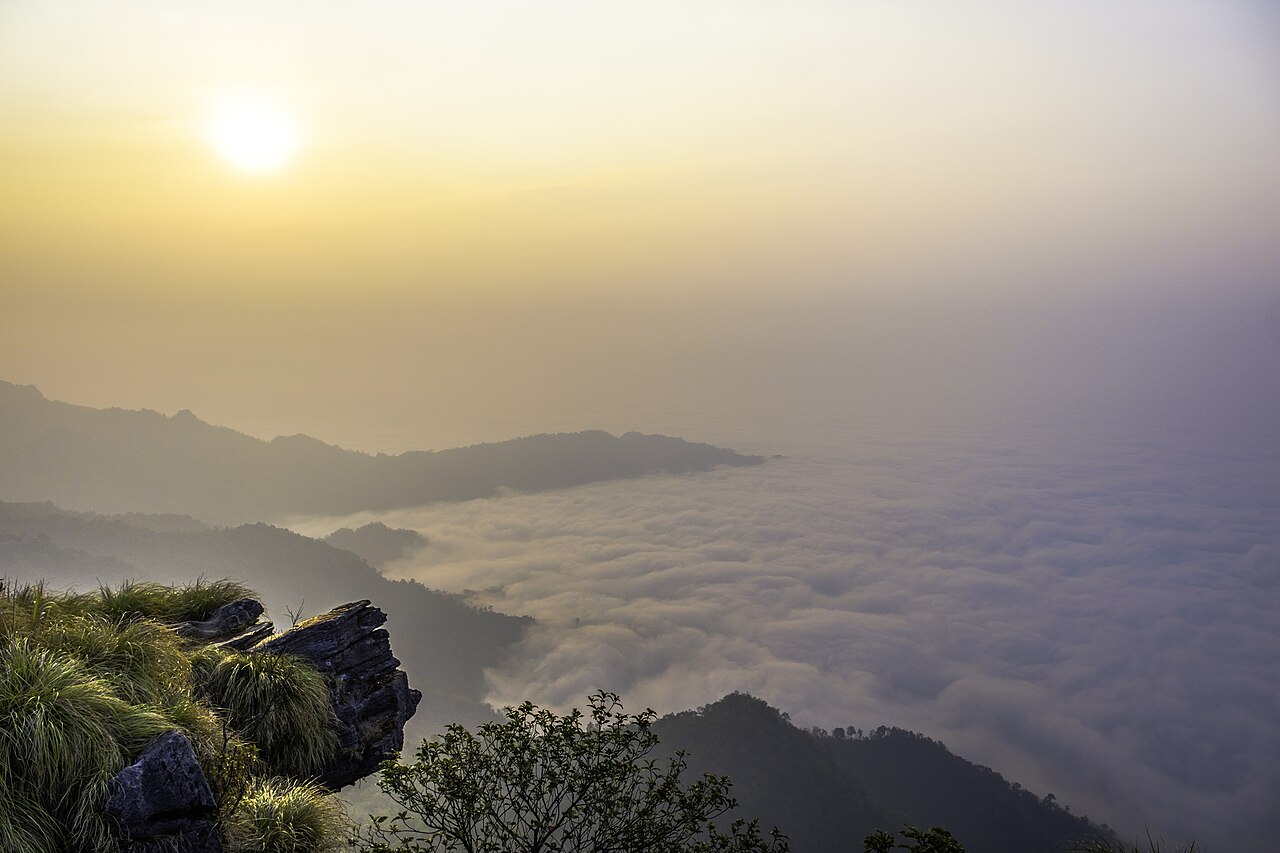
+Day 3: the Golden Triangle + Chiang Saen on the Mekong, or Doi Tung + the Mae Fah Luang Garden. For something more adventurous, head up to Doi Mae Salong (a Yunnanese-Chinese hill village and tea) or to Phu Chi Fa for the cool-season sunrise sea of mist.

There is a plan for each length: 2 days, 1 night · 3 days, 2 nights — or check when to go before you book.

Before you go

When to go + money and internet

The best window
The cool season, Nov–Feb

November to February is the best — cool (days around 28–31°C, cool nights around 14–20°C), clear, and with the cleanest air, ideal for the temples, the tea hills and the mountains. The rainy season, May to October, is green, far cleaner and cheaper, with fewer crowds — October is the sweet spot (rains easing, waterfalls full, prices still low). See month-by-month detail in when to visit →, or compare the whole country in when to visit Thailand →

Avoid: Songkran in mid-April (crowded, very hot, prices up).
🔥 The burning season — straight up
Feb–Apr, March worst

This is the thing to know before you book. From February to April (March is worst), agricultural and forest burning across the north sends PM2.5 high — Chiang Rai has recorded March averages above 100 µg/m³, with the AQI often over 150 — leaving hazy skies, mountain views lost in the smoke, and temperatures near 40°C. Travellers who are sensitive or have respiratory issues should avoid this window. If you can't, pack an N95 mask and check the daily air quality before heading out.

The fix: come in the cool or rainy season instead — far better views and far easier to breathe.
Money, internet and etiquette: the town widely takes PromptPay/QR and cash, but small market and hillside stalls are often cash-only, so carry ฿500–1,000 · for a local SIM or eSIM, see our Thailand eSIM & SIM guide → · at the temples and Baan Dam, dress modestly (cover shoulders and knees), remove shoes where signed, and keep your voice down.
Getting to Chiang Rai

How to reach Chiang Rai

Chiang Rai has no train — Thailand's Northern rail line ends at Chiang Mai, so arriving by rail means a train to Chiang Mai and then a bus or van for about three hours. Most people fly or take a bus. Here is what suits whom.

Fly — the fastest way
Mae Fah Luang–Chiang Rai Airport (CEI)

Direct flights from Bangkok Don Muang (DMK) / Suvarnabhumi (BKK) land at Mae Fah Luang–Chiang Rai International Airport (CEI) in about 1 hour 20 minutes, with several daily, plus some regional routes. The airport is only ~10 km from the centre — but since August 2024 there is no airport bus into town, leaving a taxi, Grab or a pre-booked transfer.

Bus / van — the main overland way
Hourly from Chiang Mai · overnight from Bangkok

GreenBus from Chiang Mai runs hourly in about 3 to 3 hours 45 minutes (the VIP service is a touch quicker), with fares around ฿250–600 — the popular choice if you are already in Chiang Mai. From Bangkok there are overnight coaches from Mo Chit, about 11–12 hours. There are vans from Chiang Mai too; both drop at the Chiang Rai bus terminal, from where a songthaew or Grab takes you to your hotel.

Self-drive: ~3 hours from Chiang Mai (Route 118), scenic, with some winding sections.
⚠️ No train reaches Chiang Rai: the railway ends at Chiang Mai, so to come by rail you take the train to Chiang Mai and then a GreenBus or van for about three hours. To save the most time, flying direct into CEI is the better bet — but if you are visiting Chiang Mai anyway, the bus across is easy and good value.
Getting around

What to use in and around town

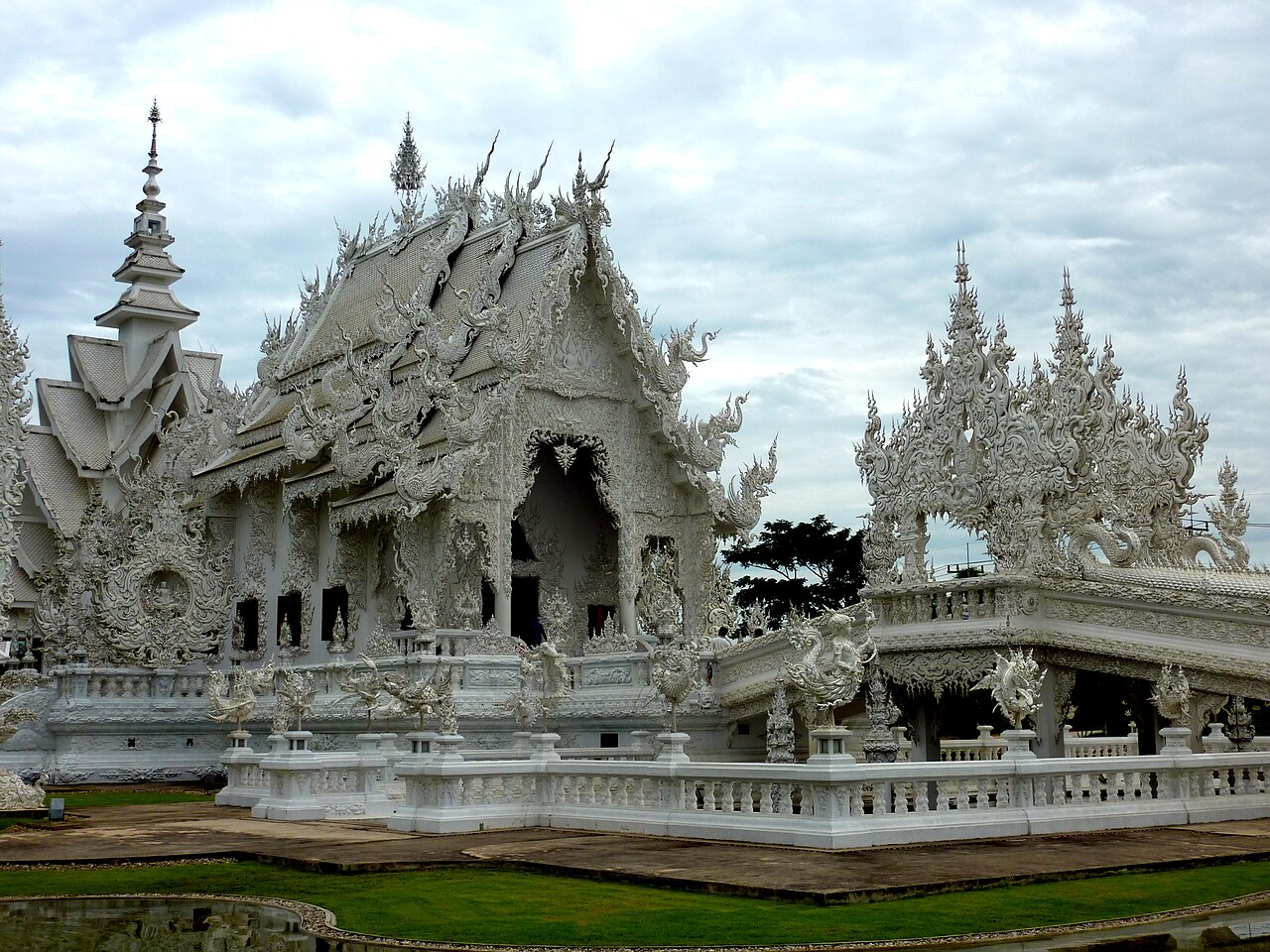
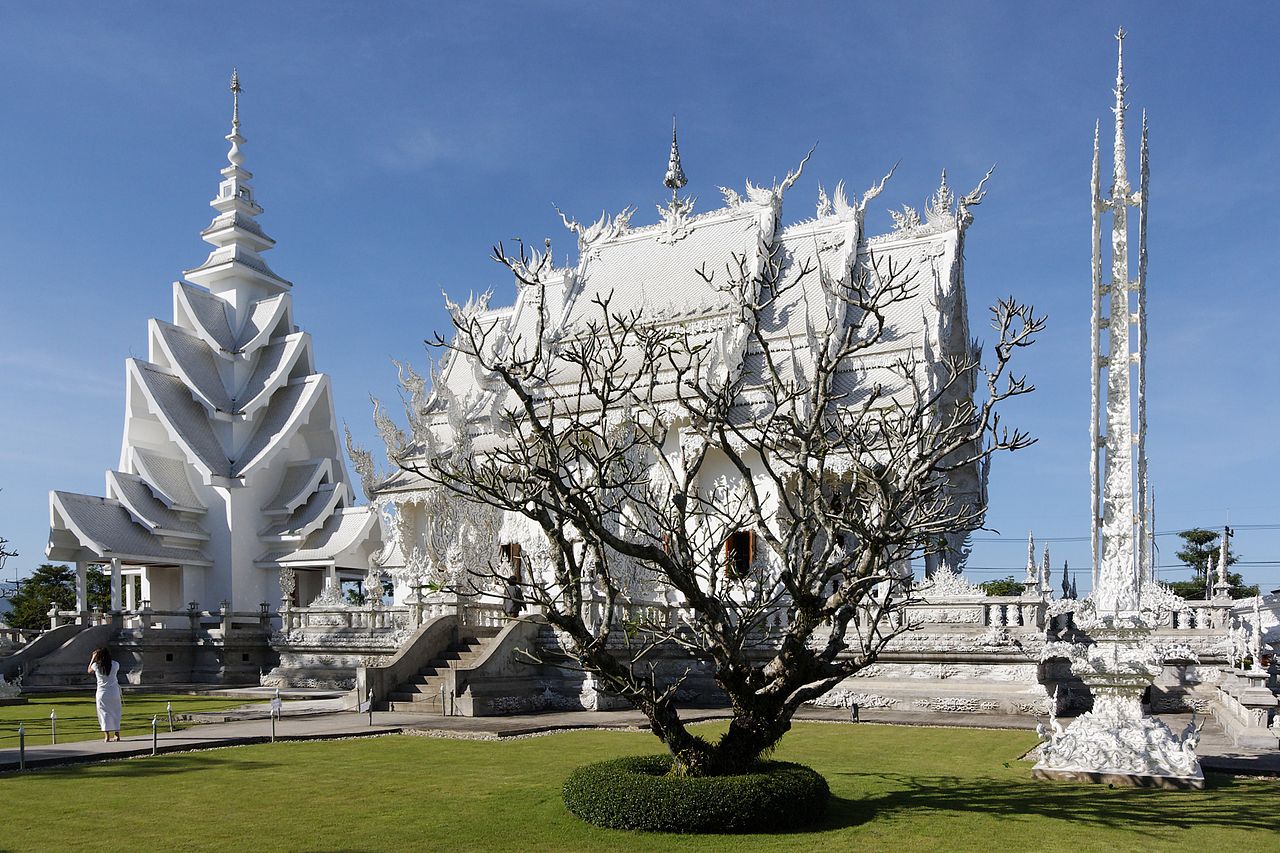
Wat Rong Khun (the White Temple) in Chiang Rai — an all-white temple sparkling with mirrored glass, with a bridge over a 'sea of reaching hands' in front
Getting around Chiang Rai — no metro
Songthaew · tuk-tuk · Grab · scooter

Chiang Rai has no metro, no BTS/MRT and no city train. The small centre around the Clock Tower and Night Bazaar is walkable, and otherwise you get around by songthaew (shared blue/red pickups), tuk-tuk (agree the fare before you get in — be blunt about where and how much), Grab (it works, but supply is limited and you may wait), or a rented scooter. The temple-circuit sights and the mountains are spread out beyond town — the easiest option is a hired car with driver or a half- or full-day tour. See detail in our getting around Chiang Rai guide →

Tip: a half-day car for the three temples is great value · for Doi Tung, Mae Salong or Phu Chi Fa the roads are steep and winding, so a driver is safer than riding yourself.
🛵
Renting a scooter — honestly
Maximum freedom, but mind the safety

Scooters rent around town for ~฿200–300 a day and give you freedom for the city and nearby spots. But be straight with yourself: you need an International Driving Permit (police do check), wear a helmet every time, and watch the roads up to Doi Tung, Doi Mae Salong and Phu Chi Fa, which are steep and very winding. If you are not used to mountain roads, riding them yourself is risky — for those routes a hired car with driver is safer and far more comfortable.

Safer mix: use Grab or a songthaew in town · take a driver or a tour up the mountains and on the temple circuit.
⚠️ Chiang Rai has no metro — plan by geography: the sights are spread out (Wat Rong Khun ~13 km south of town · Baan Dam to the north · the Golden Triangle ~60 km north · Doi Tung ~60 km northwest), with no metro map to follow. The fix: group your sights by direction — a temple day in and near town, a Golden Triangle / Chiang Saen day, a separate Doi Tung / tea-hills day — then match a charter or a tour to each route. That is the most efficient way to use your time.
Where to stay

Which area to base in

In Chiang Rai you can choose your base by the kind of trip you want — the centre for walk-to-the-night-market convenience, the riverside for calm, the hills for tea-country views. Learn the areas first and choosing a hotel gets much easier. See real hotel reviews in our Top 10 Chiang Rai hotels →

City centre — Clock Tower / Night Bazaar
Walk to everything — the best first-timer base

The heart of town, within walking distance of the Clock Tower with its evening light show and the Night Bazaar for food and crafts. Stays range from budget guesthouses to mid-range hotels, and it is easy to hail a ride out to the sights. This is the answer if it is your first visit and you want to make the most of your time.

Best for: first-timers, walking to food, budget to mid-range.
By the Kok River
Calmer, with resorts

Stay along the Kok River to the north of town for a calmer feel than the centre, with riverside resorts and view rooms to choose from. It suits a relaxed pace away from the bustle, and you can still reach the centre with a short ride.

Best for: a relaxed stay, couples, families with a car.
Out of town / hills / tea country
Mountain views, need transport

The countryside and tea-covered hills around town hold boutique resorts with mountain and plantation views, where you wake to light mist over the slopes. Ideal for photographers and anyone who wants the atmosphere the city can't give — but you need a car or a charter, as these spots are far out with no public transport.

Best for: nature lovers, photographers, travellers with their own transport.
Near the bus terminal
Good value, transit-handy

Staying near the bus terminal and Night Bazaar suits arriving by bus from Chiang Mai or Bangkok and moving on afterwards. It is usually better value than the tourist core, and you can still walk to the Night Bazaar and the evening food.

Best for: arriving and leaving by bus, travellers watching the budget.
The essentials

Sights no first-timer should miss

Chiang Rai has plenty to see, but on a first visit these are the core everyone should experience — see the full list in Chiang Rai attractions → or day trips from the city →

Wat Rong Khun (the White Temple) in Chiang Rai — an all-white ubosot inlaid with mirrored glass, with a bridge over the sea of reaching hands
The number-one highlight · ~13 km south

An all-white temple inlaid with mirrored glass, the life's work of artist Chalermchai Kositpipat. A bridge crosses a "sea of reaching hands" rising from below, the ubosot is filled with surreal modern-culture murals, and a golden building (the toilets) contrasts with the white. Go early to beat the crowds and heat; foreign entry is around ฿100, and dress modestly.

Getting there: ~13 km south of town · songthaew / Grab / tour
Wat Rong Suea Ten (the Blue Temple) in Chiang Rai — a sapphire-blue and gold temple housing a large white Buddha
A sapphire-blue temple · in town

A vivid sapphire-blue temple trimmed in gold, with a large white Buddha glowing against the bold blue-and-gold interior, designed by a student of Chalermchai. It sits on the north bank of the Kok River in town, is free (donations welcome), and pairs perfectly with the White Temple on the same day.

Location: in town, north bank of the Kok River
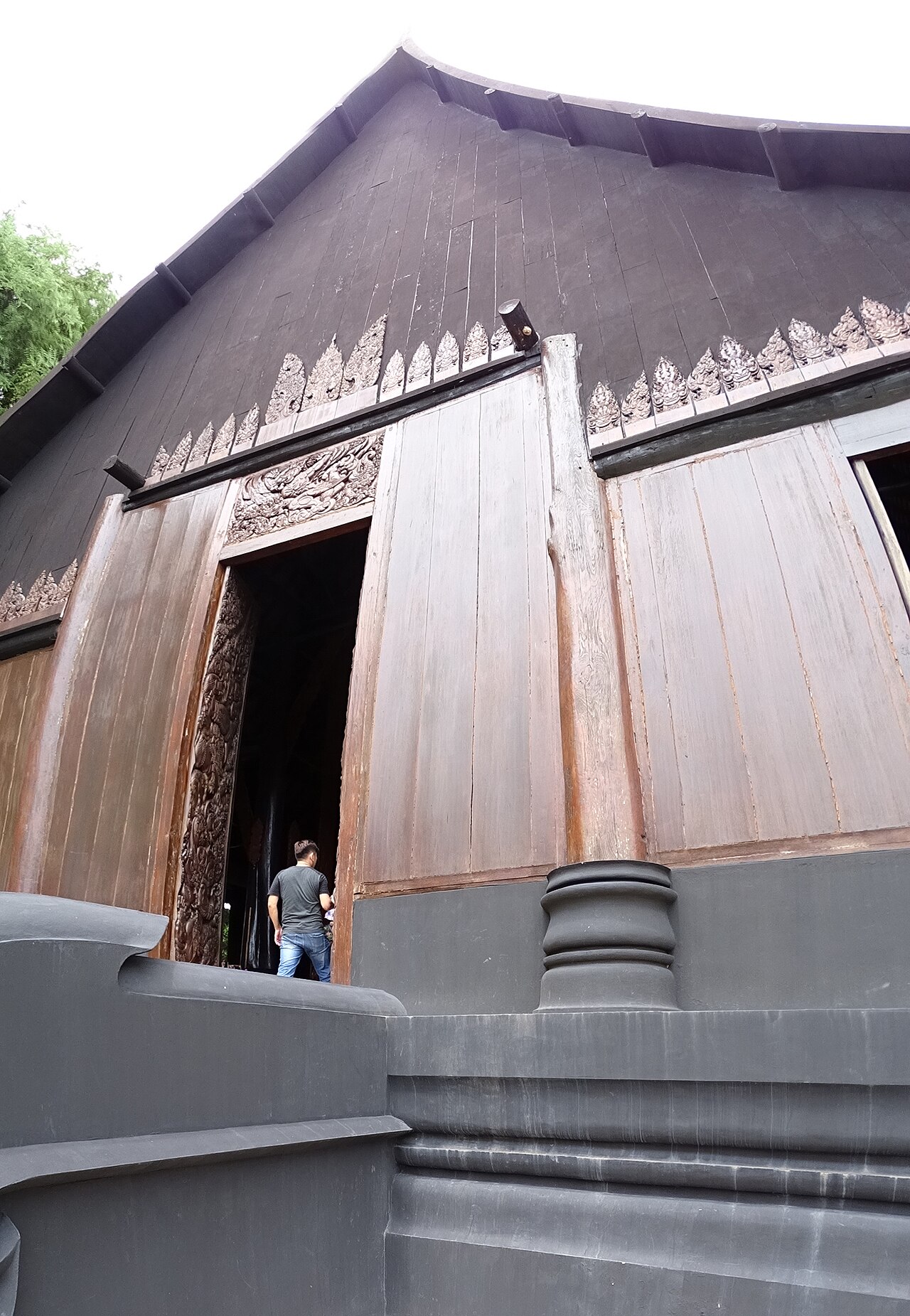
Baan Dam (the Black House Museum) in Chiang Rai — dark teak Lanna pavilions filled with bones, hides and carvings
Dark teak pavilions · north of town

Around 40 dark teak Lanna pavilions by the late artist Thawan Duchanee, filled with animal bones, hides, horns and carvings — the brooding "yin" to the White Temple's "yang". The mood is unsettling but fascinating; there is an entry fee, dress modestly, and it sits north of the city.

Location: north of town · Nang Lae area
The Golden Triangle at Chiang Saen — where Thailand, Laos and Myanmar meet on the Mekong, with a large golden Buddha by the river
Where three countries meet · ~60 km north

The point where Thailand, Laos and Myanmar meet on the Mekong (Sop Ruak), with a viewpoint and a big golden Buddha by the river. Take a long-tail Mekong boat (you can step across to the Don Sao market on the Laos side — be clear on the border formalities), visit the opium museums, and explore the ancient town of Chiang Saen with Wat Chedi Luang. A half- or full-day by charter or tour.

Getting there: charter or tour, ~60 km north
Doi Tung and the Mae Fah Luang Garden in Chiang Rai — cool-climate flower gardens on the mountain beside the Swiss-style royal villa
A cool mountain + flower garden · ~60 km

A royal mountain project — the Mae Fah Luang Villa (the Princess Mother's Swiss-style residence), the Mae Fah Luang Garden of cool-climate flowers, Wat Phra That Doi Tung, and the arabica coffee and macadamia of the Doi Tung development. The air is cool right through the dry season; combo tickets cover the sites, and the steep, winding climb means you need a car or a tour.

Getting there: ~60 km northwest · charter / tour
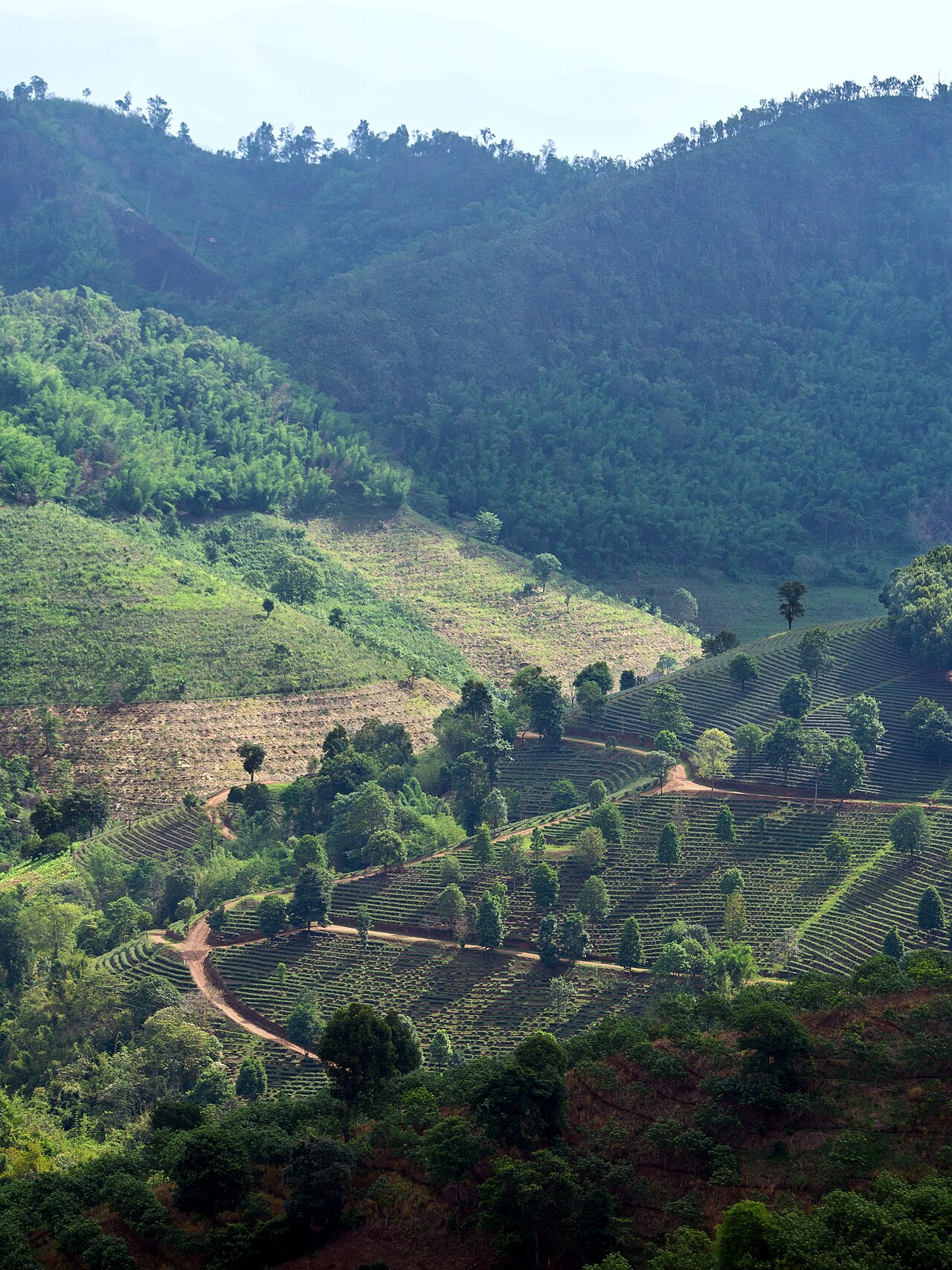
Singha Park in Chiang Rai — a vast landscaped farm with green tea plantations, a lake and the large golden lion landmark
A tea-plantation farm-park · ~12 km west

A huge landscaped farm-park by Boon Rawd — green tea plantations as far as you can see, a lake, cycling and tram tours, a balloon and a zip-line, a café, and the big golden lion landmark. Nearby, Choui Fong tea has lovely mountain views and a café over the rows. Entry is free (activities are paid), and it is at its best in the cool season.

Location: ~12 km west of town
Want to see more: Doi Mae Salong (a Yunnanese-Chinese hill village and tea) · Phu Chi Fa (the cool-season sunrise sea of mist) · Khun Korn Waterfall — see them all in Chiang Rai attractions → · day trips →
What to eat

Chiang Rai food you have to try

Chiang Rai food is northern Thai (Lanna) at heart, with a Tai Yai (Shan) edge and a Yunnanese-Chinese thread from Doi Mae Salong that sets it apart — built around khao soi, nam ngiao, sai ua and the chilli dips. See more in our Chiang Rai food guide →

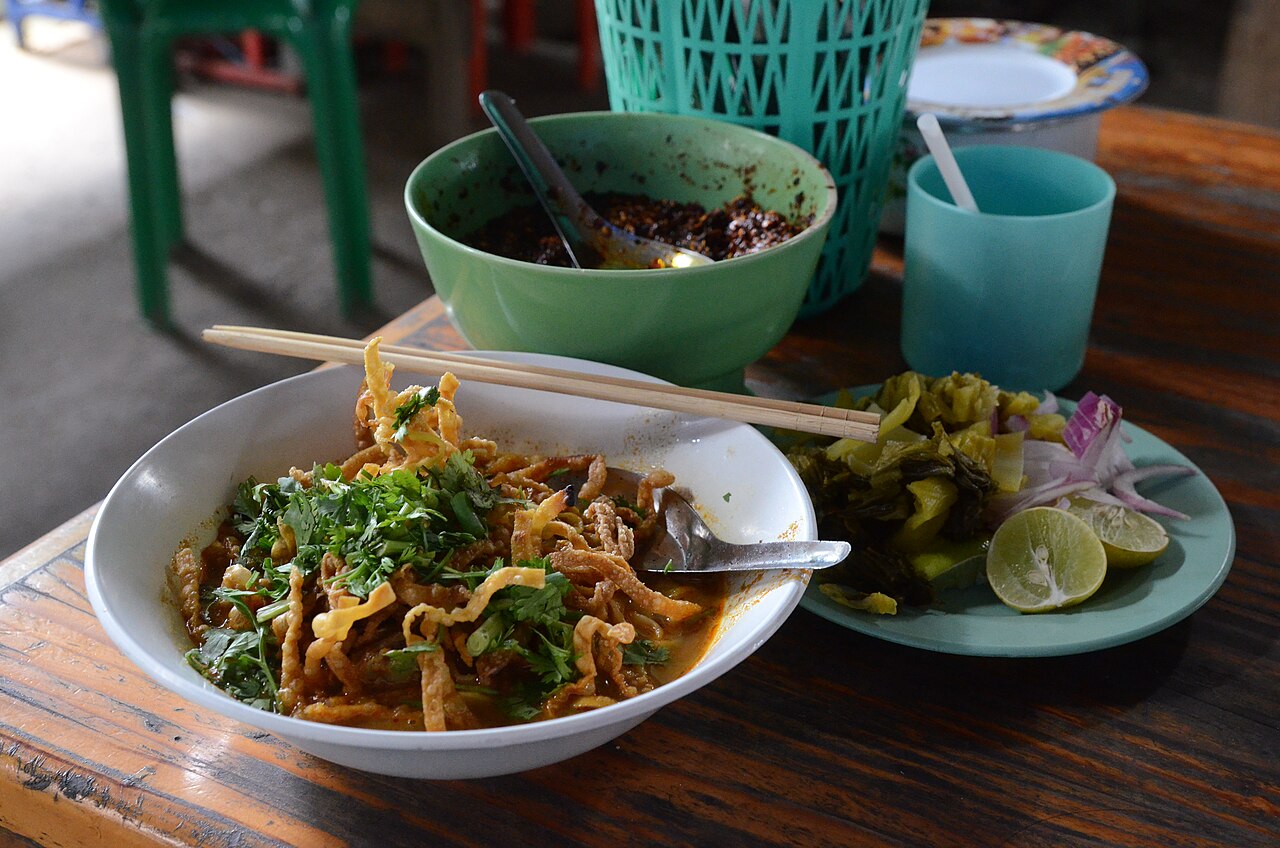
Khao soi — egg noodles in a rich golden coconut-curry broth topped with crispy noodles, served with shallots, pickled greens and lime
Khao soi
The northern dish to try first

Egg noodles in a rich golden coconut-curry broth, topped with a tangle of crispy fried noodles, served with chicken or beef plus shallots, pickled greens and lime to season yourself. Mellow and fragrant with curry spice, it is the classic introduction to northern Thai food — found across town and easy on the wallet.

Price: ~฿50–90 a bowl
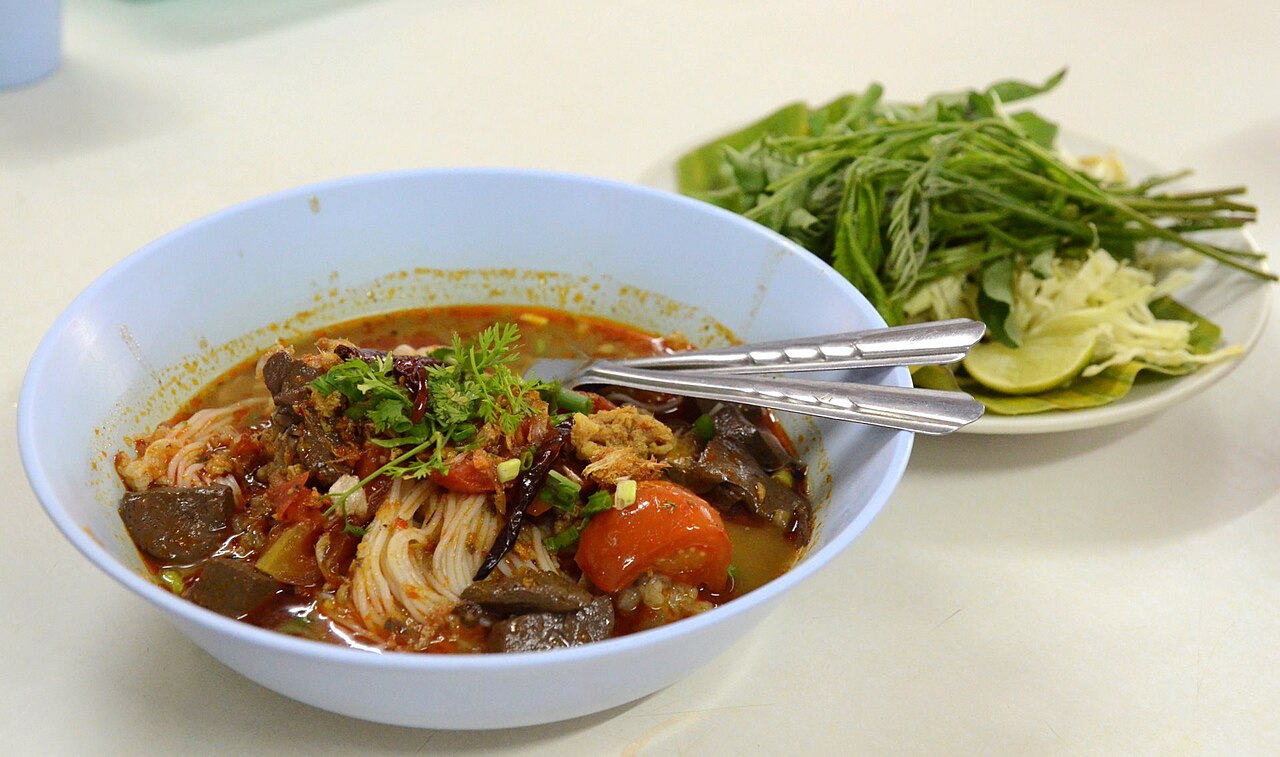
Khanom jeen nam ngiao — a reddish tomato-and-kapok-flower broth ladled over rice noodles, topped with greens and crispy pork rind
Nam ngiao / khanom jeen nam ngiao
A Tai Yai flavour Chiang Rai does well

A reddish-orange broth from tomato and dried kapok flowers, gently sour in the Tai Yai (Shan) style, ladled over rice noodles and topped with greens, bean sprouts and crispy pork rind. It is a favourite breakfast and lunch in the north, and being close to the border, Chiang Rai's Tai Yai flavours run especially bold and varied.

Price: ~฿40–70 a bowl
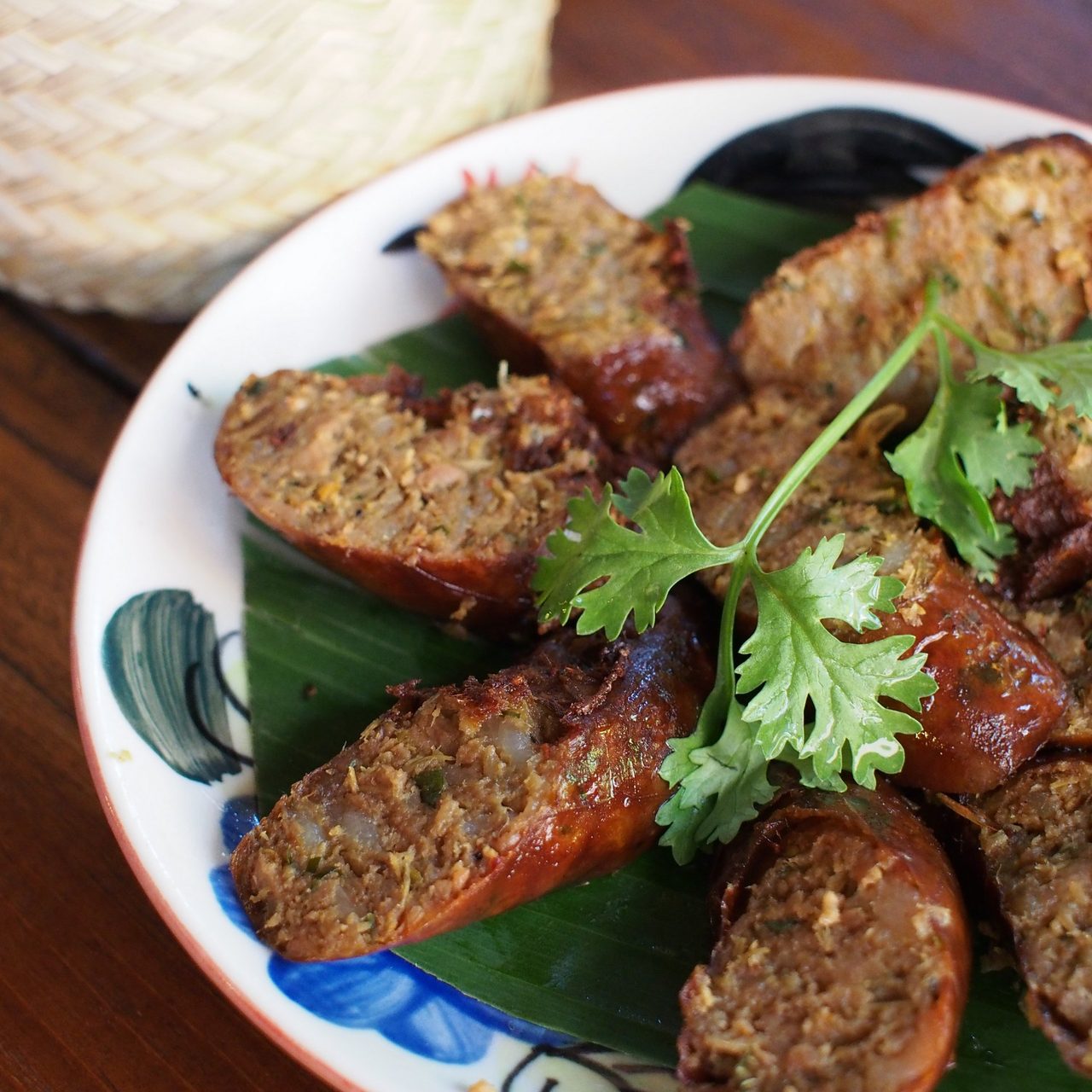
Sai ua — a northern grilled pork sausage packed with curry paste and herbs, sliced and served with chilli dip and fresh vegetables
Sai ua + nam phrik num + pork crackling
The classic northern spread

Sai ua is a grilled pork sausage packed with curry paste and northern herbs, eaten with nam phrik num (a dip of pounded roasted green chillies), pork crackling and fresh or steamed vegetables — the classic northern spread, easy to find in markets and northern restaurants. Order them as a set to get the full range of flavours.

Price: ~฿40–120 a plate
Yunnanese-Chinese food on Doi Mae Salong — steamed mantou buns served with rich braised pork belly in Chinese herbs
Mae Salong Yunnanese food + street eats
A Chinese-Haw thread up in the hills

Up on Doi Mae Salong you'll find the Yunnanese-Chinese cooking of the Chinese-Haw (KMT) community — steamed mantou buns with rich braised pork belly, Yunnan noodles and oolong tea. In town, the Night Bazaar and the weekend Walking Streets cover everything from grilled Mekong river fish to local sweets. More in our northern Thai food → · Night Bazaar & street food →

Price: ~฿30–150 per item

More Chiang Rai food: northern Thai → · Night Bazaar & street food → · cafés & tea →

Set a budget

How much will it cost?

Chiang Rai is easy on the budget — cheaper than the islands or Bangkok — with good-value stays and inexpensive food. The bigger costs are getting here (a flight versus the bus from Chiang Mai) and getting around (a car or tour for the temple circuit, the Golden Triangle and Doi Tung), plus the temple and museum entry fees. See the full breakdown in our Chiang Rai trip budget →

Tier Stay / night Food / day Total / day (rough)
Budget ฿400–900 guesthouse or budget hotel ฿200–400 ~฿900–1,800
Mid-range ฿1,200–2,800 3–4 star hotel ฿500–900 ~฿2,500–5,000
Comfort ฿3,500–8,000+ mountain-view / riverside resort ฿1,000–2,500+ ~฿6,000–13,000+

A songthaew around town is just a few baht, but budget for a half-day car for the temple circuit (~฿800–1,500) or a full-day Golden Triangle / Doi Tung tour, plus entry to Wat Rong Khun (~฿100 for foreigners), Baan Dam and the Mae Fah Luang Garden. See sample 2-day and 3-day totals in our Chiang Rai trip budget →

Good to know

What first-timers get wrong

No train, no metro
Plan by geography, not by a metro map

Chiang Rai has neither a train to the city (the line ends at Chiang Mai) nor a metro, BTS or MRT in town. The main sights are spread out beyond the centre, so group them into day-by-day clusters by direction and match a charter or tour to each — a half-day car for the three temples is great value, while the Golden Triangle and Doi Tung each warrant their own full day.

Tip: hire a car with driver on mountain days — safer than riding a scooter yourself.
🔥 The burning season, Feb–Apr
Views vanish, air quality drops

From late in the cool season into the hot months (Feb–Apr, March worst), burning across the north pushes PM2.5 high, hazing out the mountain views and the sea of mist, and leaving photos far less impressive than in the cool season. If you are sensitive, avoid it; if you can't, pack an N95 mask and check the daily air quality. See when to visit →

Sweet spots: Nov–Feb (cool, clear) · Oct (green, clean, cheap).
Allow time for the mountain distances
Farther and windier than they look

The Golden Triangle, Doi Tung, Doi Mae Salong and Phu Chi Fa are 60–100 km out, on steep, winding roads that take longer than the map suggests. Don't cram several mountains into one day — pick one direction per day and you'll enjoy it more without wearing yourself out.

Tip: Phu Chi Fa's sea of mist needs a pre-dawn start, so it is easier to stay nearby the night before.
The Walking Streets are weekend-only
Check the day

The Night Bazaar runs nightly near the bus terminal, but the lively Walking Streets are weekend-only — Saturday on Thanalai Road and Sunday at Sankhongnoi. If you want to graze on local food and crafts, check which day your trip lands on. See Night Bazaar & street food →

Nightly: Night Bazaar · Weekends: Sat/Sun Walking Streets.
Visit hill-tribe villages with respect
Choose community-minded tours

Around Chiang Rai you can learn about hill-tribe communities (Akha, Lahu, Karen), but choose tours that respect them: ask before photographing people, buy directly from makers, and avoid tours that put people on display — especially "long-neck" villages that some operators run commercially. Travel in a way that gives dignity to the people who live there.

The idea: learn, don't gawk · support communities directly.
An easy extension from Chiang Mai
A favourite northern-Thailand route

Chiang Rai is about three hours from Chiang Mai by road (Route 118), with hourly GreenBus services or you can self-drive. Many travellers do Chiang Mai first and then add two to three days in Chiang Rai for the three temples, the Golden Triangle and the tea hills, before flying home from CEI or looping back. Not sure which to pick? Read Chiang Mai vs Chiang Rai vs Pai →
Neighbours: Chiang Mai (the gateway) · Phayao (the quieter province south).
Frequently asked

FAQ · before you travel

How many days should I spend in Chiang Rai as a first-timer?
Two days covers the in-town highlights — the three temples (Wat Rong Khun, Wat Rong Suea Ten and Baan Dam) plus the clock-tower light show and the Night Bazaar. With three days you have room for the Golden Triangle and Chiang Saen, or Doi Tung and the Mae Fah Luang Garden, plus Singha Park or the tea hills. Many people add Chiang Rai as a two-to-three-day extension from Chiang Mai. See the plans: 2 days · 3 days
Does Chiang Rai have a train? How do I get there?
Chiang Rai has no train. Thailand's Northern rail line ends at Chiang Mai, so arriving by rail means a train to Chiang Mai and then a bus or van for about three hours. The most popular options are flying direct from Bangkok (Don Muang or Suvarnabhumi) into Mae Fah Luang–Chiang Rai International Airport (CEI), about 1 hour 20 minutes, or a GreenBus from Chiang Mai, hourly in about 3 to 3 hours 45 minutes. See our getting to Chiang Rai guide →
How do I get from Chiang Rai Airport (CEI) to the city?
Mae Fah Luang–Chiang Rai International Airport (CEI) is about 10 km from the centre. Since August 2024 there is no airport bus into town, so your options are a metered taxi (around ฿160–200 plus an airport surcharge), Grab (it works but supply is limited) or a pre-booked transfer, taking about 20–30 minutes. Always agree the fare before you get in. See our getting to Chiang Rai guide →
Does Chiang Rai have a metro? How do I get around the city?
Chiang Rai has no metro, no BTS/MRT and no city train. The small centre around the Clock Tower and Night Bazaar is walkable, and otherwise you get around by songthaew (shared pickups), tuk-tuk (agree the fare first), Grab (limited supply), a rented scooter, or a hired car with driver for the temple circuit and the mountains, since many sights are spread out beyond town. More in our getting around Chiang Rai guide →
What is the best month to visit Chiang Rai?
The cool season, November to February, is the best — cool, clear and with the cleanest air, ideal for the temples, the tea hills and the mountains. But be honest about the burning season, February to April (March worst): burning across the north pushes PM2.5 high (Chiang Rai has recorded March averages above 100 µg/m³, AQI often over 150), with hazy skies and temperatures near 40°C, so sensitive travellers should avoid it. The rainy season, May to October, is green, clean, quiet and cheap, with October the sweet spot. See every month in when to visit → · when to visit Thailand →
Can I visit Chiang Rai as an extension from Chiang Mai?
Yes, easily, and it is a very popular plan. Chiang Rai is about three hours from Chiang Mai by road (Route 118), with hourly GreenBus services or you can self-drive. Many travellers do Chiang Mai first and then add two to three days in Chiang Rai for the three temples, the Golden Triangle, Doi Tung and the tea hills, before flying home from CEI or looping back to Chiang Mai. Still deciding? Read Chiang Mai vs Chiang Rai vs Pai →
Klook · Chiang Rai activities

Book Chiang Rai tours and tickets ahead — skip the queue

White Temple, Blue Temple & Black House tours · Golden Triangle and Chiang Saen tours · Doi Tung + the Mae Fah Luang Garden · tea-plantation and hill-tribe treks · the Phu Chi Fa sea of mist · airport transfers — book ahead on Klook and save time at the gate.

See Chiang Rai activities on Klook →
Wherebest is a Klook affiliate partner — we may earn a commission when you book through our links, at no extra cost to you.