Home Chiang Rai Thailand Chiang Rai Hotels About
Home  ›  Asia  ›  Thailand  ›  Chiang Rai  ›  Wat Rong Khun (White Temple)
🇹🇭 Chiang Rai · Wat Rong Khun (White Temple)

Wat Rong Khun, Chiang Rai
The bridge over the sea of hands · a glittering white temple · art from end to end

Wat Rong Khun (the White Temple) is Chalermchai Kositpipat's all-white contemporary temple, about 13 km south of Chiang Rai city — you cross a bridge over a pit of hundreds of reaching hands into an all-white, mirror-glass ubosot whose interior is covered in surreal modern murals, with a golden building alongside that is actually one of the most beautiful toilets you will ever see. It is the one Chiang Rai sight you cannot skip.

Get to know it

What Wat Rong Khun is — and why it is the first stop in Chiang Rai

Let us be honest: say "Chiang Rai" and the first image most people picture is a pure-white temple that glitters as though it were spun from sugar. That is Wat Rong Khun (the White Temple), a contemporary temple that the Chiang Rai-born national artist Chalermchai Kositpipat designed and funded himself, beginning in 1997 on the grounds of a derelict old temple. He built it as a work of Buddhist art dedicated to the late King Rama IX, and it is still being built today. In short, it is not an ancient temple but a huge, unfinished artwork so striking that it became the symbol of the city.

The heart of it is the white ubosot, inlaid all over with tiny pieces of mirror glass so it flashes in the sun. To reach it you cross the bridge over the "sea of hands" — a pit full of hundreds of sculpted hands reaching up from below, standing for desire and suffering. Crossing the bridge is therefore a symbol of rising out of the cycle of rebirth toward enlightenment. Beside it stands a golden building that many people take for an important hall, but which is in fact the temple's toilets.

Ever had this happen — a famous sight that turns out flat once you actually get there? Wat Rong Khun is the opposite, because every square inch is designed to tell a story, and every angle really does photograph well. For a first visit to Chiang Rai, this is the spot to see before anything else, and it is usually paired with the Blue Temple (Wat Rong Suea Ten) and the Black House (Baan Dam museum) in one trip. See the full picture at the complete Chiang Rai attractions guide.
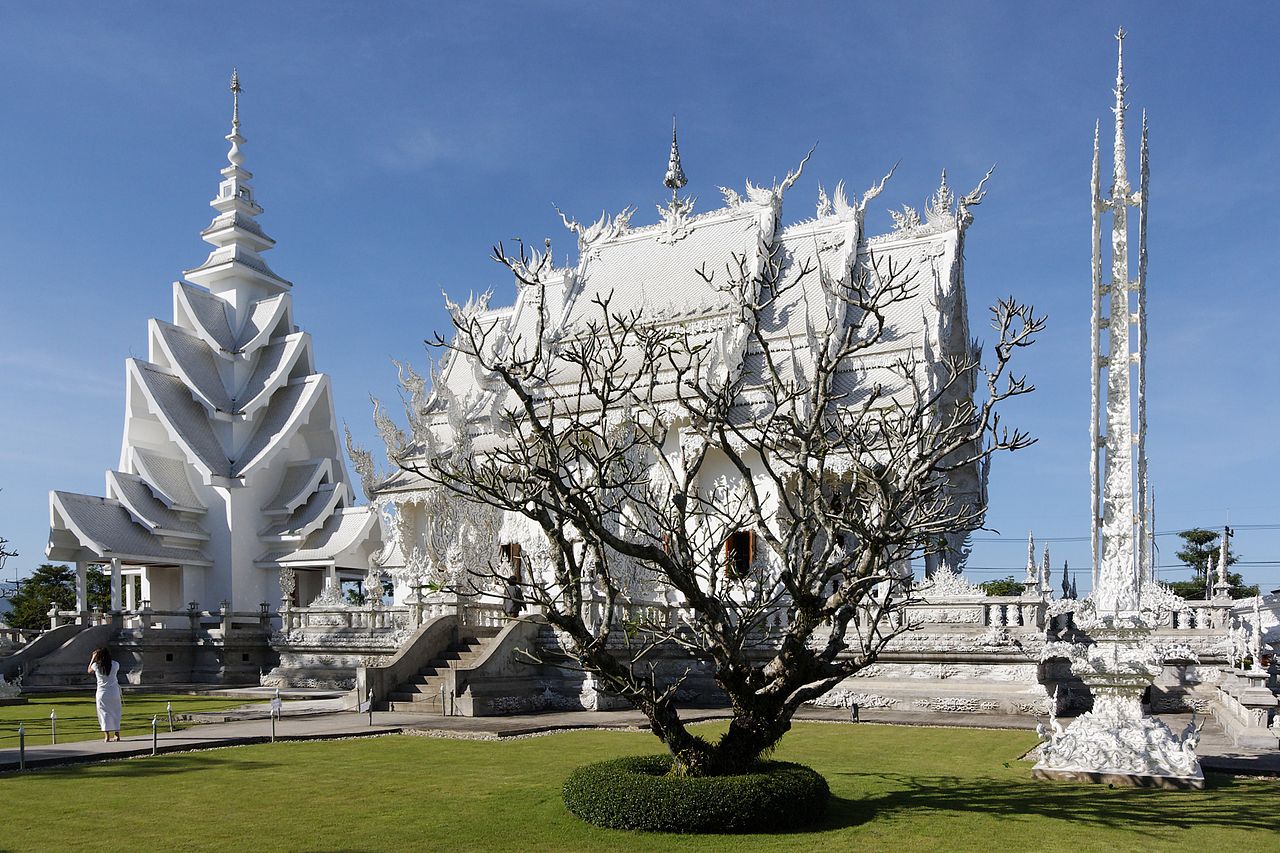
Wat Rong Khun, the White Temple, Chiang Rai — an all-white, mirror-glass ubosot designed by Chalermchai Kositpipat, flashing in the sun
Wat Rong Khun (the White Temple) — Chalermchai Kositpipat's mirror-glass white ubosot, about 13 km south of Chiang Rai city
🎨
Character
Contemporary art temple
All-white, mirror-inlaid · designed by Chalermchai
🗺️
Location
~13 km south of the city
~20-minute drive · ~10 km from CEI airport
🎟️
Entry fee
Foreigners ~฿100
Free for Thais · check on arrival (a rise reported)
🕗
Hours
Roughly 08:00–17:00
Go early for fewer crowds, soft light, less heat
👕
Dress code
Shoulders & knees covered
Shoes off before the ubosot · sarongs lent out
⏱️
Time needed
About 1–1.5 hours
One-way route only — no walking back
How it feels when you arrive

The atmosphere — blinding white outside, surreal within

Wat Rong Khun is a two-mood experience — outside it is clean, bright, dazzling white; step into the ubosot and you find serious, thought-provoking contemporary murals you did not expect.

What sets Wat Rong Khun apart from an ordinary temple is that it is designed to be walked as a storytelling route. You start at the front, where everyone stops to photograph the white ubosot against the sky, then cross the sea-of-hands bridge and the brightness slowly turns to stillness. Inside the ubosot the wall paintings are not the gods and angels you might expect, but contemporary images that fold present-day stories into Buddhist ideas. All of it sits in one place you can take in within just over an hour.

What to see

The highlights — every spot has a hidden meaning

🌉 The bridge over the "sea of hands" — the way to enlightenment

The first and most-photographed spot is the bridge over the sea of hands. Below it is a pit filled with hundreds of sculpted hands reaching upward, standing for desire, craving and the suffering of the cycle of rebirth. Crossing the bridge is a symbol of rising above hell and craving toward the white ubosot, which represents enlightenment. There is one key rule: you walk one way only and may not walk back over the bridge, in keeping with that symbolism — so it is a spot to cross slowly and study rather than rush.

⛪ The white ubosot — and the contemporary murals inside

The white ubosot is the heart of the temple, its finely moulded stucco inlaid all over with tiny mirror pieces that flash in the sun. Inside is the highlight many people do not expect — contemporary wall paintings in which Chalermchai folds present-day references into Buddhist teaching. Photography inside the ubosot is strictly forbidden, and you must remove your shoes, hat and sunglasses before entering, dressed modestly with shoulders and knees covered — so hold it in your memory instead, because this is the part of the temple you should not miss.

🚻 The golden building — one of the most beautiful toilets anywhere

The gleaming golden building standing on the other side is taken by many for a hall or shrine, but it is in fact the temple's toilets. Chalermchai meant the gold to stand for desire and the body, the opposite of the white ubosot, which stands for wisdom and the mind — which is exactly why it became the most photographed toilet around and a story people pass on. You can photograph the outside, but it is a working toilet.

🖼️ The art gallery and the grounds

Beyond the main zone, the grounds also hold an art gallery showing Chalermchai's work, a wishing tree where visitors hang bodhi-leaf metal plates inscribed with wishes, plus cafés, restaurants and souvenir shops outside that you can enter without a ticket. Leave a little time to wander the grounds after the main zone, because there are good photo angles spread all around.

🌫️ About the sky — the cool season is when the temple looks best

Because the temple is pure white, the sky makes a big difference to how good it looks. In the cool season (November to February) the sky is at its clearest and the white temple reads sharpest and best against the blue. But come in February to April, the burning season across the north, and the air turns hazy with PM2.5 (Chiang Rai has recorded March averages above 100 and air-quality readings over 150 on many days), the sky goes dull, and the photos are not as crisp as in the cool months — anyone sensitive to dust should avoid this window. See the best window for the whole province at the best time to visit Chiang Rai guide, and the country-wide picture at best time to visit Thailand.

Eat & stay

What to eat and where to stay — before or after the temple

There are cafés and restaurants within the grounds, while the best local food and the better places to stay are in Chiang Rai city, only a ~20-minute drive away.

🍜 What to eat before and after

Within the grounds there are cafés and restaurants where you can pause over a cup of local Chiang Rai hill coffee, but for a proper meal the good stuff is in the city — khao soi, nam ngiao (rice-noodle soup), sai ua (northern sausage), and nam phrik num with crispy pork crackling are the northern dishes to try, along with the Yunnanese food up at Doi Mae Salong that is so much a part of Chiang Rai. Plan your meals at the complete Chiang Rai food guide, and dig into the northern plate at the northern Thai food guide.

🏨 Where to stay when you visit

Wat Rong Khun is an easy morning trip from the city, so staying in town around the Clock Tower and Night Bazaar is the most convenient — you can walk to food and sights and easily call a ride to the temple. If you prefer quiet, there are riverside resorts on the Kok River, and for the nature-minded there are stays out of town in the hills and tea country (though you will need transport). We do not name specific hotels on this page — see a list curated and ranked by real scores at the top 10 hotels in Chiang Rai, and pick an area at the where to stay in Chiang Rai guide.

Know before you go

Entry, hours and etiquette — be ready before you reach the gate

Wat Rong Khun is still an active temple, with dress and etiquette rules worth knowing in advance so you are not held up at the gate.

On the fee: Thais enter free, while foreign visitors pay around ฿100 (some reports point to a rise to ฿200 — check on arrival). The fee covers the art-display area only, which includes the sea-of-hands bridge and the white ubosot that are the highlight; the car park, shops and restaurants outside are free without a ticket. Bring small cash, as some points may not yet accept QR payment.

On hours and dress: the temple opens daily roughly 08:00 to 17:00 (it can shift a little by season and on holidays). You must dress modestly with shoulders and knees covered — no spaghetti straps, tank tops, short shorts or skirts, and nothing see-through or too tight. If you arrive underdressed, the temple lends cover-up sarongs. Before entering the ubosot you must remove your shoes, hat and sunglasses, and photography inside is not allowed.

🎟️
Entry fee
Foreigners ~฿100
Free for Thais · check on arrival · bring cash
🕗
Hours
~08:00–17:00
Daily · earliest is least crowded
👕
Dress code
Shoulders & knees covered
Sarongs lent out · shoes off before the ubosot
📵
Inside the ubosot
No photography
Hat/sunglasses off · one-way route, no going back
⏱️
Best time of day
08:00–09:30
Fewer people, softer light, clearer sky (cool season)
Facilities
All here on site
Parking · cafés · restaurants · souvenir shops
Tip: arrive at the 08:00 opening and you get the temple while the crowds are still thin, the light is still soft, the photos are good and it is not yet hot — after 10:00 the tour buses roll in and it gets busier and hotter. If you come by Grab, ask the driver to wait or arrange a pickup time, as rides back from the temple are scarce and harder to hail than the trip out. Sort out data and a SIM before you travel at the Thailand eSIM/SIM guide.
How to get there

Getting to Wat Rong Khun from Chiang Rai city and how

The temple is about 13 km south of Chiang Rai city (a ~20-minute drive) — not far, but out of town. Chiang Rai has no train and no metro/BTS/MRT, so getting to the temple is entirely by road. The easiest ways are to drive yourself, take a Grab, or go on a tour.

🚗
Rent a car / motorbike
Drive yourself ~20 min
Most flexible · parking on site · bikes ~฿200–300/day
📱
Grab from town
~฿150–250 each way
Works, but rides are scarce · arrange a return pickup
🚌
Songthaew / CR–CM bus
Drop at the temple stop
Cheapest · the Chiang Rai–Chiang Mai bus passes it
🛺
Tuk-tuk / hired taxi
Agree the fare first, always
Set a there-wait-back price clearly · no meter
🚐
Day tour (most popular)
Three sights together
Wat Rong Khun + Blue Temple + Black House in one trip
✈️
From CEI airport
~10 km · taxi/Grab
The temple is even closer to the airport than the city
Getting around Chiang Rai: Chiang Rai has no train (the railway ends at Chiang Mai) and no metro/BTS/MRT — you reach Chiang Rai by flying into Mae Fah Luang Airport (CEI), taking a bus/van from Chiang Mai, or driving, so getting to Wat Rong Khun is by road throughout. The most popular option is a tour that bundles the three big sights (Wat Rong Khun + Blue Temple + Black House) together, since they sit in different directions. See all the ways to reach Chiang Rai at the getting to Chiang Rai guide, and getting around town at the getting around Chiang Rai guide.
Plan your visit

What to combine Wat Rong Khun with — half a day or a full day

⏱️ Morning half-day (~3–4 hours · the three-temple/house run)

08:00 — Start at Wat Rong Khun at opening, while it is quiet and the light is good, walking the sea-of-hands bridge, the ubosot and the golden building
09:30 — Drive to the Black House (Baan Dam museum) north of town — the "white vs black" counterpoint to Wat Rong Khun
11:00 — Finish at the Blue Temple (Wat Rong Suea Ten) in town
12:30 — Lunch of khao soi or nam ngiao in the city

🌇 Full day (+ tea fields and a viewpoint)

If you have the whole day, continue from the three-temple run:
13:30 — Head to Singha Park, the big tea estate and farm west of town — ride the tram through the fields and photograph the giant lion
16:00 — Sip tea at the nearby Choui Fong tea estate, with views over the terraced fields
18:00 — Back in town, walk the Night Bazaar and catch the Clock Tower fountain show

Wat Rong Khun fits a trip in several ways — see the full plans at the Chiang Rai 2-day itinerary and the 3-day itinerary, and every sight at the Chiang Rai attractions guide.

The white ubosot and the sea-of-hands bridge at Wat Rong Khun, Chiang Rai — the start of a half-day to full-day three-temple run
Wat Rong Khun — the starting point of the three-sight run (white, black and blue) that continues to the tea estates and the Night Bazaar in one day
Frequently asked questions

FAQ · Wat Rong Khun (White Temple), Chiang Rai

How much is the entry fee for Wat Rong Khun, and do Thais and foreigners pay the same?
Thai nationals enter free, while foreign visitors pay around ฿100 (some reports point to a rise to ฿200, so check the current price on arrival). The fee covers the art-display area only, which includes the bridge and the white ubosot that are the highlight. The car park, shops and restaurants outside are free to enter without a ticket. Bring small cash, as some points may not yet accept QR payment.
What time does Wat Rong Khun open, and when is it least crowded?
It opens daily roughly 08:00 to 17:00 (times can shift a little by season and on holidays, so check before you go). The quietest time with the nicest light is right at opening, 08:00 to 09:30, because the temple is pure white and looks best before the sun gets harsh. After 10:00 the tour buses start arriving and it gets crowded and hotter. Allow about 1 to 1.5 hours to walk the whole site. The cool season (November to February) has the best weather, but if you come in February to April — the burning season across the north — the sky turns hazy with PM2.5, and the white temple against the sky is not as crisp as in the cool months. See the whole province's window at the best time to visit Chiang Rai guide.
What should you wear to Wat Rong Khun, and what are the rules?
It is still an active temple, so dress modestly with shoulders and knees covered — no spaghetti straps, tank tops, short shorts or skirts, and nothing see-through or too tight. If you arrive underdressed, the temple lends cover-up sarongs. Before entering the ubosot you must remove your shoes, hat and sunglasses, and photography inside the ubosot is strictly forbidden (you cannot photograph the murals). Follow the one-way route, do not walk back over the bridge, and do not climb on or touch the sculptures.
What are the bridge over the sea of hands and the golden building at Wat Rong Khun?
The bridge over the sea of hands is the main approach to the ubosot. Below it is a pit filled with hundreds of sculpted hands reaching upward, representing desire and suffering in the cycle of rebirth; crossing the bridge symbolises rising above that suffering toward enlightenment (the white ubosot). The golden building on the other side is in fact the temple's toilets — Chalermchai meant the gold to stand for desire and the body, the opposite of the white ubosot, which stands for wisdom and the mind. As a result it has become one of the most beautiful and most photographed toilets anywhere.
How do you get to Wat Rong Khun from Chiang Rai city, and is it far?
The temple is about 13 km south of Chiang Rai city (roughly a 20-minute drive). The easiest way is to rent a car or motorbike and drive yourself, or take a Grab from town (rides back from the temple are scarce, so you may have to wait or ask the driver to wait). You can also take a songthaew or a Chiang Rai–Chiang Mai bus and get off at the temple stop, or hire a tuk-tuk/taxi with the fare agreed in advance every time. The most popular option is a day tour that bundles Wat Rong Khun, the Blue Temple and the Black House together, since the three sit in different directions. Chiang Rai has no train and no metro, so all travel here is by road. See the ways to reach Chiang Rai at the getting to Chiang Rai guide.
Klook · Chiang Rai tours & activities

A day tour of the White Temple, Blue Temple and Black House — three top sights in one trip

Book a day tour that bundles Wat Rong Khun, the Blue Temple and the Black House with hotel pickup in advance on Klook — easier than hiring a car yourself, and ideal if you would rather not drive and want to see them all in a day.

See Chiang Rai activities on Klook →
Wherebest is a Klook affiliate partner — we may earn a commission when you book through our links, at no extra cost to you.