Home Chiang Rai Thailand Chiang Rai Hotels About
Home  ›  Asia  ›  Thailand  ›  Chiang Rai  ›  Doi Tung & Mae Fah Luang
🇹🇭 Chiang Rai · Doi Tung · Royal Project

Doi Tung & Mae Fah Luang
A Swiss-style royal villa · a cool-climate garden · opium fields turned to coffee

Doi Tung is the royal-development mountain northwest of Chiang Rai. Up here you find the Princess Mother's Lanna-meets-Swiss-chalet Doi Tung Villa, the cool-climate Mae Fah Luang Garden, Wat Phra That Doi Tung, and the story of a whole mountain that swapped opium for arabica coffee and macadamia — about 60 km from the city, with a steep drive, car or tour needed, and at its best in the cool season.

Get to know it

What Doi Tung is — and why it is unlike anywhere else in Chiang Rai

Let us be honest: most of Chiang Rai's headline sights are in or around the city, a short drive away. Doi Tung is the opposite — it is a whole mountain that is a development project, in Mae Fah Luang District, about 60 km northwest of central Chiang Rai. Picture a summit noticeably cooler than the plains below, with a beautiful timber villa set among cool-climate flower beds, an old relic temple on the peak, and coffee and macadamia plantations spread across the slopes.

There are three main things here — the Doi Tung Villa, the Princess Mother's residence in a Lanna-meets-Swiss-chalet style; the Mae Fah Luang Garden, a cool-climate flower garden on a slope that bursts into bloom in winter; and Wat Phra That Doi Tung, an old twin-chedi temple on the peak. Add the Hall of Inspiration, which tells the story of the royal family and the development work, and a Doi Tung café for a coffee with a view. It all sits on the one mountain, and you can see it in a single day.

Here is the part many people do not know — this was once an opium-growing area in the Golden Triangle, until the Doi Tung development project turned it into coffee and macadamia plantations and brought the forest back. Walking around Doi Tung is therefore not just a pretty garden photo stop; you also see the story of how a whole mountain of livelihoods was changed. That is why we suggest giving Doi Tung a proper half to full day rather than a quick photo dash.
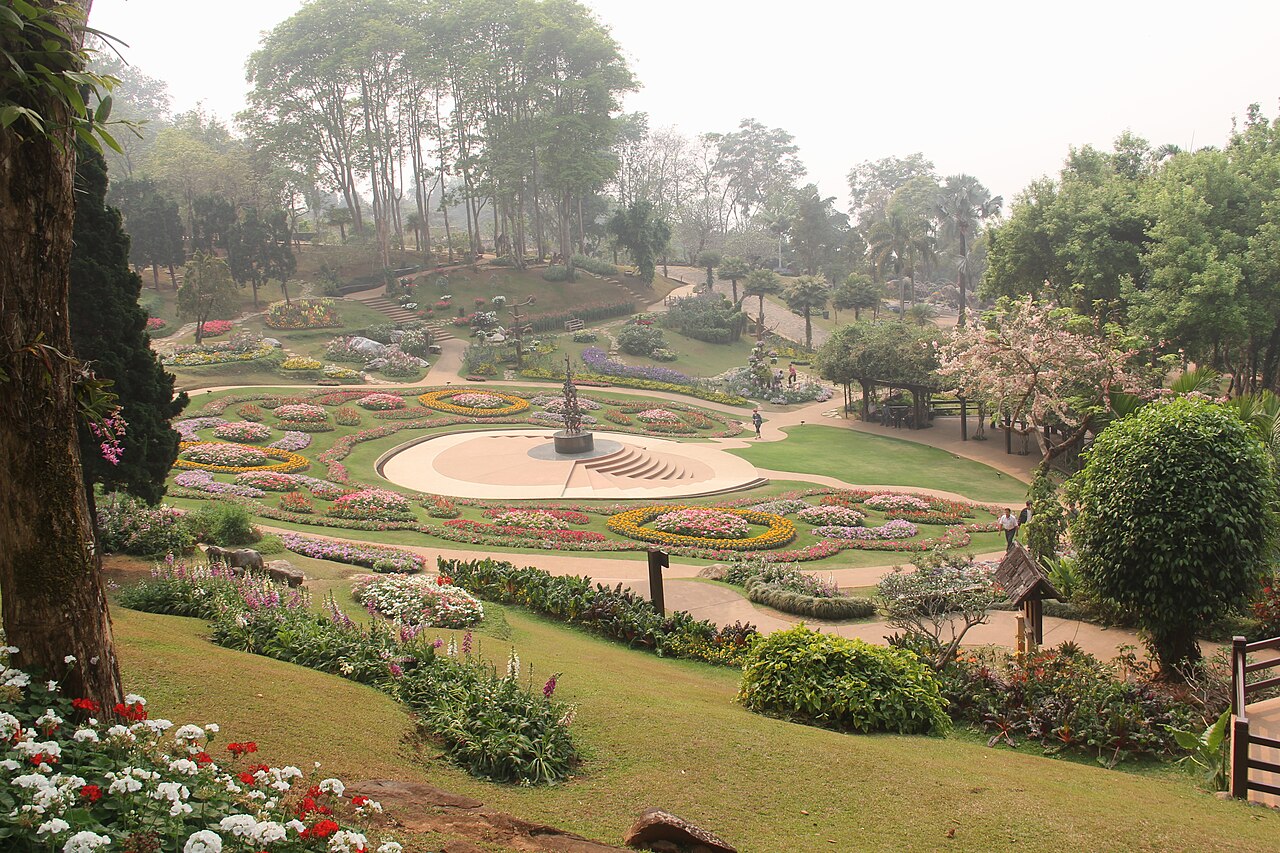
The Mae Fah Luang Garden on Doi Tung, Chiang Rai — terraced cool-climate flower beds around a central fountain with hills behind
The Mae Fah Luang Garden on Doi Tung — cool-climate flower beds terraced around a central fountain sculpture, at its best in the cool season
⛰️
Character
Royal-project mountain
Villa + garden + temple + coffee, all on one mountain
🗺️
Location
Mae Fah Luang District
~60 km from Chiang Rai city (to the northwest)
🎟️
Entry
Single / combo ticket
~฿90 per site · combo ~฿190–220 (check on site)
🌸
Best time
Cool season, Nov–Feb
Cool, clear skies, garden in full bloom
🚗
Getting there
Car or tour needed
Steep mountain road · no bus up to the villa
Famous for
Coffee + macadamia
Single-origin Doi Tung arabica grown on the mountain
The story behind it

From opium to coffee — the story that makes Doi Tung special

Before you walk the villa and garden, knowing this gives everything on the mountain a lot more meaning.

Go back to before 1988 and Doi Tung was a mountain stripped of forest, where several hill communities practised slash-and-burn farming and grew opium because there were few other options. This sits in the Golden Triangle, long notorious for opium. The turning point came when HRH Princess Srinagarindra, the Princess Mother, started the Doi Tung Development Project in 1988, under the Mae Fah Luang Foundation.

Rather than enforcement alone, the project chose to give the people of the mountain sustainable livelihoods in place of opium — arabica coffee and macadamia on the high ground, weaving and ceramic handicrafts, alongside restoring the forest that had been cleared. The result was household incomes rising many times over, the forest returning, and today Doi Tung coffee and macadamia are brands Thais know across the country. The model has been cited internationally as an example of solving a drug problem through development.

🌱 Why this matters to your visit

Because everything you walk through on the mountain — the flower garden, the green forest, the coffee fields, the craft shops — is a product of this project. Buying a coffee, picking up gifts or paying for entry directly supports the mountain communities. Walk the villa and garden, then take a little time at the Hall of Inspiration, and you will understand the whole picture best.

What to see

The key spots on Doi Tung — all doable in one day

🏡 The Doi Tung Villa — a Lanna-meets-Swiss residence

The heart of Doi Tung is the Doi Tung Villa, the Princess Mother's residence, built in timber in a Lanna-meets-Swiss-chalet style with finely carved woodwork throughout. Inside, the rooms display her belongings and the story of her royal work; the highlight is the star-painted ceiling and the warm mountain-home feel. Around the villa are gardens and a viewpoint that looks out over the ranges — you remove your shoes and dress modestly to enter, and photography is not allowed in some parts, as signed. The villa opens a little later than the garden, so check the hours before you go.

🌸 The Mae Fah Luang Garden — cool-climate flowers

Next to the villa is the Mae Fah Luang Garden, a cool-climate flower garden on a slope, terraced around a central fountain sculpture. In the cool season (Nov–Feb) the flowers are in full bloom — cool-climate blooms and colourful ornamentals alike — and it is the prettiest photo spot on the mountain. Above the garden is the Tree Top Walk, a rope walkway around 30 metres up over the treetops (a separate entry of about ฿120, with an age limit). Garden entry is around ฿90 per person, and it is an easy stroll of about an hour. Early morning, with clear skies and fewer people, is the best time.

🛕 Wat Phra That Doi Tung — twin chedis on the peak

Higher up on the peak is Wat Phra That Doi Tung, an old temple believed to be the relic shrine for those born in the Year of the Pig, and one of Lanna's important relic temples. The highlight is the pair of golden chedis set on the summit amid mountain views; the atmosphere is quiet and cool, and it has been a place of worship for northern Thais for a very long time. Dress modestly and remove your shoes before entering the chedi area. From the temple terrace the view over the ranges is wide — on a clear day you can see as far as the Myanmar side. Entry is free, with donation points for merit-making.

💡 The Hall of Inspiration + the Doi Tung café

The Hall of Inspiration is an exhibition telling the story of the Mahidol royal family and the development work that changed lives across the mountain — in education, healthcare and livelihoods. It takes about 30 to 45 minutes to walk through and is the spot that best ties the whole Doi Tung picture together. Before or after the garden, stop at the Café DoiTung to sip an arabica grown on this very mountain, take in the hill view, and pick up coffee beans, roasted macadamia and crafts to take home.

Burning-season note: Around February to April (March is worst) the north enters the burning season, when PM2.5 spikes; the mountain views get veiled by haze, the sky is no longer clear, and it gets hotter. If you are coming to Doi Tung for the views and good photos, avoid this window — and anyone sensitive to dust especially should. Read the detail in the best time to visit Chiang Rai guide.
Eat & drink

Doi Tung coffee and food on the mountain — from the source to your cup

Doi Tung is Chiang Rai's real arabica country — once you are up here, you have to try a cup of coffee grown on this mountain.

☕ Doi Tung arabica coffee

Doi Tung coffee is a single-origin arabica grown above about 800 metres on this mountain itself — smooth, rounded and fragrant, one of the coffees that put Chiang Rai on the map for coffee. Sipping a cup at the Café DoiTung with the hill view is well worth it; a cup runs about ฿80 to 150, and you can buy roasted beans to take home in the shop. Coffee lovers who want to follow the trail further should read the Chiang Rai café and coffee guide, which covers Doi Chang, Doi Tung and the view cafés across the province.

🥜 Macadamia and local food on the mountain

Paired with the coffee is Doi Tung macadamia, the nut the project brought to the mountain until it became a local name — available roasted or coated, and a good gift to take home. For food on the mountain there are project restaurants and small eateries near the garden, mostly simple northern Thai and made-to-order dishes. It is worth carrying water and snacks up, since the mountain eateries are limited and close early. To see what to eat across Chiang Rai, read the Chiang Rai food guide, and go deeper on the northern plate in the northern Thai food of Chiang Rai.

Tickets & planning

Entry, hours and what to bring — before you go up Doi Tung

Doi Tung charges entry by site and takes a full day to see properly — a little planning keeps the visit smooth and wasted time to nil.

Doi Tung charges entry separately by site, or you can buy a combination ticket. A single ticket for each site (the villa, the Mae Fah Luang Garden, the Hall of Inspiration) is around ฿90 each, while a combination ticket covering several sites on one pass is roughly ฿190 to 220, with children, seniors, monks and people with disabilities usually paying less. If you plan to see the villa, the garden and the Hall of Inspiration, the combo is usually better value than buying separately — but the price and which sites are included can change by season, so check at the ticket counter on site before you buy.

On hours, the Mae Fah Luang Garden generally opens around 07:00 to 18:00, while the Doi Tung Villa opens later (from about 11:00). The various sites keep different hours and may adjust by season, so it is best to go up from late morning into the afternoon so you can see everything in a day. Wear comfortable walking shoes, pack a light jacket (the mountain is much cooler than the plains in the cool season), and carry water.

🎟️
Single ticket
~฿90 / site
Villa · garden · Hall of Inspiration, separately
🎫
Combo ticket
~฿190–220
Several sites on one pass · best value if you see it all
🌳
Tree Top Walk
~฿120 (separate)
Rope walkway above the garden · age limit applies
🕖
Hours
Garden ~07:00–18:00
Villa opens later · check before you go
🧥
What to bring
Jacket + walking shoes
Cooler than the plains · a fair bit of walking
Time needed
Half to full day
Everything + a coffee stop = a whole day
How to get there

Getting to Doi Tung and around

Doi Tung is about 60 km from Chiang Rai city, roughly a 1 to 1.5 hour drive, and the final stretch is a winding, steep mountain road — so you need a private car, a rental car, a car with a driver, or a tour. There is no public bus that goes up to the villa. And note: Chiang Rai itself has no train and no metro, so to reach the city you fly into CEI or take a bus from Chiang Mai first, then carry on by road up the mountain.

🚗
Self-drive / rental
~1–1.5 hr from the city
Steep, bendy road · take care if new to it
🚙
Car with driver
Easiest and safest
Hire for a half or full day · no mountain-road stress
🚌
Tour
Several stops in one trip
Often paired with the Golden Triangle / Doi Mae Salong
🛵
Scooter
Only if used to mountain roads
Very steep · wear a helmet · have a licence
✈️
Reach Chiang Rai first
Fly CEI / bus
No train to Chiang Rai · the line ends at Chiang Mai
Before you go up
Fill up the tank
Few fuel stations on the mountain · check the car
Getting-around tip for Doi Tung: The easiest, most comfortable option for travellers is to hire a car with a driver from the city for a half or full day, because you do not have to tackle the mountain road yourself and you can fit in other stops on the same trip. If you do drive, check the brakes and fuel before you set off and take the bends slowly; first-timers who are not used to mountain roads should not ride a scooter up. See province-wide transport in the getting around Chiang Rai guide and how to reach the city in the getting to Chiang Rai guide.
Plan your visit

A route through Doi Tung — half a day or a full day

⏱️ Half-day (~4–5 hours · the villa + the garden)

09:00 — Leave Chiang Rai city and drive up Doi Tung (or take a car with a driver), about 1 to 1.5 hours
10:30 — Start at the Mae Fah Luang Garden, strolling the cool-climate flower beds and the central fountain
11:30 — Tour the Doi Tung Villa (opens around 11:00) for the carved woodwork and the Princess Mother's story
12:30 — Stop at the Hall of Inspiration to grasp the project, then a Doi Tung coffee
13:30 — Head back down the mountain to the city

🌄 Full day (+ the temple and on to the Golden Triangle)

A full day covers more and pairs well with other stops on the route:
08:30 — Go up Doi Tung and start at Wat Phra That Doi Tung on the peak, paying respects with clear morning views
10:00 — Come down to the Mae Fah Luang Garden + the villa + the Hall of Inspiration
12:30 — Lunch and a Doi Tung coffee on the mountain
14:00 — Head down and on to the Golden Triangle and Chiang Saen on the Mekong, or stop at Doi Mae Salong, a Yunnanese-Chinese village on a nearby route, for tea

Doi Tung pairs neatly with the northern reaches of the province — see all the options in the day trips from Chiang Rai, and plan the whole trip with the Chiang Rai 3-day itinerary.

The Mae Fah Luang Garden on Doi Tung, Chiang Rai — the starting point for a half-day to full-day route on the mountain
The Mae Fah Luang Garden — the starting point for a route through Doi Tung, continuing to the villa, the temple and the Doi Tung café in one day
Frequently asked questions

FAQ · Doi Tung & Mae Fah Luang

Where is Doi Tung in Chiang Rai, and how do you get there?
Doi Tung is in Mae Fah Luang District, northwest of central Chiang Rai, about 60 km away — roughly a 1 to 1.5 hour drive from the city. The final stretch is a winding, steep mountain road, so you need a private car, a rental car, a car with a driver, or a tour. There is no public bus that goes all the way up to the villa. The easiest and safest option for travellers is to hire a car with a driver for a half or full day, or to book a Doi Tung tour, which usually combines it with the Golden Triangle or Doi Mae Salong in one trip. First-timers not used to mountain roads should not drive themselves or ride a scooter up. See your options in the getting around Chiang Rai guide.
How much is entry to Doi Tung, and is there a combination ticket?
Doi Tung charges entry separately by site, or you can buy a combination ticket. A single ticket for each site (the Doi Tung Villa, the Mae Fah Luang Garden, the Hall of Inspiration) is around ฿90 each, while a combination ticket covering several sites on one pass is roughly ฿190 to 220 (children, seniors, monks and people with disabilities usually pay less). The price and which sites are included can change by season, so check the latest at the ticket counter before buying. If you plan to see the villa, the garden and the Hall of Inspiration, the combination ticket is usually better value than buying them separately.
What are the opening hours for the Mae Fah Luang Garden and the Doi Tung Villa?
Generally the Mae Fah Luang Garden opens around 07:00 to 18:00 daily, while the Doi Tung Villa opens later and closes later (from about 11:00). The various sites on Doi Tung keep different hours and may adjust by season, so it is best to go from morning into the afternoon so you can see the garden, the villa and the Hall of Inspiration in one day — and always check the latest hours before you set out, because if you arrive too late you may miss entry to the villa.
When is the best time to visit Doi Tung?
The best time is the cool season, roughly November to February — pleasant cool weather, clear skies, and the Mae Fah Luang Garden in full bloom, which is when the cool-climate flowers look their best. Be aware, though, that around February to April (March is worst) is the northern burning season, when PM2.5 spikes: Chiang Rai has recorded March averages above 100 µg/m³, the AQI is often above 150, the sky turns hazy, and temperatures climb to around 40°C. The mountain views go murky and anyone sensitive to dust should avoid it. The rainy season (May to October) has cleaner air, lush green hills and fewer crowds, with October the sweet spot as the rains ease off. See the detail in the best time to visit Chiang Rai guide.
What is the Doi Tung development project, and what does it have to do with opium?
The Doi Tung Development Project was founded in 1988 by HRH Princess Srinagarindra, the Princess Mother, under the Mae Fah Luang Foundation, to help the hill peoples of the Golden Triangle area — who had grown opium and practised slash-and-burn farming — move to sustainable livelihoods instead. It replaced opium fields with arabica coffee, macadamia and handicrafts, and restored the forest that had been cleared. As a result, household incomes rose many times over and the forest came back. Today Doi Tung coffee and macadamia are brands known across Thailand. Walking around Doi Tung is therefore not just visiting a pretty garden — you also see the story of how a whole mountain was transformed.
Klook · Chiang Rai tours & activities

Doi Tung & Mae Fah Luang tours — easier than tackling the mountain road yourself

Book Doi Tung and Mae Fah Luang tours in advance on Klook — often paired with the Golden Triangle or Doi Mae Salong in one trip, with a driver to take you up the mountain. Ideal if you would rather not drive the mountain road yourself.

See Chiang Rai tours on Klook →
Wherebest is a Klook affiliate partner — we may earn a commission when you book through our links, at no extra cost to you.