Home to the Doi Chang and Doi Tung arabica the world knows — a city where many cafés roast their own beans. Add the glass tea-view café at Choui Fong, the Singha Park tea estate, and a riverside brunch scene that grows a little more every year.
Picture driving up a mountain north of Chiang Rai on a winter morning — cool air, a thin mist over coffee grown under forest shade, then a stop at a small café pouring the very beans picked from the trees around it. That is what sets Chiang Rai apart from other café towns in Thailand. It isn't just pretty shops to photograph; it is genuine arabica country, supplying quality beans to the whole country and exporting them worldwide.
The two names that make Chiang Rai coffee country are Doi Chang and Doi Tung. Doi Chang is a village high on the mountains at around 1,500 m, where Akha and Lahu communities started growing coffee in place of opium fields back in the 1980s, until it became a Thai specialty brand coffee drinkers everywhere recognise. Doi Tung sits under the Mae Fah Luang Foundation's Doi Tung Development Project, which likewise encouraged hill-tribe farmers to grow arabica and macadamia instead of opium. Beans from these two mountains carry the fruity and floral notes roasters chase, and you can drink them anywhere from the source up on the hills to a roastery in town.
The other side of Chiang Rai is its tea-view cafés — the Choui Fong plantation in Mae Chan and the Singha Park (Boon Rawd Farm) estate, both with glass cafés where you sip tea or coffee looking out over rolling green tea rows and a long line of mountains. To be straight with you, in high season they get crowded and prices climb, because you're paying for the view, but sitting with a warm drink in the middle of a tea field is something you can't get in town. And the city itself has specialty roasters serious about their beans spread across a few districts, so you can drink Chiang Rai coffee in any mood.
Cool northern mountains that suit arabica and tea — which is why Chiang Rai has both coffee at the source and views you'll struggle to find elsewhere.
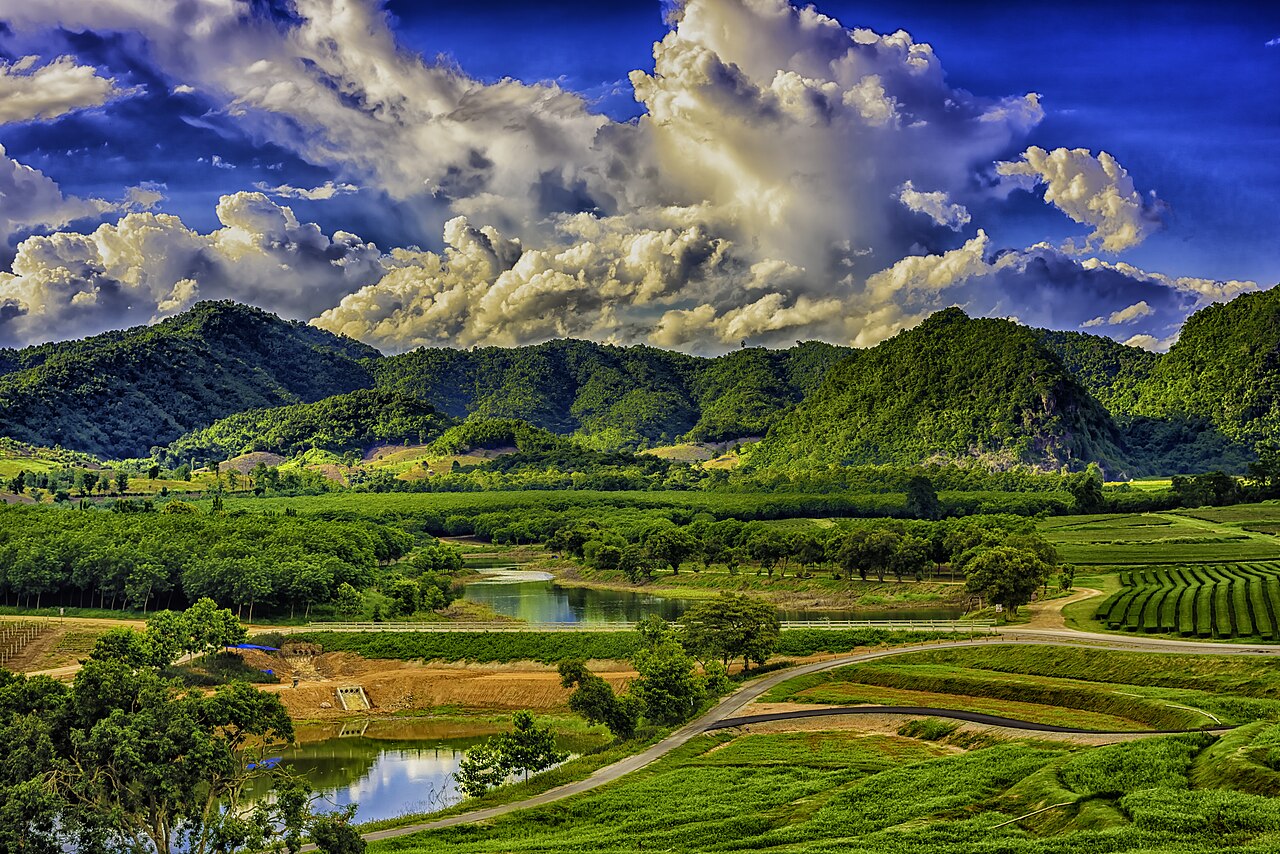
The hills and tea farms of Chiang Rai — the cool northern mountains that give the coffee and tea here their own character.
The reason Chiang Rai's coffee and tea are so good comes down to the land. The high mountains in the north are cool and misty with good soil, which suits arabica — a crop that likes altitude and cooler temperatures. Much of the coffee here grows under big shade trees, so the cherries ripen slowly and build up their full flavour. The tea on the Mae Chan hills gets the same cool air, giving a soft, fragrant leaf. All of it makes Chiang Rai both a growing region and a destination for people who want to drink at the source.
Just as important, Chiang Rai's coffee and tea are inseparable from the story of its hill-tribe communities. Many of these farms came from a switch away from opium fields to more sustainable cash crops. When you buy a cup of Doi Chang or Doi Tung coffee, part of the money cycles back to the communities up on the mountains. It's coffee that gives you both the taste and the story in one cup.
Get the types straight first, then decide whether today is about coffee at the source, a tea-field view, or a roaster in town.
The coffee that put Chiang Rai on the world coffee map — Doi Chang is a village high on the mountains at around 1,500 m, where Akha and Lahu communities have grown arabica in place of opium fields since the 1980s. The beans tend to show fruity flavours and a bright acidity, roasted light or medium, and a pour-over draws out the aroma best. Up at Doi Chang village there are brand cafés and roasteries where you can drink it at the source with mountain views, or you can have it in town at a roaster using Doi Chang beans.
Coffee under the Mae Fah Luang Foundation's Doi Tung Development Project, founded in 1988, which got Akha, Lahu and Karen farmers growing arabica and macadamia instead of opium. The beans grow under forest shade, so they ripen slowly into a rounded, balanced cup, roasted, brewed and sold under the Doi Tung brand, with proceeds going back to the mountain communities. There are several Doi Tung cafés in the project area — one near the ticket booth, another near Wat Phra That Doi Tung — where you sip coffee in cool air with views of the Mae Fah Luang Garden.
The Choui Fong plantation in Mae Chan is one of Chiang Rai's biggest tea estates, about an hour from the city. The highlight is a glass café on the hillside where you sip tea or coffee over terraced green tea rows and a long line of mountains — one of Chiang Rai's favourite photo spots. The menu runs to green tea, oolong, Thai tea and desserts made from the estate's own tea, like crepe cakes, buns and tea ice cream. Entry is free, open daily roughly 8:30–17:30. Come early or in the cool season for the clearest skies and coolest air.
Singha Park, or Boon Rawd Farm, about 12 km from the city, is a big landscaped farm-park with tea fields, a lake, flower meadows and a giant golden lion as its landmark. There are cafés where you can sip the estate's own oolong tea and coffee over the wide fields, and you can cycle or take the tram around the estate. Entry is free, but some activities (the tram, zipline, balloon) are paid. It suits a relaxed half-day of tea, views and photos. Come in the cool season for the coolest air and the flowers in bloom.
Chiang Rai town has a specialty scene getting more serious all the time. Independent roasters use Doi Chang and Doi Tung beans, and beans from other mountains in the province, roasting their own and pouring a steady pour-over and espresso. Many cluster around Sanambin Road in the Rop Wiang area, regarded as the birthplace of the city's third-wave scene; some even have their own Doi Chang coffee farm and sell only their estate beans. If you take your coffee seriously and want to compare several local beans, the in-town roasters are the answer.
Beyond coffee at the source and the mountain-view cafés, Chiang Rai also has easygoing spots for a long sit. North of the city along the Kok River are cafés and brunch places where you can watch the water — good for a late breakfast or a lazy afternoon. Around the Clock Tower and the city centre there are small cafés and slow bars within walking distance of each other, a good pit stop between the White Temple, the Blue Temple and the Night Bazaar. Some serve Chiang Rai's own local beans, so you get the good stuff and the atmosphere both.
Four scenes, each a different mood — coffee at the source on the mountains, tea-view cafés, in-town roasters and a riverside chill.
If you want coffee at the source, head up Doi Chang (Mae Suai) or Doi Tung. On Doi Chang there are brand cafés and roasteries where you sip with views of the mountains and the coffee farm; on Doi Tung there are Doi Tung cafés in the project area, near the ticket booth and near Wat Phra That Doi Tung, with cool air and the Mae Fah Luang Garden alongside. Both mountain roads are steep and winding — you'll need a rental car, a car and driver, or a tour. There's no direct public bus.
North of the city in Mae Chan is tea country, and Choui Fong is the highlight — a glass café on the hillside where you sip tea and coffee over terraced tea rows and mountains, with tea-based desserts to go with it. Entry is free, open daily about 8:30–17:30. Several other small tea farms and cafés sit nearby to drop into. Come early or in the cool season for clear skies and cool air. It pairs well with a day that also takes in Doi Tung or the Golden Triangle.
In Chiang Rai town the specialty scene clusters around Sanambin Road in the Rop Wiang area, where several roasters serious about local beans sit side by side, pouring a steady pour-over and espresso; some have their own Doi Chang farm. Around the Clock Tower and the city centre there are small cafés and slow bars within walking distance. The mood is a real city, with more locals than a tourist quarter — a good place to sit with a good coffee between sights in town.
For an easygoing café with a view, the Kok River north of the city has cafés and brunch places looking out over the water — good for a late breakfast or a lazy afternoon. On the edge of town, garden and farm cafés keep opening too, mostly airy spaces where you can linger. This suits anyone who wants to escape the bustle in town and sip coffee in peace with a natural view. You'll want a scooter, Grab or a car to reach them comfortably.
Some are known for the view, some for the beans — pick by the day you're having.
A big tea estate in Mae Chan district, about an hour from the city. The highlight is a glass café on the hillside designed for sipping tea or coffee while looking out over terraced green tea rows and a long line of mountains. The menu runs to green tea, oolong, Thai tea and desserts made from the estate's tea, like crepe cakes and tea ice cream. Entry is free, open daily roughly 8:30–17:30. To be straight with you, it gets very busy in high season, so come early for an open view and cool air. Hours can change, so check before you go.
In the Doi Tung Development Project area there are several Doi Tung cafés serving arabica grown, harvested and roasted on site — one near the ticket booth, another near Wat Phra That Doi Tung. You sip coffee in cool air with the Mae Fah Luang Garden alongside, its cool-climate flowers in full bloom. The draw isn't just good coffee, it's that the proceeds go back to the Akha, Lahu and Karen communities who grow it in place of opium. If you make it up Doi Tung, stop for a cup and take some beans home.
Sanambin Road in the Rop Wiang area is the heart of the town's third-wave scene. The Roastery by Roj is widely credited as the spot that started Chiang Rai's specialty coffee, with a good range of local beans to choose from. 22 Grams is known for punchy espresso from beans grown in the province. Both are serious about their roasting and brewing, and they're a good way to compare several Chiang Rai beans in one district. Hours and menus can change, so check before you go.
The city centre around the Clock Tower has its own good roasters and slow bars. Alio Slow Bar is one coffee people talk about, because it serves only beans from its own Doi Chang farm, brewed slowly for the fullest flavour. It's a small, quiet, coffee-focused spot, good for a fine pour-over between sights in town. Several other independent cafés sit within walking distance, so it's worth exploring the area — you'll find one you like easily. Hours can change, so check before you go.
Singha Park, or Boon Rawd Farm, about 12 km from the city, is a wide farm-park with oolong tea fields, a lake, flower meadows and a giant golden lion as its landmark. There are cafés where you can sip the estate's tea and coffee over the wide fields, and you can cycle or take the tram around. Entry is free, but some activities (the tram, zipline, balloon) are charged separately. It suits a relaxed half-day of tea, views and photos. Come in the cool season for the coolest air and the flowers in bloom.
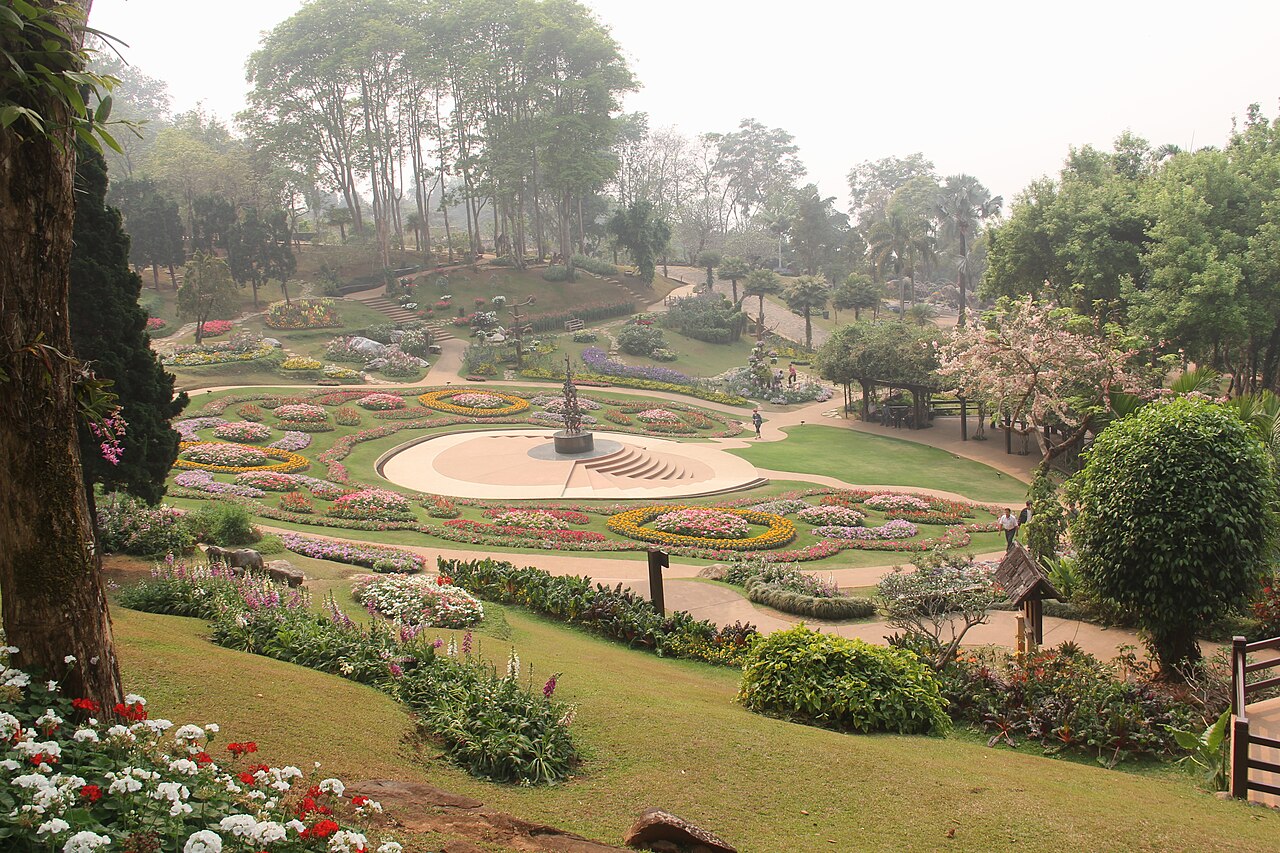
The Mae Fah Luang Garden on Doi Tung — the Doi Tung cafés around it serve arabica grown and roasted within the project area.
Things you can drink in Chiang Rai right at the source.
The drink that sums up Chiang Rai coffee best — Doi Chang beans roasted light or medium, brewed as a hand-dripped pour-over for the clearest fruity notes and bright acidity. Several roasters in town do it well, and it's a good place to start if you want to know Chiang Rai's local flavour. Order it with a light dessert and you'll understand why Doi Chang beans are known worldwide.
Doi Tung beans grown under forest shade give a rounded, balanced cup that isn't too intense, which makes a soft, gentle latte even people who don't like strong coffee enjoy. The Doi Tung cafés and Doi Tung shops in town do it well. The special part is that every cup helps support the hill-tribe communities who switched from opium fields to coffee, so you get the taste and the story together.
On the Mae Chan hills and inside Boon Rawd Farm there's oolong and green tea grown and processed on site — soft and fragrant, drunk hot with a view over the green tea rows at the Choui Fong glass café or the Singha Park café. It's a drink that has been part of Chiang Rai as long as the coffee has. If you don't drink coffee, try the estate's tea — it suits the tea-field setting best.
Many tea-estate cafés make cold drinks from their own tea — iced Thai tea, blended green tea and signature cold drinks using their own leaf, sweet and refreshing. They suit a sunny day when you want to sit out in the tea fields. If you're with kids or with anyone who doesn't drink coffee or hot tea, these cold drinks are a good call — a fun way to taste Chiang Rai's tea.
Most cafés and shops in Chiang Rai take PromptPay / QR scan and cash; larger cafés and the tea-estate spots often take credit cards too. Small shops up on the mountains and roadside stalls usually take cash or QR only, so carry some cash when you head up Doi Chang or Doi Tung. If you're coming from abroad, set up a SIM or eSIM so you always have data for QR payments and navigation — see our Thailand SIM and eSIM guide.
On getting around, understand first that Chiang Rai's prettiest cafés are out of town — Choui Fong, Singha Park, Doi Chang and Doi Tung all need a vehicle to reach comfortably. There's no train to Chiang Rai (the railway ends at Chiang Mai, so it's a train to Chiang Mai then a bus or van) and no BTS/MRT/metro. So if you want to do a café crawl out of town, the best options are a rental car, a hired car and driver, or Grab (it works, but supply is limited). In town it's small and easy to walk, and you can hop around by rented scooter or songthaew — a scooter is handy, but the mountain roads are steep and winding, so wear a helmet and carry a licence.
The best window for mountain-view cafés is the cool season, November to February — cool air, clear skies, fresh green tea fields and crisp mountain views. But to be straight with you, February to April (March is worst) is the burning season across the north, when PM2.5 spikes (Chiang Rai has posted March averages above 100 µg/m³, with AQI often over 150), the skies go hazy and the mountain views disappear in the smoke — sensitive travellers should avoid it. The rainy season, May to October, is far cleaner, with green fields, fewer crowds and lower prices — see the full breakdown in our Chiang Rai best-time guide and best time to visit Thailand.
The golden lion landmark of Singha Park — surrounded by tea fields and view cafés where you can sip a warm drink all day.
Stay central to walk to the roasters and cafés around the Clock Tower, or stay quietly along the Kok River near the brunch cafés.