Home Chiang Rai Thailand Chiang Rai Hotels About
Home  ›  Asia  ›  Thailand  ›  Chiang Rai  ›  3-Day Itinerary
🗓️ Chiang Rai Itinerary · 3 Days · 2026

3 Days in Chiang Rai —
three art temples, the Mekong and the tea hills

From the White Temple, the Blue Temple and the Black House on day one, to the Golden Triangle and old Chiang Saen on the Mekong on day two, finishing with the Singha Park tea hills and the Yunnanese-Chinese village of Doi Mae Salong — or a cool-season Phu Chi Fa sunrise. This is the plan that goes deeper than two days, without the rush.

Why 3 days

Art, the Mekong and the mountains in one trip

Chiang Rai is hard to do in two days, because its best parts fall into three rings. There is Chiang Rai town itself, with three legendary art temples — the White, the Blue and the Black House — and the Night Bazaar; the far north on the Mekong, with the Golden Triangle and the ancient town of Chiang Saen; and the mountains around the city, from Doi Tung to the tea hills and Doi Mae Salong, a village with a strong Yunnanese-Chinese character. Three days is the length that lets you reach all three rings without hurrying.

This 3-day plan is built for travellers who want to go deeper into Chiang Rai — often as an extension of a Chiang Mai trip, arriving by bus. Day one covers the three temples in town, day two is either the Golden Triangle and Chiang Saen or a day up at Doi Tung, and day three splits between the Singha Park tea hills and Doi Mae Salong — or, if you come in the cool season, a pre-dawn Phu Chi Fa sunrise instead. Every leg runs on planes, buses, songthaews and a car-with-driver or tour, because Chiang Rai has no train (the railway ends at Chiang Mai) and no BTS, MRT or metro. Everything moves on roads.

Shorter trip? See the 2-day plan, which covers the three temples and the city highlights in tighter form. Wondering when to come (and about the dry-season haze)? See the best time to visit Chiang Rai. Working out costs? See the Chiang Rai trip budget.

Day One

The three art temples & the Night Bazaar

A glittering white temple in the fields, a blue-and-gold sanctuary, the unsettling Black House, and an easy night of food and crafts at the bazaar — the day you understand why Chiang Rai is a city of artists.
01
Day 1
White Temple · Blue Temple · Black House · Night Bazaar
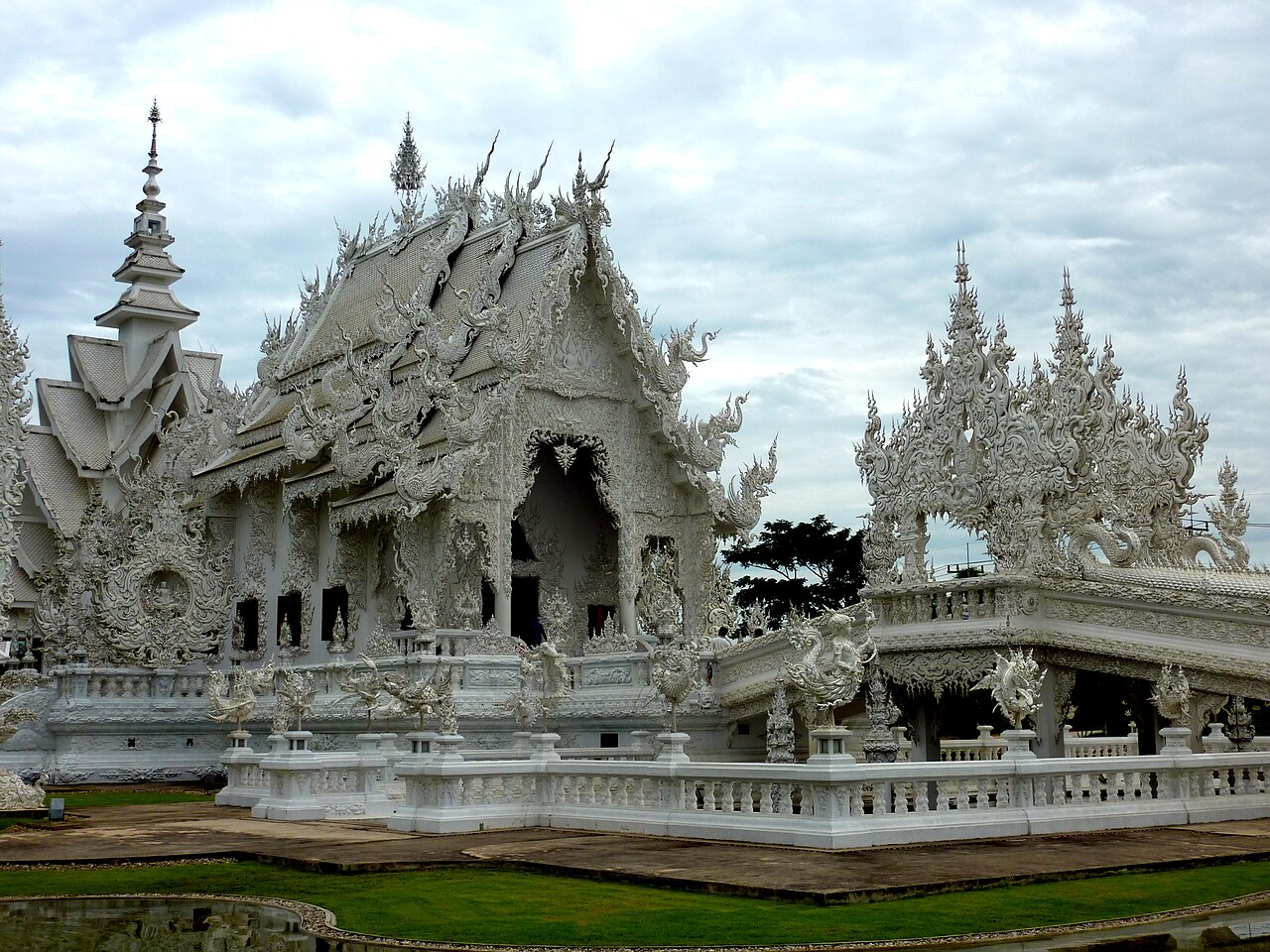
The White Temple (Wat Rong Khun) in Chiang Rai — Chalermchai Kositpipat's all-white, mirror-glass contemporary temple
Morning · ~2.5 hours
The White Temple (Wat Rong Khun) — glittering white art

Start the first morning early at Wat Rong Khun, the White Temple — an all-white, mirror-glass contemporary temple that the artist Chalermchai Kositpipat has been building by hand for over 25 years. The highlight is the bridge over a "sea of reaching hands" before you cross into the white ubosot, where the murals turn surreal and contemporary, and the gleaming gold building beside it (the toilets) is set deliberately against the white.

Going as early as possible helps — softer sun, fewer crowds. Dress modestly (shoulders and knees covered). It sits about 13 km south of town, reachable by songthaew, Grab or on a three-temple tour. Read the best angles and hours in the White Temple guide.

Getting there: ~13 km south of town · songthaew / Grab / taxi ~฿200–300 one way, or part of a three-temple tour
Cost: ฿200 for foreigners (from 1 Jan 2026, includes the Cave of Art) · free for Thais · open ~08:00–17:00
Tip: Arrive before 09:00 to beat the tour buses · shoot the bridge into the morning light · you cannot walk back across the bridge (a temple rule)
Late morning–afternoon · ~3 hours
The Blue Temple (Wat Rong Suea Ten) + the Black House

On the way back into town, stop at Wat Rong Suea Ten, the Blue Temple — a sapphire-blue sanctuary trimmed in gold, built by a student of Chalermchai. Inside, a big white Buddha glows against the vivid blue walls; it is the kind of interior that stops you in your tracks. It sits on the north bank of the Kok River, not far from the centre, and entry is free (donations welcome) — a natural pairing after the White Temple. See the Blue Temple guide.

In the afternoon, continue to the Black House (Baan Dam Museum) — a cluster of around 40 dark teak pavilions by the artist Thawan Duchanee, filled with bones, hides and carvings. It is the "yin" to the White Temple's "yang": unsettling but fascinating. It lies north of town; dress modestly here too. Details in the Black House guide.

Getting there: The Blue Temple is in town (north bank of the Kok River) · the Black House is ~10–13 km north · songthaew / Grab, or part of a tour
Cost: Blue Temple by donation · Black House ~฿100 · open ~09:00–17:00 (the Black House closes for lunch ~12:00–13:00)
Lunch: Try khao soi, nam ngiao or sai ua at a spot in town · see northern Thai food in Chiang Rai · ~฿60–150 per person
Timing tip: The three temples are in different directions (White to the south, Blue in town, Black House to the north), so a half-day car-with-driver or a three-temple tour is far easier than doing it yourself. Find three-temple tours on Klook. You can ride a rented scooter and self-drive, but allow for the heat and the distances.
Evening · ~2.5 hours
The golden Clock Tower + the Chiang Rai Night Bazaar

Close the first day in the centre at the Chiang Rai Clock Tower — another gold design by Chalermchai, with a short light-and-sound show set to music each evening (roughly 19:00 / 20:00 / 21:00, a few minutes each). It is an easy walk from the central hotel area.

From there, walk on to the Chiang Rai Night Bazaar next to the old bus station, open every evening — a big food court, northern snacks, souvenirs, crafts and a stage with dance performances. It is a relaxed place to settle dinner in one spot. See what to eat in the Night Bazaar and street food guide.
Getting there: The Clock Tower and Night Bazaar are central, walkable from hotels in the centre
Cost: Both free · Night Bazaar food court ~฿50–150 per person
Stay: Sleep in the Clock Tower / Night Bazaar area tonight, central and walkable · see where to stay in Chiang Rai
If it is a weekend: Saturday brings the Thanalai Road Walking Street and Sunday the Sankhongnoi Walking Street — longer than the Night Bazaar, with more food and crafts. If your dates line up, swap in the walking street instead.
Day Two

The Golden Triangle + Chiang Saen or Doi Tung

Pick one full day — head to the far north at the Golden Triangle, where three countries meet on the Mekong, then wander old Chiang Saen; or climb Doi Tung for the Princess Mother's Swiss-style villa and a cool-climate flower garden.

02
Day 2 · Option A
Golden Triangle · Chiang Saen · the Mekong
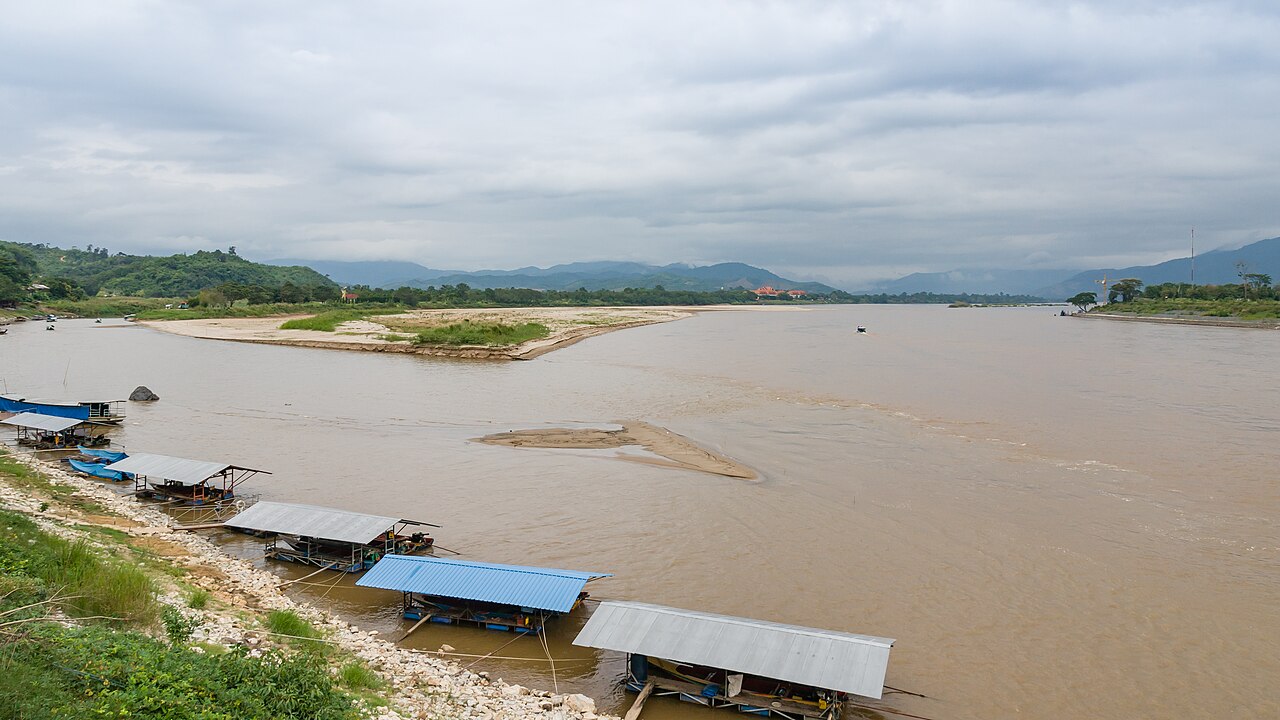
The Golden Triangle at Sop Ruak, Chiang Rai — where Thailand, Laos and Myanmar meet on the Mekong, with a golden riverside Buddha
Morning · leave town ~08:30
The Golden Triangle (Sop Ruak) — three countries meet

This morning, head about 70 km north (~1.5 hours) to the Golden Triangle at Sop Ruak — the point where Thailand, Laos and Myanmar meet on the Mekong. There is a viewpoint with a large golden riverside Buddha, looking clearly across the water to the Lao and Myanmar banks. You can take a long-tail boat on the Mekong to see all three countries (some tours make a short stop at the Lao market on Don Sao island — if you plan to step ashore, check the paperwork and the border rules first; do not assume it is a free, casual crossing).

The area has two opium museums to choose from — the Hall of Opium (a large learning centre about 2 km northwest of Sop Ruak) and the smaller House of Opium in Sop Ruak itself; both tell the region's opium history well. See the route and stops in the Golden Triangle and Chiang Saen guide.

Getting there: Chiang Rai → Sop Ruak ~70 km · ~1.5 hr · a car-with-driver or tour is easiest
On your own: Blue songthaew Chiang Rai → Chiang Saen every ~30 min (~฿37–50), then a 7 km songthaew up to Sop Ruak (~฿20)
Cost: Viewpoint free · Mekong long-tail boat ~฿300–600 per boat · Hall of Opium has a separate entry fee
Afternoon · ~3 hours
Old Chiang Saen + Wat Chedi Luang

In the afternoon, drop about 9 km south from Sop Ruak to old Chiang Saen, an ancient town on the Mekong that was once a centre of the early Lanna kingdom. Walk the old city walls and the temple ruins scattered across town; the highlight is Wat Chedi Luang, a large bell-shaped stupa several centuries old, alongside the Chiang Saen National Museum, which tells the town's story well. It is quiet, with the weight of history all around.

Sit by the Mekong with a coffee, watch the cargo boats pass, then drive back to Chiang Rai in the early evening (~1.5 hours). You sleep in town again tonight.

Getting there: Sop Ruak → Chiang Saen ~9 km · Chiang Saen → Chiang Rai ~60 km · ~1.5 hr
Cost: Wat Chedi Luang / the old town are free to wander · the Chiang Saen National Museum has a modest entry fee
Tip: On a tour, the Golden Triangle + Chiang Saen + an opium museum usually come together in one day. Find Golden Triangle tours on Klook
Alternative · a full day at Doi Tung
Option B: Doi Tung + the villa + the Mae Fah Luang garden

If you would rather spend the day in the mountains than on the river, swap day two for Doi Tung — a royal development on a mountain northwest of the city, about 60 km away. The highlights are the Mae Fah Luang Villa, the Princess Mother's Swiss-style residence, the Mae Fah Luang Garden packed with cool-climate flowers, and Wat Phra That Doi Tung on the summit — plus the Doi Tung development's arabica coffee and macadamia, grown to replace opium.

The road up is a winding mountain drive, so a car-with-driver or a tour is best (you can self-drive a scooter, but the climbs are steep). It is at its best in the cool season, when the flowers are out and the air is crisp. Details in the Doi Tung and Mae Fah Luang guide.

Getting there: Chiang Rai → Doi Tung ~60 km · a winding mountain road · car-with-driver or tour recommended
Cost: A combined ticket for the villa + Mae Fah Luang Garden + the Hall of Inspiration (fees vary by site)
Tip: Doi Tung and the Golden Triangle are in different directions — pick one per day · save the other for day three, or combine if you have time
Day Three

Singha Park + Doi Mae Salong or a Phu Chi Fa sunrise

A last day among rolling green tea and the Yunnanese-Chinese village of Doi Mae Salong — or, if you come in the cool season, a pre-dawn climb to see the Phu Chi Fa sea of mist for yourself, before you travel home.

03
Day 3 · Option A
Singha Park / tea hills · Doi Mae Salong · back
The Singha Park tea plantation in Chiang Rai — terraced green tea rolling across the wide hills of the Boon Rawd farm
Morning · ~2.5–3 hours
Singha Park (Boon Rawd Farm) + Choui Fong tea

Start the last day at Singha Park, a huge farm-park west of the city, about 12 km out — terraced green tea, a lake, seasonal flower fields, a tram tour, bike hire, a zip-line, a balloon, cafés and the big lion statue everyone photographs. Entry is free (activities are paid separately), and the open, airy setting is lovely in the morning light.

Nearby is Choui Fong, a well-known tea plantation with a café over beautiful terraced tea slopes — a good spot to follow up with tea and a snack. Chiang Rai is genuine tea-and-coffee country; see more view cafés in the Chiang Rai café guide, and the park details in the Singha Park guide.

Getting there: Singha Park ~12 km west of town · Grab / taxi / car-with-driver · Choui Fong is in a different direction (to the north), so you will want a car
Cost: Singha Park free entry · tram / bikes / activities paid separately · Choui Fong free entry (pay for food and drink)
Tip: Go early for good light and cooler air · it is at its best in the cool season, when the tea is fresh green and the air is crisp
Afternoon · ~3–4 hours
Doi Mae Salong (Santikhiri) — a Yunnanese-Chinese hill village

In the afternoon, climb to Doi Mae Salong (Santikhiri), northwest of the city — a hill village settled by Chinese Nationalist (Kuomintang) soldiers who fled here after the Chinese civil war. The result is a strongly Yunnanese-Chinese place: terraced oolong tea, tea houses, Yunnan food (man tou with braised pork, Yunnan noodles), a general's memorial, and lovely mountain views, with cool air year-round.

The road up is another winding mountain climb, so a car-with-driver or a tour is best. If time is tight, you can swap Doi Mae Salong in for day two instead. See the route and stops around the city in the Chiang Rai day trips guide.

Getting there: Chiang Rai → Doi Mae Salong ~65 km · a winding mountain road ~1.5–2 hr · car-with-driver or tour recommended
Cost: Walking the village / tasting tea is free · Yunnan food ~฿80–200 per person · you can stay overnight on the hill for the sunrise
Back: Come down to Chiang Rai this evening (~1.5–2 hr) · if you are flying out, leave time to reach CEI airport
🌫️ Dry-season note: The mountain views from Doi Mae Salong, Singha Park and Doi Tung are at their best in the clear cool season, but from February to April (March is worst) the north has its burning season: PM2.5 spikes (Chiang Rai has averaged above 100 µg/m³, with the AQI often over 150), the sky turns hazy and the mountain views can vanish into the smoke. If you come then, the photos may suffer and sensitive travellers should take care. See the best time to visit.
Alternative · cool season only
Option B: a Phu Chi Fa sunrise over the sea of mist

If you visit in the cold months (mid-November to January), one of Chiang Rai's most rewarding experiences is climbing Phu Chi Fa for sunrise over a sea of mist — a clifftop viewpoint in the east of the province, about 90 km away (~2–3 hours). You stay nearby the night before, rise at around 4–5am and make the short ~20–30 minute climb to the viewpoint to catch the first light. It is very cold at the top, around 8–10°C, so bring warm layers.

Because Phu Chi Fa is far and needs an overnight, if you want this option you should rework the plan so night two is near Phu Chi Fa (or treat it as a separate trip), then loop back for the tea hills or Doi Mae Salong the following day — it suits travellers who come specifically to chase the mist. See the spots and seasons in the Chiang Rai day trips guide.

Getting there: Chiang Rai → Phu Chi Fa ~90 km · ~2–3 hr · a mountain road, so you need a car or tour · stay near Phu Chi Fa overnight
Season: The sea of mist is most reliable mid-Nov–Jan · rise ~4–5am · climb ~20–30 min · the summit is ~8–10°C
Note: Outside the cool season the sea of mist is rare, and the dry season brings haze — this is a cool-season experience only
🏞️
Less time?
See the 2-day plan — the three temples and the city highlights, tightened up
See the 2-day plan →
Practical info

Where to stay · getting around · budget

🏨
Where to stay

This plan sleeps in town both nights, since you return to the city each evening — no need to change hotels. The Clock Tower / Night Bazaar area in the centre is the easiest base, walkable and with rooms in every band. Prefer quiet? Pick the Kok River or an out-of-town resort in the tea country (you will need transport). See options in the Top 10 Chiang Rai hotels or read which area to stay in.

🚕
Getting around

Chiang Rai has no train (the railway ends at Chiang Mai) and no BTS, MRT or metro — in town you use blue songthaews (shared trucks), tuk-tuks (always agree the fare first) and Grab (it works, but supply is limited). For the temple circuit and the mountains, a car-with-driver or a tour is easiest. The compact centre around the Clock Tower is walkable. See getting around Chiang Rai.

✈️
Getting to Chiang Rai

Fly into Mae Fah Luang–Chiang Rai (CEI), ~1 hr 20 from Bangkok — the airport is ~10 km from town, but there is no airport bus any more (it stopped in Aug 2024), so it is taxi / Grab / private transfer only (agree the fare first). Or take a bus — GreenBus from Chiang Mai hourly, ~3–3¾ hr. See getting to Chiang Rai.

Budget

Approximate cost per day, per person

Item Budget Mid-range Comfort
Stay (per night) ฿350–700
(hostel / guesthouse)
฿800–1,800
(3-star hotel)
฿2,500–6,000+
(resort / 4–5 star)
3 meals ฿150–300
(local / market)
฿350–600
(sit-down)
฿700–1,500
(cafés / nicer spots)
Transport (road / tour) ฿100–300
(songthaew / Grab)
฿500–1,200
(scooter / shared tour)
฿1,500–2,500
(car-with-driver / day)
Tickets / activities ฿100–300
(temples / Black House)
฿300–800
(Mekong boat + Doi Tung)
฿800–1,500
(full-day tours)
Daily total (approx.) ฿700–1,600
(~$20–46)
฿1,950–4,400
(~$55–126)
฿5,500–11,500+
(~$157–329+)

Indicative rates at roughly ฿35 ≈ $1 USD · the big single costs are getting here (a Bangkok–Chiang Rai flight or a bus from Chiang Mai) and a car-with-driver or tour on the days you head out of town · prices are approximate and vary by season and by how many split the car — check before you go. See the breakdown in the Chiang Rai trip budget.

Frequently asked

FAQ · 3-day Chiang Rai plan

Is 3 days enough for Chiang Rai?
Yes — and three days is the sweet spot for most travellers. Day one covers the three art temples in town (the White Temple, the Blue Temple and the Black House) and the Night Bazaar; day two heads north to the Golden Triangle and Chiang Saen on the Mekong, or up to Doi Tung; and day three is the Singha Park tea hills with Doi Mae Salong, or a cool-season Phu Chi Fa sunrise. You get the art, the Mekong and the mountains in one trip. With only two days you can still see the main highlights — see the 2-day plan — but three days lets you fit the Golden Triangle, Doi Tung and Doi Mae Salong without rushing.
What is the best time of year to visit Chiang Rai, and what about the haze?
The best time is the cool season, roughly November to February — comfortable days around 28–31°C, cool nights in the hills of 14–20°C, clear skies and the cleanest air, ideal for the temples, the mountains and the Phu Chi Fa sea of mist. But be honest with yourself about the burning season: from February to April (March is worst), widespread agricultural and forest burning across the north sends PM2.5 spiking — Chiang Rai has recorded March averages above 100 µg/m³, the AQI often tops 150, skies turn hazy, mountain views disappear and temperatures climb towards 40°C. Sensitive travellers should avoid February to April. The rainy season, May to October, is greener, far cleaner and cheaper, with October the sweet spot. See the best time to visit Chiang Rai and the best time to visit Thailand.
Can I do the Golden Triangle and Chiang Saen on my own, or should I hire a car or take a tour?
The Golden Triangle (Sop Ruak) is about 70 km from Chiang Rai, roughly a 1.5-hour drive, and old Chiang Saen sits about 9 km from Sop Ruak. You can do it by public transport: blue songthaews run from Chiang Rai to Chiang Saen roughly every 30 minutes (about 37–50 baht), then a short songthaew covers the 7 km north to Sop Ruak (about 20 baht). But to fit the viewpoint, the golden Buddha, an opium museum and the Chiang Saen ruins into a single day without wasting time, a car with driver or a tour is far easier, because the sights are spread out and public transport thins out in the afternoon. See the Golden Triangle and Chiang Saen guide.
What is a realistic budget for 3 days in Chiang Rai?
Chiang Rai is clearly cheaper than the islands or Bangkok. A mid-range budget runs roughly ฿1,500–3,000 per person per day, covering a mid-range room (฿800–1,500), three meals (฿250–500), in-town transport — songthaews, taxis and Grab (฿100–300) — and entry tickets. The big single costs are getting to Chiang Rai (a flight from Bangkok versus a bus from Chiang Mai) and a tour or car-with-driver for the Golden Triangle or Doi Tung day (from about ฿1,500–2,500 per car per day). The White Temple is ฿200 for foreigners (free for Thais), the Black House is ฿100, and the Blue Temple is by donation. Budget travellers eating at local spots and staying in hostels can get by on ฿800–1,200 a day. See the breakdown in the Chiang Rai trip budget.
Where should I stay in Chiang Rai for this 3-day plan?
You can stay in town both nights without moving, since this is a trip that returns to the city each evening. The Clock Tower / Night Bazaar area in the centre is the easiest base — walkable for food and sights, with rooms in every price band. If you prefer quiet, choose the Kok River or an out-of-town resort in the tea country (you will need transport). The Golden Triangle, Doi Tung, Doi Mae Salong and Phu Chi Fa can all be done as day trips from the city (Phu Chi Fa needs a pre-dawn start or a night nearby). See the Top 10 Chiang Rai hotels and which area to stay in.
Does Chiang Rai have a train or metro, and how do I get around?
Chiang Rai has no train — Thailand's Northern Line ends at Chiang Mai — and there is no BTS, MRT or metro in the city. You arrive by flying into Mae Fah Luang–Chiang Rai International Airport (CEI), about 1 hour 20 from Bangkok, by bus or van from Chiang Mai (GreenBus hourly, about 3–3¾ hours), or by overnight coach from Bangkok. Around town you use blue songthaews (shared trucks), tuk-tuks (always agree the fare before you get in), Grab (it works but supply is limited), or a rented scooter or car-with-driver for the temple circuit and the mountains. The compact centre around the Clock Tower and Night Bazaar is walkable. See the getting to Chiang Rai and getting around Chiang Rai guides.