12 places worth your time
Ordered from the city outward — start with the three coloured temples and the clock tower, then head into the hills and up to the Mekong.
 1
1
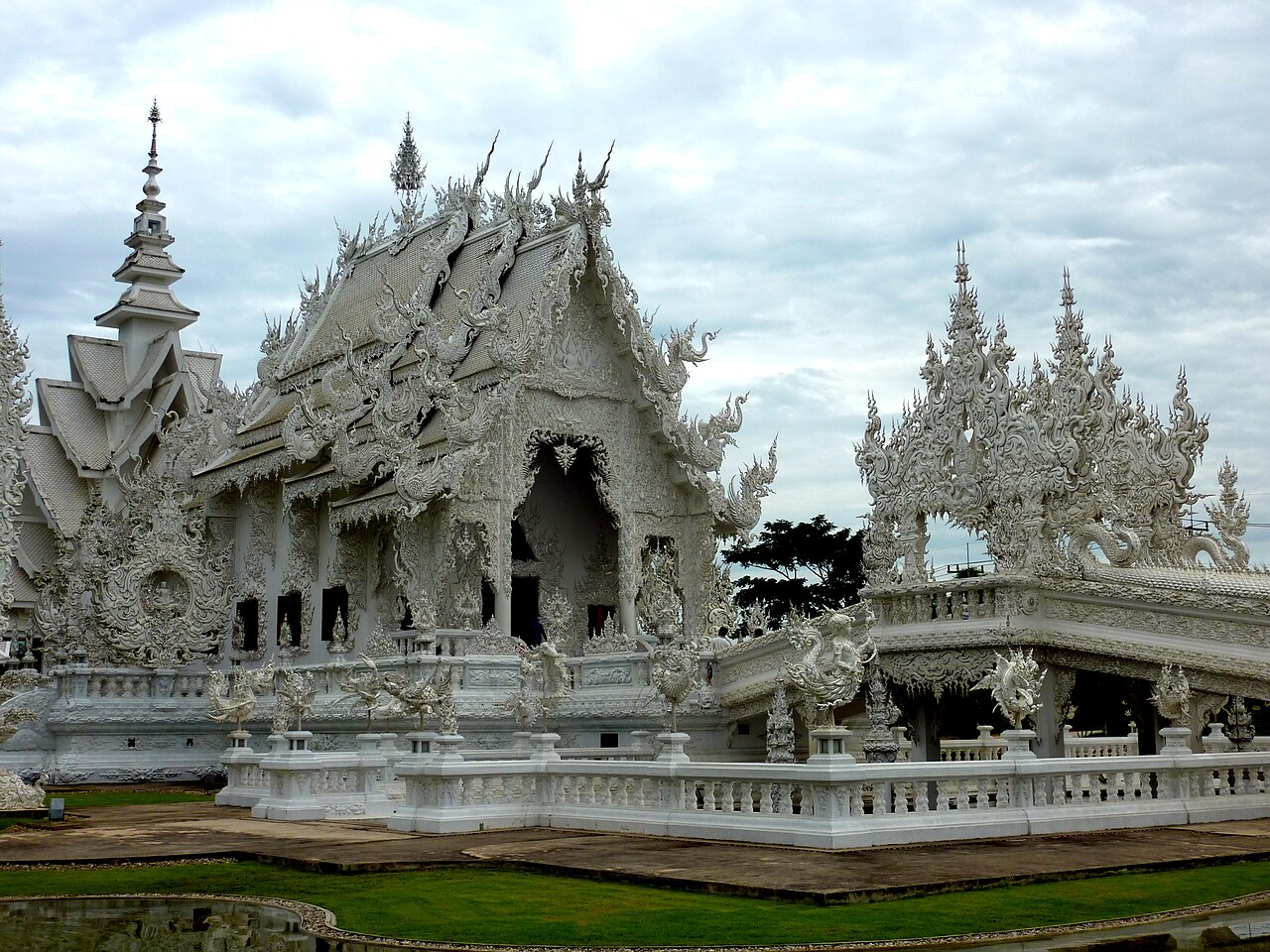
Picture this: a whole temple in pure white, set with thousands of mirror-glass chips, its plasterwork rippling like white flames. This is Wat Rong Khun, the life's work of the artist Chalermchai Kositpipat, who started building it himself in 1997. To reach the main hall you cross the bridge over the cycle of rebirth, with hundreds of hands reaching up from a hell below. Inside are wildly imaginative contemporary murals, and the "golden building" is the most beautiful set of toilets in Thailand. Be honest with yourself about timing: by mid-morning it is crowded and very hot, so go early. Dress modestly, shoulders and knees covered.
 2
2
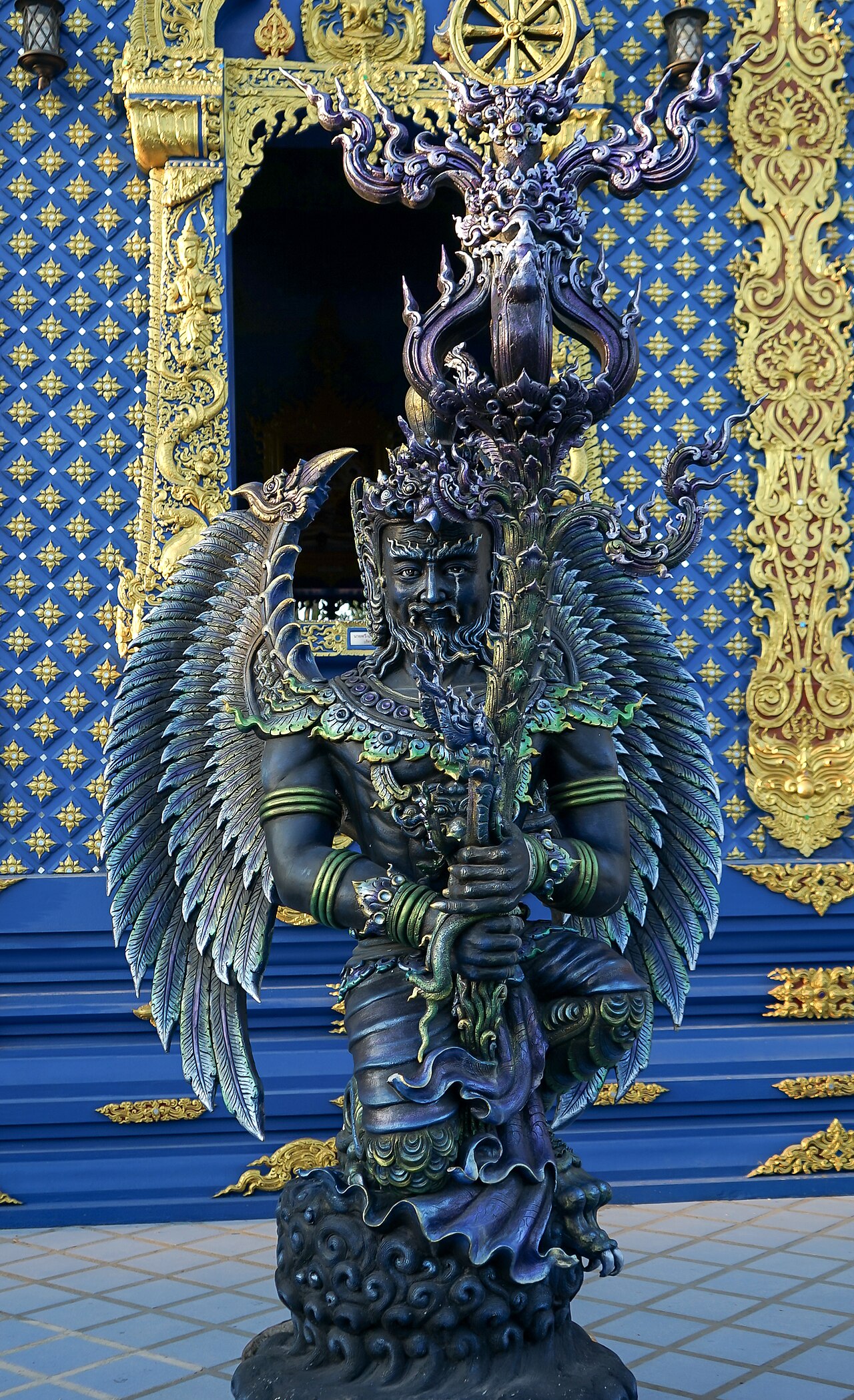
If Wat Rong Khun is white, Wat Rong Suea Ten is the most intense sapphire blue in Chiang Rai. The whole temple is painted deep indigo and trimmed in gold — walls, pillars, roof and statues alike — and inside it glows with bright blue-and-gold murals. Behind it stands a large white Buddha set against the sky. It was built by Putha Kabkaew, a student of Chalermchai, and most people see it together with the White Temple in a single day. It sits on the north bank of the Kok River, closer to town. The light is best in the morning or late afternoon. Dress modestly, as at any temple.
The Black House is the dark counterpart to Wat Rong Khun — one is bright white, this is brooding black. It is the life's work of the artist Thawan Duchanee: more than 40 black teak buildings scattered through shaded gardens, filled with animal bones, hides, buffalo horns and giant-scale furniture. The mood is unsettling but fascinating, and it makes you think. A reminder: this is a museum, not a temple. A walk around takes about 1–1.5 hours. It is in the Nang Lae area north of the city. Dress modestly and explore respectfully.
In the centre of Chiang Rai stands a gleaming golden clock tower designed by Chalermchai Kositpipat — the same artist behind Wat Rong Khun — and finished in 2008, in the same ornate style. The highlight is the light-and-sound show in the evening, at about 7, 8 and 9 pm, when the whole tower shifts colour from gold to pink, green and blue in time with Thai music for about 10–15 minutes (the 9 pm show is in full darkness and the brightest). From the tower you can walk to Wat Phra Kaew — once home to the Emerald Buddha — and on to the Night Bazaar, all in the compact centre.
Doi Tung is a royal-project mountain about 60 km northwest of the city. The highlights are the Doi Tung Royal Villa, the Princess Mother's residence blending Swiss and Lanna architecture; the Mae Fah Luang Garden, a vivid cool-climate flower garden that rotates through the year; and Wat Phra That Doi Tung on the summit. The surrounding slopes grow the arabica coffee and macadamia of the Doi Tung Development Project, which turned former opium-growing land into tea and coffee farms and hill-tribe crafts. The mountain road is steep and winding, so you need a car or a tour. It is best in the cool season when the garden is in full bloom.
Formerly Boon Rawd Farm, the farm of Boon Rawd Brewery (the makers of Singha beer, founded in 1933), today it is a vast agritourism park. The highlights are the terraced tea fields stretching to the horizon, a lake, seasonal flower fields, and the giant golden lion that everyone photographs. You can ride the farm tram (~฿50 · running about 9.30 am–5 pm, roughly 45–60 minutes, through the tea fields and an animal-viewing stop), cycle, or try the zip-line, and there is a café for tea with a view over the fields. Entry is free (activities and the tram are charged separately). It is at its best in the cool season.
Chiang Rai is real tea country, and the most photogenic plantation is Choui Fong — rows of tea terraces that ripple down the hillsides in green stripes, like a painting. Its tea-house café juts out over the fields, so you can sip green tea or oolong with a slice of green-tea cake and look out across the rows. People usually pair it with Singha Park, since they are in the same area. It is good all year, but greenest at the end of the rains into the early cool season. The last stretch of road is hilly, so a car helps. Come early, when the crowds are thin and the light is soft for photos.
About 60–70 km north of Chiang Rai, a 1–1.5 hour drive, is the Golden Triangle (Sop Ruak), the point where Thailand, Laos and Myanmar meet on the Mekong, marked by a viewpoint and a large golden Buddha. You can take a long-tail boat to see all three countries (~฿400–500 per person for about an hour) and step across to Don Sao island on the Lao side for a day visit (check the border formalities carefully). The Hall of Opium and the House of Opium museum cover the region's opium history in detail. Nearby is the ancient town of Chiang Saen (~8 km), with old city walls, ruined temples and Wat Chedi Luang. It works as a half- or full-day trip.
Climb into the hills north of the city for about 1.5–2 hours, the air cooling all the way, and you reach Doi Mae Salong, a ridge-top village with a story unlike anywhere else. This is a Yunnanese-Chinese community descended from former soldiers of the 93rd Division of the Kuomintang, who settled here after fleeing China. Today it is a Yunnan-style village, officially called Santikhiri, with quality oolong tea, tea houses, Yunnanese food and a living Chinese-Haw culture. The pace is slow, quieter than Pai, and it suits a scenic drive or a night up on the hill to catch the morning mist.
If you want to know where the sea of mist Chiang Rai people are proudest of actually is, it is Phu Chi Fa — a cliff on the Thai-Lao border that juts out over a wide white sea of cloud. It is about 90 km from the city, a 2–3 hour drive, so most people stay nearby for a night, then rise before 5 am to walk up to the viewpoint (a short trail of about 760 metres, ~20–30 minutes) for sunrise over the mist. Be honest with yourself: the sea of mist is a cool-season thing (Nov–Feb) only — in the Feb–Apr burning season haze blocks the view, and the rains make the trail wet and slippery. Bring a warm layer; early mornings up here are genuinely cold.
For some green nature close to the city, Khun Korn Waterfall is the answer — the tallest waterfall in Chiang Rai province, dropping more than 70 metres into a clear pool below. It sits inside a forest reserve, so you have to walk in about 1.5 km through shady jungle and along a stream (it is a real forest path, so wear shoes with grip). At the bottom you can swim in the shallow pool. It is fullest and prettiest at the end of the rains, when the air is cool. It makes an easy half-day close to town, about 30 km south of the city.
After dark, the place where locals and travellers gather is the Night Bazaar, the nightly market by the old bus station in the centre of town. It opens every evening, with a food court for northern dishes, stir-fries and grills, and a stage with live music and traditional dance. Around it are craft stalls, hill-tribe textiles and souvenirs — easy to stroll and graze. If you are here on a weekend, add the Saturday Walking Street (Thanalai Road) and the Sunday Walking Street (Sankhongnoi). It is right in the centre, an easy walk from any hotel around the clock tower.