Home Chiang Rai Thailand Chiang Rai Hotels About
Home  ›  Thailand  ›  Chiang Rai  ›  Golden Triangle & Chiang Saen
🛕 Day Trip from Chiang Rai · 2026

The Golden Triangle
where three countries meet on the Mekong

Stand in one spot and see three lands — Thailand, Laos and Myanmar meet where the Ruak River joins the Mekong, about 60 km north of Chiang Rai. There's a big golden Buddha at the water's edge, long-tail boats that hop you over to Laos at Don Sao, the Hall of Opium telling the region's heavy past, and the ancient town of Chiang Saen, older than Chiang Mai.

Why head north to the Golden Triangle

Leave Chiang Rai city for the far edge on the Mekong

Plenty of people come to Chiang Rai to tick off the three famous temples — the White Temple, the Blue Temple, the Black House — and call it done, which is fine. But if you have a spare day, drive another ~60 km north and you reach a completely different world: the Golden Triangle at Ban Sop Ruak, the point where three national borders meet in the middle of the Mekong. Stand on the Thai bank, look across the water, and Laos is on your right, Myanmar's Shan State on your left, all in one frame.

Everything worth seeing here sits within a few dozen kilometres — the viewpoint, the big golden Buddha on a boat, a long-tail Mekong cruise with a stop at Laos's Don Sao island, the Hall of Opium museum that tells the region's opium-trade past, and the ancient riverside town of Chiang Saen with its old Lanna chedis. We've ordered them in the way you'd actually visit, with an honest note on which are easy and which need time and a car. Before you plan, browse all our Chiang Rai day trips.

🗺️
The route at a glance
Chiang Rai → Chiang Saen (the old town) → Sop Ruak (the Golden Triangle + a Mekong boat + the Hall of Opium) all line up — one easy day
See all Chiang Rai sights →
6 things to see

From the Mekong bank to the ancient town

Ordered the way you'd visit — with an honest note on which is a quick photo stop, which needs time, and which involves the border.
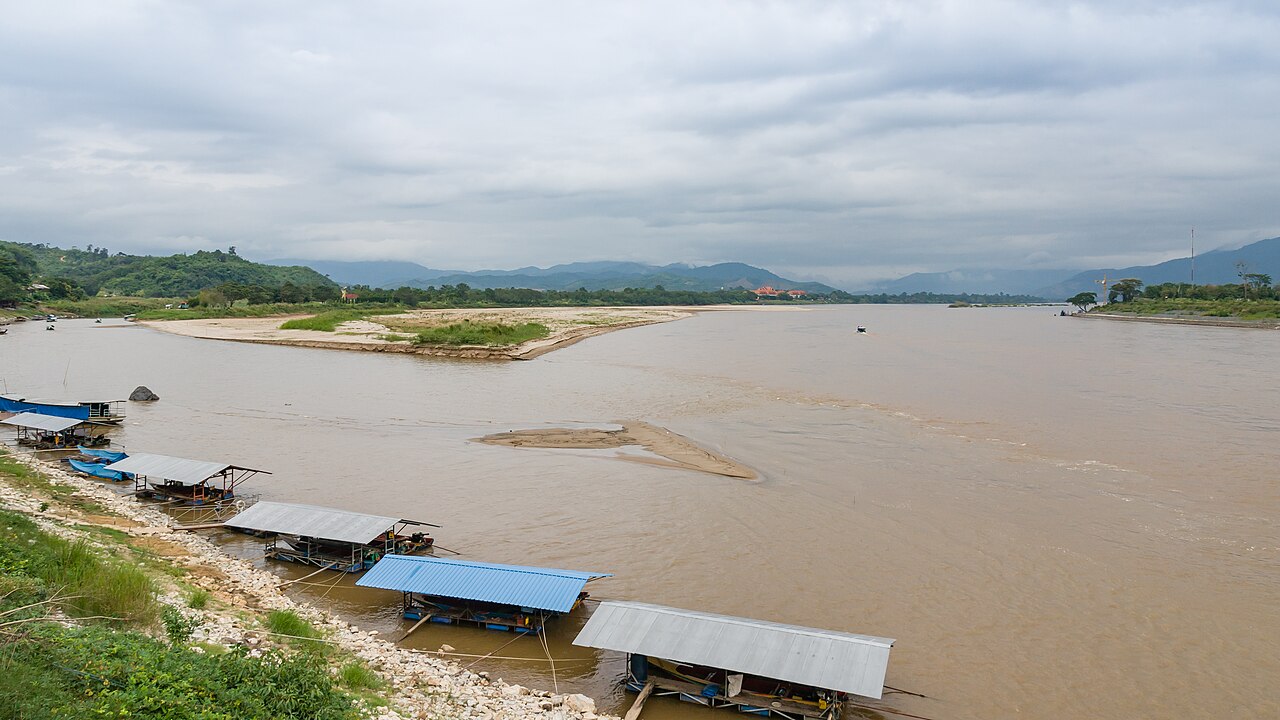
The Golden Triangle viewpoint at Sop Ruak, Chiang Rai — the wide, muddy Mekong where the Ruak River joins it, with the hills of Laos and Myanmar across the water and long-tail boats moored on the Thai bank 1
Sop Ruak Golden Triangle viewpoint
Where Thailand, Laos & Myanmar meet · big golden Buddha on a boat · free

If there's one spot to see here, make it this one. The Golden Triangle viewpoint is at Ban Sop Ruak in Chiang Saen district — right where the Ruak River flows into the Mekong. Stand on the Thai side and look across: Laos is on your right, Myanmar's Shan State on your left, three lands in one frame. The name "Golden Triangle" comes from the area's past as one of the world's biggest opium-growing and trading regions.

The photo highlight is the big golden Buddha seated on a boat (the Phra Chiang Saen Si Phaendin) by the river, with the gilded Golden Triangle archway and signs. Climb up to the small hilltop temple of Wat Phra That Doi Pu Khao for a sweeping view of the wide river. The viewpoint is free, and around it are shops, cafes and the boat pier. Honestly, come early or late for the best light and fewer people than at midday.

Getting there: ~60 km north of Chiang Rai city, ~1–1.5 hr by car/private driver · or a bus to Chiang Saen then a songthaew/tuk-tuk for the last ~10 km (agree the fare first)
Entry: The viewpoint, archway and riverside Buddha are free
Time needed: ~1–1.5 hr (with photos and the climb to the hilltop viewpoint)
Tip: Walk up to Wat Phra That Doi Pu Khao or the elephant-shaped tower for the panoramic river view
Best time: The cool season (Nov–Feb), clear skies and good views across to Laos and Myanmar · avoid the burning season (Feb–Apr, March worst), when PM2.5 haze blots out the view and ruins photos
🛶2
A long-tail Mekong boat + Don Sao
Cruise the Mekong · set foot in Laos at Don Sao · ~30–45 min

Once you're at the river, most people want to get on the water. At the pier near the big Buddha, long-tail boats take you out to see the three-country confluence from midstream — you can spot the two-toned line where the Ruak meets the Mekong, and get a closer look at the Laos and Myanmar banks. The popular trip is a stop on Don Sao island, on the Laos side, with a small market selling duty-free alcohol, cigarettes and souvenirs, plus a casino.

Be clear about the border. Honestly — a return day visit to Don Sao needs no visa, but it's an informal crossing: you leave your passport at the Thai immigration checkpoint at the pier and collect it on the way back, and you can only visit within the designated island zone. Entering mainland Laos from here requires a full Laos visa, so check with the boatman and the checkpoint first. Boats may wait to fill up or you'll have to negotiate the fare — weigh that against a tour that arranges the boat for you.

Getting there: Board at Sop Ruak pier, near the big Buddha · the confluence cruise + a Don Sao stop runs ~30–45 min (depends on the trip)
Boat fare: Round-trip to Don Sao ~฿400–500/person (some seasons or groups pay more) · agree the fare and stops before you board · check before you go
Documents: Leave your passport at the Thai checkpoint, collect it on return · Don Sao only within its zone · mainland Laos needs a visa
Tip: A tour that includes the boat is easier than haggling yourself · carry cash (baht/kip) to shop on the island
🏛️3
Hall of Opium
The region's opium-history museum · Mae Fah Luang Foundation · ~฿200–300

The name "Golden Triangle" comes from the area's heavy opium-trade past, and the place that tells that story best is the Hall of Opium at the Golden Triangle Park, the large museum run by the Mae Fah Luang Foundation, near the Sop Ruak viewpoint. The displays are modern: you enter through a dark tunnel that sets the mood, then the museum walks you through the origins of opium, the Opium Wars, the human and social toll, and the work to tackle drugs and replace opium crops with the royal project's alternatives.

Honestly, the content is fairly heavy and serious — it isn't a place for pretty photos — but if you want to understand why this corner of Thailand is called the "Golden Triangle," this gives the fullest answer. Allow a relaxed 1.5–2 hours; it suits anyone interested in history, and adults more than small children.

Getting there: In the Sop Ruak area, ~2–3 km from the viewpoint · fits straight into the Golden Triangle route
Entry: ~฿200–300 (check before you go, it changes by period) · discounts for children/seniors
Time needed: ~1.5–2 hr
Open: roughly 8.30 am–4.00 pm · usually closed Mondays — check the opening day before you go
Note: It's an air-conditioned indoor museum, good in any season — a handy escape from the sun or rain between outdoor stops
🪔4
House of Opium
A small private museum near the viewpoint · ~฿50

If the Hall of Opium is the big, full-length museum, the House of Opium is the small, abridged version. It's a little privately run museum right by the Sop Ruak viewpoint, gathering real opium paraphernalia — pipes, lamps, scales and everyday objects once used in the opium trade — with labels telling the story up close.

Honestly, it's much smaller than the Hall of Opium and won't take long, but it's cheap and sits right at the viewpoint. It suits travellers who are short on time but want a quick taste of the area's opium history. If you want a serious study, go to the Hall of Opium; if you just want a quick look while you're photographing the viewpoint, the House of Opium does the job.

Getting there: Right by the Sop Ruak viewpoint, a short walk from the big Buddha plaza
Entry: ~฿50 (check before you go)
Time needed: ~30–45 min
Tip: Pick one of the two if time is tight — the Hall of Opium (full) or the House of Opium (quick)
🏯5
Ancient Chiang Saen
Wat Chedi Luang · Wat Pa Sak · old walls on the Mekong · older than Chiang Mai

On the way to Sop Ruak you pass through ancient Chiang Saen, a centuries-old town on the Mekong that was once an important Lanna city. In and around the town, Lanna-era ruins are scattered within walking distance, and it's quiet and atmospheric — a real contrast to the famous temples back in Chiang Rai city.

The highlights are Wat Chedi Luang, a bell-shaped chedi about 58 metres tall built around 1515, the largest in town, and Wat Pa Sak just outside the walls, whose finely stuccoed chedi is regarded as one of the most beautiful Lanna chedis in the north. The Chiang Saen National Museum is a good starting point for the town's history, and there are old city walls and a moat to wander too. A relaxed half day is enough to soak it up.

Getting there: ~60 km from Chiang Rai (~1–1.5 hr by road) · Chiang Saen to Sop Ruak is another ~10 km · do them together in one day
Entry: Most temples and the walls are free / donation · the National Museum charges around ฿100 for foreigners (check before you go)
Time needed: Half a day (walking the temples and museum)
Tip: Dress modestly for the temples · start early before the heat, as the ruins are out in the open
Best time: The cool season (Nov–Feb) is easiest for walking the open-air ruins · avoid the burning season (Feb–Apr), with its hazy skies and heat up to ~40°C
🚗6
How to do it in a day
Tour or private car · ~60 km north · half to a full day

The good news is that everything above lines up on the same route, so you can do it comfortably in a day. A good plan is to leave Chiang Rai early, stop at ancient Chiang Saen before the heat, then move on to Sop Ruak mid-morning for the viewpoint, a Mekong boat or a Don Sao hop, and finish at the Hall of Opium in the afternoon, back in Chiang Rai by evening.

Honestly, public transport on the last leg (Chiang Saen → Sop Ruak) is sparse. If there are a few of you, hiring a car with a driver is better value and far more flexible — you can stop wherever you like. Or, if you'd rather not deal with logistics, take a day tour that usually folds in Wat Rong Khun or Doi Tung on the route, with hotel pick-up, a guide and entry tickets included. Some people do the three city temples on day one and keep the Golden Triangle and Chiang Saen for day two, the way our 3-day Chiang Rai itinerary sets it out.

Getting there: Private car/driver from Chiang Rai ~1–1.5 hr · or a tour with hotel pick-up
Rough budget: A full-day car + driver runs ~฿1,500–2,500 per vehicle (depends on distance and bargaining) · a shared tour is cheaper per head if there are only a few of you
Time needed: Half a day (viewpoint + boat) to a full day (with Chiang Saen + Hall of Opium)
Tip: Compare Golden Triangle + Chiang Saen tours on Klook · start early to beat the heat and crowds
Before you go

What to know before you leave Chiang Rai

Match your transport to the trip — the Golden Triangle and Chiang Saen are out of town, and there is no train here (Thailand's northern railway ends at Chiang Mai), while Chiang Rai itself has no BTS, MRT or metro. So the smoothest options are a hired car with a driver or a day tour. If you want to go independently, take a bus from the Chiang Rai bus terminal (Terminal 1) to Chiang Saen, about 1.5 hours, then a songthaew or tuk-tuk for the last ~10 km to Sop Ruak — buses on that leg are infrequent, so allow time and check the return. Read our overview of how to get to Chiang Rai and getting around Chiang Rai first.

Be clear about the border — if you take the boat to Don Sao on the Laos side, bring your actual passport to leave at the Thai immigration checkpoint at the pier, and collect it on return. A day visit to Don Sao needs no visa, but it's an informal crossing and you can only visit within the designated zone; entering mainland Laos requires a full Laos visa. On the island you can use both baht and kip, so carry cash if you want to shop, and always agree the boat fare and stops with the boatman before you board.

Season and what to pack — come in the cool season (Nov–Feb) for clear skies and good three-country views; it's the best time. Honestly, the burning season (Feb–Apr, March worst) brings spikes in PM2.5 haze, dull skies and heat, and views and photos suffer badly — sensitive travellers should avoid it. See the detail in our when to visit Chiang Rai and when to visit Thailand guides. The sights are outdoors and at temples, so dress modestly and bring a hat, water and sunscreen. Mobile data works well here; if you don't have a SIM yet, see our Thailand eSIM/SIM guide.

Frequently asked questions

FAQ · The Golden Triangle & Chiang Saen

How far is the Golden Triangle from Chiang Rai city, and how do I get there?
The Golden Triangle viewpoint at Sop Ruak is about 60 km north of Chiang Rai city, roughly 1 to 1.5 hours by road, passing through Chiang Saen district. The easiest way is to hire a car with a driver, or take a day tour that usually combines it with Wat Rong Khun or Doi Tung on the same route. If you want to do it yourself, take a bus from the Chiang Rai bus terminal (Terminal 1) to Chiang Saen, about 1.5 hours, then a songthaew or tuk-tuk for the last ~10 km to Sop Ruak — agree the fare before you get in. Honestly, public transport on that last leg is infrequent, so if there are a few of you, hiring a car is better value and far more flexible.
Do I need my passport or a visa to take the boat to Don Sao in Laos?
A return day visit to Don Sao island in Laos does not require a visa, but it's an informal crossing — you leave your passport at the Thai immigration checkpoint at the pier and collect it on the way back. The island has a market selling duty-free alcohol, cigarettes and souvenirs, plus a casino. A round-trip long-tail boat costs around ฿400–500 per person (some seasons or groups pay more), and the trip takes about 30–45 minutes. Important: entering mainland Laos from this point requires a full Laos visa — Don Sao can only be visited within its designated zone. Always check the conditions with the boatman and the checkpoint first.
What's the difference between the Hall of Opium and the House of Opium — which should I visit?
They are two separate museums of very different size. The Hall of Opium is the large museum run by the Mae Fah Luang Foundation, with a modern, in-depth telling of the region's and the world's opium history; allow about 1.5–2 hours, with entry around ฿200–300 (check before you go). It opens roughly 8.30 am–4.00 pm and usually closes on Mondays. The House of Opium is a small, privately run museum near the viewpoint, with entry around ฿50, telling the story through everyday opium objects. If you're short on time but seriously interested in the history, choose the Hall of Opium; if you just want a quick look near the viewpoint, the House of Opium will do.
What is there to see in ancient Chiang Saen, and how long does it take?
Chiang Saen is a centuries-old town on the Mekong, with Lanna-era ruins scattered through and around it, most within walking distance. The highlights are Wat Chedi Luang, whose bell-shaped chedi stands about 58 metres tall and was built around 1515, and Wat Pa Sak just outside the old walls, whose finely stuccoed chedi is regarded as one of the most beautiful Lanna chedis in the north. The Chiang Saen National Museum is a good place to start understanding the town's history, and there are the old city walls and moat to wander too. A relaxed half day takes in the atmosphere, and it's usually paired with the Golden Triangle in one day, as the two are only ~10 km apart.
When is the best time to visit the Golden Triangle and Chiang Saen?
The best months are the cool season, roughly November to February, when the air is clear and you can see across the Mekong to Laos and Myanmar — ideal for walking the open-air ruins. Be honest with yourself about February to April (March is the worst): this is the northern burning season, when PM2.5 spikes, the sky turns hazy and temperatures hit around 40°C, so views and photos suffer badly — sensitive travellers should avoid it. The rainy season, May to October, brings cleaner air, lush greenery, fewer crowds and a full Mekong, with October the sweet spot as the rains ease. See the detail in our when to visit Chiang Rai and when to visit Thailand guides.
Can I do the Golden Triangle and Chiang Saen in one day?
Yes, and comfortably, because the two are only ~10 km apart. A good plan is to leave Chiang Rai early, stop at ancient Chiang Saen (Wat Chedi Luang, Wat Pa Sak, the old walls) before the heat, then move on to Sop Ruak mid-morning to photograph the Golden Triangle viewpoint and the big golden Buddha, take a Mekong boat or hop over to Don Sao, and finish at the Hall of Opium in the afternoon, back in Chiang Rai by evening. A car with a driver or a tour is the smoothest option, since public transport on the last leg is sparse and there are several stops to fit in. See our 3-day Chiang Rai itinerary for how it fits.
Klook · Day Tours

Golden Triangle + Chiang Saen tours — with transfers, a boat and a guide

Don't want to juggle a bus and a boat? Klook sells day tours from Chiang Rai and Chiang Mai that take in the Golden Triangle, a Mekong cruise and ancient Chiang Saen, usually folding in Wat Rong Khun or Doi Tung on the route — with hotel pick-up, a guide and entry tickets included. Out in the morning, back in the evening, nothing to figure out.

See Golden Triangle tours on Klook →
Wherebest is a Klook affiliate partner — we may earn a commission when you book through our links, at no extra cost to you.