Home Chiang Rai Thailand Chiang Rai Hotels About
Home  ›  Asia  ›  Thailand  ›  Chiang Rai  ›  2-Day Itinerary
🗓️ Chiang Rai Itinerary · 2 Days · 2026

2 Days in Chiang Rai —
three art temples, tea hills and ridgelines

A mirror-glass white temple that looks like a dream, a sapphire-blue temple trimmed in gold, a black house that raises the hairs on your arms, then the Clock Tower light show and the Night Bazaar after dark — and the next morning, up into the tea hills. Forty-eight hours is just enough to capture the best of Thailand's far north.

Why plan matters

48 hours in Chiang Rai — get the sequence right

Here is the honest thing about Chiang Rai: unlike an island trip, the good stuff is spread out in different directions. The White Temple is south of town, the Black House is north, the tea hills are up on the ridges, and the Golden Triangle is another hour beyond that. So the key to a short trip is sequencing it well and having transport. Two days is plenty for the Chiang Rai people talk about — the three famous works of art (the White, Blue and Black houses), the Clock Tower light show after dark, the Night Bazaar, and a morning in the tea hills on Day 2.

This plan is built for a weekend visitor — a short Saturday-to-Sunday break, or anyone adding Chiang Rai on from Chiang Mai (about 3.5 hours by bus, then two days here). Day 1 ticks off the city's three works of art, followed by the Clock Tower show and the Night Bazaar. Day 2 heads up into the tea hills and stops at a temple or the Walking Street, or — if you have good transport — runs out to the Golden Triangle. What it deliberately excludes is Doi Tung, Doi Mae Salong and Phu Chi Fa, each of which eats most of a day and involves mountain driving. If you want those, see the 3-day itinerary.

The single most useful tip: if you are travelling independently and do not want the hassle of connecting rides, hire a car with a driver for a half or full day, or book a three-temple tour that does them all in one loop — the Day 1 sights are in different directions and public transport between them is limited. See the getting around Chiang Rai guide. For where to stay, see the top-10 Chiang Rai hotels for options at every budget.

Day one

Chiang Rai's three works of art — White, Blue and Black

Start early at the White Temple (Wat Rong Khun) south of town · the Blue Temple (Wat Rong Suea Ten) in town · the Black House (Baan Dam) to the north · the Clock Tower light show and the Night Bazaar after dark, with northern Thai food
01
Day 1
White Temple · Blue Temple · Black House · Night Bazaar
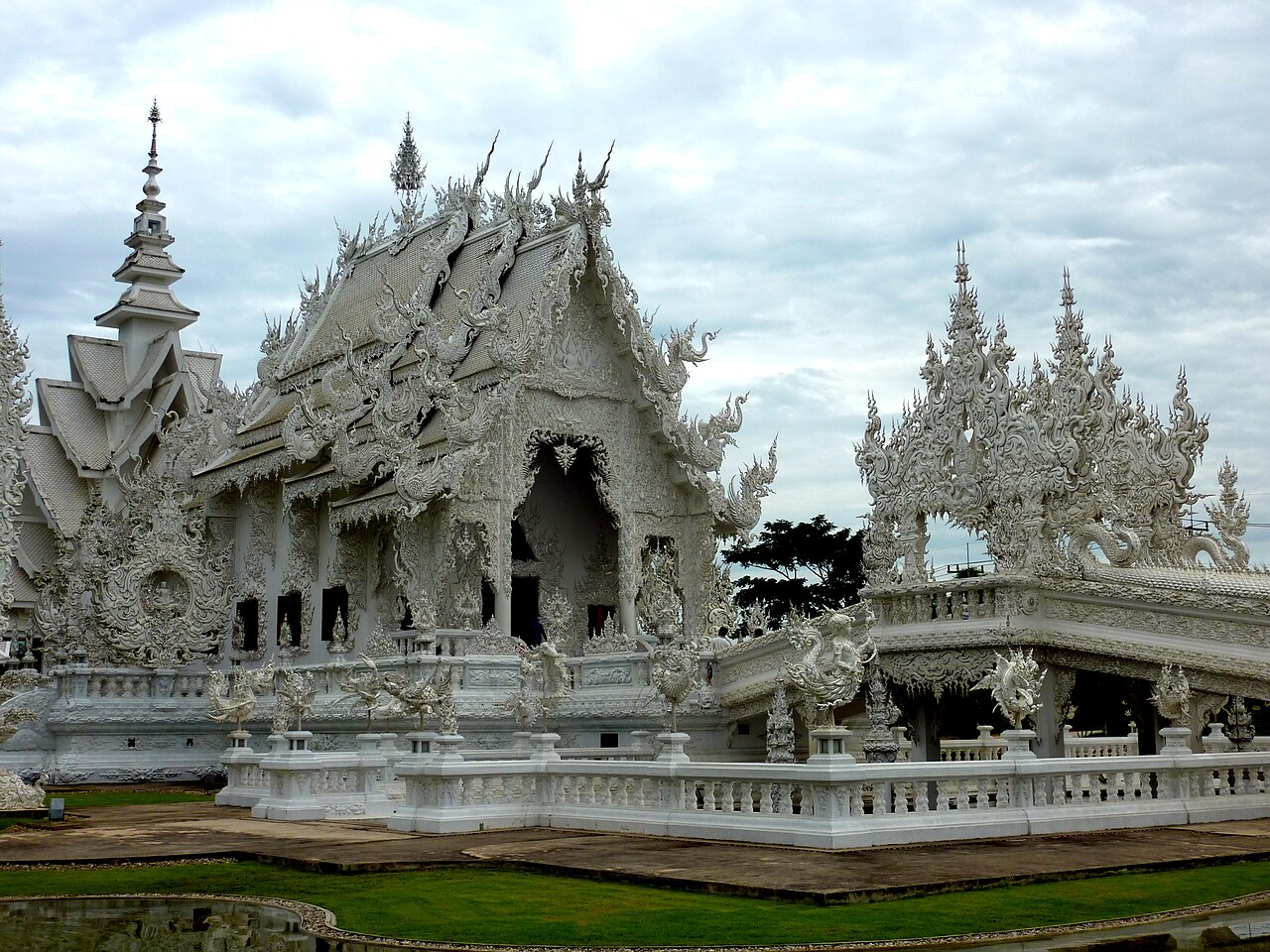
Wat Rong Khun, Chiang Rai — the all-white, mirror-glass temple gleaming in the morning light against a clear sky
Morning 8.00–11.30 am · ~3.5 hours

Start the day early at the White Temple, about 13 km south of town — the life's work of artist Chalermchai Kositpipat, an all-white, mirror-glass temple built entirely new. The highlight is the bridge over the "sea of reaching hands" rising up from hell, leading to an ordination hall with surreal contemporary murals inside, and a golden building (the toilets) so ornate that everyone photographs it. Going early pays off — the sun is still soft and the crowds have not arrived.

Then head into town to the Blue Temple, on the north bank of the Kok River — a deep sapphire-blue temple trimmed in gold, with a large white Buddha standing out in the courtyard and a glowing blue-on-blue interior, the work of a student of Chalermchai. It is free or by donation, in the city and easy to reach, and pairs neatly with the White Temple before a lunch break.

White Temple: ~13 km south · open 8.00 am–5.30 pm · ฿200 for foreigners (includes the art gallery) · free for Thais · dress modestly
Blue Temple: in town, north bank of the Kok River · free / donation · open roughly 7.00 am–8.00 pm
Getting there: a car with driver or a three-temple tour is the most time-efficient · Grab / songthaew work if you agree the fare first
Do the White Temple early: from about 8.00–9.30 am there are fewer people and the best light for photos; by mid-morning the tour groups arrive and the sun is harsh. Dress modestly (shoulders and knees covered) at both temples. Book a three-temple tour (White, Blue and Black) in one loop on Klook.
Afternoon 12.30–4.30 pm · ~4 hours
Northern Thai lunch → the Black House (Baan Dam Museum)

Break for a northern Thai lunch first — khao soi, nam ngiao and sai ua (northern sausage) are everywhere in town (see the Chiang Rai food guide for recommended spots). Then head north out of town to the Black House, the work of artist Thawan Duchanee — a cluster of nearly 40 dark teak pavilions filled with bones, animal horns, hides and carvings. It is the "yin" — dark and raw — to the pure white "yang" of the White Temple.

The Black House is unsettling but riveting — you can easily spend an hour wandering, as each pavilion holds its own strange collection. Some visitors love it, some find it uncomfortable, but it is undeniably powerful art. The Black House closes for lunch around noon to 1 pm, so check the timing before you go.

Black House: ~13 km north · open 9.00 am–5.00 pm (lunch closure ~12–1 pm) · entry ฿80
Lunch: ฿80–200 per person · northern Thai — khao soi, nam ngiao, sai ua
Getting there: continue in the same car / tour loop · the Black House is on the opposite side of town from the White Temple
Dress modestly: the Black House is an art museum rather than a temple, but it is still best to dress neatly. The displays include bones and hides, so if you are bringing sensitive young children, prepare them. Photos are fine, but do not touch the artefacts.
Evening 6.30–9.30 pm · ~3 hours
The Clock Tower light show + the Night Bazaar

Finish Day 1 back in town — the Chiang Rai Clock Tower, a gleaming golden landmark in the city centre, is another Chalermchai work. Every evening there is a light-and-music show at 7, 8 and 9 pm, when the tower shifts through gold, purple and green in time with the music for about 5–10 minutes — free to watch from the street around the roundabout, a charming moment where locals and travellers gather together.

A short walk away is the Chiang Rai Night Bazaar, by the old bus station, open every night — with an open-air food court, craft stalls and a stage for local performances. Order northern dishes, grilled food and noodles, and sit down to eat with live music. If you happen to be here on a Saturday or Sunday, there is also a bigger Walking Street to carry on to (see Day 2).
Clock Tower show: free · at 7, 8 and 9 pm · about 5–10 minutes each · city centre
Night Bazaar: open nightly ~6 pm–midnight · by the old bus station · food court + crafts + shows
Dinner: ฿100–250 per person · northern dishes / grilled food in the food court · try khao soi and sai ua
Day two

Tea hills and countryside — Choui Fong, Singha Park, or the Golden Triangle

A morning in the Choui Fong tea hills or at Singha Park · an in-town temple · the Walking Street (if it is a weekend) · or, with good transport, a run out to the Golden Triangle and Chiang Saen before you head home

02
Day 2
Tea Hills · Temple / Walking Street · The Transfer Home
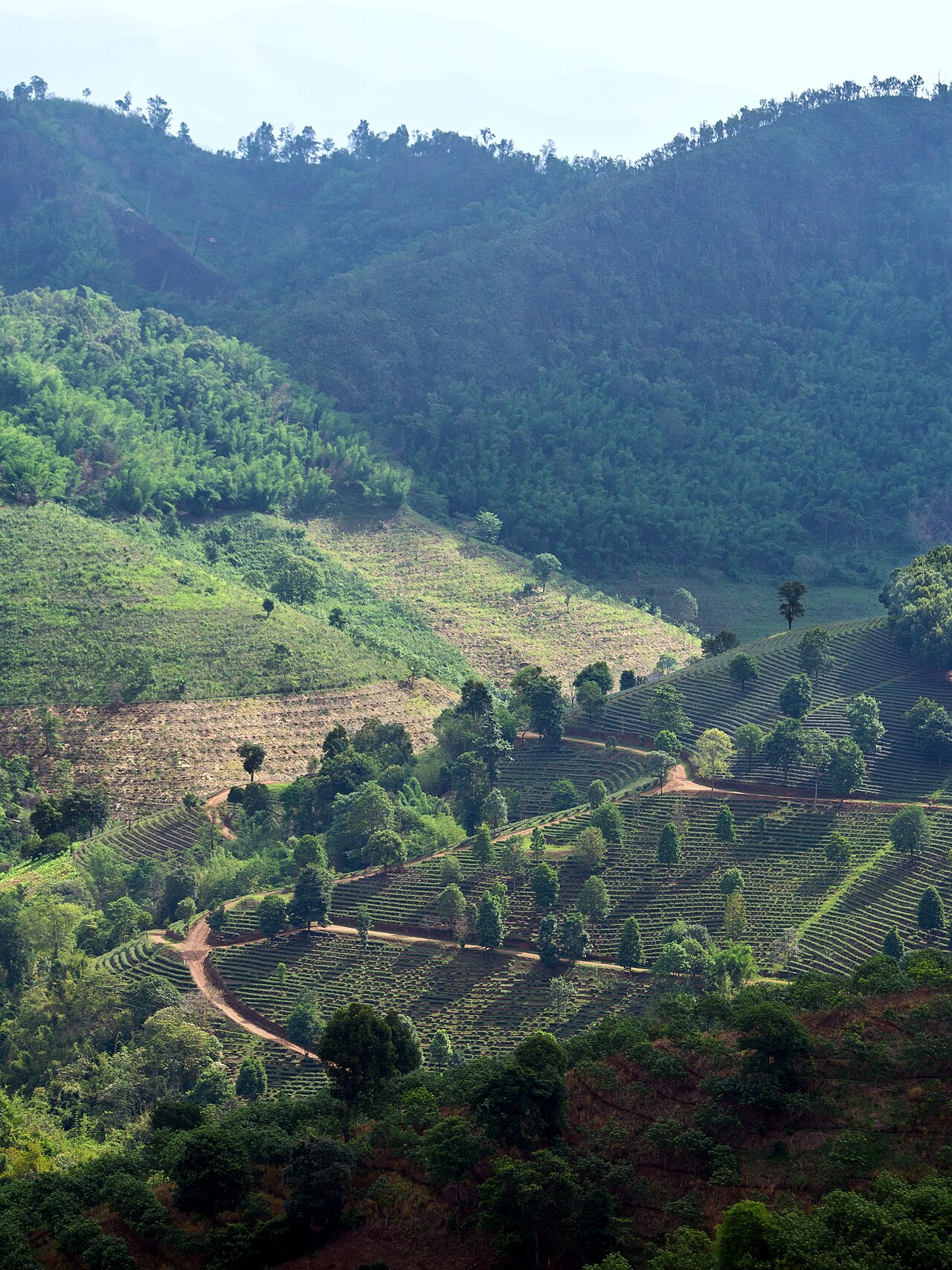
The tea hills of Chiang Rai — rows of green tea terraces sweeping across the hillsides, the Choui Fong tea estate landscape
Morning 8.30 am–12.00 pm · ~3.5 hours
Singha Park or the Choui Fong tea hills

Begin Day 2 with something gentler than Day 1 — head up into the tea hills Chiang Rai is known for. There are two popular choices. If you want a large area with lots to do, pick Singha Park (Boon Rawd Farm), a vast landscaped farm-park west of town (~12 km) with tea plots, a lake, bikes, a tram tour around the farm, a balloon and zip-line, a café, and the giant lion mascot — free to enter, with paid activities, and great for families.

If you want classic terraced tea views and an iced tea in a quiet setting, pick the Choui Fong tea estate — green tea slopes rolling as far as you can see, with a hillside café to sit and take in the view, though it is further out to the north (~40–50 minutes from town and you need a car). Pick one to suit your style; both are at their best in the cool season, when the air is crisp and the skies are clear.

Singha Park: ~12 km west · free entry · activities (tram / bikes / zip-line) cost extra · roughly 9 am–6 pm
Choui Fong tea: ~40–50 minutes north · free to visit · café / tea cost extra · car needed
Getting there: car / Grab / scooter · the tea hills are outside town and hard to reach by public transport
Best in the cool season — but watch the burning season: from Nov–Feb the air is cool and clear and the tea is lush green, the best window. But from Feb–Apr the north has its burning season — hazy skies and PM2.5 spikes (March is worst), which spoil the views and photos; sensitive travellers should avoid it. See the best time to visit.
Afternoon 12.30–4.30 pm · ~4 hours
Lunch → an in-town temple + the Walking Street (or swap in the Golden Triangle)

Head back into town for lunch, then stop at an in-town templeWat Phra Kaew (the temple where the original Emerald Buddha was discovered) or Wat Huay Pla Kang, with its 9-tier pagoda and a giant Guan Yin statue on the hill with sweeping city views. The afternoon cools off and temples are easy to walk. If you are here on a Saturday, finish at the Thanon Thanalai Walking Street, or on a Sunday at the Sankhongnoi Walking Street — grazing on local food and shopping for crafts.

An alternative, if you have good transport and want a big highlight: spend the second half of the day out at the Golden Triangle (Sop Ruak) and Chiang Saen, about 60 km north — where Thailand, Laos and Myanmar meet on the Mekong, with a viewpoint, a big golden Buddha, long-tail boat rides on the river, and the ancient ruins of Chiang Saen. But if you do the Golden Triangle, you will have to drop the tea hills or the Walking Street, as it takes most of the afternoon. See the Golden Triangle and Chiang Saen.

In-town temples: Wat Phra Kaew / Wat Huay Pla Kang · free / donation · dress modestly
Walking Street: Sat = Thanon Thanalai · Sun = Sankhongnoi · evening · food + crafts
Alternative: the Golden Triangle and Chiang Saen ~60 km north · half a day · car / tour needed
Pack for sun and water: the midday Chiang Rai sun is strong and temples and tea hills offer little shade — bring a hat, sunscreen and water. If you fly out on Day 2, allow time to reach the airport (CEI, ~15 minutes from town) and to check in.
Afternoon–evening 4.30–6.30 pm · the transfer home
Grab your bags → head home

Finish the trip by heading home — your choice depends on where you came from. If you are flying back to Bangkok, go to Mae Fah Luang–Chiang Rai International Airport (CEI), about 10 km north of town, with direct flights to DMK/BKK in roughly 1 hour 20 minutes. Note that since August 2024 there is no public airport bus, so it is taxi, Grab or a hotel transfer (agree the fare first).

If you are returning to Chiang Mai, the straight-into-the-city option is the bus from Chiang Rai bus terminal — GreenBus runs frequently all day, taking ~3 hours 20 minutes (VIP) to 3 hours 45 minutes (express) for ~฿270–380. Chiang Rai has no train — the Northern Line ends at Chiang Mai, so to travel by rail you take the train to Chiang Mai first, then a bus or van on to Chiang Rai. See how to get to Chiang Rai for a full comparison.

Fly to Bangkok: CEI → DMK/BKK ~1 h 20 min · CEI into town = taxi / Grab / transfer (no airport bus)
Bus to Chiang Mai: ~3 h 20 min–3 h 45 min · ~฿270–380 · GreenBus runs frequently
Good to know: no train and no city metro · arriving by rail means Chiang Mai first, then a bus on
🗓️
Want to stay longer?
The 3-day plan adds a full day at the Golden Triangle and Chiang Saen · Doi Tung and the Mae Fah Luang Garden · a sunrise at Doi Mae Salong or Phu Chi Fa
See the 3-day plan →
Practical info

Where to stay · getting around · budget

🏨
Where to stay for one night

For a two-day weekend, staying in the city centre around the Clock Tower and Night Bazaar is best — you can walk to restaurants, the night market and the Clock Tower show, and you are close to where a car will collect you for the three temples. If you want quiet and river views, try along the Kok River, or for full-on countryside there are resorts out in the tea hills and mountains (but you will need a car). There are rooms at every level. See the top-10 hotels, or read how to pick an area in where to stay in Chiang Rai.

🚗
Getting around

Chiang Rai has no metro or city train — the centre is small and walkable around the Clock Tower / Night Bazaar, but the three temples and tea hills are in different directions. The best value is to hire a car with a driver, or book a three-temple tour. Grab works but supply is limited, and songthaews / tuk-tuks need a fare agreed before you get in. A rented scooter is handy but mind road safety — wear a helmet, carry a licence, and the mountain roads (Doi Tung / Mae Salong / Phu Chi Fa) are steep. See the getting around Chiang Rai guide.

📱
Connectivity & paying

Chiang Rai widely accepts QR payment (PromptPay) and cash; some small market and tea-hill stalls prefer cash, so carry small notes. To stay online the whole trip, set up a SIM or eSIM before you arrive — see the Thailand SIM & eSIM guide. Book tours and activities ahead on Klook.

Budget

Approximate cost per day, per person

Item Budget Mid-range Comfort
Hotel (1 night, in town) ฿350–700
(guesthouse / hostel)
฿700–1,500
(3-star hotel)
฿2,000–5,000+
(resort / 4–5 star)
3 meals/day ฿200–350 ฿300–600 ฿700–1,400
Getting around (car / three-temple tour) ฿250–500
(rented scooter)
฿400–900
(tour / shared car)
฿1,200–2,500
(private car + driver)
Entry fees (White Temple ฿200 + Black House ฿80) ฿280
(the two main ones · Blue Temple free)
฿350–550
(+ tea / Singha Park activities)
฿700–1,200
(+ tours / extra activities)
Total for 2 days (approx.) ฿1,800–3,200 ฿3,200–6,000 ฿7,500–18,000+

Prices are approximate and shift with the season · hotel cost is for 1 night · the single biggest cost is usually getting to Chiang Rai (a flight or the bus) — see the full Chiang Rai trip budget

Frequently asked

FAQ · 2 days in Chiang Rai

Is 2 days enough for Chiang Rai?
Two days is enough for the Chiang Rai everyone comes for — the three famous works of art (the White Temple Wat Rong Khun, the Blue Temple Wat Rong Suea Ten and the Black House Baan Dam), the Clock Tower light show after dark, the Night Bazaar, and a morning in the tea hills on Day 2 — as long as you sequence it well and have a car or a tour. What you have to skip is the Golden Triangle and Chiang Saen, Doi Tung, and Doi Mae Salong or Phu Chi Fa, each of which eats most of a day because they are far out and involve mountain driving. If you want those too, extend to three days.
Can you do 2 days in Chiang Rai with kids?
Yes, and children usually enjoy Chiang Rai because there is a mix of striking art and open space. The White and Blue Temples are full of colour and detail that kids find fascinating, and on Day 2 Singha Park has a farm with animals, bikes, a tram and plenty of room to run around. The one caveat is the Black House (Baan Dam), which displays animal bones and hides in a dark, unusual atmosphere — sensitive younger children may find it unsettling. All the temples require modest dress, and the midday Chiang Rai sun is strong, so bring a hat and water.
Where should I stay for a 2-day Chiang Rai weekend?
Staying in the city centre around the Clock Tower and Night Bazaar is best for a two-day weekend, because you can walk to restaurants, the night market and the Clock Tower show, and you are close to where a car or taxi will collect you for the three temples on Day 1. There are rooms at every level, from guesthouses to mid-range hotels. If you want quiet and river views, look along the Kok River, and if you want full-on countryside there are resorts out in the tea hills and mountains (but you will need a car). Read how to choose an area in where to stay in Chiang Rai, or see the top-10 Chiang Rai hotels.
How do I get around the three temples in one day?
The three Day 1 sights are in different directions — the White Temple is about 13 km south of town, the Blue Temple is in the city on the north bank of the river, and the Black House is further north again. The easiest and most time-efficient option is to hire a car with a driver for a half or full day, or book a three-temple tour that does all of them in one loop. If you go independently, Grab works but supply is limited and fares climb once you leave the centre, while songthaews (shared trucks) and tuk-tuks need a price agreed before you get in. Chiang Rai has no metro or city train. Start at the White Temple early to beat the heat and the crowds. See the getting around Chiang Rai guide.
What is a realistic budget for 2 days in Chiang Rai?
A mid-range budget runs roughly ฿1,500–2,800 per person per day, covering a mid-range hotel in town at ฿700–1,500, three meals at ฿300–600, getting around (a half-day car with driver or a three-temple tour) at ฿400–900, and entry fees — the White Temple is ฿200 for foreigners and the Black House is ฿80, while the Blue Temple and the in-town temples are free or by donation. Budget travellers using a guesthouse and a rented scooter can get by on roughly ฿900–1,300 a day. The single biggest cost is usually getting to Chiang Rai itself — a flight from Bangkok or the bus from Chiang Mai. See the Chiang Rai trip budget.