Home Chongqing China Chongqing Hotels About
Home  ›  Asia  ›  China  ›  Chongqing  ›  4-Day Itinerary
🗓️ Chongqing Itinerary · 4 Days · 2026

4 Days in Chongqing —
The 8D city, a UNESCO day out, and China's best night view

Two days in central Yuzhong, one full UNESCO day trip on day three, and a slow final day with old lanes and the night view from Nanshan — this is the Chongqing that has time both to thrill you and to let you breathe.

Why four days

Between rushed and more than you need

Here's the honest truth about Chongqing: it tricks you. It looks like a two-day city, but the moment you arrive you realise it is a three-dimensional place stacked in layers — this street is the roof of the tower below it, a metro train runs straight through a residential block, a cable car floats across the river, and the best night view means climbing a mountain to see it. Two days is genuinely not enough.

Four days is the sweet spot. Days one and two cover the whole city core (Jiefangbei, Hongyadong, the Yangtze cableway, Liziba Station, Ciqikou). Day three is a full UNESCO day trip out of town. And day four is the day shorter trips never get — slow wandering through old lanes, with the night view to close it all out.

Unlike cramming everything into two breathless days, this plan gives each stop room to breathe and includes one full day trip out of the city (you choose Wulong or Dazu). It suits travellers who have exactly four days and want to see the whole of Chongqing — the city core and the headline sights around it.

4 days, 3 nights UNESCO day trip Metro + high-speed rail ¥1,100–2,300/person
Day one

Central Yuzhong — Jiefangbei, Hongyadong, the cableway

A buzzing pedestrian CBD · cliff-clinging stilt-house architecture · a cable car gliding across the Yangtze — day one squeezes the heart of Yuzhong into one stretch.
01
Day 1
Jiefangbei · Bayi Street · Yangtze Cableway · Hongyadong by night
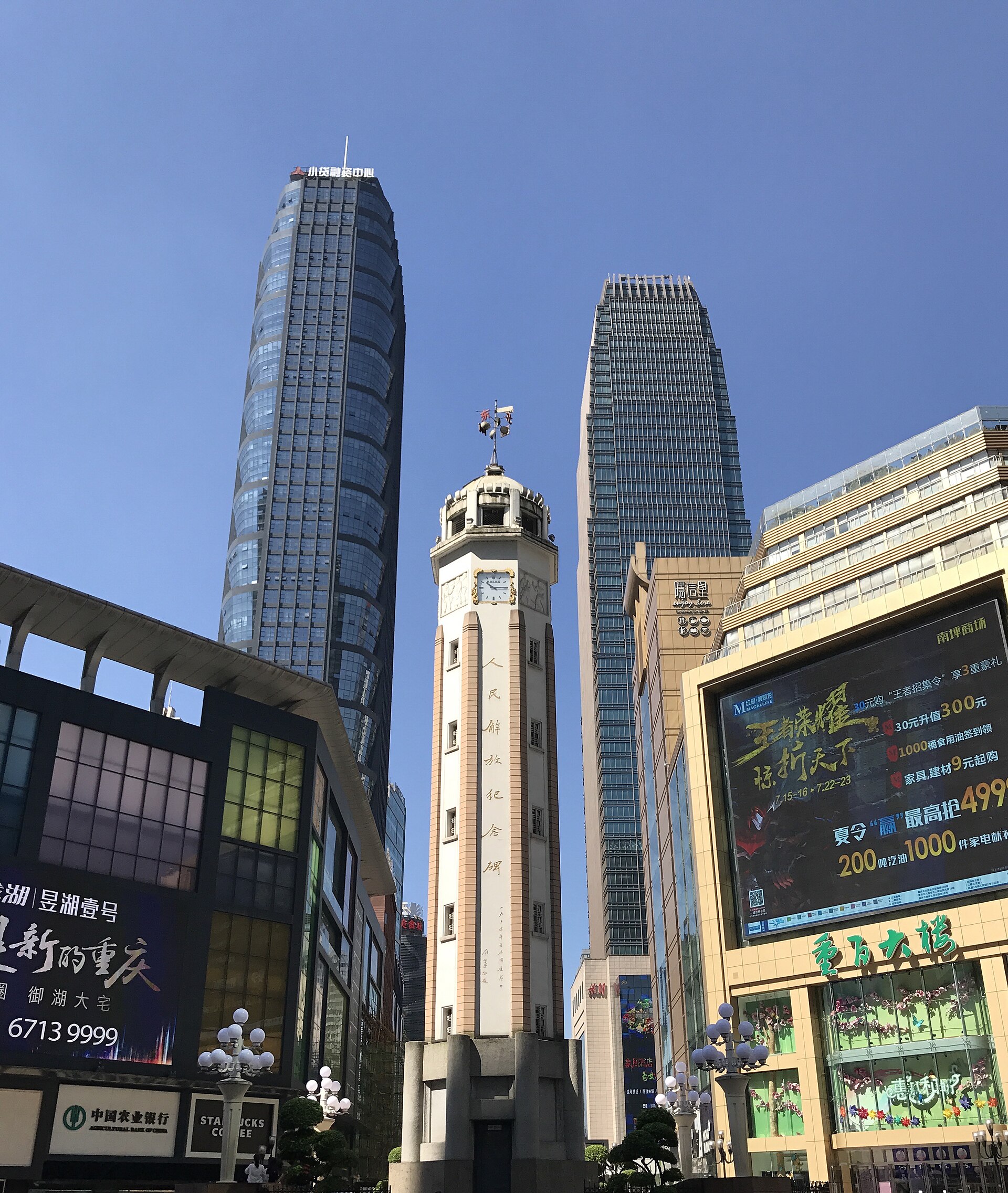
Jiefangbei Chongqing — the Liberation Monument square at the heart of the CBD, ringed by skyscrapers and LED screens
Morning · ~3 hours
Jiefangbei (解放碑) + Bayi snack street

Start at Jiefangbei — the Liberation Monument square that is the city's centre of gravity. It is still quiet in the morning, so spend about 45 minutes walking around the ring of skyscrapers, the giant LED screens and the early-morning crowd getting their day going. At night this place is far busier, which is exactly why the morning is the time for photos.

A short walk away is Bayi snack street (八一好吃街) — the street-food lane where locals actually eat. Xiaomian noodles, spicy hongyou chaoshou wontons, dumplings and every kind of fried snack. Try a proper Chongqing breakfast here before you set off; see our Chongqing food guide.

Metro: Line 1/2 Jiaochangkou (较场口) or Linjiangmen, ~5 min walk
Jiefangbei: free · open 24 hours
Bayi Street: snacks ¥10–40 each · open late morning to late night
Afternoon · ~3 hours

In the afternoon, walk to the cableway station on the Yuzhong side and ride the Yangtze River Cableway — a passenger cable car that was once real public transport across the river and is now the city's signature ride, floating high above the wide Yangtze with the skyline rising on both banks. A one-way ticket is ¥30. Ride it in the late afternoon, before the light softens, for the best views.

Cross to the Nan'an side and stroll along Nanbin Road (南滨路), the riverside promenade — this is the best spot to turn back and look at the Yuzhong skyline, with riverside cafés and restaurants to rest in while the light shifts toward evening.

Cableway (Yuzhong side): Xinhua Road station · Metro Line 1/6 Xiaoshizi, ~8 min walk
Cableway ticket: ¥30 (~฿150) one way · ¥40 return · ~5:30am–10:30pm
Tip: buy via the WeChat mini-program "重庆索道公司" to skip the queue
Tip: the cableway queue gets very long in the evening and on weekends. For an easy ride, go between 2pm and 4pm, and save the night skyline for the view from Nanbin Road or Nanshan on day four instead.
Evening · ~2.5 hours
Hongyadong (洪崖洞) by night — the city's most beautiful hour

Cross back to the Yuzhong side at dusk and head for Hongyadong — an 11-storey cluster of traditional stilt houses (吊脚楼) clinging to the cliff above the Jialing River. When all its golden lights switch on together, you understand why people compare Chongqing to the world of Spirited Away. Wait until it is fully dark, around 7–8pm, to see the lights at their best. You can walk all 11 levels for free and exit at both the upper and lower street levels.
Metro: Line 1/6 Xiaoshizi (小什字) Exit 5, ~5 min walk
Hongyadong: free · lights on roughly 6:30pm–10pm (varies by season)
Dinner: a Chongqing hotpot · ¥80–200/person · see our hotpot guide
Day two

The 8D city and the old town

A metro that runs through a tower block · a clifftop park that sees the whole city · a thousand-year-old stone lane by the river — the day that explains why Chongqing feels like a city built in three dimensions.

02
Day 2
Liziba Station · Eling Park · Ciqikou
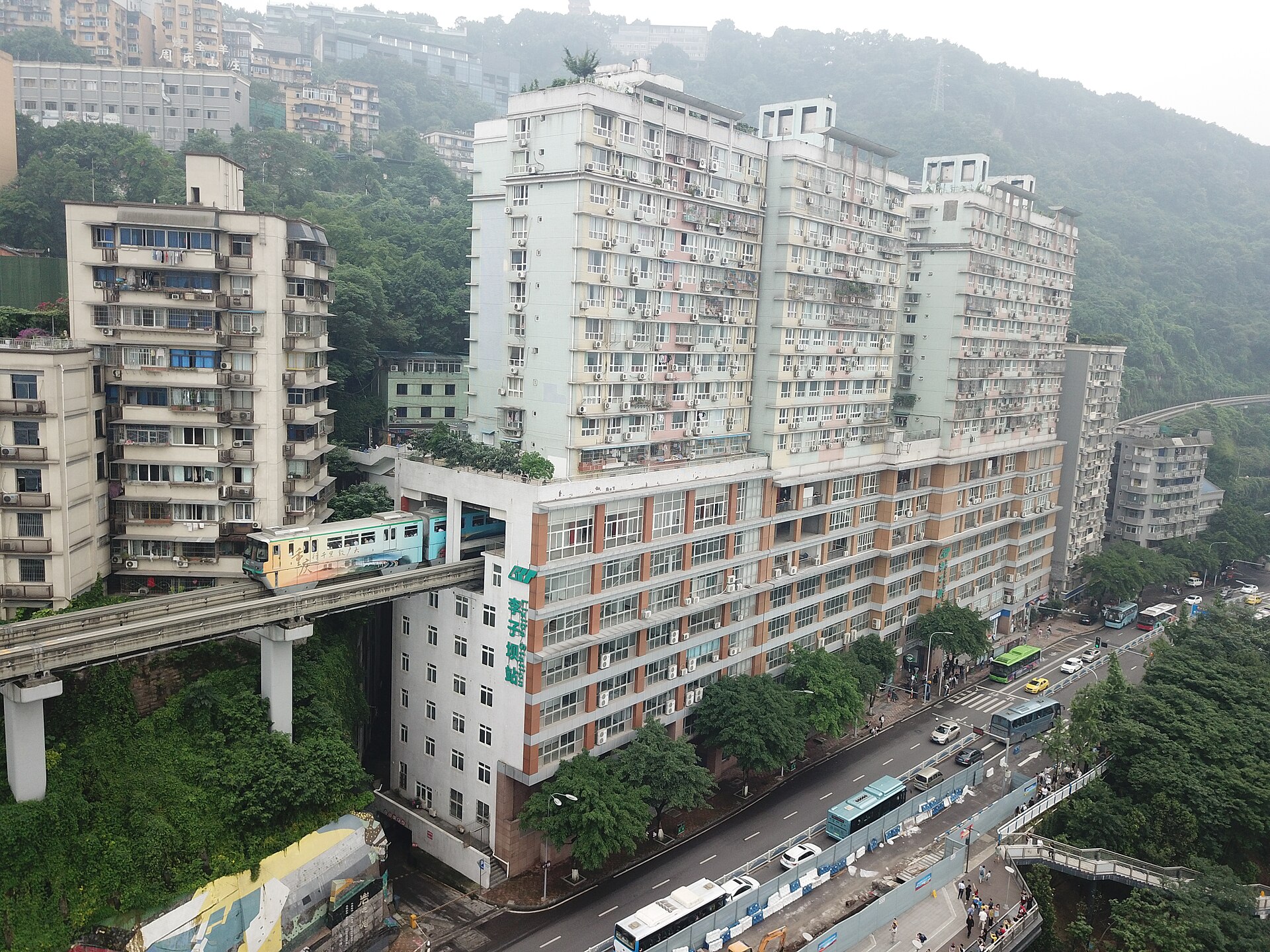
Liziba Station Chongqing — the Line 2 monorail running straight through the middle of a 19-storey residential building
Morning · ~2.5 hours

Start the morning at Liziba Station — the most famous metro station in the world, because the Line 2 monorail track runs straight through the middle of a 19-storey residential building (the platform sits on floors 6 to 8). The building and the station were designed and built together as a single structure, not cut through afterwards. There is a dedicated viewing spot below to photograph the trains entering and leaving the tower; wait for two or three to pass to get the shot.

A short climb up from Liziba is Eling Park — an old park on the Yuzhong ridge with the Kanshenglou viewing tower (瞰胜楼), looking down over the whole Yuzhong peninsula wrapped by two rivers and the great bend of the Jialing. A panorama like this is rare in the middle of a city. Wander the shaded grounds before lunch.

Metro (Liziba): Line 2 Liziba · free · open 6:30am–11:00pm
Eling Park: park free · Kanshenglou viewing tower ~¥20–30
Photo spot: the lower viewing deck on the road side has the clearest shot of trains entering the building
Afternoon · ~3.5 hours
Ciqikou (磁器口古镇) — old river town on the Jialing

After lunch, take Line 1 out to Ciqikou — an old river port more than 1,000 years old on the Jialing, which once thrived on the porcelain trade. Winding stone lanes climb and dip across the hill, lined with Ming- and Qing-era wooden houses and stalls of local snacks. Try mahua (麻花), the twisted fried-dough specialty, and Sichuan tofu pudding. Give yourself 2.5 to 3 hours to explore.

Ciqikou is at its best from late afternoon into early evening — softer light, thinning crowds and the red lanterns starting to glow. Climb to the highest point of the lanes for a view of the Jialing River and the bridge across it, and grab a closing photo before you head back.

Metro: Line 1 Ciqikou (磁器口) Exit 1, ~5 min walk
Ciqikou: free entry · shops open roughly 9am–9pm
Local specialties: twisted mahua · tofu pudding · xiaomian noodles · ¥10–40
Evening · ~2 hours
Back in the city — xiaomian or hotpot to end the day

Take Line 1 back into the city. Tonight is right for a bowl of xiaomian (小面), the spicy chilli-oil noodles locals eat as a daily staple — or, if you have not yet had the original hotpot, this is your chance: the red, beef-tallow, numbing-spicy broth here is where the hotpot loved across the whole country began. See our xiaomian guide or Jianghu cuisine guide.

Xiaomian: ¥10–25/bowl · local shops in the Yuzhong/Jiangbei area
Back to the hotel: Lines 1/2/6 cover the central districts
Day three

A UNESCO day trip — your choice

This is the day you leave the city — pick one UNESCO site that deserves a whole day, and give it everything.

03
Day 3 · your choice
Wulong Karst OR Dazu Rock Carvings
Choose 1 of 2 options

🏞️ Option A — Wulong Karst

Good if: you love dramatic nature · want giant natural stone bridges and deep gorges · don't mind a lot of walking · you're a Transformers fan (it was filmed here). Allow 2–3 hours of travel each way.

Train: Chongqing North → Wulong South ~40 min–2 hr · then a ~45 min shuttle, ¥16 Train ticket: ~¥70–120 (~฿350–600) Entry: Three Natural Bridges ~¥125 · 8:30am–4:30pm Don't miss: the lift down into the sinkhole · the Tang-style inn in the gorge

🛕 Option B — Dazu Rock Carvings

Good if: you love art, history and Buddhist sculpture · want easier, closer travel · don't fancy heavy mountain stairs · you're on a tighter budget. A UNESCO World Heritage Site over a thousand years old.

Train: Chongqing West/Shapingba → Dazu South ~26–33 min Train ticket: ~¥40 (~฿200) second class · then a ~40 min ride to Baodingshan Entry: Baodingshan ~¥115 (peak season) · 8:30am–5:30pm Don't miss: the giant reclining Buddha · tens of thousands of carved figures
Option A — how to do Wulong well

Leave early from Chongqing North on a high-speed train to Wulong South (武隆南) — the fastest service is about 40 minutes, though most take around 2 hours (this line opened in July 2025). From the station, a shuttle bus runs to the visitor centre in about 45 minutes for ¥16; from there, a further park shuttle of about 10 minutes reaches the entrance to the Three Natural Bridges.

Walk the Three Natural Bridges (天生三桥) — a lift drops you 80 metres to the floor of the sinkhole, then you walk beneath three giant natural stone arches past a Tang-dynasty-style inn. Allow 2 to 3 hours to loop it. If you still have the energy, the nearby Longshuixia Fissure Gorge pairs well, then catch an evening train back to the city.

Book train tickets ahead: via Trip.com or 12306 · seats sell out fast on holidays
Day tour: if you'd rather not chain the buses yourself, tours with transfers are on Klook
Important: Wulong involves a lot of walking on slippery stone steps, so wear grippy shoes and allow the whole day for the round trip and the park. Don't try to add another sight today — give Wulong the full day on its own.
Option B — a UNESCO Buddhist art site

Leave early from Chongqing West (重庆西) or Shapingba on a high-speed train to Dazu South (大足南) — just 26 to 33 minutes, with a second-class ticket around ¥40. From the station, a taxi (around ¥90) or local bus takes about 40 minutes to Baodingshan (宝顶山), the most complete and impressive section.

Baodingshan is a horseshoe-shaped cliff of Buddhist stone carvings begun under the Southern Song dynasty around 800 years ago. The highlights are the 31-metre reclining Buddha entering nirvana and the "thousand-armed, thousand-eyed" Guanyin — among tens of thousands of carved figures in all. Allow 2.5 to 3 hours; add Beishan (北山) if you have time, then catch an evening train back.

Baodingshan: ~¥115 (peak season Mar–Nov) · ~¥110 (low season) · 8:30am–5:30pm
Station → Baodingshan: ~40 km · taxi ~¥90 or a local bus
Day four

Slow Chongqing — night views and old lanes

A final day with no fixed schedule — the old Shibati lanes, a café and a big hotpot to say goodbye, and the night view that many call the finest in China from the top of Nanshan.

04
Day 4
Shibati · café + hotpot · leftover sights · Nanshan night view
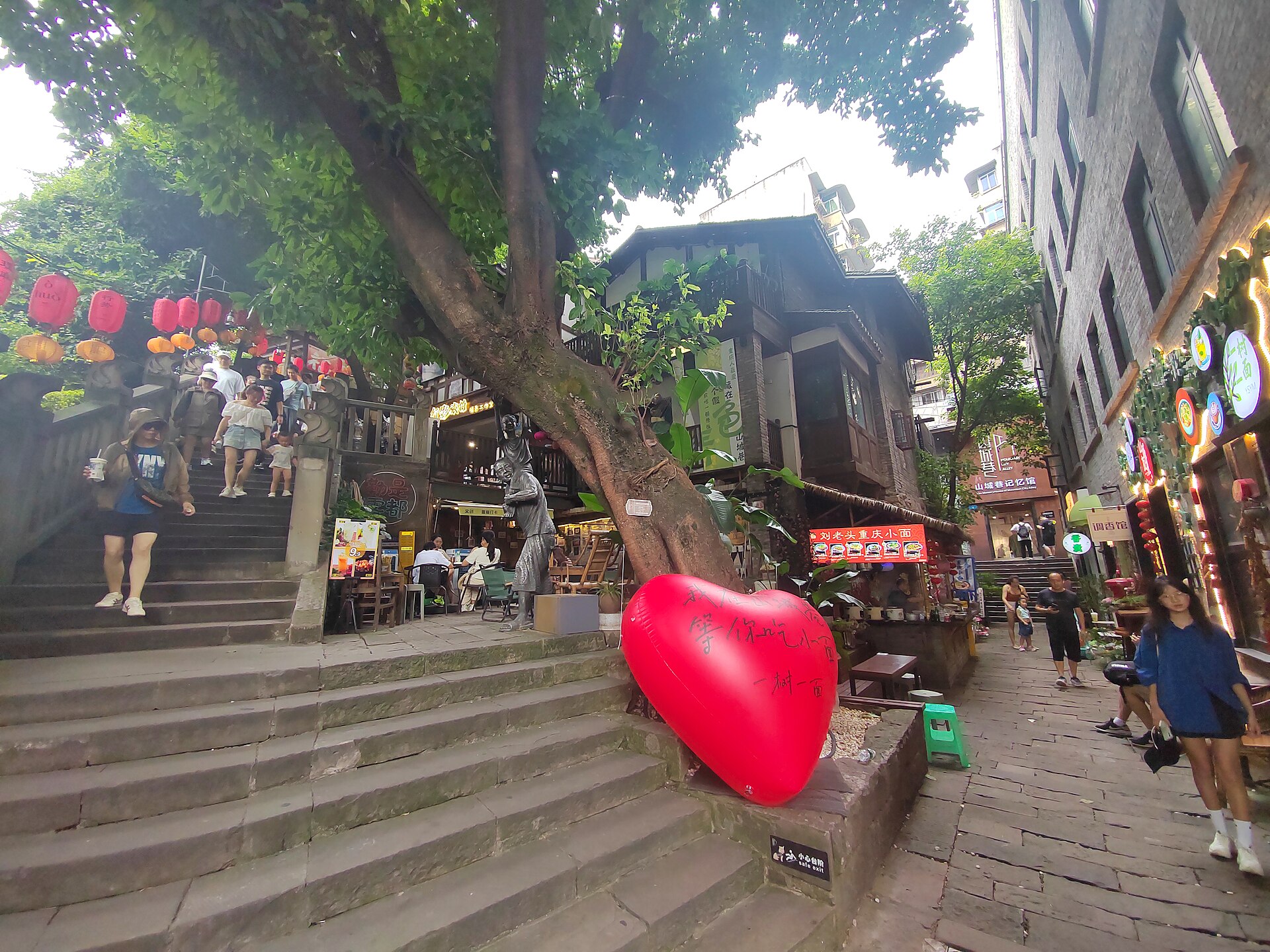
Shancheng Lane Chongqing — old stone staircases and traditional Bayu-style wooden houses climbing the hillside of the old town
Morning–late morning · ~3 hours
Shibati (十八梯) + Shancheng Lane — a slow walk through the old town

Start the final day gently at Shibati (十八梯, the "Eighteen Stairs") — a revived old quarter where a long stone staircase descends from the upper city to the lower, lined with Bayu-style wooden houses, tea shops, antique stalls and photo corners that tell the story of old Chongqing life. Take the climb up and down slowly; it's better than rushing.

Right beside it is Shancheng Lane (山城巷) — a hillside lane that still carries the feel of the genuine old town, with stilt houses clinging to the cliff, viewpoints over the Yangtze and small cafés inside old houses. The two connect on foot, and this is exactly the Chongqing a rushed trip never gets to touch.

Metro (Shibati): Line 2 Jiaochangkou (较场口) Exit 11, ~220 m walk
Shibati + Shancheng Lane: free · open all day
Tip: wear trainers — the whole quarter is stairs and steep slopes
Afternoon · ~3 hours
Café + a big hotpot + mopping up leftover sights

The final afternoon is for taking it easy — find a good café in the old quarter or by the river and rest. Chongqing has plenty of cafés tucked into old buildings and on rooftops with river views; see our Chongqing café guide. Then follow it with a proper Chongqing hotpot before you leave — if you didn't have a serious one in the first two days, this is the meal not to miss: the red beef-tallow broth, fresh offal and blood tofu.

If any sights from days one and two are still outstanding, this is the time to pick them up — go back to the cableway if the queue beat you on day one, walk Nanbin Road again, or drop into other Chongqing attractions you haven't reached. This plan leaves buffer here on purpose, so adjust it to taste.

Hotpot: ¥80–250/person · popular spots around Jiefangbei/Nanbin · see our hotpot guide
Cafés: old buildings in Yuzhong · rooftops with river views on the Nanbin side
Evening · ~2.5 hours · closing the trip
Nanshan night view at "Yikeshu" — an unforgettable way to finish

Close the trip with the thing Chongqing does best — the night view. Head up to the Nanshan One Tree viewpoint (南山一棵树) on Nanshan mountain at 437 metres, looking down over the entire Yuzhong peninsula where the Yangtze and Jialing rivers meet. Thousands of skyscraper lights blaze and reflect off the water — this is the view that earns Chongqing its reputation for the finest night cityscape in China. The best window is 6pm to 10pm.

Nanshan Yikeshu: entry ~¥30 (~฿150) · go up by taxi/DiDi from the city, ~20–30 min
Best window: 6pm–10pm (city lights at full strength)
Alternative: if you'd rather not climb the hill, the view from Nanbin Road or Hongyadong is lovely too
Before you leave: allow ~50–70 minutes to Jiangbei Airport (CKG) on Metro Line 3/10 (¥5–10), or ~40–50 minutes by taxi (¥60–90). Check which terminal you fly from — T3 is the big one. See our Chongqing travel guide.
🛕
Want it shorter or longer?
See every day trip from Chongqing — Dazu, Wulong, the Three Gorges and more
See day trips →
Practical info

Where to stay · how to get around · 4-day budget

🏨
Book 3 nights — where to stay

The Jiefangbei/Yuzhong area works best for this plan — you can walk to Hongyadong, it's close to the cableway and Shibati, and Lines 1 and 2 carry you everywhere else. If you choose Wulong on day three, one night near Chongqing North Station helps you leave early. See our 10 best hotels or luxury hotels.

🚇
Getting around the city

Use the Chongqing Rail Transit metro for most of it — Line 2 monorail (Liziba, Eling), Line 1 (Ciqikou), Line 2 again (Jiefangbei, Shibati), all ¥2–12, paid by scanning Alipay/WeChat at the gate. Watch out: stations sit on cliffs or mid-tower, so the metro level often is not the street you expect — check the exit. Use Amap or Apple Maps instead of Google.

💳
Paying + VPN

Link a Visa/Mastercard to Alipay (international mode) before you travel. Most places accept only Alipay/WeChat Pay, and some take no cash at all. Download a VPN before leaving Thailand too (Google Maps, Instagram and LINE are blocked). See our Alipay guide · Thai passport holders enter China visa-free.

Budget

Approximate cost per person, 4 days

Item Budget Mid-range Comfort
Hotel, 3 nights ¥270–540
(~฿1,350–2,700)
¥750–1,350
(~฿3,750–6,750)
¥1,800–3,600+
(~฿9,000–18,000+)
Food, 4 days ¥280–440
(~฿1,400–2,200)
¥560–960
(~฿2,800–4,800)
¥1,200–2,200
(~฿6,000–11,000)
City metro, 4 days ¥40–80
(~฿200–400)
¥70–120
(~฿350–600)
¥120–250
(~฿600–1,250)
Tickets + activities (days 1–2) ¥60–90
(cableway+tower)
¥90–150
(+Nanshan view)
¥150–250
(+extra viewpoints)
Day 3 (day trip) ¥155–240
(Dazu, train+entry)
¥330–490
(Wulong, train+shuttle+entry)
¥500–800
(+tour with transfers)
Day 4 (night view) ¥30
(Nanshan)
¥30–60
(Nanshan+taxi)
¥80+
(comfortable taxi both ways)
Whole trip (approx.) ¥835–1,420
(~฿4,175–7,100)
¥1,830–3,090
(~฿9,150–15,450)
¥3,850–7,180+
(~฿19,250–35,900+)

Reference rate ¥1 ≈ ฿5 · costs are approximate and vary by season — check before you go.

Frequently asked

FAQ · 4-day Chongqing itinerary

Is 4 days too long for Chongqing?
Not at all. Four days is genuinely the sweet spot. The first two days cover the whole city (Jiefangbei, Hongyadong, the cableway, Liziba, Ciqikou), day three is a full UNESCO day trip out of town (Wulong or Dazu), and the fourth day is slow wandering with the night view and old lanes that shorter trips always skip. If you also want an overnight Three Gorges cruise or to continue to Chengdu, extend to five days.
Should I choose Wulong or Dazu on day three?
Choose Wulong if you love dramatic nature: giant natural stone bridges, deep karst gorges and the Transformers filming location, but allow two to three hours each way and a lot of walking.

Choose Dazu if you prefer art and history: thousand-year-old UNESCO Buddhist rock carvings, with easier and closer travel (a high-speed train reaches Dazu South in about 30 minutes).

Both work as a single full day out and back, but the timing is tight, so start early.
How do I get around on a 4-day Chongqing trip?
In the city, the Chongqing Rail Transit metro does most of the work: Line 2 (the monorail through Liziba and past Eling Park), Line 1 (out to Ciqikou) and Line 2 again for Jiefangbei and Shibati, all ¥2 to ¥12, paid by scanning Alipay or WeChat at the gate.

On day three you head out of town by high-speed rail: Wulong South is about 40 minutes to 2 hours from Chongqing North, while Dazu South is about 30 minutes from Chongqing West or Shapingba. For the Nanshan night view, take a taxi or DiDi up the hill. See our Chongqing day trips.
How many hotel nights do I need for a 4-day Chongqing trip?
Three nights. The Jiefangbei and Yuzhong area works best for this itinerary: you can walk to Hongyadong, it's close to the cableway and Shibati, and Lines 1 and 2 take you everywhere else. If you plan to do Wulong on day three, staying near Chongqing North Station helps you leave early. See our 10 best hotels in Chongqing.