Home Chongqing China Chongqing Hotels About
Home  ›  China  ›  Chongqing  ›  Attractions  ›  Ciqikou Ancient Town
🏯 Chongqing Attractions · Old Town

Ciqikou Ancient Town (磁器口)
A 700-year porcelain port on the Jialing

Step off the metro, walk a few minutes, and the city slips back a hundred years — narrow stone lanes lined with old wooden houses, the smell of freshly fried Chen mahua drifting past, Sichuan opera floating out of a teahouse, and the Jialing River sliding quietly along the far end of the lane.

Why come here

An old town that still breathes inside the mountain megacity

Picture Chongqing before the skyscrapers — a city where everything moved by river, sampans crowding the wharf, porters hauling loads up and down stone steps, the endless haggle of a market that never quite stopped. That was Ciqikou (磁器口) a century ago. The towers have gone up everywhere since, but the moment you turn into Ciqikou's stone lanes, the old port atmosphere is still all here.

The town sits on the western bank of the Jialing River (嘉陵江) in Shapingba District (沙坪坝). It was first built back in the Song dynasty, around AD 998–1004, originally named Longyin (龙隐镇) — "hidden dragon" — and nicknamed "Little Chongqing". The name Ciqikou, meaning "porcelain port", came later, because under the Ming dynasty (1368–1644) and the Qing this was a major centre for making and shipping porcelain. More than twenty old kiln sites have been unearthed in the area.

Its golden age peaked at the close of the Qing dynasty, described in an old line as "a thousand people greet each other by day, ten thousand lamps flicker at night" — a hint at how busy this trading hub once was. Best of all, Ciqikou is free to enter; you only spend on the snacks you eat and a tiny fee for the temple.

Highlights in the old town

5 things you can't miss

Walk slowly, graze as you go, and sit down for a teahouse session — that's how Ciqikou is meant to be done.
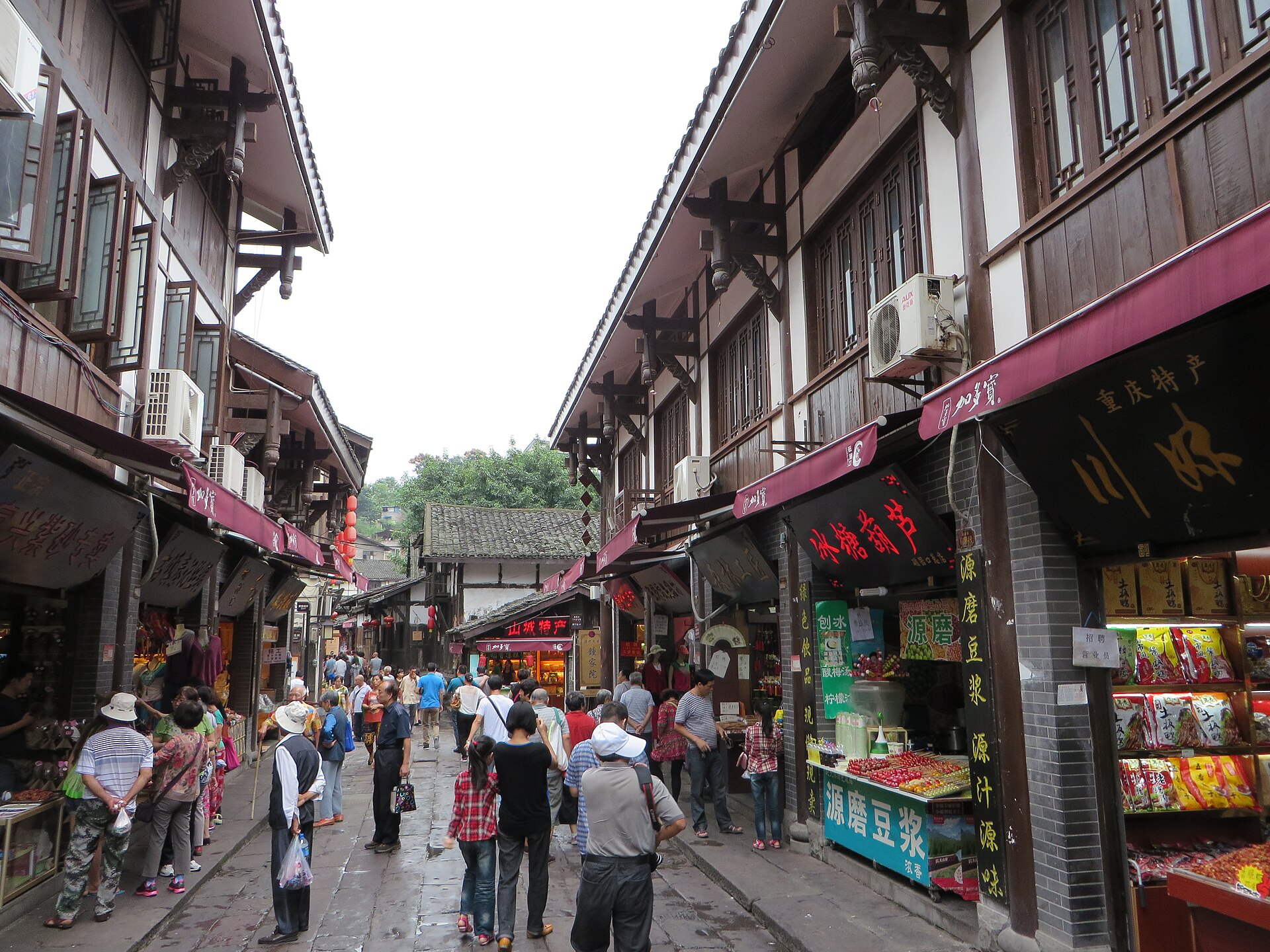
Stone-paved lane in Ciqikou Ancient Town, Chongqing — old wooden shophouses, shop signs and red lanterns 1
The stone lanes & wooden shophouses (石板老街)
Main paved street and quiet side lanes · the heart of the old town

Ciqikou's main lane is paved with stone slabs worn smooth by generations of feet, flanked by two-storey Ming-Qing wooden houses — snack shops, teahouses and souvenir stalls on the ground floor, old timber frames and balconies above. The honest truth is the main lane gets packed with visitors, but turn off into the smaller side lanes and you'll find it much quieter: real homes, laundry lines, and corners that photograph beautifully without the crowds.

Entry: Free · open to walk through all day
Tip: Duck off the main lane into the side lanes — quieter and more genuine
🥨2
Chen mahua (陈麻花)
Crunchy twisted fried dough · Ciqikou's number-one snack

If there's one thing people remember Ciqikou for, it's the mahua — dough twisted into ropes and fried until crisp, sold in flavours from the original sweet to black sesame to a numbing-spicy málà that tastes properly Chongqing. The most famous shop is Chen Jianping (陈建平麻花), where the queue often snakes a long way down the lane. The thing is, plenty of other mahua stalls along the street are just as good and far quicker to buy from. Grab a bag to nibble as you wander, or take some home as a gift.

Price: around ¥15–30 a bag (about ฿75–150)
Tip: The famous shop's queue is long — neighbours nearby are tasty too
🌶️3
Maoxuewang & the three treasures (三大特产)
Maoxuewang · pepper-salt peanuts · qianzhangpi · original Chongqing flavour

Here's a fun fact: maoxuewang (毛血旺) — that bubbling málà pot of duck blood and offal — is said to have started right here at the Ciqikou wharf in the 1940s, when a butcher's wife simmered leftover offal cheaply and added fresh blood to the broth. You can still order it at restaurants in the old town today. Maoxuewang is one of the "three treasures of Ciqikou", alongside pepper-salt peanuts (椒盐花生) and qianzhangpi (千张皮), thin pressed tofu skin. To understand where this bold, rough-and-ready flavour comes from, read on in our jianghu cuisine guide.

Maoxuewang: roughly ¥30–60 a dish (about ฿150–300)
Origin: said to have been born at this port in the 1940s
🍵4
Teahouses & Sichuan opera (茶馆 · 川剧)
Sip tea, hear a story, watch the face-changing · old-port atmosphere

The old teahouses have always been the social heart of Ciqikou. Boatmen, traders and locals would gather to sip tea, swap stories and watch a show. Some houses still stage Sichuan opera (川剧) and the famous face-changing act (变脸), where performers flip painted masks to a different colour in the blink of an eye. Sit down, order a pot of tea, rest your legs, and soak up the old town's slow rhythm for a while — honestly the best part of the day.
Tea: from around ¥20–40 a seat · opera shows priced separately
Tip: Check show times posted at the teahouse — schedules vary
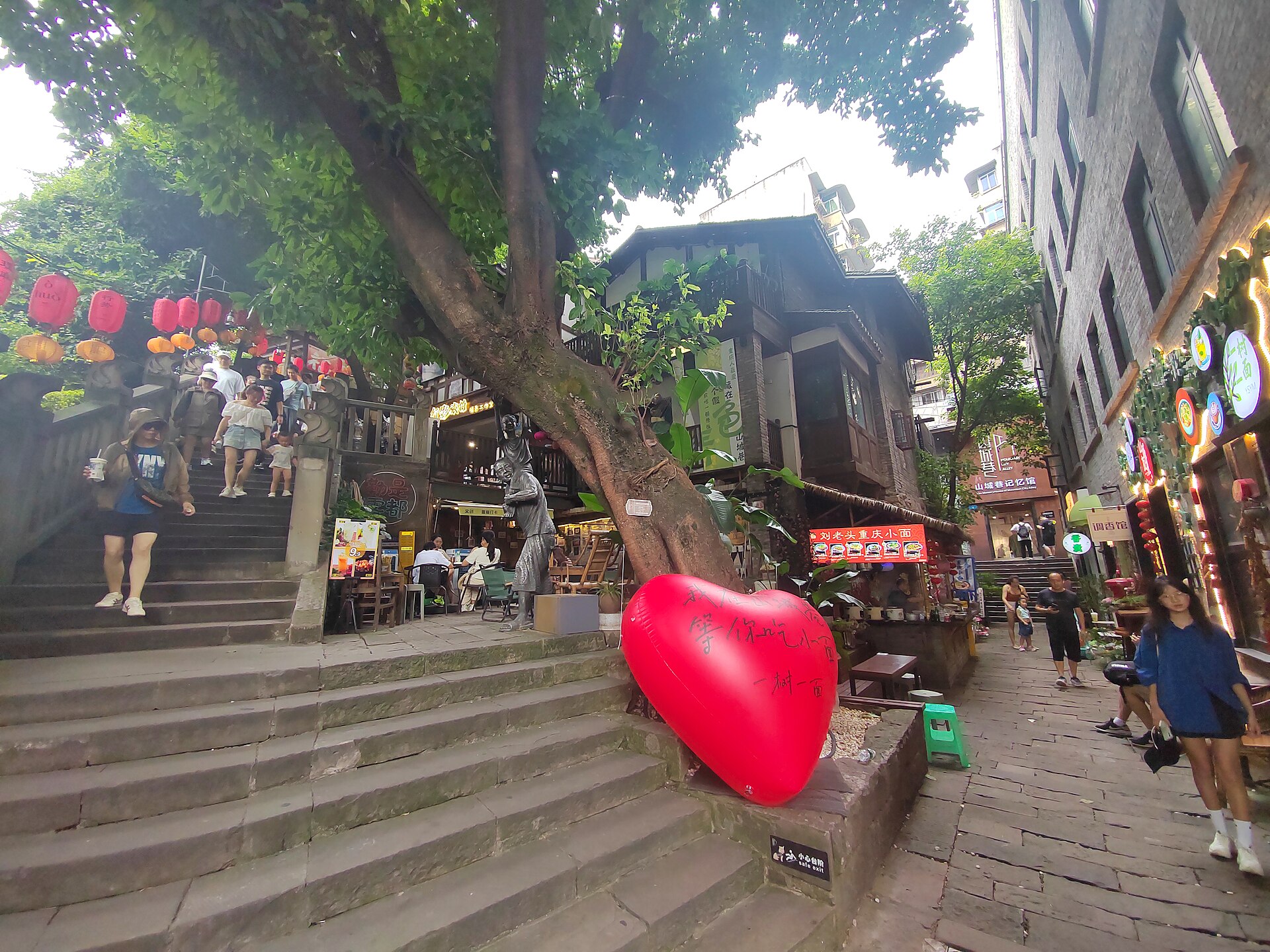
Old stepped lane in Chongqing's mountain-city streetscape — illustrative photo of a nearby historic neighbourhood, not Baolun Temple itself 5
Baolun Temple (宝轮寺)
An old Buddhist temple, also called Longyin Temple · on Heng Street

Up on the rise above the main lane stands Baolun Temple (宝轮寺), also known as Longyin Temple — one of Chongqing's older Buddhist temples, at 76 Heng Street. Inside are the Great Hall (大雄宝殿), the Guanyin Pavilion, the Heavenly King Hall and a sutra library. It's shaded and calm, a nice contrast to the busy snack lanes below. Climb up for a quiet breather, then head back down to keep grazing.

Entry: around ¥5 (about ฿25) · check hours before you go
Location: 76 Heng Street, above the main lane
Know before you go

Hours, cost & how to get there

Everything you need to know, on one page.

Admission
Free to enter the old town
You only pay for snacks/purchases · Baolun Temple ~¥5 · the Zhong Family Courtyard has a small separate ticket
Opening hours
Open to walk through anytime · shops ~11:00–21:00
The town has no closing gate, but most shops open late morning and close in the evening · midday to dusk is busiest
Metro
Line 1, Ciqikou station (磁器口)
From the exit it's a 5–10 minute signed walk to the old-town gate · the best way to dodge traffic
Time needed
Half a day (2–3 hours)
Cover the lanes, the temple, a teahouse and plenty of snacks · stay longer if you love the atmosphere
Best time
Mornings before 10:00
Shops are opening, crowds thin, easy to photograph the stone lanes · weekend afternoons get very busy
Quietest times
Weekdays + early morning
Golden Week (1–7 Oct) and Chinese New Year are the most packed — avoid if you can
The tip locals pass around: Ciqikou is over in Shapingba, on the opposite side from Jiefangbei and Hongyadong. The smart plan is to come in the morning while it's quiet, then take Metro Line 1 back into the centre for Jiefangbei and Hongyadong in the evening.
Getting there

Ciqikou is easiest by metro

Ciqikou sits in Shapingba District (沙坪坝) on the western side of the city. It sounds far, but Metro Line 1 takes you straight there:

From Jiefangbei (inner city)
Metro Line 1 · about 25–30 minutes

Ride Metro Line 1 straight to Ciqikou station — no transfer needed. Walk out following the signs for about 5–10 minutes to the old-town gate. It's the easiest and cheapest route.

Fare: ~¥5–6 · With walk: ~30–40 min
From Chongqing North / West rail stations
Metro, transfer onto Line 1 · check the route

Coming from the Chongqing North or West HSR stations, transfer onto Metro Line 1 and get off at Ciqikou. Open Amap or Apple Maps to confirm the transfer point — Chongqing's metro is complex and climbs a lot of hills, so it pays to check.

How: transfer onto Line 1 · Check: Amap instead of Google Maps
Taxi / DiDi
Convenient, but rush-hour traffic bites

A taxi or DiDi can drop you near the entrance car park, but Chongqing's traffic is heavy at peak times and the roads around Ciqikou clog badly on weekends. Overall the metro is faster and you're not gambling on the traffic.

Good when: travelling as a group / with luggage · Watch for: weekend jams
Half-day plan: the whole old town
Lanes + snacks + temple + teahouse

Come early, walk the main lane and side lanes (09:00–10:30), eat Chen mahua and maoxuewang, climb up to Baolun Temple, sit in a teahouse for a Sichuan opera show, then stroll the Jialing riverfront. Wrap up around noon and take Metro Line 1 back into the city for the afternoon.

Total: 2.5–3 hours · Budget: ¥40–80 per person with snacks
Where to stay in Chongqing

Pick a base that makes touring easy

Ciqikou is best as a morning trip, so for your base choose Jiefangbei or the city centre — easy to explore at night and a quick Line 1 ride out to Ciqikou. Browse the hotels we've reviewed and compared:

Frequently asked

FAQ · before you visit Ciqikou

Do you need a ticket to enter Ciqikou Ancient Town?
No. Walking into Ciqikou Ancient Town is free — no ticket required. You only pay for the snacks or souvenirs you buy along the way. Baolun Temple (宝轮寺) charges a small entry fee of around ¥5 (about ฿25), and the Zhong Family Courtyard (钟家院) has its own small ticket. Check the temple's hours before you go.
Which metro line goes to Ciqikou?
Take Rail Transit Line 1 and get off at Ciqikou station (磁器口). From the exit it's a 5–10 minute walk to the old-town gate following the signs. The metro is the easiest way and avoids Chongqing's heavy traffic. Ciqikou sits in Shapingba District (沙坪坝) on the western side of the city, and from Jiefangbei it's a straight ride with no transfer.
What is the best time to visit Ciqikou?
Arrive before 10:00 in the morning. Shops are opening, the crowds are still thin, and you can photograph the stone lanes in peace. By late morning and through weekend afternoons the main lane gets very busy. When it's packed, slip into the quieter side lanes for a more authentic feel and far fewer people. Golden Week (1–7 Oct) and Chinese New Year are best avoided if you can.
What food should you try at Ciqikou?
The signature snack is Chen mahua (陈麻花), crunchy twisted fried dough in flavours from sweet to numbing-spicy málà — the Chen Jianping shop draws the longest queue. Also look for maoxuewang (毛血旺), the spicy duck-blood hotpot dish said to have started at this port in the 1940s, plus pepper-salt peanuts and qianzhangpi tofu skin, together known as the three treasures of Ciqikou. To dig into where this bold flavour comes from, see our jianghu cuisine guide and Chongqing street food.
How long do you need at Ciqikou?
Allow about half a day (2–3 hours) to cover the main lane, the quiet side lanes, Baolun Temple, the Jialing riverfront and a teahouse session with a Sichuan opera show. If you love the atmosphere and want to graze on snacks, you can easily spend a whole morning or afternoon here, then head back into the city afterwards.