Red-sandstone cliffs that Tang and Song-dynasty carvers covered with tens of thousands of Buddhist figures and story-panels a thousand years ago — the 31-metre reclining Buddha, the Thousand-Hand Avalokiteshvara and the Wheel of Life at Baodingshan.
For most travellers, Chongqing means the 8D city: stacked towers, a train that runs through an apartment block, three-level interchanges and ferociously spicy hotpot. Drive about ninety minutes west, though, and you reach somewhere almost unrecognisably calm — the Dazu Rock Carvings, a series of cliff sculptures that Chinese carvers cut into soft red sandstone from the late Tang dynasty through the Song (roughly the 9th to 13th centuries), more than 50,000 figures in all.
What sets Dazu apart from China's other cave temples is that it isn't simply rows of Buddhas. It is narrative carving that brings Buddhism, Taoism and Confucian thought together — scenes of heaven and hell, lessons on filial piety, even the everyday life of Song-dynasty villagers, laid out across the rock almost like comic panels. That is exactly why UNESCO inscribed it as a World Heritage Site in 1999 and called it the last great masterpiece in the history of the world's cave art.
Among all of Chongqing's sights, Dazu is the one that is quiet, shaded and genuinely thought-provoking. If you have had your fill of the crowds at Hongyadong and Jiefangbei, this is the day you finally get to breathe.
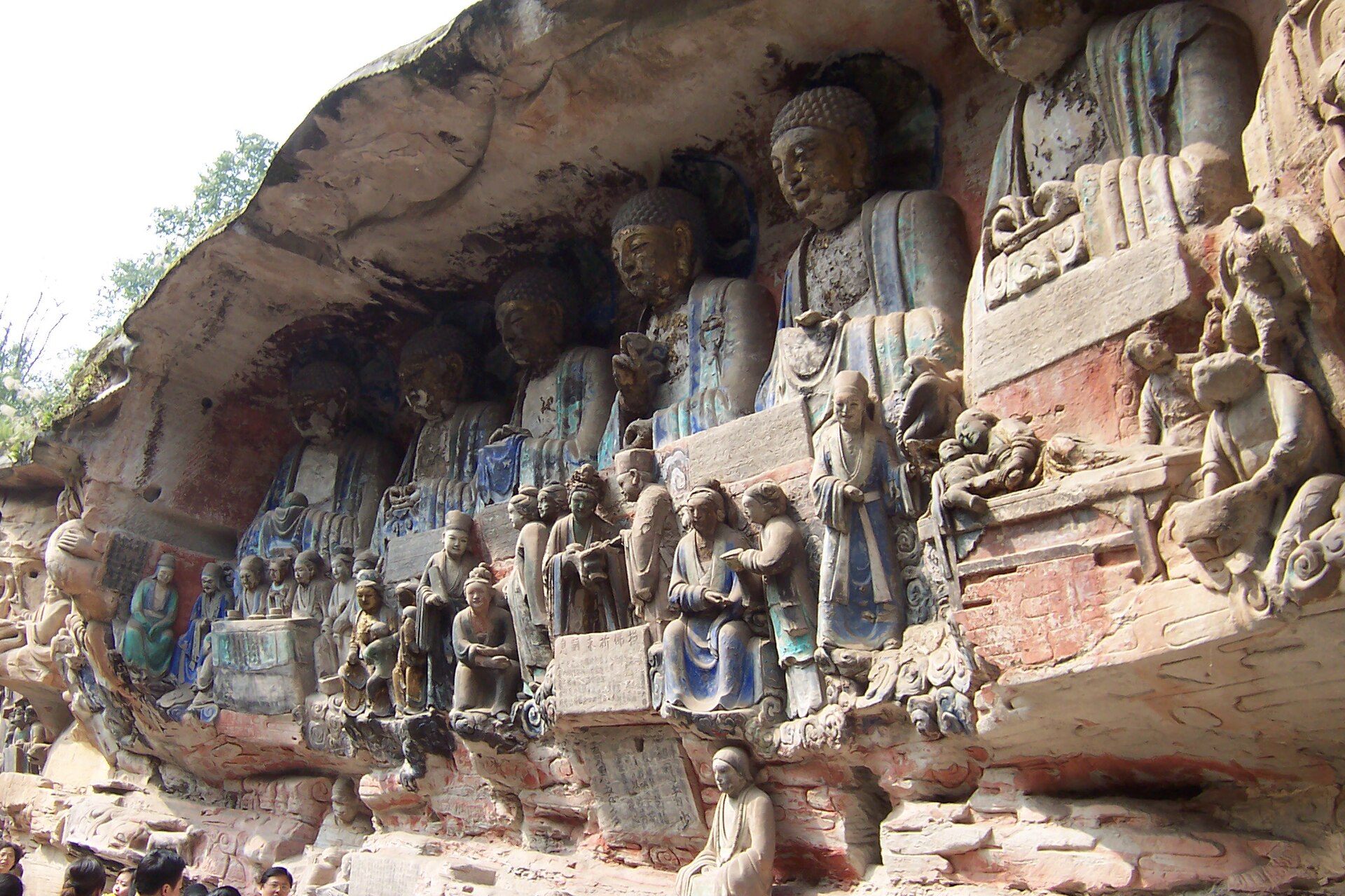
The main route at Baodingshan follows a horseshoe-shaped cliff — a continuous walk of about 500 metres past the sculptures
The Buddha entering nirvana, lying on his side and stretching 31 metres along the cliff. The carvers deliberately showed only the upper half of the body, letting the lower half disappear into the rock as if he were simply too vast for the cliff to contain — a device that gives anyone standing in front of it a real sense of scale. A row of disciples and devas stands before him in homage. This is the single most photographed point on the site.
A Guanyin whose roughly 1,007 hands fan out across the rock like a golden peacock's tail, each hand holding a different object or symbol, the whole figure gilded in gold leaf. It came through a major multi-year restoration and is now one of the most complete and intricate thousand-hand Guanyin carvings in China. You have to look up and give it a minute before the detail resolves.
A great circular wheel clamped in the jaws of the demon Mara, divided inside into the realms of rebirth according to one's deeds — heaven, the human world, animals and hell, all carved in close detail. It is a Dharma lesson that a Song-dynasty villager could read at a glance, and the best illustration of the idea that Dazu didn't just carve Buddhas, it carved teachings into the stone.
A sequence of carvings telling the debt owed to parents — from carrying a child in the womb and feeding it, through to seeing it married and grown. It is the clearest point where Confucian filial piety meets Buddhism, and the scenes are cut with so much emotion and everyday detail that they feel warm rather than austere.
One stretch of the cliff renders hell in unflinching detail — the punishment of wrongdoers alongside the reward of the virtuous — and even includes a panel of a drunkard as a caution against alcohol. It is exactly this kind of everyday detail that historians love about Dazu, because it records Song-dynasty society honestly, etched straight into the rock.
This is the unmissable hill. It was created by the monk Zhao Zhifeng, who devoted more than 70 years to carving it during the Song dynasty, and its sculptures run as a single connected story along a curved cliff about 500 metres long — the 31-metre reclining Buddha, the Thousand-Hand Avalokiteshvara and the Wheel of Life, all in one place. The main route takes about 2–3 hours to walk.
Baodingshan sits about 15 kilometres from Dazu town centre. If you only have half a day, or you are coming as a day trip, make this your first stop.
Beishan lies close to Dazu town (about 2 kilometres) and takes the form of a long walk past hundreds of small niches cut into the rock, holding over 10,000 figures. The focus here is delicate, graceful work — Guanyin, bodhisattvas and devout figures — including the famous "Coquettish Guanyin" (媚态观音), often called the most beautiful Guanyin in the East.
Beishan suits visitors who love fine detail and have a full day. If you are tight on time you could skip it, but with a combined ticket it is well worth the stop.
Dazu is in Dazu County, west of Chongqing. The fastest and best-value way is the high-speed train, then a connecting bus or taxi into the scenic area.
Dazu is one of Chongqing's most popular day trips — here are the other options, plus the in-city sights to pair it with
Even as a day trip, Dazu is easiest from a base in the city — pick somewhere near a rail station or Jiefangbei for an early start