Home Chongqing China Chongqing Hotels About
Home  ›  China  ›  Chongqing  ›  Food Guide
🇨🇳 Chongqing Food Guide · 2026

What to Eat in Chongqing
11 fiery málà dishes to try

China's hotpot capital, where people eat chillies all year round — beef tallow bubbling in a nine-grid pot, a breakfast noodle built from twenty seasonings, and fried chicken buried so deep under dried chillies you have to dig for it. If you love spice, this city is heaven.

Why eat here

Málà and beef talloware the soul of this city

Chongqing cooking sits inside the Sichuan school (川菜), like Chengdu's — but it has its own character that is heavier, spicier and oilier. The word málà (麻辣) pulls two sensations together: the numbing tingle of Sichuan peppercorn (花椒) and the fiery burn of dried chilli (辣椒), then doubles down with beef tallow (牛油) that makes everything richer and harder to put down. Chongqing is the real hotpot capital of China — locals eat hotpot through every season, including a summer so hot the city is nicknamed one of China's "furnaces," and they still gather round a boiling pot.

The other half of the city's heart is jianghu cuisine (江湖菜) — rustic home cooking born from the boatmen, porters and roadside cooks along the Yangtze, made with no fuss: big plates, bold heat, fearless flavour. It is the opposite of fine dining and the truest spirit of how Chongqing eats. Compared with Chengdu — Chengdu leans more refined, more balanced, with layered spice; Chongqing is rougher, oilier and more direct. We picked the 11 dishes and food categories that tell this city's story most clearly.

The dishes

11 dishes to try before you leave Chongqing

Ranked by how distinctive they are — the dishes you won't find this spicy or this rich anywhere else.
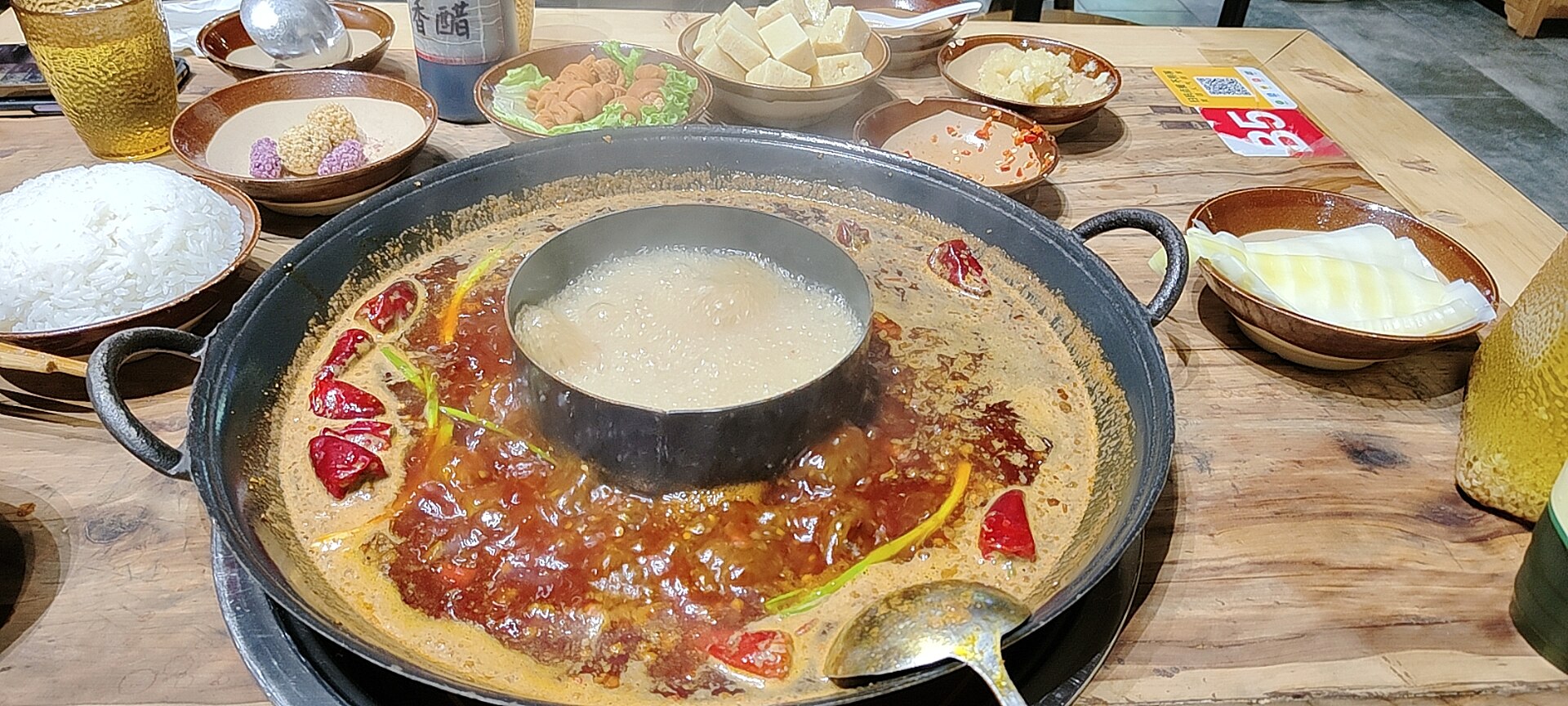
A split yuanyang Chongqing hotpot, half red málà broth and half clear broth, surrounded by plates of raw ingredients and dipping bowls 1
Chongqing Hotpot
火锅 · beef-tallow málà, nine-grid pot

This is the dish the whole city revolves around — a pure beef-tallow base with dried chillies and Sichuan peppercorns floating across the surface until it glows red. The pot is divided into a nine-grid (九宫格), each cell running at a different heat for cooking different things. Classic dunks are ox tripe (毛肚), duck intestine (鸭肠), blood curd and luncheon meat. Dip everything in a sesame-oil and garlic bowl (油碟) to cut the burn. If you don't eat spicy, order a split yuanyang (鸳鸯) pot with half clear broth.
How to eat it: swish tripe for only ~15 seconds ("seven up, eight down") · blood and offal can simmer longer · dip every bite in sesame oil
Price: ¥80–130 (฿400–650) per person to eat your fill
Tip: order mild (微辣) first if you're not used to it · eaten year-round, even in summer
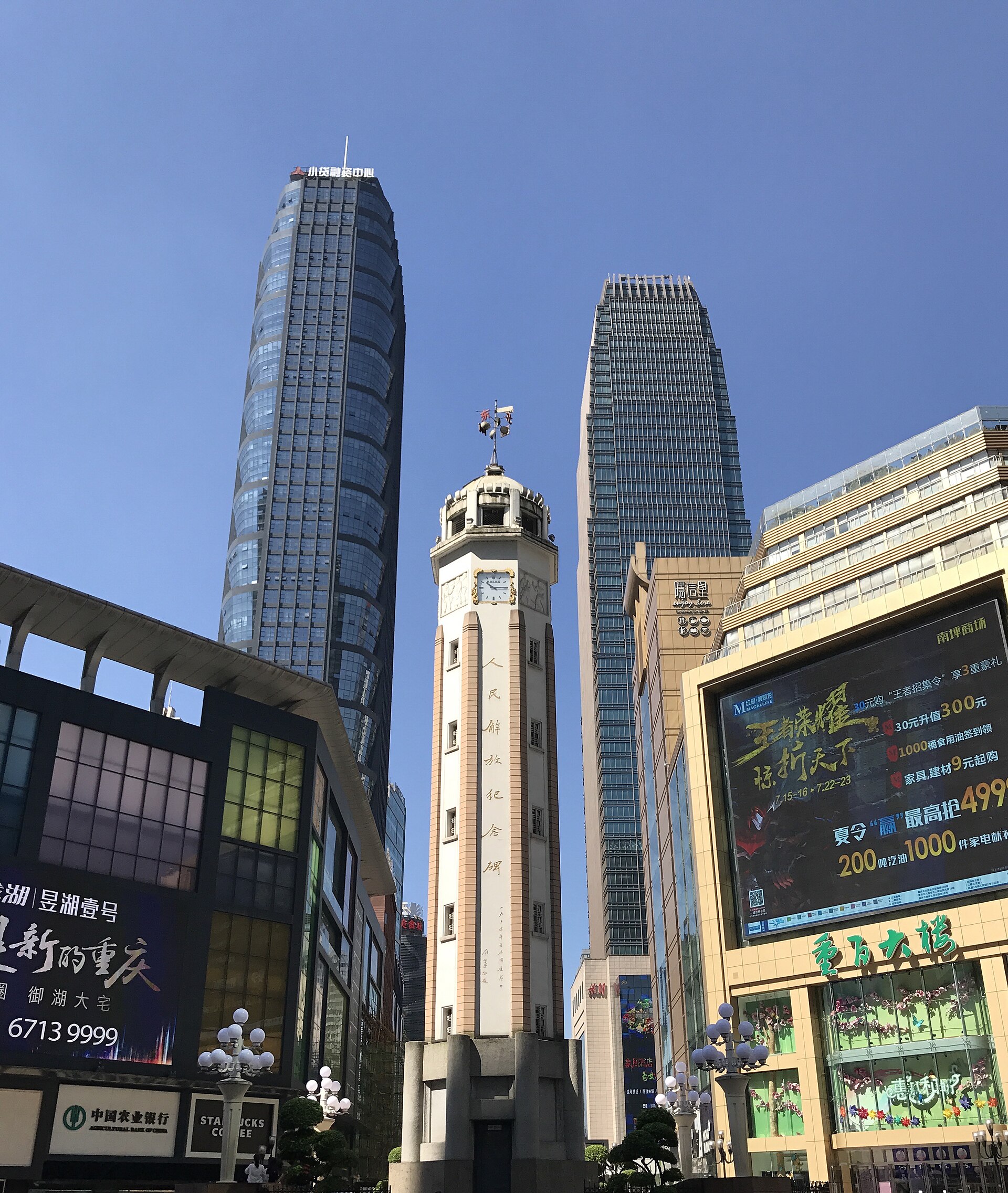
The Jiefangbei monument in downtown Chongqing ringed by skyscrapers, the central district full of noodle shops and street food 2
Xiaomian
重庆小面 · the city's spicy breakfast noodle

This is the city's breakfast — alkaline wheat noodles in a bowl built from more than twenty seasonings laid down before the noodles ever arrive: chilli oil, Sichuan peppercorn, preserved vegetable, garlic water, scallion. Then the hot noodles go on top. The favourite upgrade is wanza mian (豌杂面), topped with stewed peas and minced pork. Locals eat it perched on low plastic stools by the roadside every morning — the city even runs a "Top 50 xiaomian" ranking that people take seriously.

How to order: dry (干溜) or in soup · pick a spice level · add wanza (peas + minced pork) for the best value
Price: ¥8–15 (฿40–75) a bowl
When: best in the morning, 07:00–10:00 · stalls open very early
🌶️3
Laziji
辣子鸡 · chicken buried under a mountain of chillies

This one shocks you when it lands — bite-sized fried chicken buried under a whole plate of dried red chillies, so you genuinely have to fish the chicken out with your chopsticks. The chicken is twice-fried until crisp outside and juicy within, then tossed with dried chillies, Sichuan peppercorn, garlic and sesame, leaving a fragrant heat that lingers long after you swallow. The chillies aren't there to be eaten — they're there to perfume the chicken. It's one of the dishes Chongqing locals order most often to go with a cold beer.

Where: jianghu restaurants across the city · spots around Ciqikou and Shapingba
Price: ¥48–78 (฿240–390) a plate (shares between 2–3)
Tip: push the chillies aside, then eat the chicken · pairs with cold beer
🥘4
Maoxuewang
毛血旺 · duck blood and offal in málà broth

A big bubbling pot of málà broth packed with duck blood, beef offal, intestine, tripe, luncheon meat and bean sprouts, finished with another layer of hot chilli oil poured over the top. The dish was born in Ciqikou old town in the 1940s, when a butcher's wife refused to waste leftover offal and boiled it up at a street stall — one day she dropped fresh blood straight into the boiling broth. The word "mao (毛)" in Chongqing dialect means rough and casual, which is exactly the spirit of it. The blood is silky like pudding, the offal has bite, and the broth is fiercely numbing. A jianghu legend.
Where: jianghu restaurants · old shops in Ciqikou (its birthplace)
Price: ¥38–68 (฿190–340) a plate
Pair with: a bowl of hot white rice to cut the oil and heat
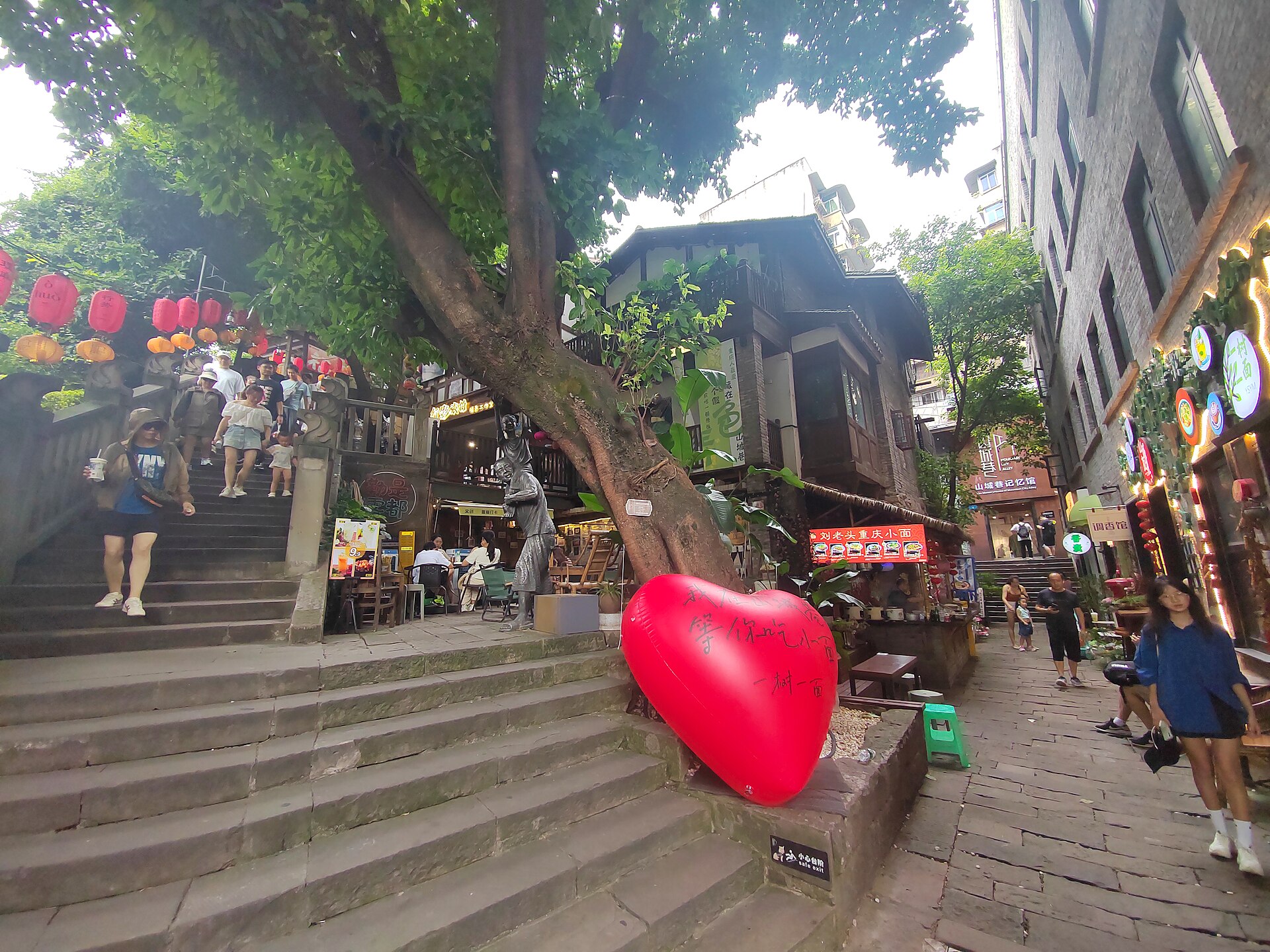
Shancheng Lane, a stepped old laneway in Chongqing lined with red lanterns and roadside eateries, the mountain-city atmosphere 5
Kaoyu (Grilled Fish)
烤鱼 · charcoal-grilled fish simmered tableside

Chongqing–Wanzhou-style grilled fish is different from a plain grilled fish: a whole fish is charred over charcoal until the skin crisps, then lowered into a tray of bubbling málà broth at your table with toppings like potato, tofu skin, enoki mushrooms, lotus root and wood-ear. You pick the fish, the spice level and the flavour (málà / pickled-chilli 泡椒 / black-bean 豆豉). It's a centrepiece the whole table shares. Wanzhou, a district of Chongqing, is known as China's "hometown of grilled fish," and the dish went nationwide from here.

Where: dedicated grilled-fish restaurants citywide · the Jiangbei and riverside areas
Price: ¥80–160 (฿400–800) per fish (shares between 2–4)
Tip: not into spice? choose the black-bean flavour · cook vegetables in the leftover broth
🍜6
Suanlafen
酸辣粉 · hot-and-sour sweet-potato noodles

Glass noodles made from sweet-potato starch — clear, springy and chewy — blanched and drowned in a hot-and-sour broth fragrant with vinegar and Sichuan peppercorn, then scattered with the two things that make it: fried peanuts and Sichuan pickles. The noodles soak up the broth so every mouthful is sour, spicy, fragrant and crunchy. It's a cheap street snack locals eat any time of day to fill a gap, and it's everywhere — stalls in Ciqikou old town and along Bayi Road snack street.

Where: street stalls citywide · Bayi Road · Ciqikou old town
Price: ¥10–18 (฿50–90) a bowl
Tip: pair it with grilled skewers (烧烤) for a light afternoon meal
🐔7
Koushui Chicken
口水鸡 · cold poached chicken in chilli sauce

The name translates to "mouth-watering chicken" — poached chicken, sliced and served cold, under a red sauce of chilli oil, Sichuan peppercorn, soy, a touch of sugar, garlic and toasted sesame. Unlike laziji it isn't fried and isn't hot; it's all about that fragrant, numbing, faintly sweet sauce. The chicken stays tender and soaks up the dressing. It's a cool starter that opens a meal nicely before the truly fiery dishes arrive.

Where: Sichuan–Chongqing restaurants everywhere · jianghu spots
Price: ¥28–48 (฿140–240) a plate (starter)
Tip: order it to start · the cold meat balances a hot pot well
🥟8
Chaoshou
抄手 · Sichuan wontons in red chilli oil

Chaoshou is the Sichuan–Chongqing word for wontons — thin wrappers around juicy minced pork, blanched in hot broth. The version Chongqing is proud of is hongyou chaoshou (红油抄手), wontons doused in fragrant red chilli oil with Sichuan peppercorn and garlic. The skins are slippery and soft, the filling sweet and juicy, and the chilli oil coats every one — spicy in a warming, not searing, way. It works as a light meal or a snack, and is often sold alongside xiaomian noodle shops.

Where: noodle shops and snack stalls citywide · morning markets
Price: ¥10–18 (฿50–90) a bowl
Style: hongyou (red chilli oil) for spice · qingtang (清汤, clear soup) if you don't eat chilli
🔥9
Jianghu Cai
江湖菜 · bold, rustic rivers-and-lakes cooking

Not one dish but a whole school — jianghu cai ("rivers-and-lakes food") is Chongqing's rustic cooking, born along the Yangtze: big plates, bold flavour, no fuss. Beyond laziji and maoxuewang, it runs to shuizhuyu (水煮鱼), tender fish in a sea of chilli oil; shaojigong (烧鸡公), a fragrant rooster stew in a big pot; quanshuiji (泉水鸡); and tai'an yu (太安鱼). They land in the middle of the table to share with bowls of hot rice — this is the truest spirit of how Chongqing eats.

Where: jianghu restaurants citywide · riverside and local-lane spots
Price: ¥40–80 (฿200–400) per person (order several to share)
Tip: come as a group and order widely — better value and you taste more
🍧10
Bingfen & Lianggao
冰粉 · 凉糕 · cold desserts to cool the heat

After a whole meal of málà, your mouth needs cooling — and Chongqing has cold sweets for exactly that. Bingfen (冰粉) is a soft, wobbly clear jelly under brown-sugar syrup, scattered with peanuts, sesame, barley and fruit — wonderfully refreshing. Lianggao (凉糕) is a smooth chilled rice dessert for summer, also drizzled with brown sugar. And liangxia (凉虾) are little shrimp-shaped rice-flour drops floating in sweet, cold syrup. Everything costs a few yuan and turns up at stalls in the old town and along the snack streets.

Where: stalls in Ciqikou old town · Bayi Road · roadside dessert shops
Price: ¥8–20 (฿40–100) a cup
When: best in summer · sold most of the year
🍡11
Shancheng Tangyuan
山城小汤圆 · little black-sesame rice balls

Chongqing is nicknamed the "mountain city (山城)" because it's built across hills and cliffs above the rivers — and its classic dessert is little tangyuan, tiny glutinous rice balls filled with ground black sesame, sugar and a little lard, floating in a warm sweet broth. Bite in and the fragrant black-sesame filling flows out — sweet and rich in just the right measure, and the small size keeps them light. It's a traditional way to close a meal, still found at old dessert shops and in the old town, and the perfect thing to settle the chilli still buzzing on your tongue.

Where: old dessert shops in town · Ciqikou old town · some breakfast spots
Price: ¥8–15 (฿40–75) a bowl
Tip: eat it warm to finish a meal · it tames the lingering heat well
Go deeper on each dish

Read on in detail

Want to go deeper? We have a separate guide for each category — start with the one you most want to eat.

Food neighbourhoods

Which area for which mood

Chongqing climbs up and down the hills in layers — know what each area does best before you set out.

Jiefangbei & Bayi Road
解放碑 · city centre · Metro Line 1/2, Jiaochangkou station

The downtown core around the Jiefangbei monument — Bayi Road snack street (八一路好吃街) packs treats from across Chongqing and all of China into one lane: suanlafen, skewers, fried potato, cold desserts, chilli-oil wontons, grazing your way down the whole street. It's touristy but iconic, and several famous hotpot names sit nearby.

Best for: street snacks · suanlafen · hotpot · When: 11:00–22:00
Ciqikou Old Town
磁器口 · Metro Line 1, Ciqikou station

A riverside old town where cobbled streets are lined with traditional snack shops — this is "walk and graze" territory: stewed chicken offal, cold desserts, and bags of hotpot base to take home. Shops selling mahua (麻花, twisted fried dough) crowd the street; the longest queues form at Chen Jianping Mahua (陈建平麻花), the flagship, and Chen Changyin Mahua. It's also where the maoxuewang legend was born in the 1940s. Packed on weekends, but worth seeing once.

Best for: Chen Mahua · cold sweets · edible souvenirs · When: 09:00–20:00
Shapingba
沙坪坝 · Metro Line 1, Shapingba station

A university district where locals actually eat — famous hotpot joints and well-priced jianghu restaurants cluster thickly, with far fewer tour groups than Ciqikou and lower prices than the centre. If you want hotpot the way Chongqing people eat it, without paying tourist rates, this is the answer.

Best for: local hotpot · jianghu food · When: dinner 17:00–23:00
Jiangbei & Riverside
江北 · Metro Line 6 · Guanyinqiao area

The more modern north bank — grilled-fish restaurants and riverside spots line up here with lovely night views of the city, ideal for a relaxed dinner with atmosphere. Guanyinqiao is a buzzy shopping-and-eating district, near Hongyadong (洪崖洞), the cliffside building lit up at night that has become the city's signature image.

Best for: grilled fish · riverside dinner · When: 17:00–22:00
Pins you shouldn't miss

The spots locals point you to

Not a list of fancy restaurants — but the neighbourhoods and food institutions that really tell this city's story. Add them to your plan.

1
Bayi Road Snack Street (八一路好吃街)
Downtown food street · near the Jiefangbei monument

The most famous food street in central Chongqing, gathering treats from across the city and all of China into one lane — suanlafen, grilled skewers, fried potato, cold desserts, chilli-oil wontons, grazing as you go. Honestly, it's fairly touristy and a touch pricier than the back lanes, but it's the easiest place to start if you have half a day and want to try a lot in one spot.

Location: Bayi Road, Yuzhong District · Metro Line 1/2, Jiaochangkou station
Hours: roughly 11:00–22:00 · Known for: assorted street snacks · mostly WeChat Pay / Alipay
2
Ciqikou Old Town (磁器口古镇)
Riverside old town · birthplace of several dishes

A cobbled old town that braids history and food together — graze on stewed chicken offal and cold desserts, and buy hotpot base to take home. Mahua (麻花, twisted fried dough) shops fill the street; the longest queues belong to Chen Jianping Mahua (陈建平麻花), the flagship, and Chen Changyin Mahua. This is also where the maoxuewang legend was born in the 1940s. Very busy on weekends, but worth seeing once.

Location: Ciqikou, Shapingba District · Metro Line 1, Ciqikou station
Hours: roughly 09:00–20:00 · Known for: Chen Jianping Mahua · stewed chicken offal · chilli souvenirs
3
Shapingba Hotpot Quarter (沙坪坝火锅)
University district · hotpot the local way

Want hotpot the way Chongqing people eat it, without paying tourist rates? Head to Shapingba, a university district where hotpot joints and well-priced jianghu restaurants cluster thickly. The beef-tallow broth is rich, the ingredients fresh, and it's packed every night — and noticeably cheaper than the centre. It's the area where real atmosphere and real flavour meet.

Location: Shapingba District · Metro Line 1, Shapingba station
Hours: most hotpot places open late · Known for: beef-tallow hotpot · friendly prices
4
Morning markets & back-lane xiaomian stalls
Citywide · the breakfast Chongqing actually eats

The best xiaomian usually isn't in a big restaurant — it's hidden at stalls in residential lanes and morning markets across the city. Look for the stall surrounded by low plastic stools and packed with locals; that's your signal it's good. You can point at the bowl the person next to you is eating and say "that one." The seasonings are lined up in the bottom of the bowl in front of you before the noodles go in, and it costs just ¥8–15 a bowl.

Location: residential lanes citywide · morning markets in every district
Hours: 06:30–10:30 (best) · Known for: xiaomian · wanza mian · chilli-oil wontons
Frequently asked

FAQ · what people ask before heading out to eat

How much does a meal cost in Chongqing?
Chongqing eats well on any budget and is noticeably cheaper than Shanghai. A breakfast bowl of xiaomian runs ¥8–15 (฿40–75), suanlafen or street snacks ¥10–20 (฿50–100), a filling solo hotpot ¥80–130 (฿400–650) per person, a large grilled fish to share between 2–3 people ¥80–160 (฿400–800) for the whole dish, and a sit-down jianghu restaurant meal ¥40–80 (฿200–400) per person.
How is Chongqing hotpot different from Chengdu hotpot?
The base broth is the clearest difference. Chongqing hotpot uses a pure beef-tallow (牛油) base — rich, oily, fiery and direct. Chengdu hotpot uses a rapeseed/vegetable-oil (清油) blend lifted with aromatic spices, so it tastes lighter and more layered. Chongqing is the genuine hotpot capital, where locals eat it year-round even in the brutal summer heat. The pot is divided into a nine-grid (九宫格), each cell running at a different heat for cooking different ingredients.
Is Chongqing food very spicy, and can you ask for it milder?
It is genuinely spicy, with a tongue-numbing tingle from Sichuan peppercorn (花椒) on top of the chilli heat. But you can choose a spice level at almost every restaurant — mild (微辣), medium (中辣) or extra-hot (特辣). Many hotpot places offer a split yuanyang (鸳鸯) pot, half clear broth and half málà, and a sesame-oil dip (油碟) cuts both the heat and the burn a lot. If you don't eat spicy, start with a black-bean-flavoured grilled fish or a soup-style noodle.
Do Chongqing restaurants take credit cards or do I need cash?
Street stalls, noodle shops and market vendors mostly take only WeChat Pay or Alipay — many take no cash and no cards at all. Download Alipay before you travel and link an international Visa/Mastercard through its international mode. Larger hotpot restaurants and mall outlets usually accept foreign credit cards.
What is jianghu cuisine (江湖菜)?
Jianghu cai (江湖菜, literally "rivers-and-lakes food") is Chongqing's rustic home cooking, born from boatmen, porters and roadside cooks along the Yangtze who cooked with no fuss — big portions, bold flavour, fearless heat. Classics include laziji (辣子鸡), maoxuewang (毛血旺), shuizhuyu (水煮鱼, fish in chilli oil) and shaojigong (烧鸡公, rooster stew). It is the anti-fine-dining heart of how Chongqing really eats. Read more in our jianghu cuisine guide.
What desserts cool the heat in Chongqing?
After a full málà meal, locals reach for cold sweets. Bingfen (冰粉) is a soft clear jelly topped with brown-sugar syrup, peanuts, sesame and fruit; lianggao (凉糕) is a smooth chilled rice dessert for summer; liangxia (凉虾) are little shrimp-shaped rice-flour drops in sweet syrup; and shancheng xiao tangyuan (山城小汤圆) are little black-sesame glutinous rice balls. Find them at street stalls on Bayi Road and in Ciqikou old town for ¥8–25 (฿40–125).
Klook · Food Tour

Chongqing Food Tour — eat at the right spots with someone who knows

A Chongqing food tour with a local guide who walks you through back lanes for beef-tallow hotpot, the best xiaomian and street snacks in Ciqikou — taste it for real, no language barrier and no fear of ordering something too spicy.

See Chongqing food tours on Klook →
Wherebest is a Klook affiliate partner — we may earn a commission when you book through our link, at no extra cost to you.