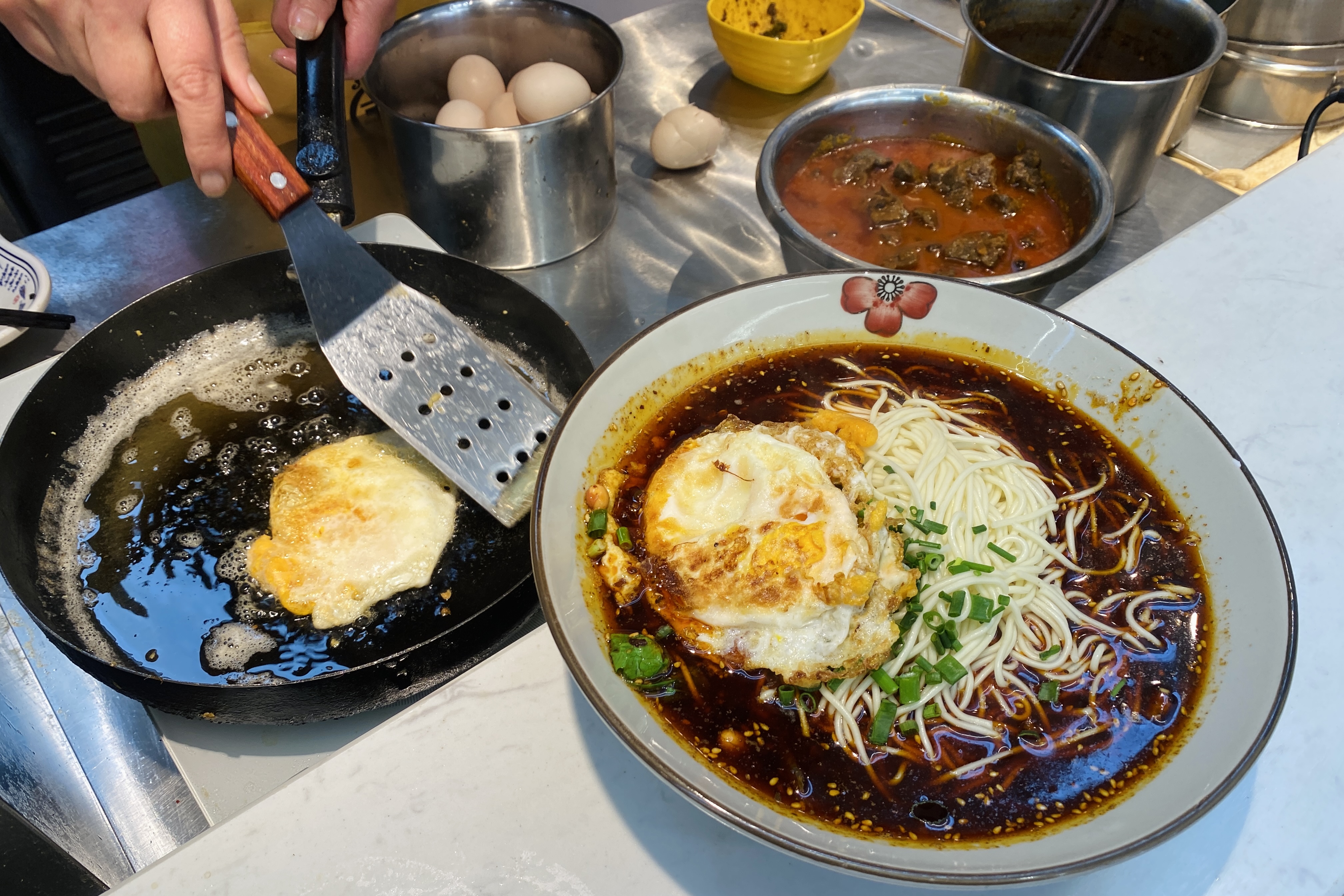
Springy alkaline noodles over 20-plus seasonings layered before the noodles, numbing with Sichuan peppercorn, fragrant with chilli oil — ¥8–15 a bowl. The first-timer's guide that gets you ordering like a Chongqing local.
Walk down any street in Chongqing between 6am and 9am and you will see the same picture in every lane — businessmen in suits, construction workers, students and retirees, all hunched on tiny plastic stools by the kerb, heads down over a steaming red bowl. This is xiaomian (重庆小面 chóngqìng xiǎo miàn) — the name means "small noodles", but in a Chongqing heart it is the biggest meal of the day.
It looks almost too plain to matter: boiled noodles tipped over dark-red chilli oil, a scatter of scallion, and that's it. The secret is everything you cannot see. Before the noodles go in, the cook has already laid out more than 20 seasonings (作料 zuòliào) at the bottom of the bowl — chilli oil, ground Sichuan peppercorn, preserved mustard greens, garlic water, lard, sesame oil and more. Xiaomian is not great because of its broth; it is great because of the cook's seasoning hand. That is exactly why every shop tastes different, and why a Chongqing local will happily walk twenty minutes to their favourite stall.
The flavour at its core is málà (麻辣) — "má" is the tongue-buzzing numbness of Sichuan peppercorn, "là" is the burn of chilli. Together they are the signature of the entire Chongqing kitchen, from the hotpot cauldron to the morning noodle bowl. Chongqing belongs to the Sichuan school of cooking (川菜), but it is heavier-handed, spicier, oilier and more rustic than neighbouring Chengdu. Xiaomian is the clearest expression of that personality — and the best place to start understanding why an entire city wakes up for chilli.
Noodles, seasonings, toppings — the three layers that build the legendary red bowl.
1
This is what separates a great shop from an ordinary one. Before the noodles land, the cook spoons in a whole set of seasonings — chilli oil (辣椒油) made by frying dried chillies until red and crushing them into hot oil, ground Sichuan peppercorn (花椒) for the numbing buzz, preserved mustard greens (芽菜 or 榨菜) for a salty-savoury edge, garlic water, lard for richness, soy sauce, black Chinkiang vinegar, sesame oil, scallions, and more depending on the recipe. The instant the hot noodles and a splash of cooking water hit the bowl, every aroma blooms at once.
The traditional noodle is an alkaline wheat noodle — wheat dough made with alkaline salts, which turns it faintly yellow and gives it a slippery, springy, chewy bite that ordinary noodles lack. That bounce matters, because the noodles have to be tossed through thick chilli oil without going soft. They are usually thin to medium round strands, boiled in furiously rolling water for about a minute and a half. Chongqing eaters like them with a little backbone left, never mushy — and if you prefer them softer or firmer, just say so.
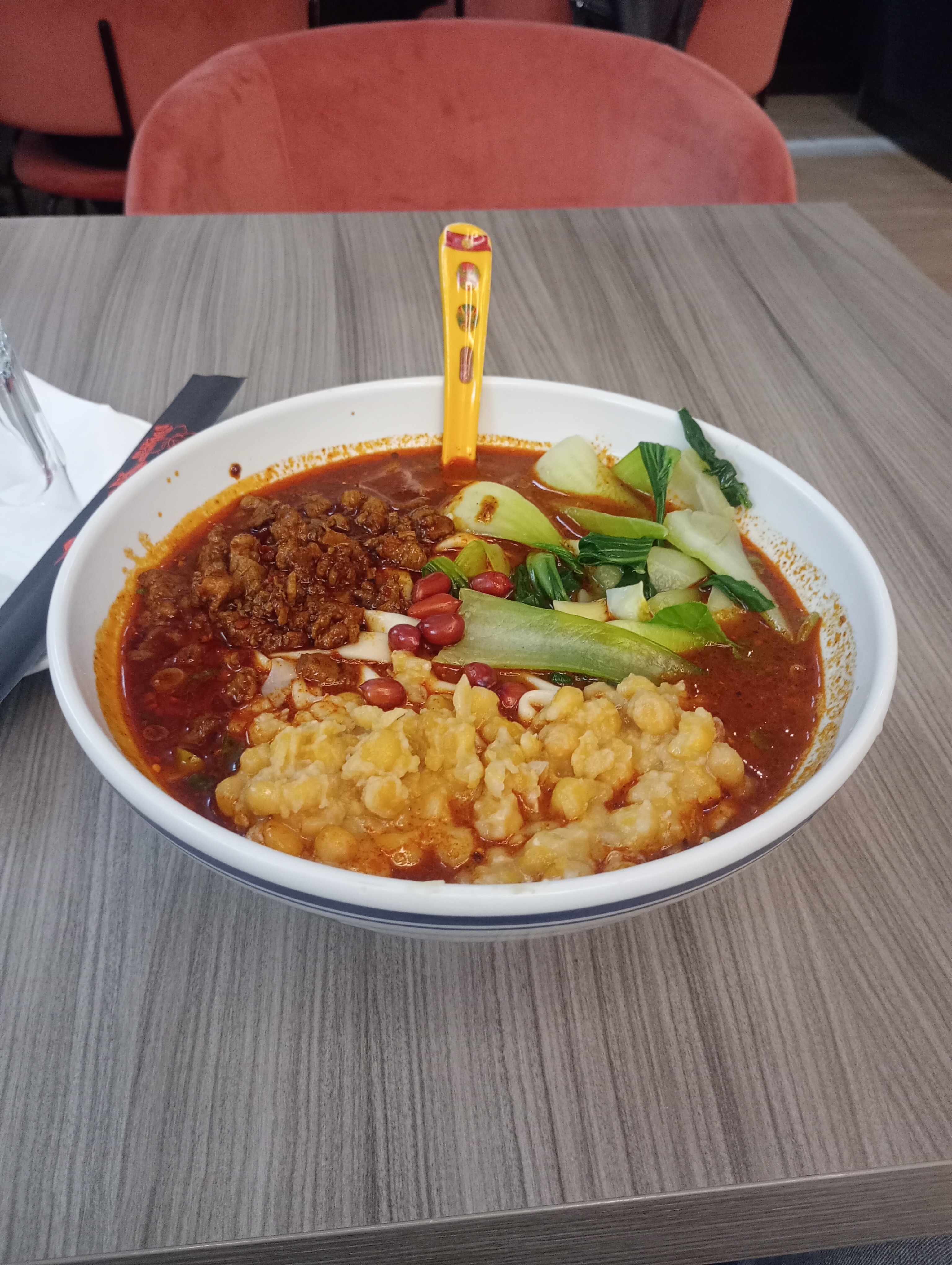
The most basic bowl has no topping at all — just seasonings, noodles, roasted peanuts and scallion, known as plain xiaomian (素小面). Most people add a topping though. The favourite by far is wanza (yellow peas plus minced pork fried with bean paste), followed by soy-braised beef (红烧牛肉), braised pork intestine (肥肠), and chilli chicken. Some shops serve a properly Chongqing diced-rabbit-with-green-chilli topping (尖椒兔). Whatever you pick, it goes on top of the noodles and gets stirred through the seasonings at the bottom.
4
If you are standing in front of a shop in Chongqing for the first time, order wanzamian and you cannot go wrong. 豌 (wān) is yellow peas boiled until they collapse into something almost creamy, and 杂 (zá, short for 杂酱) is minced pork fried with fermented bean paste and preserved veg until deep and savoury. Both go over the noodles, and you stir until creamy peas, salty-rich pork and fiery chilli oil become one thing — soft, rich, spicy and fragrant in a single mouthful. It is the bowl that best explains why Chongqing people are so devoted to their own noodles.
Xiaomian comes two ways. With soup (汤面 tāng miàn) is just enough cooking water to cover the noodles — sippable, rounder, ideal on a cold morning. Dry, called "gan liu" (干溜 gān liū), uses very little liquid, so the noodles end up thickly coated in seasoning with nothing to drink — bolder and far more concentrated. Plenty of locals eat wanzamian gan liu so the peas and pork stand out. Just tell the cook "gan liu" for dry or "tang mian" for soup.
The fierce red colour looks scarier than it tastes — Chongqing chilli oil is more fragrant than raw-hot, but the chilli heat and the numbing tingle of Sichuan peppercorn are very real. If you are not used to it, just say "wei la" (微辣 = barely spicy) or "shao la" (少辣 = mild), and ask for "shao huajiao" if you would rather skip the numbness. Want the full experience? "Duo la" (多辣) gets you extra heat. Cooks adjust every bowl to the eater, so there is no need to be shy.
Almost every xiaomian shop takes WeChat Pay and Alipay by QR scan. Many lane shops do not take foreign cards and some prefer cash in yuan, so it is easiest to set up Alipay with a Visa or Mastercard before you go. You usually pay first or give a table number, then find your own plastic stool. Some shops are so packed you eat standing or wait in line — usually a sign you have found the right place. Keep a glass of water or soy milk on the side to cool the heat.
Chongqing has an estimated 86,000 noodle shops. The trick to finding the right one isn't in the reviews — it's in the feet of the locals.
The best xiaomian in Chongqing rarely comes from a polished shopfront — it comes from tiny hole-in-the-wall shops down side streets, some with barely any storefront at all, just a small kitchen and plastic stools on the pavement. From breakfast to lunchtime the queues are long, and many sell out and close by around 1–2pm. The simplest rule: on a weekday morning, walk into a residential lane and eat at whichever shop the locals have packed.
Chongqing's obsession with xiaomian runs so deep that there is a running "Top 50 Xiaomian" (小面50强) ranking, voted on by media and eaters, and which shops are in or out is a genuine annual talking point — the list shifts almost every year because the competition is ferocious. Shops that have made past lists, like Zhu'er Noodles (朱儿面) or the Xin family's chicken-noodle shop, are names locals have argued about for years. If you spot a "50强" sign in a window, it means the shop has been voted in before — but don't fixate on it, because plenty of award-less little shops are every bit as good.
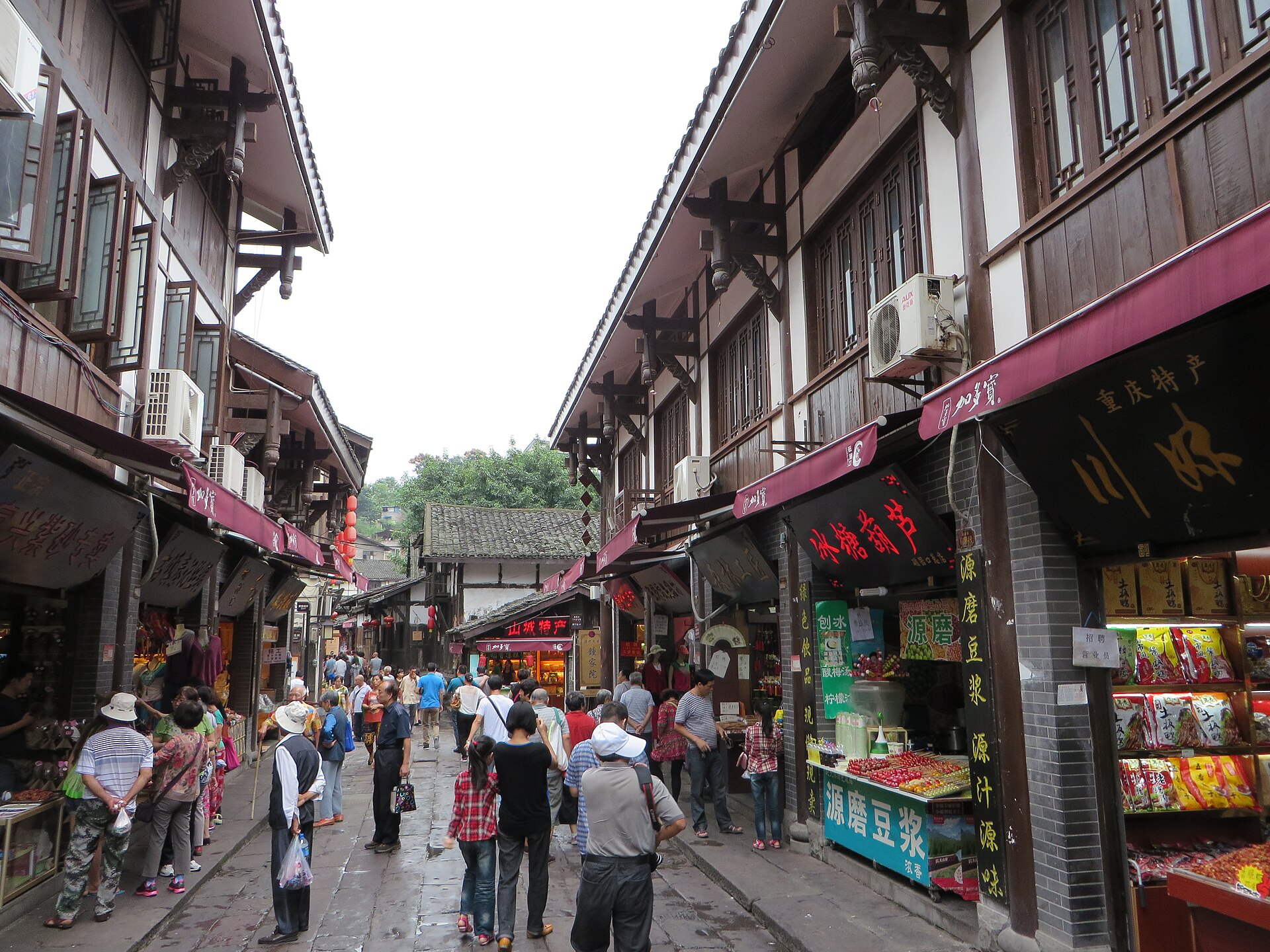
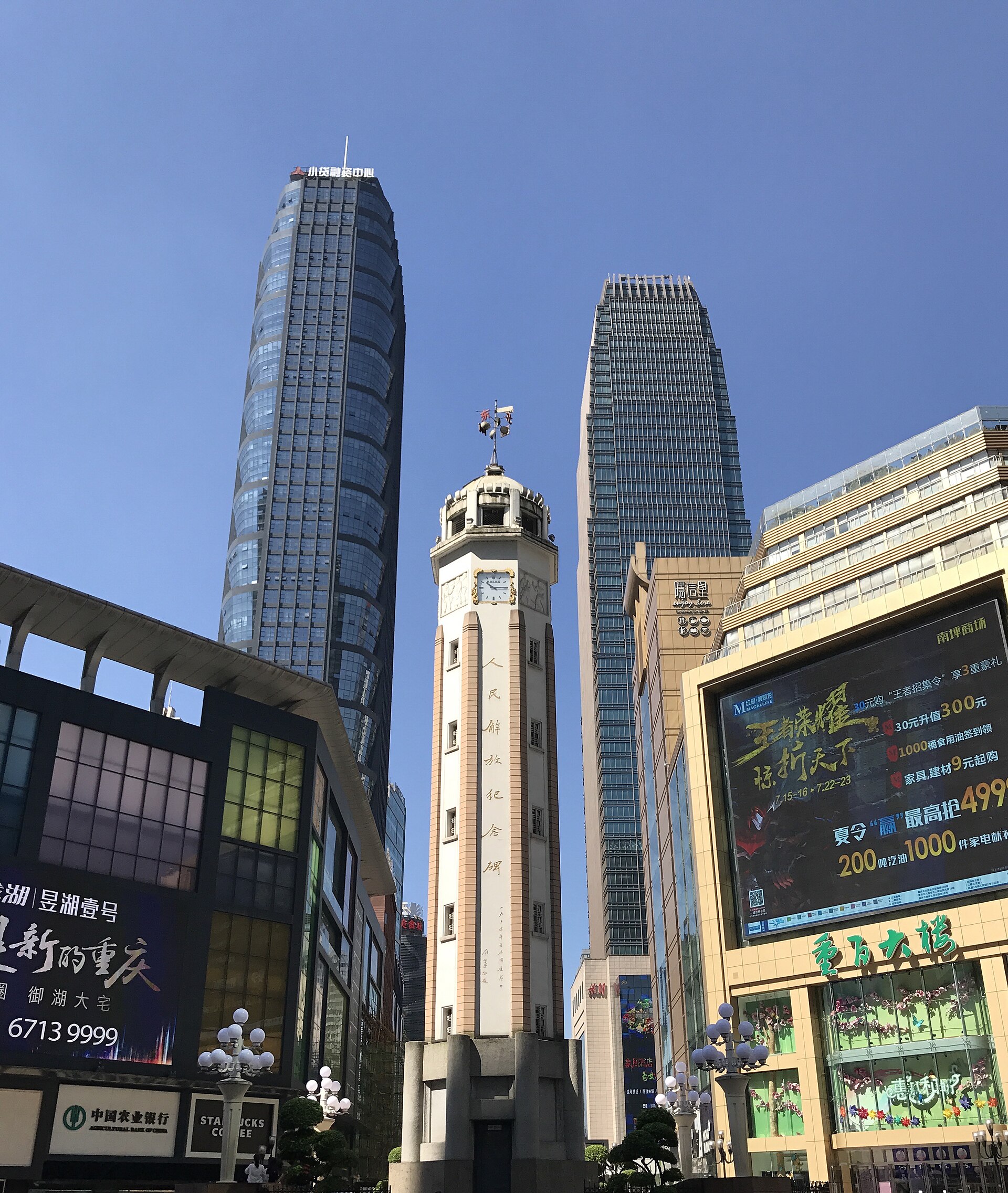
If you are staying central around Jiefangbei (解放碑), step off the main shopping street into the side lanes and you'll find several breakfast noodle shops. Ciqikou (磁器口) old town has plenty of noodles and snacks but at tourist prices — so if you want local prices and local seasoning, head into a residential lane in a district like Yuzhong (渝中) or Jiangbei (江北). Shops there sell to the neighbourhood every day, so they're cheap and the flavour isn't toned down for visitors.