Home Chongqing China Chongqing Hotels About
Home  ›  China  ›  Chongqing  ›  Chongqing Hotpot
🇨🇳 China's Hotpot Capital · 2026

Chongqing Hotpot (火锅)
Beef-tallow málà, the spiciest in China

A pot of red broth bubbling hard, a thick slick of beef tallow, peppercorns numbing your tongue — in Chongqing people eat hotpot year-round, even in the brutal summer heat. This isn't just a meal. It's how the whole city lives.

Before You Dig In

Chongqing Hotpot — the heart the whole city shares

If one dish could explain everything about Chongqing, it would be hotpot (火锅 huǒguō). This really is China's hotpot capital — not a slogan. The city is said to have more than thirty thousand hotpot restaurants, and people here eat it all year round, including the deep summer when temperatures push 40°C. Crank the air-con, gather around a bubbling red pot, sweat pouring — that, to a local, is happiness.

The soul of Chongqing hotpot is the word málà (麻辣) — 麻 (má) is the tingling numbness on your tongue from huajiao (花椒, Sichuan peppercorn), and 辣 (là) is the fiery heat from dried chillies. Both float in a thick layer of beef tallow (牛油 niúyóu), simmered with chillies, peppercorns, fermented black beans and dozens of spices. The tallow is the real star: it coats every piece you dip, holds heat and aroma better than vegetable oil, and the broth only grows richer the longer it bubbles.

Chongqing hotpot was born among Yangtze River dockworkers about a century ago — the offcuts and offal other people threw away, blanched in a fiery pot of chilli oil by the riverside, cheap and warming. From working-class food it became the symbol of a city where everyone, from taxi drivers to business owners, eats the same thing. This is jianghu (江湖) cooking — raw, direct, unfussy — and it's exactly what sets it apart from the more refined hotpot of Chengdu.

Anatomy of the Pot

The broth, the pot, the dip — three things to understand

Get your head around these three before you drop the first piece in, and the whole meal gets better fast.
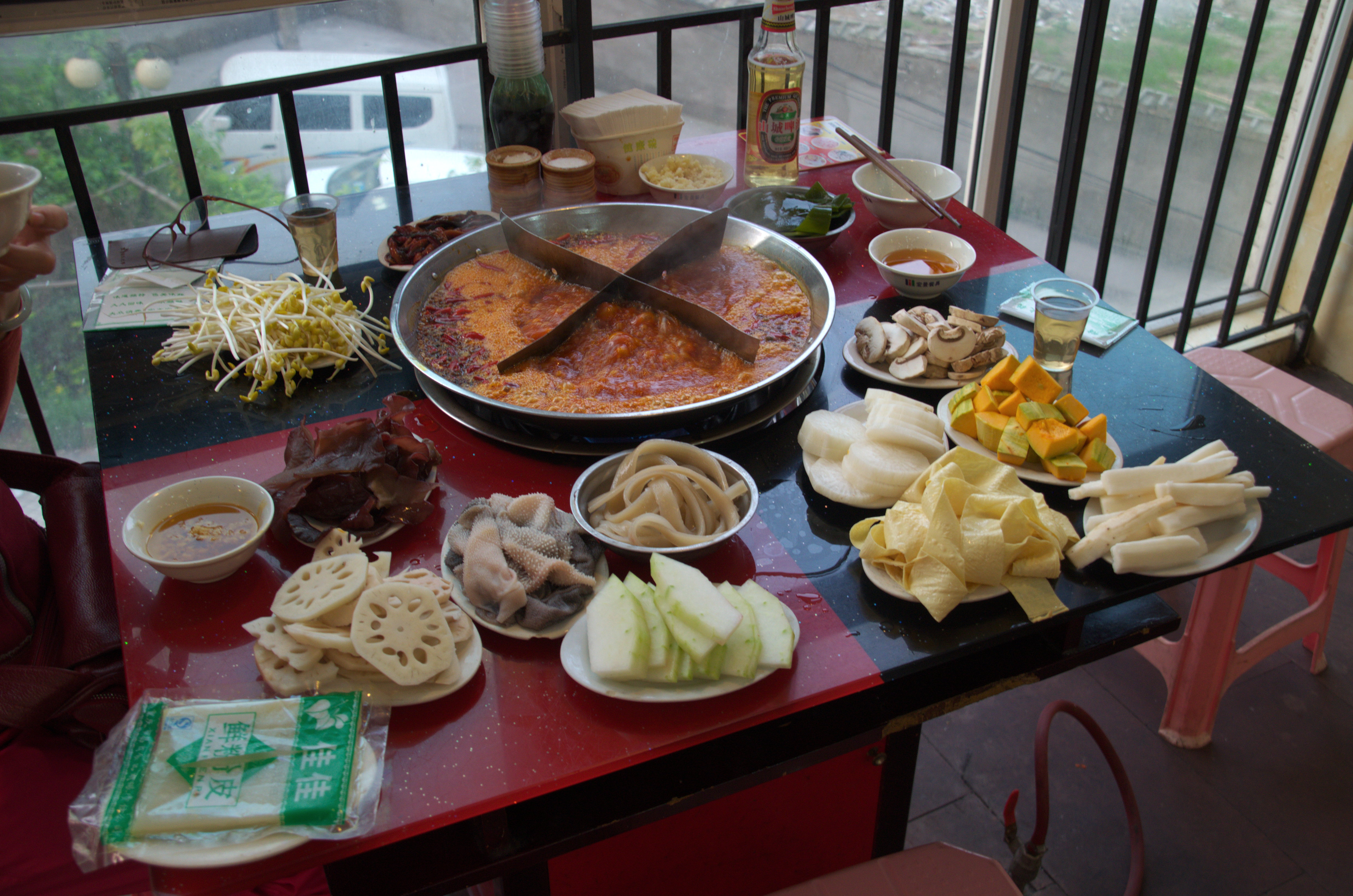
Chongqing hotpot with a thick red beef-tallow málà broth full of chillies and peppercorns, ringed by plates of tripe, lotus root, mushrooms and tofu 1
Beef-Tallow Málà Broth
牛油锅底 · the heart of Chongqing hotpot

Beef tallow is what makes Chongqing hotpot Chongqing. Blocks of golden-yellow tallow are simmered with dried chillies, huajiao, fermented black beans, garlic, ginger and a long list of spices until the broth turns deep red with a thick slick of oil on the surface. That oil layer is the point — it coats every dunk, holds the heat in, and carries the chilli and the numbing tingle into your mouth at once. The flavour isn't just spicy; it's deep and layered, and it intensifies the longer the pot boils.

Core flavour: 麻 (numbing huajiao) + 辣 (chilli heat) + rich beef-tallow aroma
Broth charge: ¥30–90 per pot (~฿150–450), billed separately from dunks
Tip: Let it reach a full rolling boil before you start; the broth is at its best mid-meal
🔲2
The Nine-Grid Pot
九宫格 jiǔ gōng gé · nine squares, each a different heat

The nine-grid pot isn't for looks — each square runs at a different heat. The centre square boils hardest, for things that cook in seconds like tripe and duck intestine. The middle-edge squares sit at medium heat for beef, meatballs and mushrooms. The corner squares are coolest, for slow-simmer items like duck blood, potato or thick beef tripe. Put each item in the right square and everything cooks just so — never rubbery, never mushy.

Centre: high heat — tripe, duck intestine, thin meat: dip and eat
Corners: low heat — duck blood, potato, lotus root: leave them simmering
Note: some places use a four-square cross pot or a plain round pot — both common
🧄3
The Oil Dish
油碟 yóu dié · sesame oil + mashed garlic, the heat-tamer

Chongqing's dipping sauce is gloriously simple compared to elsewhere — mostly sesame oil with mashed garlic. The logic: the málà broth is already intense, so loading the dish with extra sauces would just drown it. The sesame oil does two jobs: it makes each piece silky, and it takes the sting of the heat off your mouth and throat. Dip every hot piece in the oil before it goes in — that's the local trick for handling the spice, and it differs from Chengdu, where people like coriander and oyster sauce.

Chongqing recipe: sesame oil + mashed garlic (+ spring onion, coriander to taste)
What it does: coats the food, tames the heat, adds aroma — always dip first
Tip: pile in the garlic; some places put out crushed peanuts to stir through
☯️4
The Yuanyang Split Pot
鸳鸯锅 yuānyāng guō · half spicy, half clear, for everyone

Can't take the heat, or eating with a mixed group? Order a yuanyang pot — named after mandarin ducks, which pair for life. The pot is split by an S-shaped metal divider: one side holds the fiery red málà, the other a clear, non-spicy broth, usually bone, chicken or tomato. Dip your food in whichever side suits you, so kids, older diners and the spice-shy all have somewhere to cook. It's what makes Chongqing hotpot a meal the whole table can genuinely share.

Spicy side: beef-tallow málà, heat dialled from mild to extra hot
Clear side: bone, chicken, tomato or mushroom broth — no chilli
Good for: families, kids, the spice-shy, or first-timers to CQ hotpot
Heat levels: order anywhere from 微辣 (wēi là · mild) to 中辣 (zhōng là · medium) to 特辣 (tè là · extra hot). Chongqing málà hits harder than most people expect — first-timers should start at mild or medium and work up next time.
The Must-Order Dunks

6 classic dunks you can't skip

Real Chongqing hotpot starts with offal and beef — these are what locals order at every table, with the right cooking time for each.

🫧1
Ox Tripe (Maodu)
毛肚 · the king of the dunks

If a local could order only one dunk, it would be tripe — fresh ox tripe sliced into thin, frilly petals, dipped in the hottest centre square with the mantra 七上八下 (seven up, eight down): in and out about seven or eight times, 10–15 seconds total. The moment it starts to curl, lift it out and into your oil dish. It comes up crisp and springy. Leave it too long and it turns to rubber instantly.

Cooking time: 10–15 seconds (seven-up-eight-down) in the high-heat square
Price: ¥38–68 per plate (~฿190–340)
Tip: order fresh tripe (鲜毛肚) over the soaked kind — far crunchier
🍜2
Duck Intestine (Yachang)
鸭肠 · crunchy, springy, tripe's best friend

Tripe's partner, loved just as fiercely — long, fresh strands of duck intestine. Pinch one end, swish it in the boiling broth for just 15–20 seconds, and it shrinks into tight curls with a crunchy snap that almost dances in your mouth. It sounds intimidating to a first-timer, but most people are hooked after one bite. This is the charm of Chongqing hotpot — it uses offal boldly and proudly.

Cooking time: 15–20 seconds — eat the moment it's done
Price: ¥32–58 per plate (~฿160–290)
Tip: hold one end and swish it through the broth so it cooks evenly and stays put
🥢3
Huanghou
黄喉 · beef/pork heart artery — its own crunch

A lot of people assume huanghou is the windpipe, but it's actually the large artery from a cow or pig's heart, cut into pieces. It has a crunch all of its own, unlike anything else in the pot, and it soaks up the málà broth beautifully. Dip it in the high-heat square for about 20–30 seconds. It's a classic offal dunk that's been part of Chongqing hotpot forever — those in the know order it right alongside the tripe and duck intestine.

Cooking time: 20–30 seconds in the high-heat square
Price: ¥32–55 per plate (~฿160–275)
Texture: crunchy and springy — soaks up the broth well
🟥4
Duck Blood (Yaxue)
鸭血 · soft blood curd — better the longer it simmers

The opposite of the rush-to-eat dunks — soft, slippery cubes of duck blood are something you want to simmer for a long time. Drop them in a cool corner square and leave them all meal. The blood curd soaks up the málà broth until it's soaked through, silky and melting on the tongue, with the spicy aroma right inside it. Locals order it early and spoon it out near the end. Cheap as anything, and far better than the price suggests.

Cooking time: several minutes to the whole meal — soaks up more over time
Price: ¥18–35 per plate (~฿90–175)
Where: a cool corner square; leave it simmering for the end of the meal
🥩5
Luncheon Meat (Wucanrou)
午餐肉 · the dunk everyone loves

Not flashy, but on every table — luncheon meat cut into thick slices, dipped in the málà broth until the edges drink in the spicy, fragrant oil while the middle stays soft. It's easy to like, kids love it, and it cuts nicely against the intensity of the offal. A safe, happy dunk for first-timers who don't want to gamble on texture — it's ready after a short dip.

Cooking time: 30–60 seconds, until the edges soak up the broth
Price: ¥22–38 per plate (~฿110–190)
Good for: first-timers, kids, anyone wanting something soft to cut the richness
🐄6
Tender Beef (Nenniurou)
嫩牛肉 · thin-sliced beef — a few seconds only

Fresh beef, sliced thin and marinated tender, needs only a few seconds in the broth — the instant it changes colour, it's done. It comes out soft and holds all its juices. Leave it any longer and it goes tough and chewy. This is the meat-lover's pick for anyone not sold on offal: dip it in the sesame-garlic oil and bite — rich, spicy, fragrant and tender, all in one mouthful.

Cooking time: a few seconds — done as soon as the beef changes colour
Price: ¥42–78 per plate (~฿210–390)
Pair with: greens, lotus root, mushrooms or tofu to cut the richness
Other dunks locals order often: sliced lotus root (藕片) · potato (土豆) · enoki mushrooms (金针菇) · sliced tofu / tofu skin (豆皮) · napa cabbage and leafy greens (蔬菜) · shrimp paste (虾滑) — vegetables and starchy items cut the richness of the beef tallow nicely, so don't order only meat and offal.
Eat Like a Local

How a hotpot meal actually runs

The order of play — so you don't slip up

Start by choosing the broth — if you handle spice, order a full málà pot (全红 quán hóng); if not, order a yuanyang (鸳鸯). Then pick your heat level and build your own sesame-oil-and-garlic dish.

Wait until the broth is at a full rolling boil before you start. Drop the slow-cookers (duck blood, potato) into the cool corner squares first, then dip the quick items (tripe, duck intestine, thin meat) one at a time in the high-heat centre. Keep the 七上八下 rule in mind for the tripe.

Group size: two people order 5–7 plates of dunks; four people order a comfortable 8–12, plus vegetables and starch. Per head: a local restaurant runs ¥80–150 (~฿400–750); a famous or view-blessed spot ¥150–250 (~฿750–1,250).

Drinks, dessert and paying the bill

Locals usually order something to cool the burn — chilled soy milk (豆奶), iced herbal tea, or cold beer. The favourite finisher is bingfen (冰粉), a cold jelly with brown sugar syrup, or lianggao (凉糕), a chilled rice sweet — both do a great job of putting out the málà fire in your mouth.

Most hotpot places take WeChat Pay and Alipay; some accept cash in yuan, but rarely foreign credit cards, so set up Alipay or WeChat in advance. Famous spots get long queues in the evening (especially Friday to Sunday) — arrive before 6pm or be ready to wait.

Where to Eat

Which place — where locals queue

Spots locals and food lovers have talked about for years — always check opening hours and the queue before you go.

1
Yuwei Xiaoyu (渝味晓宇火锅)
A legend · Yuzhong · featured on the documentary A Bite of China

Name a Chongqing hotpot place that all of China knows, and Yuwei Xiaoyu is on the list — a long-running institution that once topped Chongqing's 50-best hotpot ranking and appeared on the famous food documentary A Bite of China. Its broth uses the punchy "Chaotianhong" dried chilli and a bright-coloured peppercorn, so the soup is both beautifully red and seriously spicy. The room is old-school Chongqing through and through. Queues are normal — go early or settle in to wait.

Address: 86 Pipashan Main St, Yuzhong District
Hours: roughly 10:00–24:00 · Price: ¥120–200/person (~฿600–1,000) · check the queue first
2
Peijie Hotpot (珮姐老火锅)
A crowd favourite · near Jiefangbei · lively old-Chongqing buzz

One of the places both locals and travellers love — Peijie is known for a punchy old-Chongqing beef-tallow málà broth and a buzzing, full-of-life atmosphere. Its branches near Jiefangbei and on Bayi Road are handy for anyone staying downtown. Expect a queue in the evening, though the booking system is reasonably organised, and there are several branches across the city so you can pick the one nearest your hotel.

Address: multiple branches · Bayi Road branch near Jiefangbei, Yuzhong District
Hours: roughly 11:00–midnight · Price: ¥150–250/person (~฿750–1,250) · long evening queues
3
Dezhuang (德庄火锅)
A major institution-grade chain · once held the Guinness record for the world's largest hotpot

An institution-grade Chongqing hotpot chain that once set the Guinness World Record for the largest hotpot — Dezhuang is known for a deep red, oily broth rich with beef tallow, huajiao and chilli. It's an easy-to-find, consistent option with branches all over the city and the country. A solid pick if you want genuine Chongqing hotpot without the gamble of hunting down a hard-to-find hole-in-the-wall.

Address: multiple branches across Chongqing · check the nearest on the Dianping app
Hours: roughly 11:00–22:00 · Price: ¥100–180/person (~฿500–900)
4
Lao Zao Hotpot (老灶火锅)
Old-Chongqing atmosphere · some branches with Yangtze River views

If you want the full old-Chongqing atmosphere, Lao Zao delivers — stone walls, bamboo tables, warm light, and at some branches a Yangtze River view by night. The broth is hand-stirred fresh daily and the smell of chilli oil fills the room. It's a good choice when you want flavour and setting together. There are several branches, so pick one with a view if you want the complete experience: a bubbling red pot with the city lights reflecting off the water.

Address: multiple branches in Chongqing · choose a riverside branch for the view
Hours: roughly 11:00–midnight · Price: ¥100–180/person (~฿500–900)
Frequently Asked

FAQ · what to know before your Chongqing hotpot

How is Chongqing hotpot different from Chengdu hotpot?
Both belong to the Sichuan school (川菜) and both use chilli and huajiao. But Chongqing leans hard on beef tallow (牛油), is spicier and more direct, and carries a thick layer of red oil on the broth. Chengdu uses more rapeseed oil, adds rock sugar and fermented rice for a rounder, gentler flavour, and offers far more non-spicy broth options. In short: Chongqing is raw and bold, Chengdu is balanced.
What is the nine-grid pot (九宫格) and what is each grid for?
The nine-grid pot (jiǔ gōng gé) is a pot with a grid that divides it into nine squares, each running at a different heat. The centre square boils hardest, for items that cook in seconds like tripe and duck intestine. The middle-edge squares are medium heat for things that need a little longer. The corner squares are coolest, for slow-simmer items like duck blood and potato. Use the right grid and everything cooks perfectly, never rubbery or mushy.
What is the oil dish (油碟) and why do locals dip that way?
Chongqing's oil dish (yóu dié) is mostly just sesame oil with mashed garlic — deliberately simple, because the málà broth is already intense and extra sauces would drown its flavour. The sesame oil coats each piece to make it silky, takes the edge off the heat on your mouth, and adds aroma. This differs from Chengdu, where people like to add coriander and oyster sauce. You can stir in more garlic, chopped spring onion, or crushed peanuts to taste.
How many seconds should I dip tripe (毛肚) for?
Locals use the mantra 七上八下 (seven up, eight down) — lift the tripe in and out of the boiling broth about seven or eight times, roughly 10–15 seconds total. As soon as it curls slightly, it's ready, with a crisp, springy texture. Leave it too long and it goes rubbery. Duck intestine (鸭肠) is the same — only 15–20 seconds. Duck blood and thick beef tripe, on the other hand, can simmer for several minutes.
Can I eat Chongqing hotpot if I don't handle spice well?
Absolutely — order a yuanyang pot (鸳鸯锅). It's split in two: one side is the red málà broth, the other a clear, non-spicy broth (usually bone, chicken or tomato). Dip your food in whichever side you like. On the spicy side you can choose your heat from 微辣 (mild) to 中辣 (medium) to 特辣 (extra hot). First-timers should start at mild or medium, because Chongqing málà hits harder than most people expect.
How much does Chongqing hotpot cost, and how do you pay?
A typical local restaurant runs ¥80–150 per person (~฿400–750). Well-known or view-blessed spots like Peijie or Yuwei Xiaoyu sit at ¥150–250 per person (~฿750–1,250). The broth base (锅底) is charged separately at around ¥30–90, then you pay per plate of dunks. Most places take WeChat Pay and Alipay; some accept cash in yuan but rarely foreign credit cards, so set up Alipay or WeChat in advance.
Klook · Food Tour

Chongqing Hotpot & Food Tour — eat at the right places, with someone who knows

A Chongqing hotpot and street-food tour with a local guide who picks your dunks, sets your heat level and takes you where locals actually eat — no language stress, no gambling on which restaurant to choose.

See Chongqing food tours on Klook →
Wherebest is a Klook affiliate partner — we may earn a commission when you book through our links, at no extra cost to you.