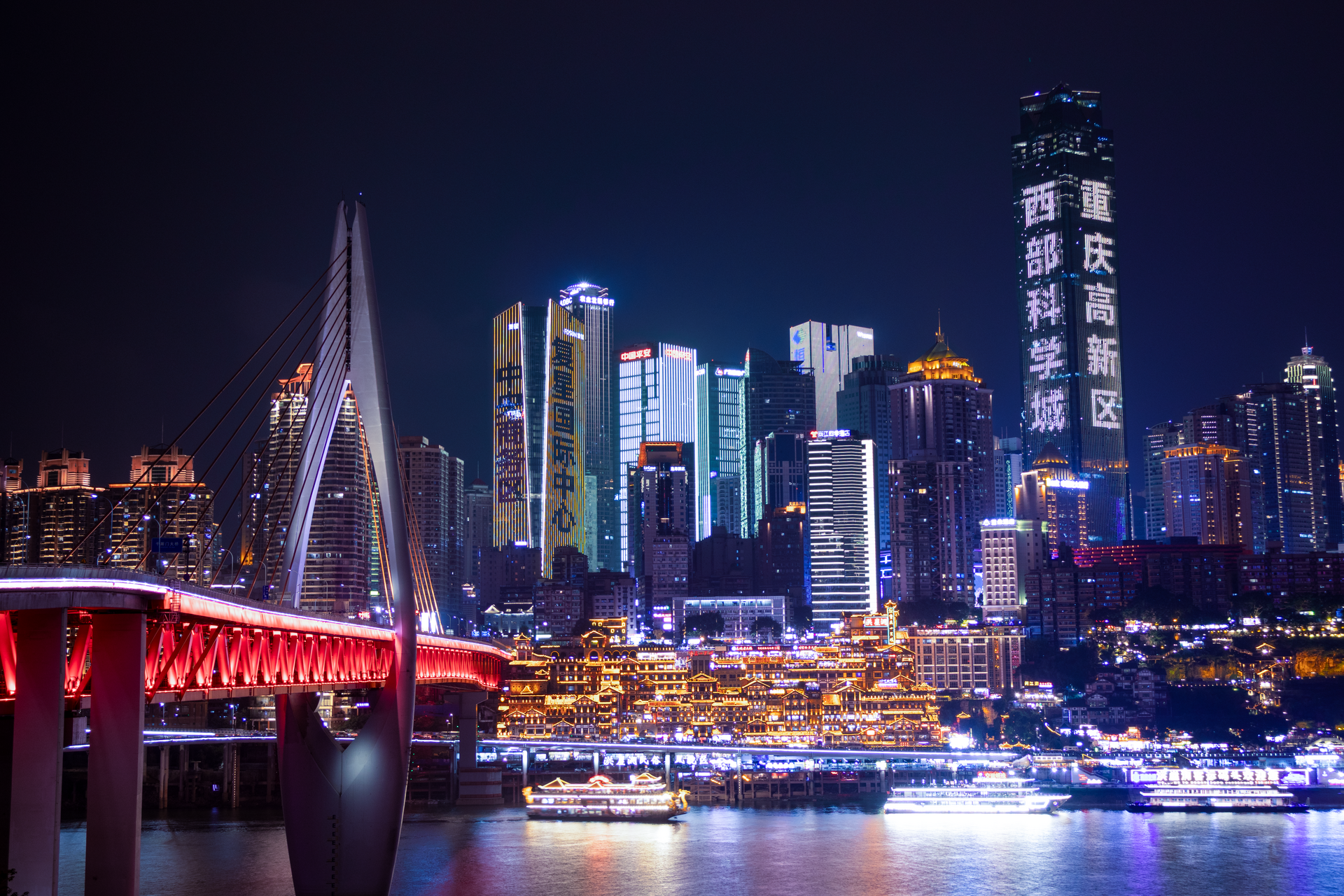
Stand in Chongqing's busiest pedestrian square and the city climbs the hillside around you in stacked layers — a wartime monument from 1947, luxury malls, the Bayi snack street and an observation deck above the clouds. The square is free.
Picture this: you come up out of the metro, surface into a square, and there it is — a tall cream-coloured stone column with a clock near the top, ringed by giant LED screens, a Louis Vuitton, an Apple Store and a crowd moving in every direction. Then you look up. Skyscrapers rise in layers up the hillside behind it, some linked by walkways in mid-air, and somewhere a doorway on the "ground floor" turns out to be the tenth storey of another street. This is what people mean when they call Chongqing the "8D city," and its centre of gravity is right here.
Jiefangbei (解放碑), the "People's Liberation Monument," is a 27.5-metre column at the centre of the pedestrian core of Yuzhong District. Its history is the interesting part: completed on 10 October 1947, it was built to commemorate China's victory in the War of Resistance against Japan — the WWII years, when Chongqing was the country's wartime capital — which makes it the only monument in China built specifically for that victory. It was renamed to its current name in September 1949.
What sets Jiefangbei apart from most historic landmarks is that it was never roped off into a quiet museum. It stands in the middle of the busiest commercial district in the city, surrounded by a 36,000-square-metre pedestrian zone — free, never closed — and it's where locals meet, where visitors start their trip, and where everyone regroups before heading off to Hongyadong, the cable car or a hotpot dinner.
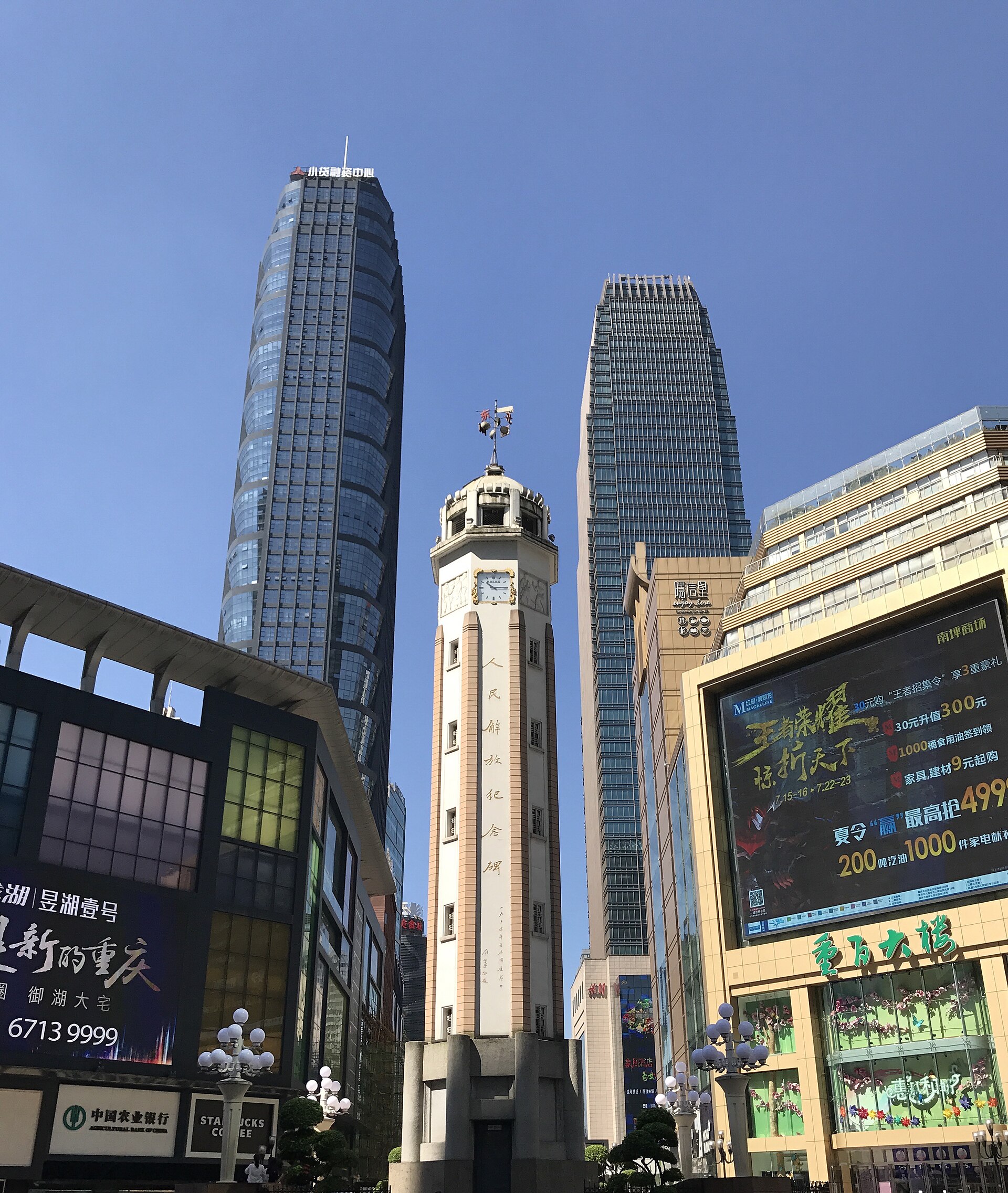
The area is compact but dense — one loop covers eating, shopping, a skyline view and a walk down to the river.
The cream-coloured octagonal column with a clock on top looks plain next to the giant LED screens around it — and that's exactly the appeal: a piece of 1947 standing still amid the luxury malls and modern screens. At night the surrounding billboards light the square up and make the best backdrop for a photo.
A narrow lane crammed with genuine Chongqing snacks — suan la fen (sour-and-spicy sweet-potato noodles), chuan chuan skewers dunked in chilli oil, xiao tangyuan (glutinous rice balls) and grilled sweet potato. Most plates run ¥10–25, Alipay and WeChat accepted everywhere, busiest in the evening. For the deeper dive, read Chongqing street food.
The World Financial Center (环球金融中心) at 188 Minzu Road has the Hui Xian Lou observation deck on floors 73–75 — billed as the highest open-air high-rise deck in China. You get a 360-degree view over the confluence of the Yangtze and Jialing rivers and the Chongqing skyline; floor 75 is fully open-air. It's best at dusk. Reckon on about ¥120 (check before you go — prices vary by platform).
The Jiefangbei pedestrian street is the first commercial walking street in western China, and the square is ringed by Louis Vuitton, an Apple Store, Times Square and Wangfujing department stores. When it rains (Chongqing gets plenty) or the humidity bites, the malls connect underground and overhead — air-conditioned, with food courts inside.
From the square the ground slopes down toward the Jialing River and lands you at Hongyadong — the 11-storey complex of stilt houses that glows gold at night like something out of an animated film. Pair Jiefangbei and Hongyadong in the same evening: snacks at Bayi first, then arrive for the Hongyadong lights at dusk. More at Hongyadong.
Chongqing was built on hills at the meeting point of two rivers, so the city isn't flat the way most cities are — it stacks vertically. The result: "floor 1" of one building can be "floor 10" of another street sitting higher up the slope. You'll walk out of a mall you thought was at ground level and find yourself on an elevated bridge above a different road. GPS handles the horizontal distance fine but rarely knows how many floors you need to go up or down.
The simplest fix: read the signs in metro stations and malls telling you which street level each exit lands on — and don't be alarmed when a lift carries you up eight floors just to "step outside at ground level." That's normal here.
Jiefangbei square is at its best and busiest from late afternoon into the evening (after 5 pm), when the whole district's lighting comes on at once and you can carry the evening straight on to the Hongyadong lights. In the middle of a hot, bright day the area has little shade and the humidity is real — duck into the malls in stretches.
A clean half-day afternoon-into-evening route: metro to Jiaochangkou → photograph the monument → eat your way along Bayi snack street → go up the WFC deck as the sky starts to darken → walk downhill to Hongyadong for the lights. It all ends in one place, on foot, no taxis needed.
Metro is the most direct option — it brings you up right into the pedestrian street.
A central Yuzhong base — step out of the hotel and you're at the monument, the food and the cable car.