Home Chongqing China Chongqing Hotels About
Home  ›  Asia  ›  China  ›  Chongqing  ›  3-Day Itinerary
🗓️ Chongqing Itinerary · 3 Days · 2026

3 Days in Chongqing —
a city stacked up a mountain

The gold lights of Hongyadong over the river on night one, a train punching clean through a 19-storey apartment block on day two, a million city lights from the top of Nanshan on the final night — three days is just enough to take in China's strangest, most vertical city.

Why 3 days

A city built vertically, not flat

Chongqing does not behave like any other Chinese city you have visited. It spreads across the ridgelines where the Yangtze and Jialing rivers meet, with towers stacked in layers so steep that a single metro exit can open onto streets several floors apart, trains run straight through residential buildings, and a cable car is still genuine public transport. Locals call it the "8D Magic City" — and once you are walking it, the nickname stops being marketing and starts being literal.

This plan is built for a first visit to Chongqing. Day one takes in central Yuzhong and the riverside lights, day two digs into the 8D city and the old town, and day three climbs the mountain for the night view and closes with hotpot. It deliberately leaves out the out-of-city day trips — the Dazu rock carvings and the Wulong karst each need a half to a full day. Every leg here runs mostly on the metro, which saves time and spares you the stop-start traffic on roads that climb and dive constantly.

Shorter trip? See the 2-day plan. More time? The 4-day plan adds a day trip out of the city.

Day One

Central Yuzhong & the riverside gold

A wartime monument in the CBD, a snack lane locals actually eat in, a stilted village glowing gold at dusk, and China's most famous river cable car — the day you fall for this city.
01
Day 1
Jiefangbei · Hongyadong · Yangtze Cableway
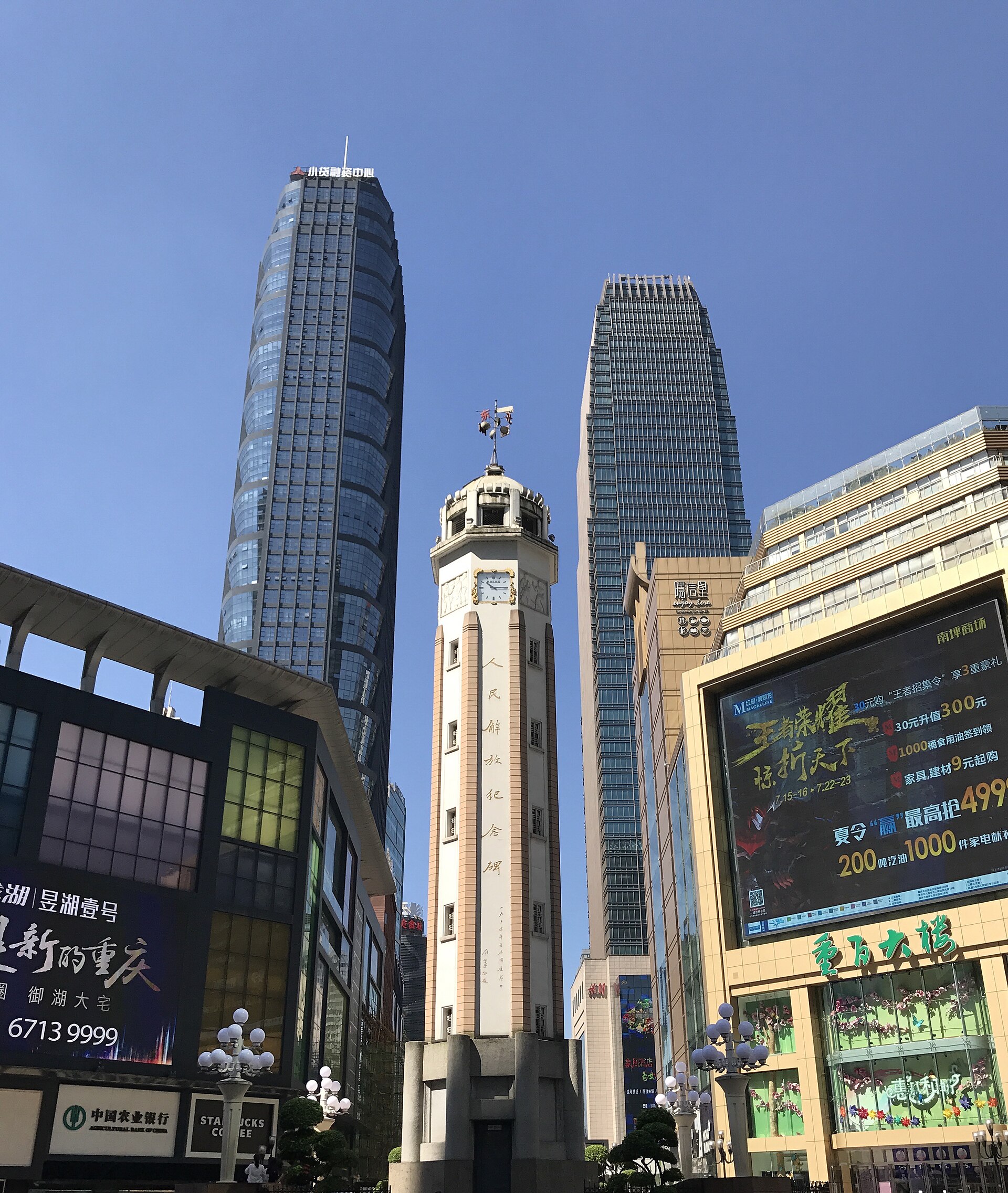
Jiefangbei Square Chongqing — the Liberation Monument column ringed by CBD skyscrapers and giant LED screens
Morning · ~3 hours
Jiefangbei (解放碑) + Bayi Snack Street (八一好吃街)

Start at Jiefangbei Square, the heart of the Yuzhong district. The wartime Liberation Monument stands in the middle of a ring of skyscrapers and giant LED screens — it is the clearest single shot of "modern Chongqing" you will find. Wander and photograph the square for a while, then head into the wider Jiefangbei district, which is both the CBD and the city's biggest shopping zone.

A few steps away is Bayi Snack Street, a narrow lane packed with Chongqing street food — xiaomian (fiery, heavily seasoned noodles), sanxian wontons, skewer hotpot, and bingbing sweets. Graze your way through it as a late breakfast or brunch, eating as you walk. Think of it as warming up your tongue before the real hotpot on day three.

Metro: Line 1 or 2 to Jiaochangkou (较场口) or Linjiangmen (临江门), 5–8 minute walk
Cost: The square and snack street are both free · Street snacks ¥8–30 each
Tip: If your hotel is in the Jiefangbei area, you barely need the metro today — everything is walkable
Afternoon · ~3 hours
Yangtze River Cableway (长江索道) + Nan'an side

In the afternoon, walk from Jiefangbei to the Yuzhong-side terminal of the Yangtze River Cableway (near Chang'an Temple, off Xinhua Road). This is China's most famous river cable car, gliding across the wide Yangtze to the Nan'an side in about four to six minutes one way, with the city skyline and the tea-coloured river spread out below you.

The Nan'an side (Longmenhao station) has the old Longmenhao district to stroll. You can ride the cableway back, or take the metro back across to Yuzhong. Key tip: buy a one-way ticket only — a round-trip ticket forces you to exit and re-join the queue on the far side, which can eat a lot of time.

Metro: Line 1 or 6 to Xiaoshizi (小什字), 5-minute walk to the Yuzhong-side terminal
Ticket: ¥30 (~$4 USD) one way · Open 08:00–22:00 (last sale 21:00) · Same-day tickets only, from 07:45
Best time: 17:00–19:00 catches both the daytime and the lit-up views in one ride · Weekday mornings are quietest
Timing tip: To dodge the longest queues, ride the cableway in the late afternoon (before 17:00), then circle back to Hongyadong once its lights come on. On public holidays the wait can run 1–2 hours. More detail in the Yangtze cableway guide.
Evening · ~2.5 hours
Hongyadong gold lights at night (洪崖洞)

Back on the Yuzhong side, walk to Hongyadong in time for the lights — around 19:00. This is the image of Chongqing everyone has seen: an 11-storey complex of stilted wooden houses (diaojiaolou) clinging to the cliff above the Jialing River. When the gold light washes over the whole facade at night, it looks uncannily like a Studio Ghibli set. Climb between the levels, browse the snack and souvenir shops, and find a spot along the balconies.

The best photo of Hongyadong is from Qiansimen Bridge (千厮门大桥), which frames the entire complex — a short walk from the building. Find dinner nearby, or save your appetite for hotpot later in the trip.
Metro: Line 1 or 6 to Xiaoshizi (小什字), exit 5 or 6, 5-minute walk
Cost: Free · Lights on roughly 18:30–22:00 (they switch off around 22:00)
Dinner: Restaurants inside Hongyadong and across the Jiefangbei area · ¥60–200 per person
Tip: Hongyadong gets very crowded after dark. To get a clean photo, claim a spot on Qiansimen Bridge about 15 minutes before the lights come on. More in the Hongyadong guide.
Day Two

The 8D City & the old town

A train that runs through a building, a city view from a hilltop park, old stone lanes by the river, and a cruise under a thousand lights — the day that explains why Chongqing looks like nowhere else in China.

02
Day 2
Liziba · Eling Park · Ciqikou · Two-Rivers Cruise
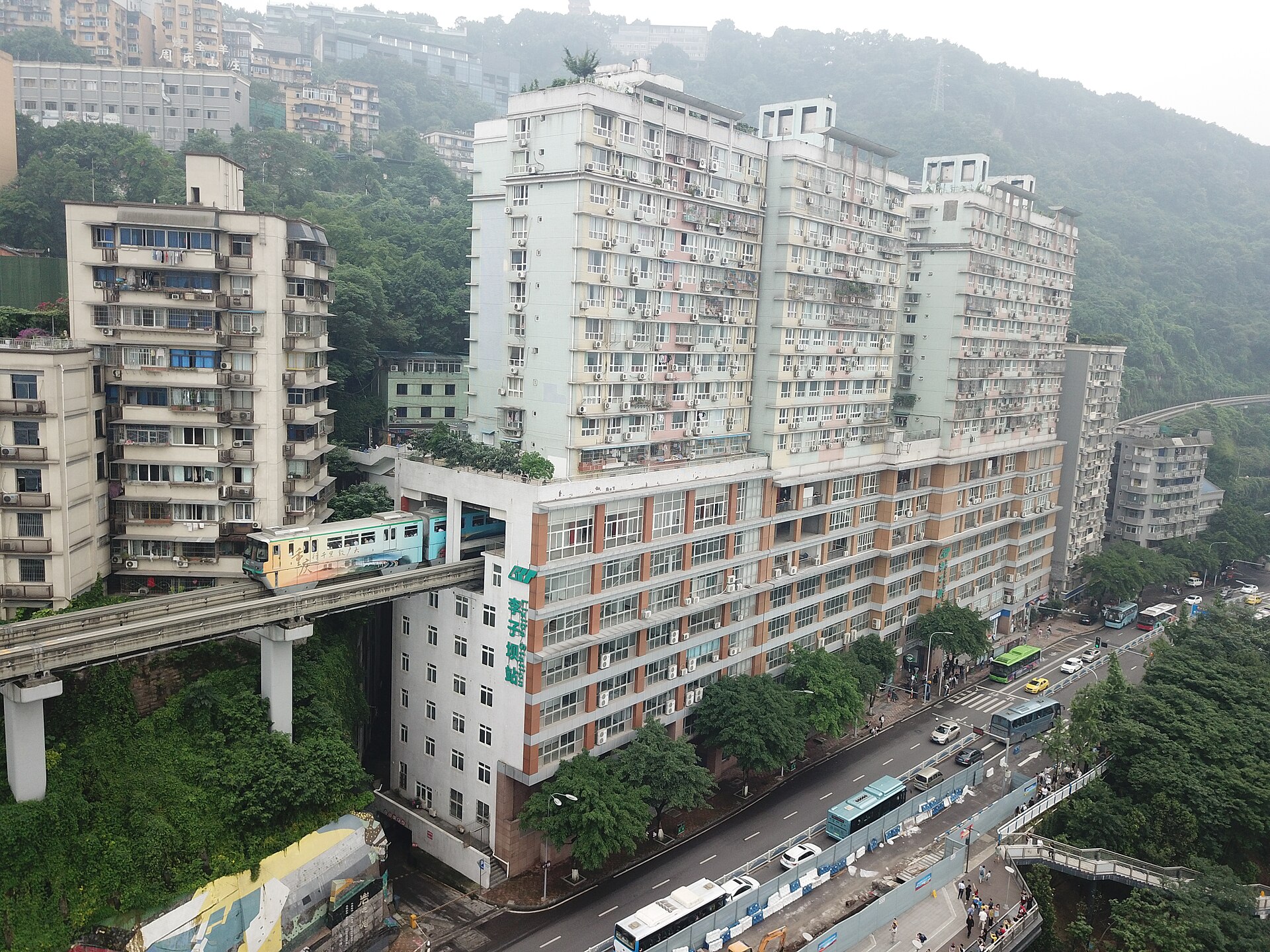
Chongqing Line 2 monorail running straight through the middle of a 19-storey residential building at Liziba station
Morning · ~2.5 hours
Liziba train-through-a-building (李子坝) + Eling Park (鹅岭公园)

Start the morning at Liziba station — a Line 2 monorail stop built between floors 6 and 8 of a 19-storey residential tower. The train really does run straight through the middle of the building, and people genuinely still live in the apartments above and below. A dedicated viewing platform sits on the opposite bank of the Jialing River so you can catch the full moment of the train entering and leaving the block.

From Liziba, a short metro ride or taxi takes you to Eling Park, a quiet hilltop park with free, uncrowded panoramic views over the city and the Yuzhong peninsula. There is also a recently opened clifftop skywalk here that gives you a fresh angle on the Line 2 train threading through the Liziba tower.

Metro (Liziba): Line 2 to Liziba (李子坝) — the station is the sight itself; the viewing platform is on the opposite bank
Metro (Eling): Line 1 to Eling (鹅岭), 15-minute walk
Cost: Both free · Liziba open 06:30–23:00 · Best photos at sunrise or sunset
Tip: The Liziba viewing platform gets busy by mid-morning — arrive before 09:00 for a clearer angle. Train timings and the best shooting spots are in the Liziba monorail guide, and the city views in the Eling Park guide.
Afternoon · ~3.5 hours
Ciqikou Ancient Town (磁器口古镇)

After lunch, take Line 1 to Ciqikou Ancient Town in the Shapingba district — an old river port on the Jialing that once thrived on the Ming-Qing porcelain trade. Stone-paved lanes, old timber houses, teahouses and traditional snack stalls — try skewer hotpot, mahua (crispy fried dough twists) and tea in one of the old teahouses. Two to three hours is comfortable for wandering.

Ciqikou is the clearest place to see "old Chongqing" as it was before the skyscraper era. Walk past the busy main lane into the smaller side alleys and you will find it much quieter and more genuine.

Metro: Line 1 to Ciqikou (磁器口), exit 1, 5-minute walk
Cost: Free to enter the town (some heritage houses/museums charge separately) · Snacks ¥10–40 each
Hours: Most shops open roughly 09:00–21:00
Tip: Ciqikou is packed on weekends — a weekday afternoon is far more walkable. Full detail in the Ciqikou Ancient Town guide.
Evening · ~2 hours
Two-rivers night cruise (两江夜游)

Head back into the centre in the evening for the two-rivers night cruise, boarding at Chaotianmen wharf (朝天门) or the Hongyadong wharf. The boat runs out to the point where the Yangtze and Jialing rivers meet, passing Hongyadong, Qiansimen Bridge and the lit-up skylines on both banks — it is a beautiful way to see the "8D city" from water level. The ride takes about 45–60 minutes.

If you would rather not cruise, the free alternative is to watch the lights from the Chaotianmen riverfront or from Qiansimen Bridge — almost as good. Choose based on your budget and how much energy you have left that night.

Metro: Line 1 or 6 to Xiaoshizi (小什字), walk to the Chaotianmen / Hongyadong wharf
Cruise ticket: ¥138–198 (~$19–28 USD) · Departures roughly 19:00–22:00 (about 45–60 min each) · Book ahead
Dinner: Restaurants around Chaotianmen / Jiefangbei before or after the cruise · ¥80–250 per person
Day Three

A mountaintop night view & your own pace

A million lights from a hilltop, the old stone stairs that kept a piece of old Chongqing, the real hotpot, and a café in a restored factory — the day you set your own pace.

03
Day 3
Shibati · Eling Er Chang · Hotpot · Nanshan Night View
Chongqing skyline at night along the Yangtze River, lit skyscrapers reflected on the water, seen from the opposite bank
Morning · ~3 hours
Shibati old stairs (十八梯) + Shancheng Alley (山城巷)

Begin the final day at Shibati (the Eighteen Stairs) — an old stone staircase district that once linked the hilltop town to the river wharves. Fully reopened across all five zones in 2024, it blends restored timber houses with shops, cafés and old-style teahouses. Walk up and down the steps and collect the kind of old-town views that get rarer by the year in this fast-changing city.

Right beside it is Shancheng Alley (the Mountain City Lane), a clifftop walkway looking out over the Yangtze and the old stilted houses. You can carry straight on from Shibati — it is a morning of seeing "stacked Chongqing" on foot.

Metro: Line 1 or 2 to Jiaochangkou (较场口), walk south ~5 minutes
Cost: Shibati and Shancheng Alley are free to enter · Coffee/snacks ¥20–60
Walking time: Shibati + Shancheng Alley together ~2–3 hours
Afternoon · ~3.5 hours
Chongqing hotpot + Eling Er Chang factory café (鹅岭二厂)

Lunch today has to be real Chongqing hotpot — a deep red broth built on beef tallow, dried chillies and numbing Sichuan peppercorns (huajiao) that leave your lips buzzing, with beef, offal, vegetables and tofu dipped into the bubbling pot. This is the city that invented this style of hotpot. Ask for a split yuanyang pot (half spicy, half mild) if the heat worries you — how to order and where to go is in the Chongqing hotpot guide, or for bolder, more local flavours see jianghu cuisine.

In the later afternoon, stop by Eling Er Chang (the No. 2 Factory at Eling), a 1937 printing works on the Yuzhong peninsula reborn as a creative quarter — red-brick walls, exposed steel frames, street art, indie design shops and rooftop cafés with a view over the city. It is an easy place to sit with a coffee and rest your legs. More picks in the Chongqing café guide.

Metro (Eling Er Chang): Line 1 to Eling (鹅岭), 10–15 minute walk
Hotpot: ¥80–200 per person · Eling Er Chang is free to enter · Coffee ¥30–55 per cup
Want more? If you are extending to four days, this afternoon can instead be the start of an out-of-city day trip (Dazu rock carvings or Wulong karst) — see the day trips from Chongqing guide.
Evening · ~3 hours
Nanshan Yikeshu night view (南山一棵树)

Close the trip with the image that will stay with you longest — head up to the Yikeshu (One Tree) observation deck on Nanshan mountain, on the Nan'an side, at roughly 437 metres elevation. It gives you a 270-degree panorama over the Yuzhong peninsula, and as night falls the whole city lights up at once, the two rivers reflecting the glow like a carpet of light. This is why Chongqing is regularly called one of the best night views in China.

Have dinner on the Nan'an or Nanbin side before or after the climb. Nanbin Road (南滨路) along the river is lined with restaurants that look straight across at the skyline — a fitting way to end the trip with the city's atmosphere right in front of you.

Getting there: Metro Line 6 to Shangxin Street (上新街), exit D, then the Nanshan shuttle ¥15 (~20 min) · or taxi/DiDi from the centre ~¥40
Ticket: ¥30 (~$4 USD) · Open 09:00–22:30 (last entry 22:00) · Arrive at dusk for both the daytime and lit-up views
Airport (next day): CKG Jiangbei → Metro Line 3 or 10 ~50–70 min (¥5–10) · taxi/DiDi ~40–50 min (¥60–90) · check whether you fly from T2 or T3
Tip: Arrive about 30–45 minutes before sunset to watch the city shift from daylight to night lights — far better than turning up after dark. If it is heavily foggy (common in winter) the view may not be clear, so check the forecast before you go.
✈️
Want more time?
See the 4-day plan — add a day trip to the Dazu rock carvings or the Wulong karst
See the 4-day plan →
Practical info

Where to stay · getting around · budget

🏨
Where to stay

For this trip, base yourself in Jiefangbei / Yuzhong — central, walkable to Hongyadong and the Bayi snack street, with the metro reaching everywhere in three days. Alternatives are Jiangbei / Guanyinqiao (shopping, airport side) and Nanbin (across-river skyline views). See the Top 10 Chongqing hotels or the 6 luxury picks.

🚇
Getting around

Use the metro as your backbone — about 13 lines including the elevated monorail Lines 2 and 3, ¥2–12 per trip, paid by scanning a QR code in Alipay or WeChat Pay at the gate. Because the city is on mountainsides, exits can be several floors apart — check the exit number, and use Amap or Apple Maps rather than Google Maps. See the high-speed rail guide if you are continuing to another city.

💳
Payments

Link a Visa or Mastercard to Alipay (via its international mode) before you travel. Most shops in Chongqing accept only Alipay or WeChat Pay, and some take no cash at all — see the Alipay & WeChat Pay guide and the internet, VPN & eSIM guide to set up before you go.

Budget

Approximate cost per day, per person

Item Budget Mid-range Comfort
Hotel (per night) ¥90–180
(~$13–25)
¥250–500
(~$35–70)
¥600–1,200+
(~$85–170+)
3 meals (incl. hotpot) ¥70–120
(~$10–17)
¥150–280
(~$21–39)
¥300–550
(~$42–77)
Metro + transport ¥15–25
(~$2–3.50)
¥20–40
(~$3–5.50)
¥40–90
(~$5.50–13)
Entry tickets ¥0–30
(most sights free)
¥60–230
(cableway + Nanshan + cruise)
¥230–400
(add tours / premium)
Daily total (approx.) ¥175–355
(~$25–50)
¥480–1,050
(~$68–148)
¥1,170–2,240+
(~$165–315+)

Indicative rates at roughly ¥7 ≈ $1 USD · prices are approximate and vary by season — check before you go.

Frequently asked

FAQ · 3-day Chongqing plan

Is 3 days enough for Chongqing?
Three days comfortably covers all the in-city highlights: Jiefangbei, Hongyadong, the Yangtze cableway, the Liziba train-through-a-building, Eling Park, Ciqikou old town, a two-rivers night cruise and the Nanshan night view. What you have to skip is an out-of-city day trip such as the Dazu rock carvings or the Wulong karst. If you want those, extend to four or five days — see the 4-day plan.
What is the best time of year to visit Chongqing?
March to May (spring) and September to November (autumn) offer the best walking weather, with autumn clearer and cooler — ideal for a city full of stairs and slopes. Summer (June to August) is brutally hot and humid, often hitting 38–40 degrees Celsius, as Chongqing is one of China's "Three Furnaces". Winter (December to February) is cool and often grey or foggy — Chongqing is nicknamed the "Fog City" — though Hongyadong's lights still shine. Avoid Golden Week (1–7 October) and Chinese New Year, when crowds peak. See the best time to visit China guide.
How do you get around Chongqing — and why check the exit?
Chongqing Rail Transit has around 13 lines, including the famous elevated monorail Lines 2 and 3. Fares are ¥2–12 and you pay by scanning a QR code in Alipay or WeChat Pay at the gate. Because Chongqing is an "8D city" built on mountainsides, stations sit on cliffs or mid-tower and the exits can be several floors apart — some are very deep, with long escalators and lifts. The level where the train stops is often not the street you expect, so check your exit number before you ride. Use Amap or Apple Maps rather than Google Maps.
What is a realistic budget for 3 days in Chongqing?
A mid-range budget runs roughly ¥500–1,000 per person per day, covering a 3–4 star hotel (¥250–500 per night), three meals including hotpot (¥120–250), metro fares (¥15–35) and entry tickets (¥60–200). Most of the headline sights — Hongyadong, Eling Park, Ciqikou — are free; you only pay for the cableway (¥30), the Nanshan viewpoint (¥30) and the night cruise (¥138–198) if you choose it. Budget travellers staying in hostels and eating at local spots can get by on ¥300–400 per day.
Which neighbourhood should a first-time visitor stay in?
Jiefangbei / Yuzhong (the central CBD) is the most practical base for a first trip — you can walk to Hongyadong and the Bayi snack street, and the metro reaches everywhere else. Alternatives are Jiangbei / Guanyinqiao (shopping, on the airport side) and Nanbin / Nan'an (across-river skyline views and riverside dining). The metro stitches every area together in 15–30 minutes. See the Top 10 Chongqing hotels for picks in each area.
Do I need a VPN in Chongqing?
Yes, if you want to use Google Maps, Instagram, WhatsApp, Facebook or Gmail. Download and activate your VPN before you leave home — most VPN websites are themselves blocked inside China. Apps that work without a VPN include Alipay (payments), WeChat, DiDi (taxis) and Amap or Baidu Maps. In a city this vertical, with complex multi-level exits, a maps app that works inside China is genuinely useful — see the internet, VPN & eSIM in China guide.