Hongyadong glowing gold after dark, a cable car drifting across the Yangtze, a train slicing clean through a 19-storey tower, an old riverside town that smells of tea — forty-eight hours is exactly enough to feel the best of this vertical city.
Chongqing is not like any other Chinese city. It is built over mountains, stacked in layers, and the metro exit you climb up from may not be the street you expected — locals call it the "8D city" for a reason. Two days is enough for the Chongqing people talk about — Hongyadong after dark, the Yangtze cable car, the Liziba train-through-a-building, the skyline from Eling Park and the old town of Ciqikou — as long as you get the rhythm right and don't get lost in the city's maze of levels.
This plan is built for a weekend visitor — a short Saturday-to-Sunday break, or anyone testing the water before committing more time. Day 1 stays on the Yuzhong peninsula in the city centre, where almost everything is walkable. Day 2 heads out to the 8D city and the old town, which take a little more metro. Every stop runs on the metro. What this plan deliberately excludes is the out-of-city day trips to Dazu or Wulong (each needs a full day). If you want those, see the 3-day itinerary, or start with the 1-day plan if you have less time.
The single most useful thing to do before you arrive: book a hotel in Jiefangbei — you can walk to Hongyadong and Bayi snack street, and Lines 1 and 2 reach every stop on this itinerary. See the top-10 Chongqing hotels for options at every budget.
The city-centre square and Bayi snack street in the morning · a cable car across the river in the afternoon · the Chaotianmen confluence · a hotpot dinner · then back for the best lights in the city after dark
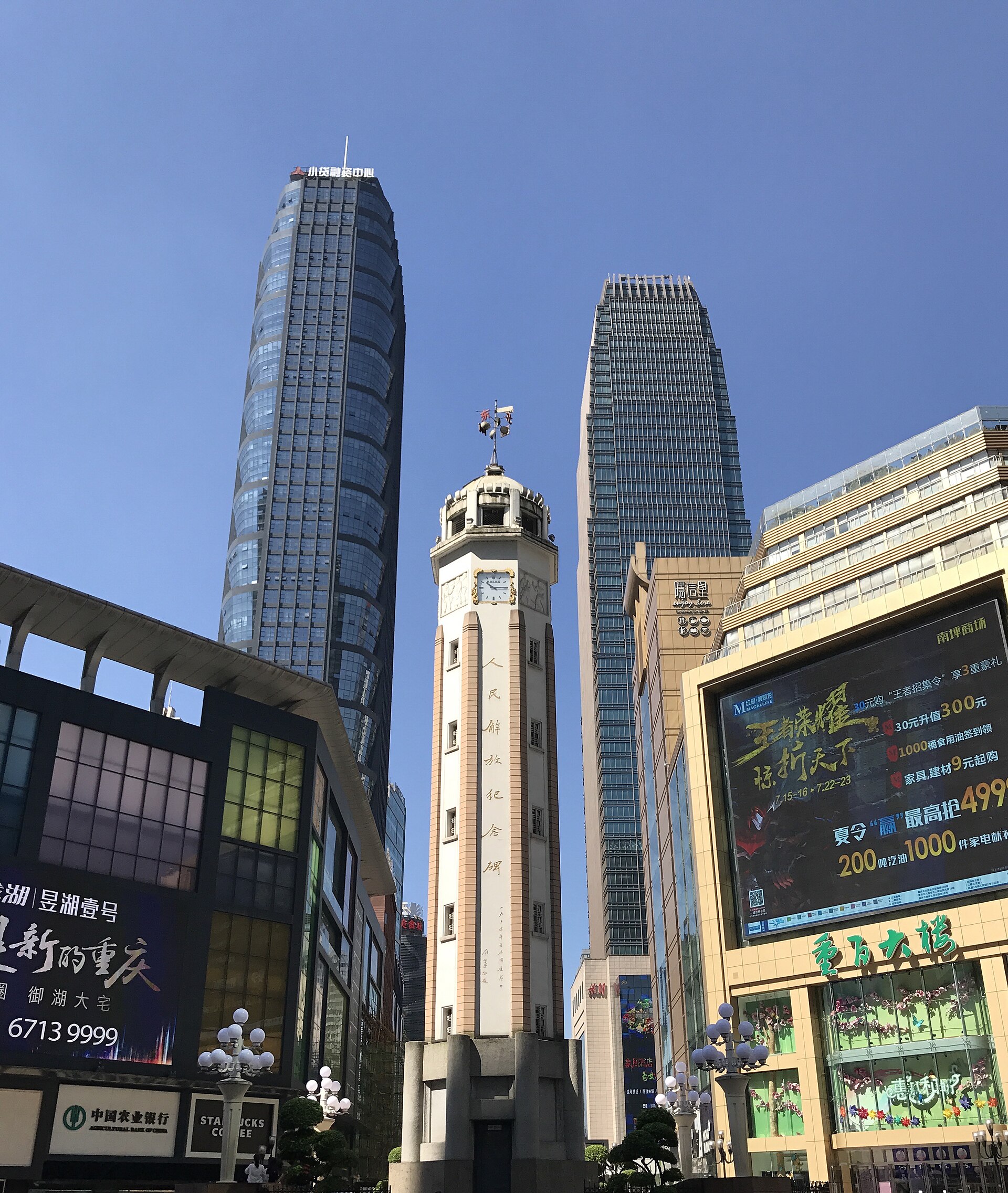
Start at the heart of Chongqing — Jiefangbei, the 1947 Liberation Monument that has become the busiest commercial hub in the city. Skyscrapers ring the square, screens flash overhead, department stores spill in every direction; stand here and you understand that Chongqing really is a megacity of more than thirty million. Explore the district, then duck into Bayi snack street (八一好吃街) nearby — a Chongqing street-food paradise of xiaomian (fiery noodles), spicy soup dumplings, grilled squid and countless small bites.
From Jiefangbei it is a 10-minute walk to Hongyadong (洪崖洞) — a cluster of traditional stilt houses in the diaojiaolou style, eleven storeys clinging to the cliff above the Jialing River. Come by day to explore the levels, take in the timber architecture and scout your photo angles — because you will be back tonight when the lights are on.
After lunch, head for the Yangtze River Cableway (长江索道) — the boarding station is near Xinhua Road, by Chang'an Temple. The cable car floats across the Yangtze from the Yuzhong side to the Nan'an side in about four to five minutes, with both riverbanks and the skyline spread out beneath you. This used to be a genuine commuter route for locals before it became a visitor highlight.
Cross back to Yuzhong and continue to Chaotianmen (朝天门) — the very tip of the peninsula, where the brown Yangtze and the green Jialing meet. Above it rises Raffles City, the sail-shaped twin towers topped by the Crystal "horizontal skyscraper" sky-bridge. Go up to the viewing deck on the bridge to see the confluence of the two rivers from above (deck ticket about ¥98).
Your first night in Chongqing has to be hotpot (火锅) — this is the birthplace of beef-tallow, chilli-and-Sichuan-pepper hotpot, the kind of numbing heat you do not forget. Order a divided pot (鸳鸯锅), half spicy and half clear broth, if you are not ready to go all in. Famous spots cluster around Jiefangbei; pick one where the locals are queuing. See the Chongqing hotpot guide for recommendations and how to order.
Once you are full, come back to Hongyadong for the 6.30–8.30 pm window — this is the reason people fly to Chongqing. The amber lights climb the eleven storeys of stilt houses tier by tier, reflecting off the Jialing River; people say it looks like a scene from Spirited Away. The best vantage points are from Qiansimen Bridge (千厮门大桥) or the opposite riverbank — the night view is a completely different experience from the daytime one, and it would be a real shame to come and not stay for it.
A train through a 19-storey tower in the morning · a skyline view from a hilltop park · a Ming-Qing old town by the river, snacks and teahouses · an optional Two-Rivers cruise to finish
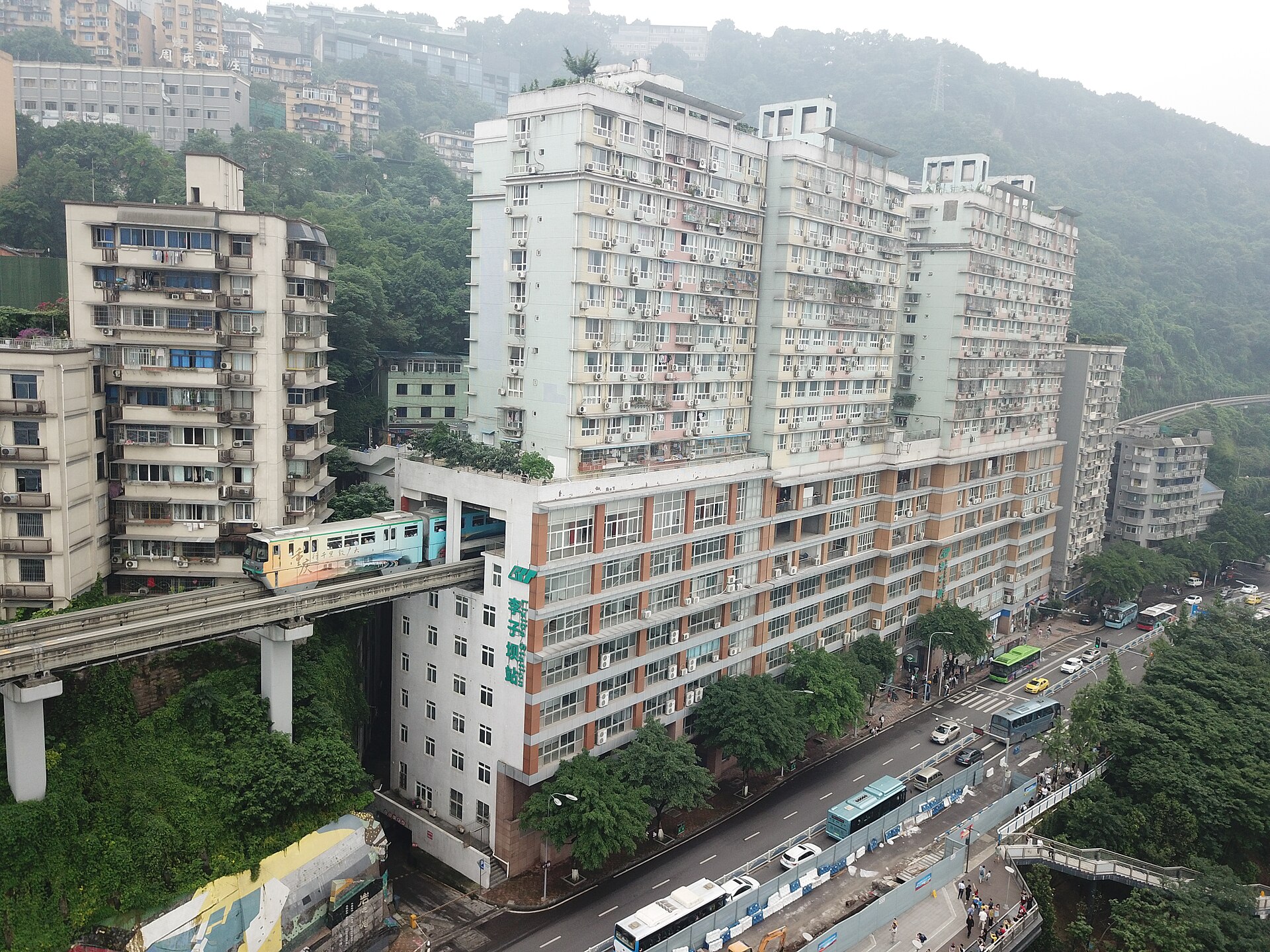
Begin Day 2 with the emblem of the 8D city — Liziba Station on Monorail Line 2 sits on the 6th to 8th floors of a 19-storey residential building, and the train runs straight through the middle of the tower. The remarkable part: the building and the station were designed and built together as a single structure from the start — the line was not retrofitted through an existing block. There is a dedicated viewing platform below where you can stand and photograph the train sliding into the building, which it does every few minutes.
For an angle with fewer people, leave by Exit 2 and walk about 200 metres down the road — you can catch the train curving into the tower with the river behind it. The morning light between 9 and 11 am is the best.
From Liziba, head up to Eling Park on the ridge in the middle of the Yuzhong peninsula — an old garden whose Kansheng Tower (瞰胜楼) is a viewpoint that takes in both the Yangtze and the Jialing wrapping around the peninsula, with the skyline stretching away. It is a rare full panorama of Chongqing from a single spot. The park is free; the tower charges a small fee to climb. Grab lunch around here before moving on.
The afternoon heads to Ciqikou (磁器口) — a thousand-year-old town on the Jialing River, with Ming- and Qing-dynasty houses and stone lanes sloping down to the wharf. Locals call it "Little Chongqing." Walk the narrow alleys fragrant with old-fashioned snacks — máhuā (fried dough twists), tofu flower, spun sugar — then stop at an old teahouse for a cup of tea and a snatch of Sichuan opera. The pace slows right down from the rush of the big city.
Finish the trip with a choice. If you want to see the whole of Chongqing lit up from the water: the Two-Rivers Night Cruise (两江游) leaves from Chaotianmen Pier and sails along both the Yangtze and the Jialing, passing Hongyadong, Qiansimen Bridge and the full illuminated skyline. The 7.30–10 pm departures give the best views. A standard 45-minute cruise is about ¥158 (~฿790); book ahead on Klook.
If you have walked enough today and want to rest your legs, head back to Jiefangbei for one last Chongqing meal: grilled fish (烤鱼), a final bowl of xiaomian, or làzijī chicken fried with dried chillies. See the Chongqing food guide, or if you never got your fill of noodles, the xiaomian guide for the best spots.
The Jiefangbei area is the most practical base for this itinerary — you can walk to Hongyadong and Bayi snack street, and Lines 1 and 2 reach everything. It has rooms at every level, from hostels at ¥80–150 to five-star towers like Niccolo; three- and four-star hotels run ¥250–450 per night. See the top-10 hotels, or if you want luxury, the 6 best luxury hotels in Chongqing.
The metro covers every stop on this plan — Line 1 (Ciqikou / Xiaoshizi) and Line 2 (the Liziba monorail / Eling) are the workhorses. Fares are ¥2–12 per trip; pay by scanning Alipay or WeChat Pay QR. Chongqing is a mountain city, so a station exit may be on a different level from the street you expect — check the exit signs. Use Amap rather than Google Maps. See the Chongqing day trips guide for beyond the city.
Set up Alipay (the international version, linked to a Visa/Mastercard) before you travel. Most shops and street-food stalls take only Alipay or WeChat Pay, and some no longer accept cash. See the Alipay & WeChat Pay setup guide.
| Item | Budget | Mid-range | Comfort |
|---|---|---|---|
| Hotel (1 night) | ¥80–150 (~฿400–750) |
¥250–450 (~฿1,250–2,250) |
¥600–1,500+ (~฿3,000–7,500+) |
| 3 meals/day | ¥60–100 (~฿300–500) |
¥120–250 (~฿600–1,250) |
¥300–600 (~฿1,500–3,000) |
| Metro for 2 days | ¥20–30 | ¥25–40 | ¥50–100 (+ the odd taxi) |
| Activities (2 days total) | ¥30 (Yangtze Cableway ¥30) |
¥190–290 (+ cruise ¥158 / Raffles ¥98) |
¥290–400 (+ premium cruise ¥198) |
| Total for 2 days (approx.) | ¥390–610 (~฿1,950–3,050) |
¥845–1,470 (~฿4,225–7,350) |
¥2,090–4,700+ (~฿10,450–23,500+) |
Exchange rate used: ¥1 ≈ ฿5 · prices are approximate and shift with the season · hotel cost is for 1 night · most of Chongqing's headline sights are free