A Ming-dynasty tower stands at the dead centre of the walled city, with the Drum Tower just beyond it and a maze of halal food lanes that stay busy until midnight. This is the base you walk home to — on Metro Line 2, inside the old city wall.
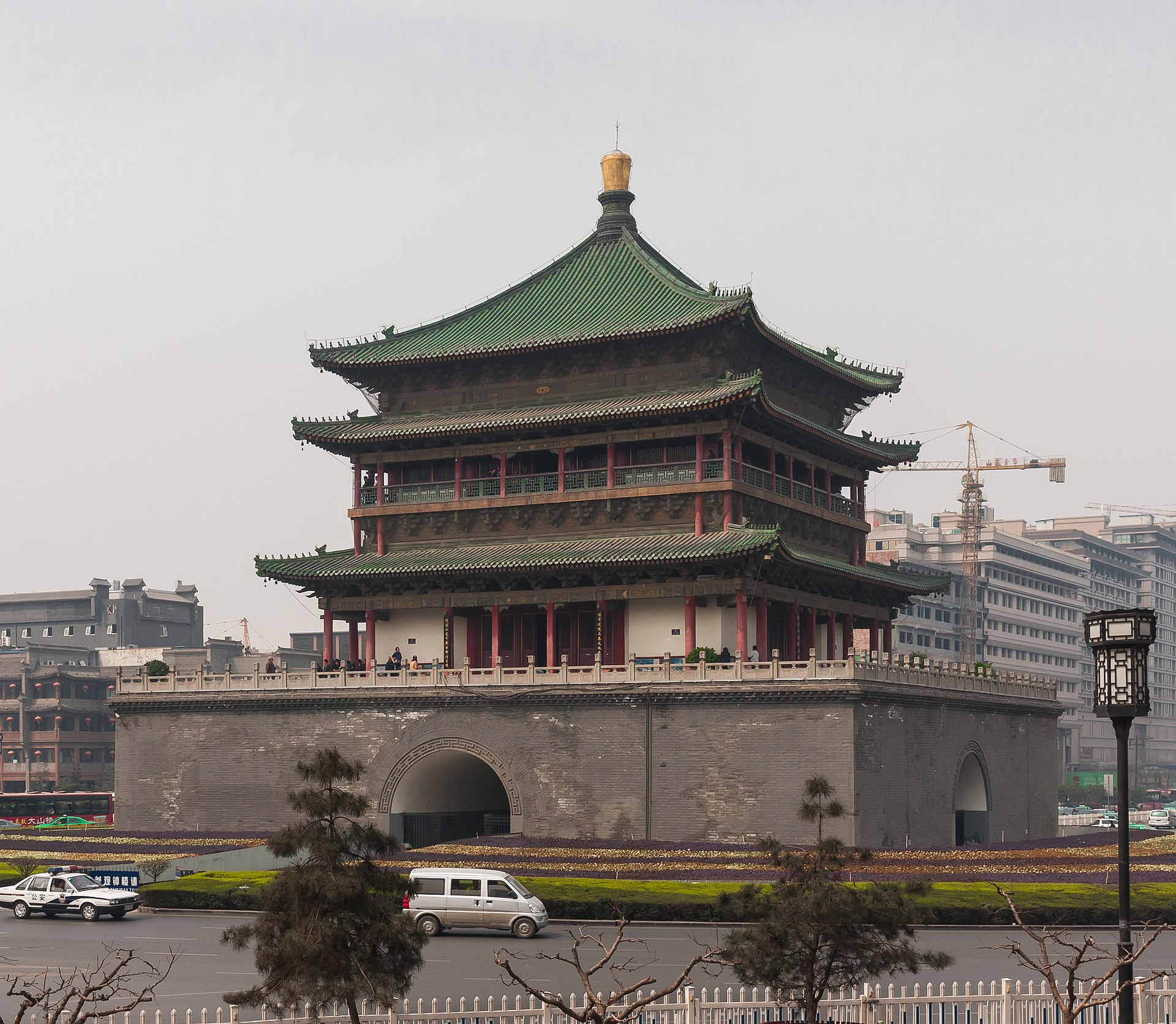
Picture a red-and-gold Ming-dynasty timber tower standing in the middle of a traffic roundabout, with the city's four main streets radiating out from it in the cardinal directions. That is the Bell Tower (钟楼) — and it is not merely "near the centre". It is the literal geographic centre of Xi'an's walled old city, the point the entire street grid was laid out from. Stand here and you are, quite precisely, in the middle of everything.
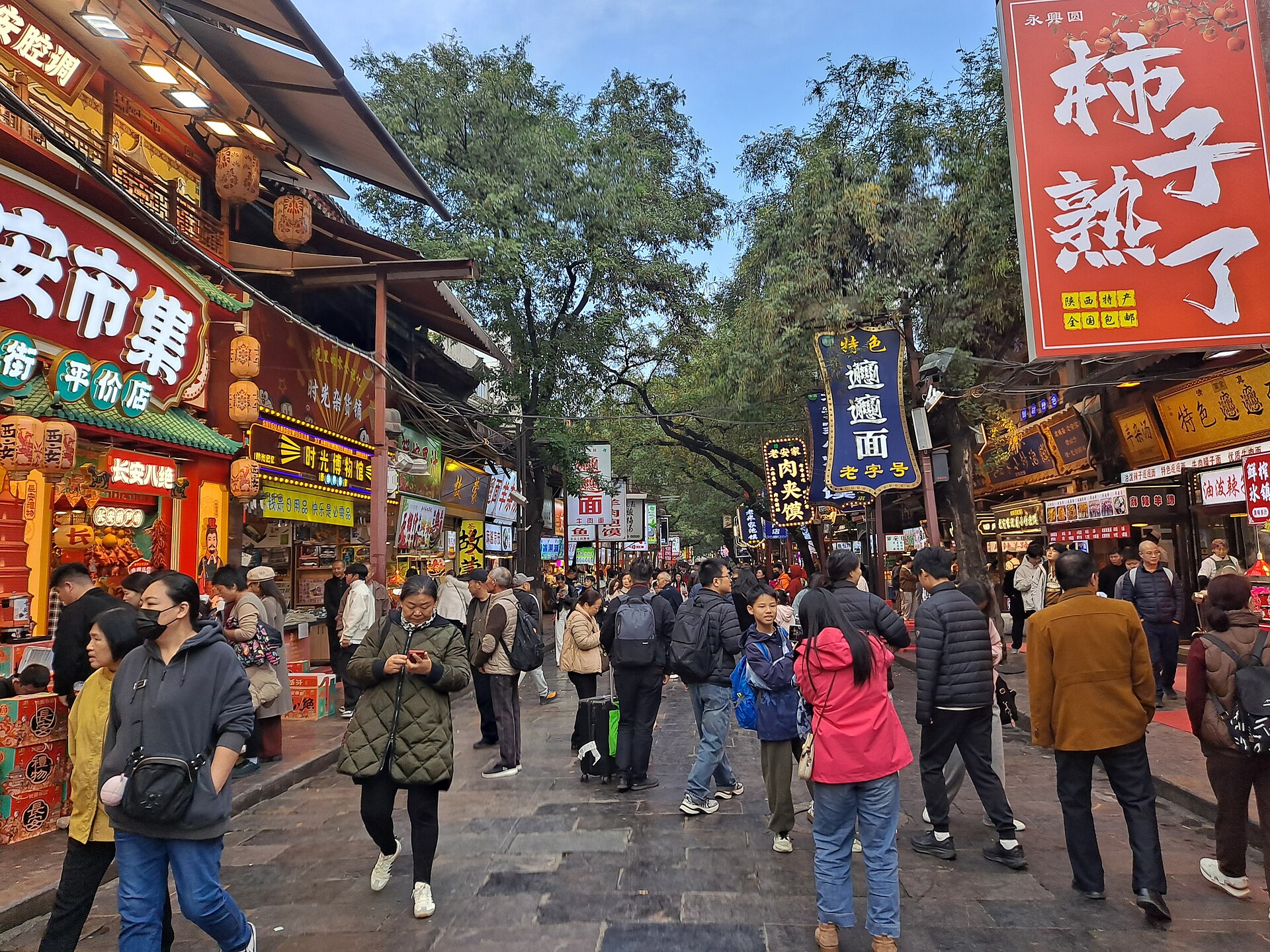
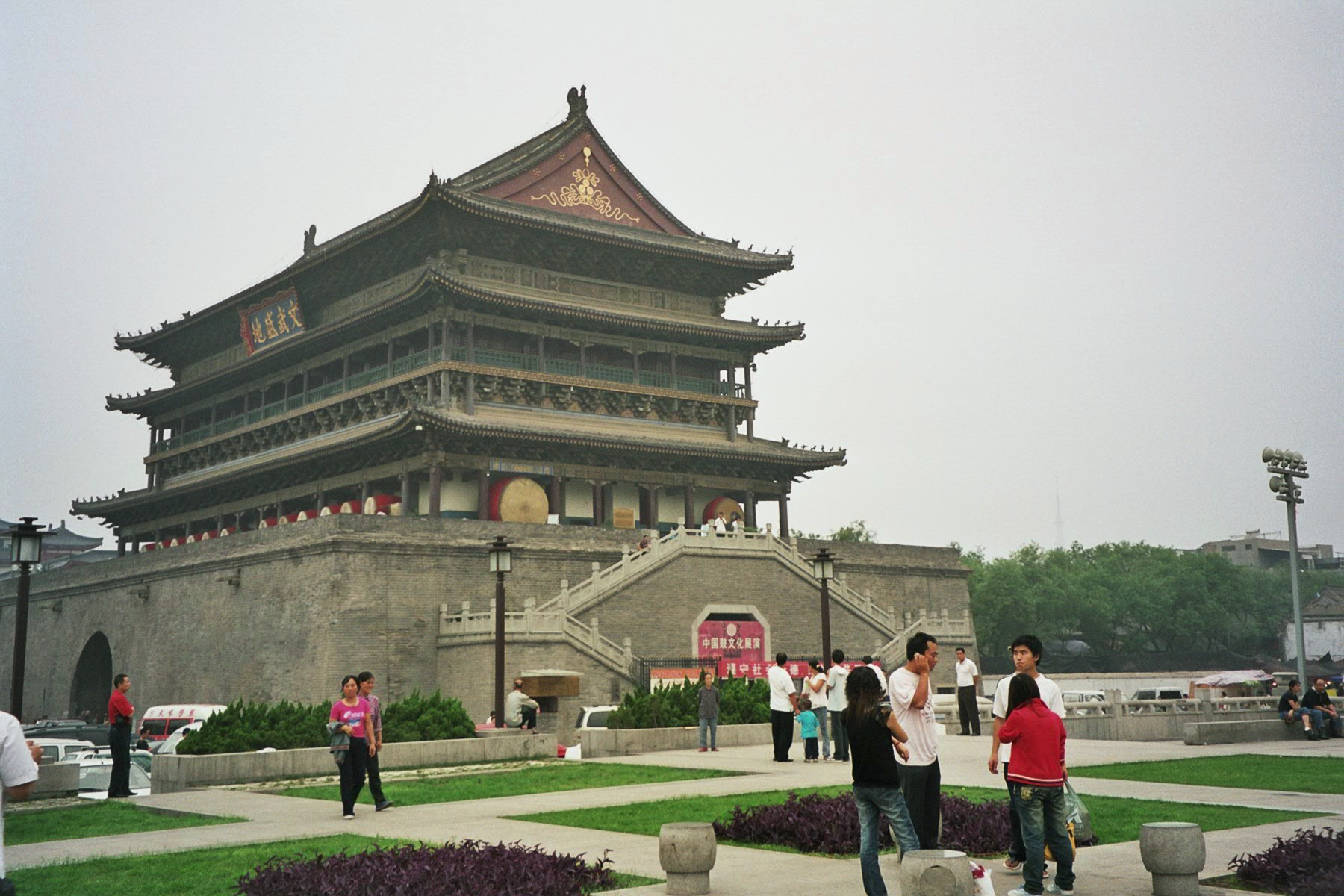
About 200 metres to the northwest stands the Drum Tower (鼓楼), its twin — once used to beat the close of day, as the Bell Tower rang in the dawn. And just north of the Drum Tower begins the Muslim Quarter (回民街, Huimin Jie), a network of food lanes where the Hui community has lived and cooked for many centuries. Deeper inside the lanes, hidden behind the souvenir shops, is the Great Mosque (大清真寺) — a mosque built entirely in the Chinese architectural tradition, with pavilions and gardens in place of domes and minarets.
Here is the thing that surprises first-time visitors: the map suggests you will be hopping between taxis, but in reality everything is on foot. The Bell Tower, Drum Tower, Muslim Quarter, Great Mosque and the old city wall are all within an easy walking radius. That is exactly why, if you are coming to Xi'an for the first time, we would point you to this neighbourhood before any other.
To be straight with you: this is not a quiet neighbourhood. The daytime is crowded and the food lanes get loud in the evening. But that energy is the appeal — and the fact that you can walk to everything more than makes up for it.
What makes this area work is that everything sits inside a single walkable radius. A few steps from the Bell Tower brings you to the Drum Tower; turn into the lane behind it and you are in the Muslim Quarter, surrounded by food stalls; walk a little deeper and you reach the Great Mosque, so calm it is hard to believe it sits just metres from the busiest lane in the city. This is the neighbourhood where simply deciding to "go for a walk" shows you almost every side of Xi'an.
The Bell Tower in its roundabout and the Drum Tower beyond it are the postcard image many people carry of Xi'an. Mornings are best — good light, fewer people, and a clear view of the old city rooftops from the upper gallery. At night both towers are floodlit in gold, and you can frame the shot from the edge of the roundabout or from one of the upper-floor cafés around it.
The Muslim Quarter is the obvious draw for anyone who travels to eat. All the food is halal, the meat mostly lamb and beef. The things to try are roujiamo (the Chinese braised-meat 'burger'), yangrou paomo (mutton soup over torn flatbread), grilled lamb skewers, wide biangbiang noodles, and fried persimmon cakes. Late afternoon into the evening is when the lanes truly come alive.
The Great Mosque (大清真寺) is one of the oldest mosques in China, but it looks like nowhere else — it is built entirely in the Chinese architectural tradition, with halls, gardens and a pavilion in place of domes and a minaret. Stepping in from the crowded lane to the quiet of the gardens is like crossing into a different world, and it is the best place in the city to understand the story of Xi'an's Hui community.
If you are in Xi'an for two or three days and would rather not waste time in taxis, this is the answer. From here you can walk to the Bell Tower, Drum Tower, Muslim Quarter, Great Mosque and the south gate of the city wall. Bell Tower station on Metro Line 2 gets you to the airport or the high-speed rail station in a few connections. It is ideal for travellers who want a hotel they can keep walking back to whenever they tire.
A Ming-dynasty timber tower built in 1384, standing at the centre of the roundabout that marks the heart of the old city. Climb to the upper gallery for a view down all four main streets and across the old-city rooftops; inside there is an old bell and an exhibition on the tower's history. Access is via the underground pedestrian passage from the metro — you cannot cross the roundabout traffic above. A combined Bell Tower + Drum Tower ticket is around ¥50 (~฿250). Open approximately 08:30–20:30 in summer, shorter in winter.
Full details at the Bell & Drum Tower complete guide.
The Bell Tower's twin, about 200 metres to the northwest. In imperial times it beat the drum to mark the close of day, just as the Bell Tower rang in the morning. Inside today there are Tang-dynasty-style drum performances at set times, each lasting around 10–15 minutes, and a collection of antique drums on display. The key thing to know: the entrance to the Muslim Quarter is directly behind the Drum Tower, so most people visit the tower and then walk straight on into the food lanes.
Not a single street, as many people assume, but a network of several lanes — Beiyuanmen (北院门), the main tourist spine; Bei Guangji Street (北广济街), quieter and more residential; Xiyangshi (西羊市), with its older established shops; and Dapiyuan (大皮院), where the food is densest and most varied. All of it is halal. The lanes are at their liveliest from late afternoon into the evening. Full detail at the Muslim Quarter street-food guide.
One of the oldest and largest mosques in China, tucked away on Huajue Lane (化觉巷) deep off Beiyuanmen. Its remarkable feature is that it is built entirely in the Chinese architectural style — pavilions, courtyards, ornamental gateways and a tower in place of the dome and minaret you would expect. Admission is around ¥25 (~฿125), open approximately 08:00–19:00. Non-Muslim visitors are welcome (the prayer halls themselves may be restricted). Dress modestly, with shoulders and knees covered.
Full details at the Great Mosque complete guide.
Beyond the food, the lanes of the Muslim Quarter are full of souvenir shops — traditional sweets, candied nuts, dried persimmons, spices, local handicrafts, and shops selling brassware and trinkets. Prices are negotiable in the souvenir stalls, though most food vendors post clear prices. Around the Bell Tower and Drum Tower you will also find modern malls and convenience stores for water and everyday essentials.
From the Bell Tower area, a short walk south along South Street brings you to Yongningmen (永宁门), the south gate and the most popular point to climb onto the wall. Xi'an's city wall is the most complete ancient city wall in China — you can walk it or rent a bicycle to ride a circuit. Late afternoon brings good light and cooler air than the middle of the day, and it pairs easily with the Bell Tower area in a single day.
This is a neighbourhood you can eat your way through all day without leaving — starting with snacks in the lanes and ending with coffee from an upper floor watching the Bell Tower light up.
If you only have room for a few things, start with these three: roujiamo (肉夹馍), spiced braised meat chopped and stuffed into a crisp baked flatbread; yangrou paomo (羊肉泡馍), mutton soup that you tear the flatbread into yourself — Xi'an's most famous dish; and grilled lamb skewers, cooked fresh in the lanes with a smell that follows you the whole way. Snacks in the lanes start at around ¥10–30 (~฿50–150) each; a proper filling meal is roughly ¥40–80 (~฿200–400) per person.
Read the deep dives: roujiamo · yangrou paomo · the complete Xi'an food guide.
Beyond the meat, the quarter is the place to try biangbiang noodles — thick, wide, hand-pulled noodles tossed with dried chilli, garlic and spring onion, a big and satisfying plate. For something sweet, look for fried persimmon cakes (黄桂柿子饼), persimmon-dough cakes fried with a sweet filling scented with osmanthus, and the freshly pressed pomegranate juice sold from stalls all down the lanes. Eating as you walk is the best way to experience this place.
Read more: biangbiang noodles · Xi'an dumplings.
Around the Bell Tower roundabout and along the main streets there are several upper-floor cafés where you can sit looking straight at the tower — especially worthwhile in the evening when it is lit in gold. Finding a spot for a coffee or tea to watch the Bell Tower light up is the perfect pause after an evening of eating in the lanes. Coffee generally runs ¥30–55 (~฿150–275) a cup. More options at the Xi'an café guide.
The most beginner-friendly base in Xi'an: you walk to everything, and Bell Tower station on Metro Line 2 connects you to the airport and the high-speed rail.
The strongest argument for basing yourself here is convenience of movement. Bell Tower station on Metro Line 2 runs south to Yongningmen (the south gate of the city wall) and north toward the railway station, while the connecting Line 14 takes you to XIY airport and to Xi'an North (the high-speed rail hub). On top of that, everything worth seeing in the old city is on foot — no time lost going back and forth in taxis.
The one trade-off is that the area is crowded by day and the food lanes are loud in the evening. If you sleep lightly, choose a hotel on a side street behind the main road, or a higher floor facing away from the lanes. But for travellers who love the buzz and want to be able to walk down for a bite any time of day, this neighbourhood is exactly the dream.
Or read the individual hotel reviews for properties in the area:
The heart of this area is Bell Tower station on Metro Line 2, which has an underground passage connecting directly up to the tower itself. Every point in the neighbourhood is walkable from there.
08:30 — Start at the Bell Tower (Metro Bell Tower, Line 2, up through the underpass) before the crowds. Climb to the upper gallery for the view down all four streets.
09:30 — Walk to the Drum Tower, about 200 metres on. Catch a drum performance if the timing works.
10:00 — Through the lane behind the Drum Tower into the Muslim Quarter. Start with a roujiamo and a lamb skewer.
10:45 — Walk deeper into Huajue Lane to find the Great Mosque (大清真寺) and the quiet of its Chinese-style gardens.
11:30 — Back out to browse the souvenir lanes around Dapiyuan to round off the half day.
Follow the half-day route above through the morning, then continue into the afternoon and evening:
13:00 — Lunch on yangrou paomo (mutton soup over torn flatbread) in one of the quarter's long-established restaurants.
14:30 — Walk south along South Street to the Yongningmen south gate and climb onto the old city wall.
15:00–17:00 — Walk or rent a bicycle along the wall. The late-afternoon light is lovely and the air is cooler than midday.
18:00 — Back into the Muslim Quarter at dusk, when the lanes are at their liveliest, the lanterns are lit, and you can eat your way slowly through dinner.
20:00 — Finish at an upper-floor café around the Bell Tower, watching it and the Drum Tower lit in gold.
To build this into a multi-day plan, see all of Xi'an's attractions and the complete Xi'an city guide.