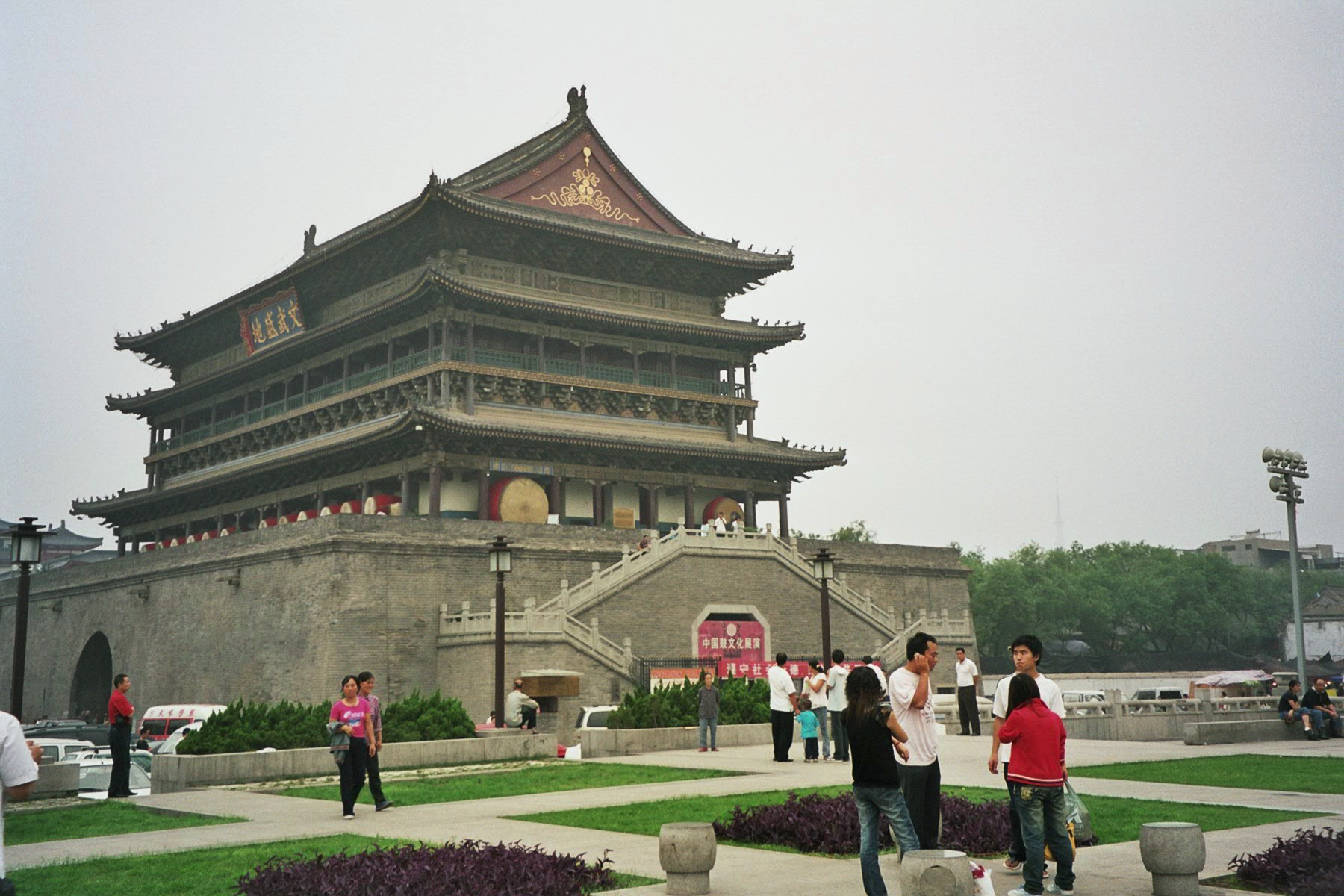
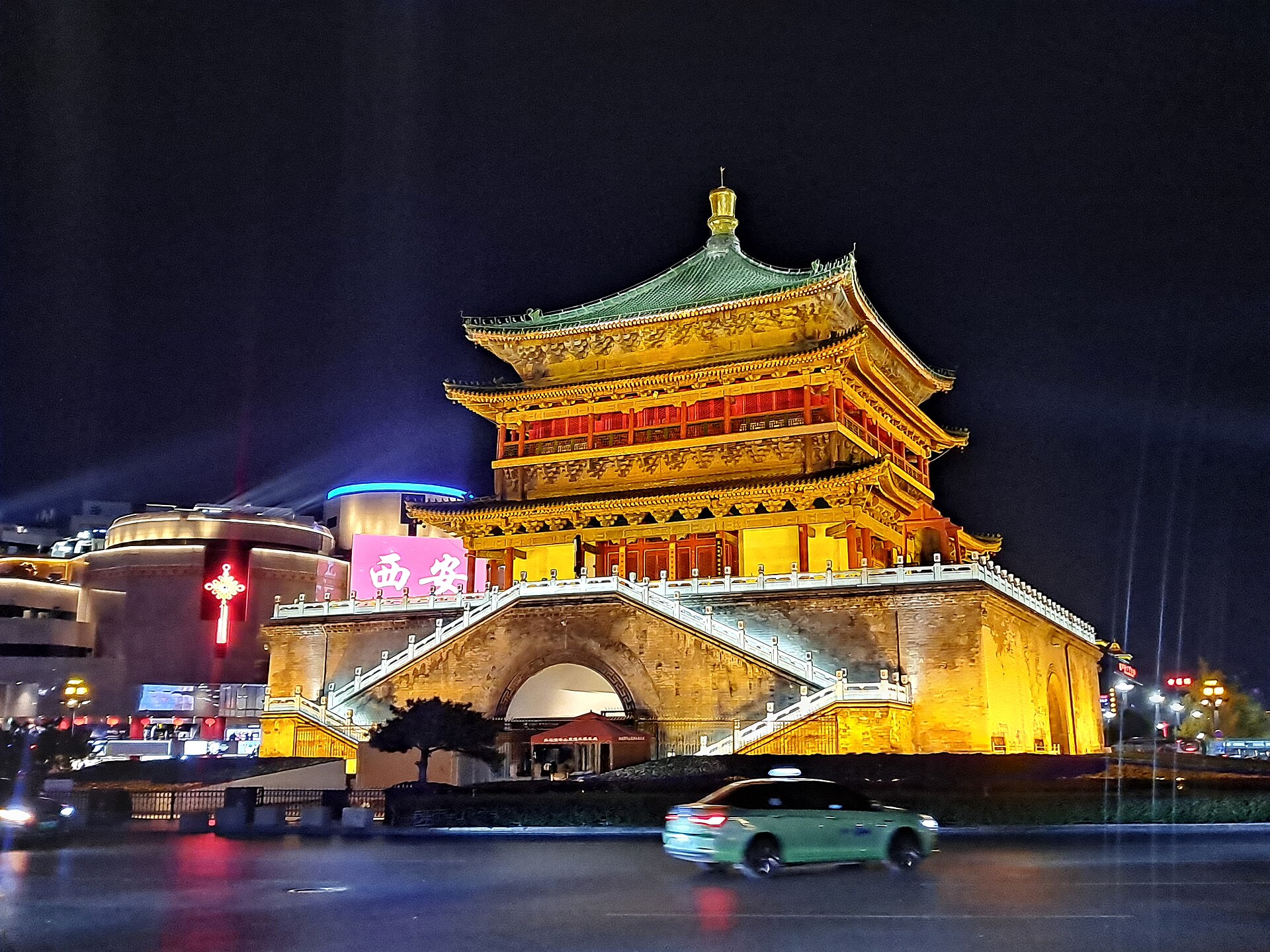
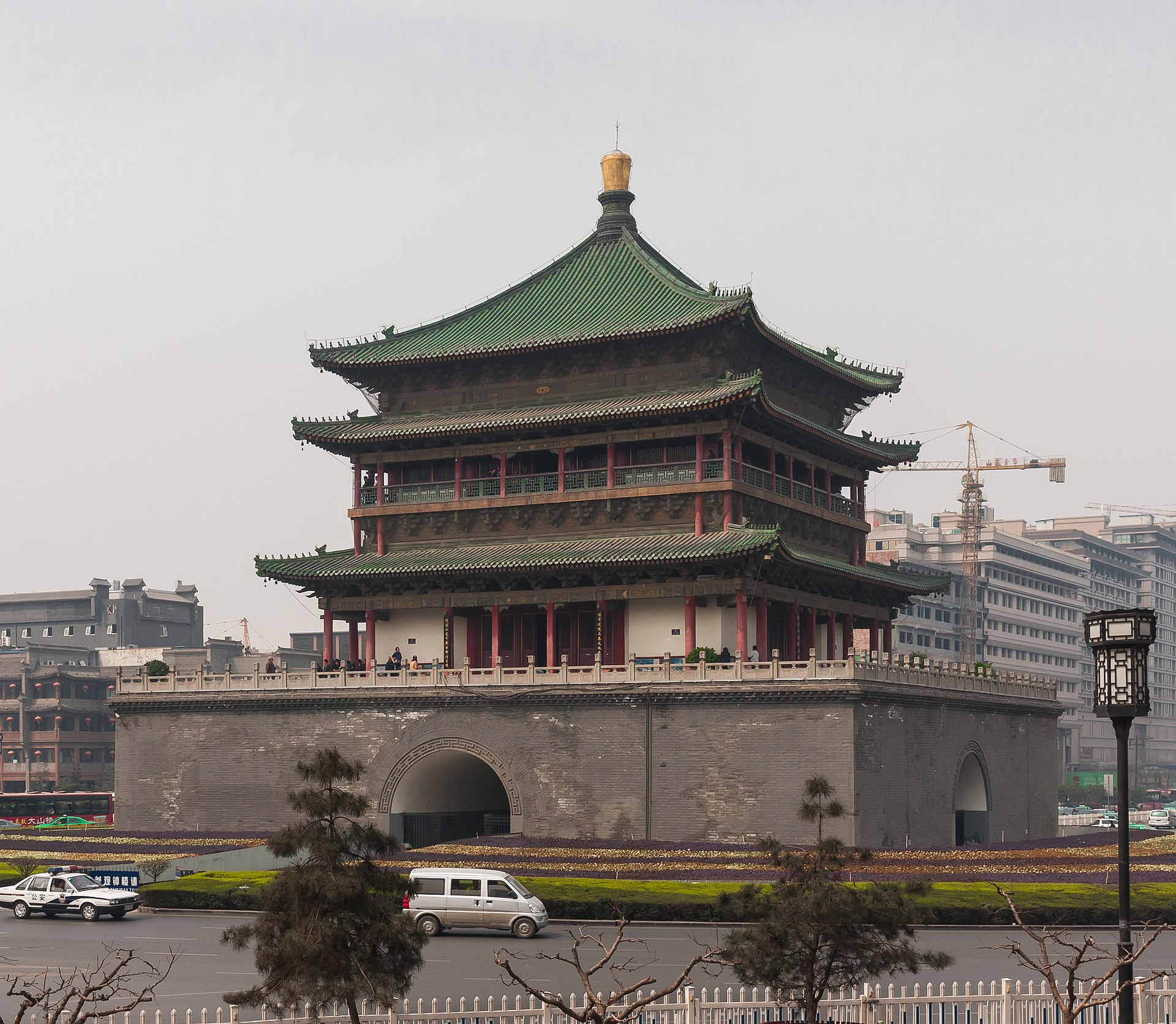
The Ming-era Bell Tower of 1384 stands dead-centre on the city's roundabout — the largest surviving timber bell tower in China. A few minutes away is the Drum Tower, the gateway into the Muslim Quarter. Both are at their best when the lights come on at night.
Stand on the upper gallery of the Bell Tower and look down: four avenues run away from you in perfectly straight lines, due north, south, east and west. This is not a coincidence. The Bell Tower (钟楼) has marked the geographic centre of Xi'an since it was built in 1384 — the entire city grid is laid out around this axis, and every main street points directly at it. Standing here, you understand the city in a way no map quite explains.
The Bell Tower is a three-tier timber structure with triple eaves on a tall brick base, built in the early Ming dynasty and considered the largest and oldest surviving timber-frame bell tower in China. It once housed a giant bronze bell rung to mark dawn across the whole city. About 250 metres to the northwest stands the Drum Tower (鼓楼), built slightly earlier in 1380 — wider and longer, with rows of large hide drums on its upper floor that were beaten to mark nightfall. For centuries the two worked as a pair, in the phrase the Chinese still use: "morning bell, evening drum" (晨钟暮鼓).
What makes them worth your time is not only their age but their position at the centre of everything. From here you can walk to the city wall, the shopping streets, and — most usefully — straight through the back of the Drum Tower into the Muslim Quarter, the city's best street-food district. Put simply: if you arrive in Xi'an and have no idea where to start, start here. You will not go wrong.
Two paired structures that show how an ancient city kept time for centuries.
A three-storey timber pavilion on a 36-metre brick base, with three tiers of green glazed-tile roof, standing in the middle of the roundabout where all four main avenues meet. It was moved to its present spot in 1582. Inside are bronze bells and Ming–Qing-era timber furnishings; climb to the upper gallery for a clear view down the four avenues and across to the Drum Tower opposite.
About 250 metres northwest of the Bell Tower, this one is wider and longer. Its upper floor is lined with dozens of large hide drums, including the "24 Solar Terms Drums". Originally used to mark nightfall for the whole city, the Drum Tower opens at its rear onto Beiyuanmen Street, which leads straight into the Muslim Quarter.
The Drum Tower stages drumming set to a Tang-dynasty-style dance several times a day (typically 9.30, 10.15, 11.00, 11.45, 14.00, 14.45, 15.30, 16.20). The ceremonial "morning bell, evening drum" strikes the replica bell on the Bell Tower 24 times at 9 am, noon and 3 pm, and sounds the drums on the Drum Tower at 6 pm. Time your visit to a performance and it's included with your ticket.
The open square between the two towers has fountains and seating, and is the spot to photograph both the Bell Tower and Drum Tower in a single frame. The square itself is free even if you don't buy a ticket to climb. At night, when both towers are lit at once, this is where locals and visitors gather to take photos.
Because the Bell Tower sits in the middle of a roundabout with traffic circling it, you reach the tower itself via the underpass that links the four street corners (the same one as the metro). Don't try to cross at street level — look for the stairs down at a corner, then follow the signs to the ticket window beneath the tower base.
Both towers let you climb to the upper gallery. From the Bell Tower you see the four avenues radiating out as the city's axis, with the Drum Tower clearly visible. From the Drum Tower you look down on the grey-tiled rooftops of the Muslim Quarter stretching out behind. Climbing both takes about 1 to 1.5 hours (the stairs are fairly steep but not high).
If you're short on time and have to pick one, the Drum Tower wins for the drum performances and the direct walk-through into the Muslim Quarter. The Bell Tower wins for the city-axis view and its status as Xi'an's icon. But if budget and time allow, the ¥50 combined ticket for both is the best value.
The drum performance on the Drum Tower is the highlight most people miss simply because they didn't check the times. There are usually about 8 a day (9.30 am–4.20 pm), each 10–15 minutes — an ensemble of drums set to a Tang-dynasty dance. When you arrive, ask staff or check the board for the next slot so you can pace your walk to catch it.
The ceremonial "morning bell, evening drum" is a symbolic performance revived since 2007 — the replica bell on the Bell Tower struck 24 times in the morning, at noon and mid-afternoon, opening with the 24 Solar Terms Drums at 6 pm. Schedules can shift by season, so confirm at the ticket office on the day.
Both the Bell Tower and the Drum Tower are at their best once the sun goes down and the floodlights come on — the towers turn amber against a deep-blue sky, the image of Xi'an that ends up on postcards and in people's memories. The best vantage points are the Bell-Drum Tower Square between the two, and the upper floors of the malls across the roundabout, which look down on the whole Bell Tower.
In peak season the towers stay open until 9.30 pm, so you can actually be up on the gallery while the lights are on. In low season, when they close at 6 pm, the towers themselves may shut before the lighting peaks — but you can still photograph from the square below, since the external lighting stays on after the towers close.
Sitting dead-centre in the city, this is the easiest place in Xi'an to reach — the metro brings you right to the entrance.
Central addresses around the Bell Tower — walk out of the lobby to the towers, the Muslim Quarter and the city wall.