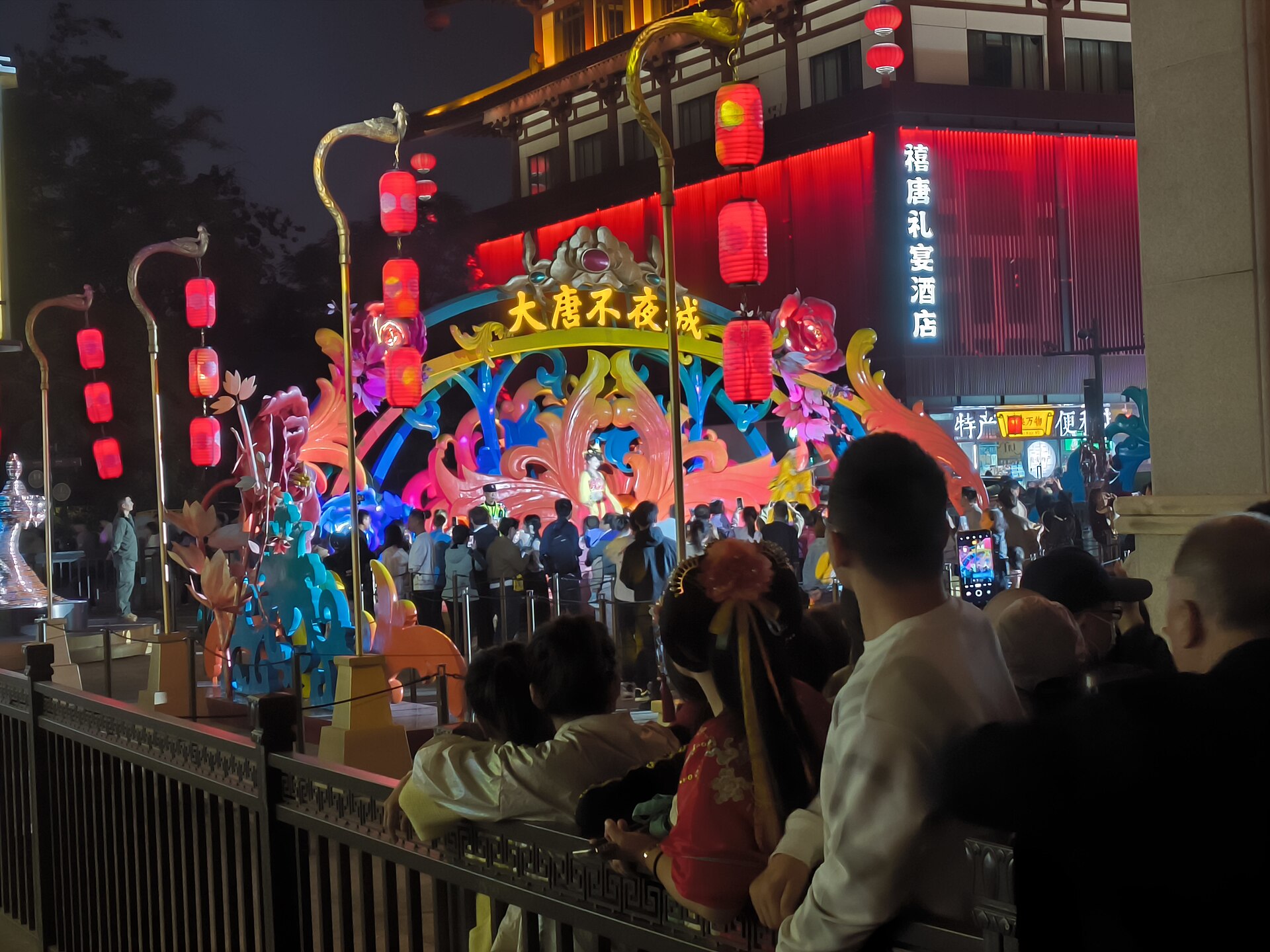
Xi'an's southern district rebuilt the Tang dynasty at full scale — a 1,300-year-old pagoda at the centre of Asia's largest music fountain, and a few steps south, Datang Everbright City, so brightly lit at night they named it "the City That Never Sleeps".
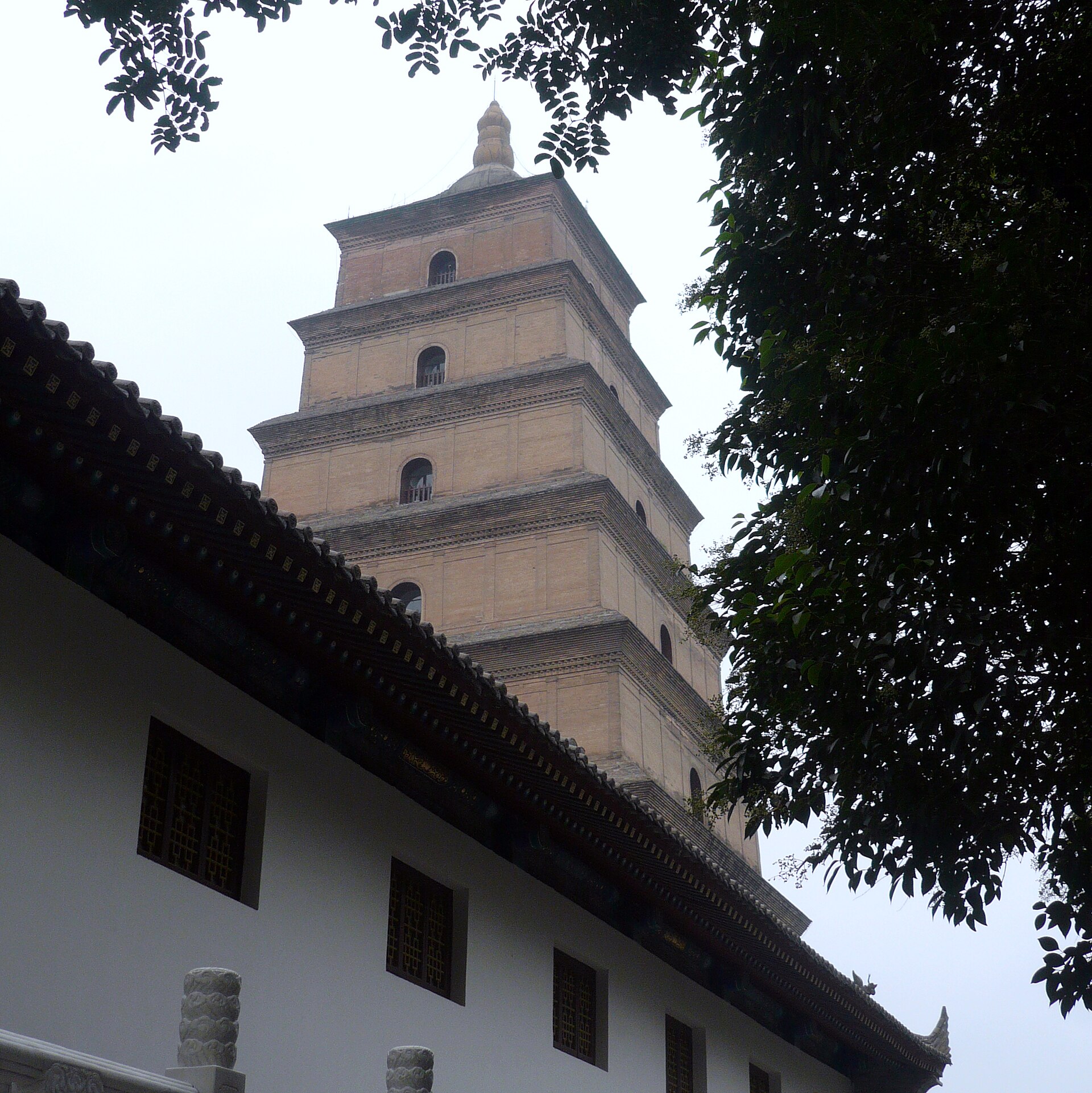
Picture a brick pagoda more than 1,300 years old — the tower where the monk Xuanzang (the historical figure behind the Monkey King's Tripitaka) once stored the scriptures he carried back from India — standing at the centre of a vast square, ringed by a Tang-themed pedestrian street, a recreated imperial garden and a row of newly built five-star hotels. That is the Yanta–Qujiang district (雁塔-曲江), the southern part of Xi'an that most people simply call "the Big Wild Goose Pagoda area" or "the Datang area".
Unlike the old City Wall, where real history is packed into narrow lanes, this is Xi'an planned and built anew, as a single themed district. Around the Big Wild Goose Pagoda (大雁塔) there is a music-fountain plaza; immediately south is Datang Everbright City (大唐不夜城), a night-lit pedestrian street running nearly two kilometres; and to the south-east is Tang Paradise (大唐芙蓉园), a large lakeside imperial-style garden. Close by stands the Shaanxi History Museum (陕西历史博物馆), which many people rate as the finest museum in China.
The honest appeal of this district is that it goes big without apology — daytime is for the pagoda and the museum; after dark the whole area turns into a sea of golden light, and Chinese travellers from Beijing and Shanghai fly in to photograph it. If you like new hotels with big rooms and a dramatic night-time atmosphere, this is the one part of Xi'an that gives you both in the same place.
The Datang area is not a district of narrow historic lanes like the City Wall. It is Xi'an designed for comfortable walking and good photographs — by day and, especially, by night.
What sets this district apart from the city centre is that it is open and unhurried: wide roads, wide pavements, wide plazas. You can walk from the Big Wild Goose Pagoda south through Datang Everbright City to Tang Paradise in a single line, without the elbow-to-elbow crush of the Muslim Quarter. Daytime is quiet and bright — good for the museum and the pagoda. After dark the crowds pour in for the lights. It is the district in Xi'an whose character changes most clearly with the hour of the day.
Datang Everbright City at night is the image many people now picture when they think of modern Xi'an — Tang-style buildings lining both sides of a street nearly two kilometres long, the whole district washed in gold. There are living statues (performers in Tang costume standing perfectly still), street performers, and food and craft stalls. It is all free to enter. The best photographs come in the early evening, when the sky is not yet fully dark but the lights are already on.
The Shaanxi History Museum holds hundreds of thousands of artefacts spanning from prehistory to the Tang dynasty, including tomb murals from Tang princes and princesses that you will not see anywhere else. The one catch is that you must book in advance (details below). And the Big Wild Goose Pagoda nearby is where Xuanzang actually translated Buddhist scriptures in the 7th century — not a recreation, but the real site.
Qujiang is where the newer international hotel brands have clustered — W Xi'an sits about 500 metres from the pagoda, The Westin Xi'an is directly opposite the pagoda within the Grand Tang Everbright City complex, and Shangri-La Xi'an is in the newer Qujiang sub-district. Rooms here tend to be larger, with pools and full gyms. It suits travellers who value newer-hotel comfort over an old-city-centre address.
Tang Paradise (Datang Furong Yuan) is a large recreated Tang-style imperial garden on a lake in the south-east of the district, with pavilions, bridges and a water-and-light show in the evening. It suits travellers who want to stroll slowly through a period setting without fighting crowds. It is a ticketed park, unlike Datang Everbright City, which sits outside the gates and is free.
A Tang-dynasty brick pagoda built in 652 AD to house the Buddhist scriptures the monk Xuanzang brought back from India. It stands seven storeys tall today and is part of a UNESCO World Heritage listing. The surrounding Da Ci'en Temple is still an active working temple. Admission to the temple grounds and to climb the pagoda comes in tiers — check the day's prices before you go. Arrive early for thinner crowds and gentler sun.
Full details at the Big Wild Goose Pagoda complete guide.
The square on the pagoda's north side holds the largest music fountain in Asia (around 168,000 sqm). It runs roughly four times a day (around 12:00, 16:00, 19:00 and 21:00 — the schedule shifts with the season and holidays), each show lasting about 15 minutes. Watching from the square is free; viewing-platform seats cost about ¥30 (~฿150). The evening shows are the most striking thanks to the lighting. Shows are usually suspended from November to January — check before you go.
A Tang-themed pedestrian street running nearly two kilometres, linking the pagoda's South Square to Tang Paradise. Entry is completely free — no ticket needed. The lights come on around 18:30–19:30 and the street is busiest from about 19:30 to 21:30, with living statues, street performers, food and souvenir stalls. The name "Bu Ye Cheng" means "the city that never sleeps" — it stays bright all night. It is the best-value night-time activity in Xi'an because all of it is free to see.
Full details at the Datang Everbright City complete guide.
Many travellers rate it the best museum in China, holding artefacts from a region that served as the capital of thirteen dynasties. Entry is free but must be booked in advance — visitors are capped at around 6,000 a day, and online tickets are very limited (roughly 500 per day). Reserve through the official website (ticket.sxhm.com) or official WeChat up to 10 days ahead. Open around 08:30–19:00 (last admission 18:00), closed Mondays. If you cannot get a free slot, the paid special exhibitions are a fallback.
Full details at the Shaanxi History Museum complete guide.
A large recreated Tang-dynasty imperial garden on a lake in the south-east of the district, with pavilions, bridges and a water-light-and-colour show after dark. Open approximately 09:00–22:00 (last admission around 21:30). Admission in peak season (March–November) is about ¥120 (~฿600), off-season about ¥90 (~฿450). It suits travellers who want to walk slowly through a period setting at an unhurried pace — check the evening show schedule before you go.
The Datang–Qujiang area has several newer malls and complexes (such as the retail zone near Dayanta station and within Datang Everbright City itself), with air-conditioned restaurants, cinemas and cafés. They are useful on a very hot day or to escape rain, and are an easy walk from the district's hotels. Mall prices run higher than the street stalls, but the seating is more comfortable.
The Datang area has food at every level, but its real strength is the street food along Datang Everbright City at night and the comfortable cafés in the newer malls.
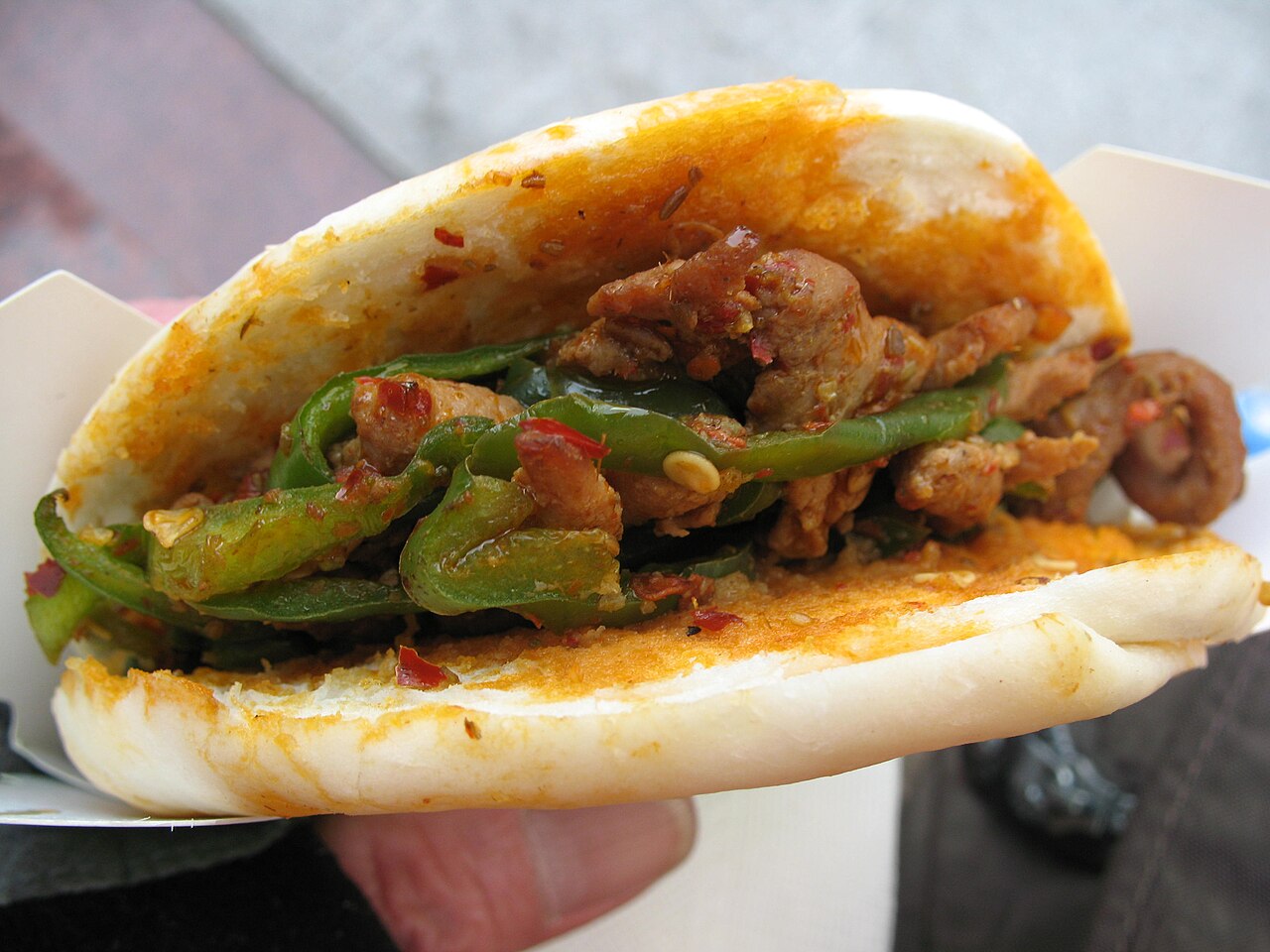
At night the Datang Everbright City street fills with food stalls — grilled lamb skewers (羊肉串), roujiamo (肉夹馍, the Chinese "hamburger"), Tang-style sweets and an array of unusual snacks. Street-stall prices are clearly easier on the wallet than the mall restaurants, roughly ¥10–40 (~฿50–200) per item. You can eat as you walk and watch the lights. For the full sweep of Xi'an's signature dishes, start with the Xi'an food guide.
More: Roujiamo — arguably the world's oldest hamburger · Biangbiang's belt-wide noodles
This district has more cafés than the old walled city, thanks to its newer malls and complexes — both big chains and specialty roasters. Coffee runs around ¥30–55 (~฿150–275). They work well for an afternoon break out of the hot sun, or to rest before heading out for the evening lights. For Xi'an's café scene more broadly, see the Xi'an café guide.
This is where the newer international hotel brands have set up — bigger rooms, pools, and Metro Lines 3/4 connecting back into the old city.
The strongest argument for staying in the Datang area is newer hotels at better value. The luxury properties here tend to have larger rooms, full pools and gyms, and rates that are often better than the cramped luxury hotels inside the City Wall. The location also puts the pagoda, the fountain and Datang Everbright City within walking distance — wake up to the pagoda, walk out to the lights in the evening, no taxi required.
The trade-off is that it is a way from the old city centre. If you want to walk out of your hotel and reach the Bell Tower, the Muslim Quarter and the traditional restaurants immediately, this district means a 15–20 minute metro ride. For travellers who plan to spend all day exploring the centre on foot, a base inside the walls makes more sense — compare the two at the Xi'an where-to-stay guide.
Or read the individual hotel reviews for properties in this district:
Several metro stations cover the key sights well. Choose based on where you want to start.
14:30 — Start at the Big Wild Goose Pagoda (Metro Dayanta, Lines 3/4, Exit B/C). Walk the pagoda and Da Ci'en Temple grounds.
16:00 — Catch the afternoon music-fountain show on the North Square (check the day's schedule). Watching from the square is free.
16:45 — Walk south through the South Square into Datang Everbright City. Stop for a coffee or a snack.
18:00 — Wait for the lights to come on along Datang Everbright City and shoot the early-evening blue hour, before the sky goes fully dark.
If you secure a museum ticket, start early and run all the way through to the night lights:
09:00 — Shaanxi History Museum (book in advance) — allow 2–3 hours.
12:00 — Lunch around Xiaozhai or in a mall near the museum.
13:30 — Big Wild Goose Pagoda and North Square; catch an afternoon fountain show.
15:30 — Tang Paradise (Datang Furong Yuan) — walk the lakeside imperial garden.
18:30 — Back into Datang Everbright City for the night lights, street food and living statues to close the evening.
The Datang area pairs well with a day in the old centre — see Xi'an's top attractions, or the sibling neighbourhood guides for the Bell Tower & Muslim Quarter and the City Wall & South Gate.