Wheat noodles as wide as a belt, pulled by hand into one giant strand, slapped against the board with a "biang-biang" and drenched in sizzling chili oil — this bowl is Xi'an, from its 57-stroke name down to the first chewy mouthful.
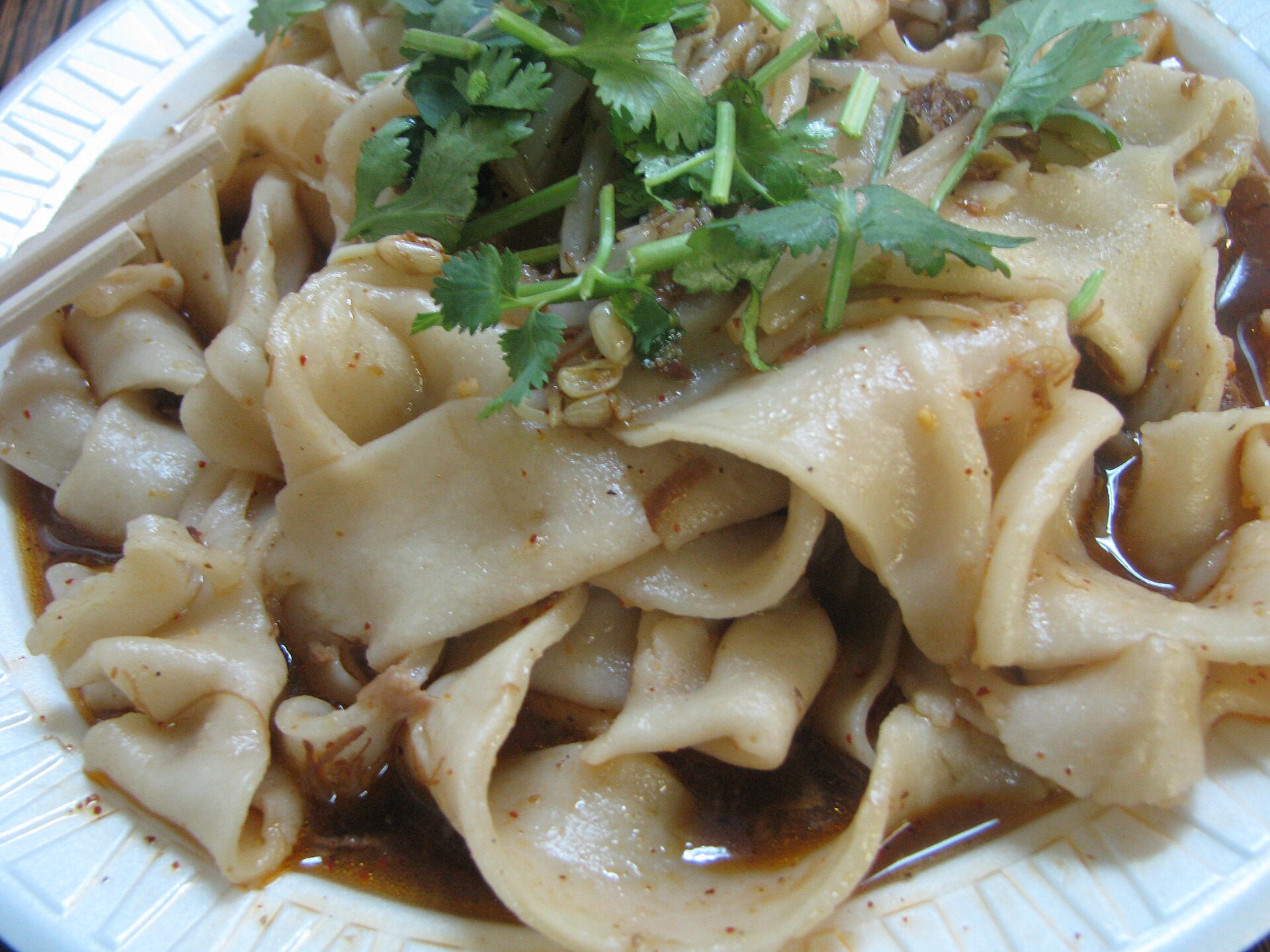
Lift the lid on a bowl of biangbiang noodles and you might find a single strand — but that strand is as wide as a belt, thick, chewy, folded back and forth to fill the whole bowl. This is biangbiang noodles (biáng biáng 面), one of the signature dishes of Shaanxi province, whose capital is Xi'an. They're hand-pulled wheat noodles, not rice — because this is China's wheat country. People in Xi'an eat noodles and flatbread far more than the steamed white rice of the south.
That odd name, "biangbiang," is actually a sound — the noise the dough makes when the cook grabs both ends and swings it, letting the middle slap the wooden board with each stroke. Biang! Biang! The more literal name is youpomian (油泼面), "oil-poured noodles," because the first thing most people picture is a mound of Shaanxi chili flakes, scallions and garlic sitting on the noodles, then scorching-hot oil poured straight over it until the whole bowl sizzles.
Biangbiang noodles started out as labourers' food — for porters, farmers, anyone without the time to roll out delicate thin strands. So they pulled the noodles big and wide, fast to make, filling, and cheap, just a few yuan a bowl. Over time they became the face of Shaanxi cooking, earning a place among the "Eight Wonders of Shaanxi" (陕西八大怪), the local saying that the noodles here are as wide as a trouser belt. Today, whether you duck into a stall in the Muslim Quarter or a tiny shop near the old city wall, biangbiang noodles are still cheap and still genuinely filling.
The only dish in the world whose name is one of the most complex characters in the entire Chinese language.
The traditional biáng character has a staggering 57 strokes, making it one of the most complex characters in written Chinese. It crams an absurd number of components into one square: 言 (speak) in the middle, flanked by 幺 (tiny) on both sides; 馬 (horse) below, flanked by 長 (grow); plus 月 (moon), 心 (heart) and 刂 (knife), all wrapped by 穴 (cave) on top and 辶 (walk) curling around the left and bottom.
People in Shaanxi memorise the stroke order with a rhyming mnemonic that tells a little story, roughly: "A dot rises to the sky, two bends by the Yellow River..." right through to the end. Or, if you prefer the traveller's shortcut: imagine a tiny talking horse growing in the moonlight, with eight knives in its heart, walking across a rooftop.
The remarkable part: for most of its existence you simply couldn't type it, because it wasn't in standard Unicode. Noodle shops all over Xi'an had to hand-paint the name, or fall back on the pinyin biáng. The character was finally encoded in 2020 — yet to this day most phones and screens still can't render it. (If you're seeing an empty box instead of a character above, that's exactly why.)
Note: the tale that the Qin-dynasty premier Li Si invented this character is a legend that can't be verified. Scholars think it was more likely created by a noodle shop in much later times — a great story, but not real history.
From a lump of dough to a sizzling bowl — knowing the parts makes eating it a lot more fun.
1
The cook kneads wheat dough, rests it so the gluten relaxes, then rolls it into a long strip and presses a groove down the middle with a chopstick. They grab both ends and swing it like a skipping rope, letting the centre slap the board on every stroke — biang! biang! — stretching the noodle longer and longer until it's a single broad, chewy band. Some shops pull one noodle a metre long. A quick dunk in boiling water and it's done, with a springy, satisfying bite that's nothing like a thin strand.
The most popular version. The noodles come out of the water and into the bowl, then a mound of Shaanxi chili flakes, sliced scallions and minced garlic goes on top — many shops add blanched bean sprouts and leafy greens too. The cook ladles scorching oil straight onto the chili and it erupts with a sizzle and a cloud of fragrance, the heat bursting the chili wide open. A splash of soy sauce and black vinegar follows, and you toss everything yourself until every wide noodle is coated in glossy red oil. Shaanxi chili leans fragrant and deep-red rather than mouth-numbing, so most people who like spice take to it easily.
Beyond the dry oil-poured style, biangbiang noodles also come with sauces. The one you'll meet most is saozi (臊子), a rich minced-pork sauce with diced vegetables and spices. The other Xi'an favourite is tomato with egg and minced pork (西红柿鸡蛋) spooned over the wide noodles — soft, sweet-sour and easy to like, perfect if you're not ready for a full hit of chili. Both use the same broad biangbiang noodle; only the topping and sauce change.
Many Shaanxi noodle houses are genuine local spots with Chinese-only menus, and some have you pay at a counter first and carry a ticket to collect your bowl. The easiest move is to look for a biáng biáng 面 or 油泼面 sign and point, then ask for one bowl of biangbiang noodles. Want it milder? Say shao la (少辣, less chili) or bu yao la (不要辣, no chili). One bowl of these wide noodles is more filling than it looks — order a single bowl first and top up only if you've still got room.
You'll find it almost everywhere, but a few areas are where Xi'an locals actually head. A bowl runs ¥15–30 (~฿75–150).
The Muslim Quarter is the beating heart of Xi'an's food scene, lined with noodle shops where you can watch the dough being pulled right at the door. Be honest with yourself, though: the main drag (回民街) is squarely a tourist strip and prices run a touch higher than usual. Turn off into a back lane like Damaiyuan (大皮院) and you'll find the places locals actually eat at, for less. A good rule of thumb is to follow the queue of Chinese diners. Noodles here are halal (清真), in keeping with the quarter's Hui Muslim culture.
A food courtyard that gathers famous bites from across Shaanxi province into one place, so you can chase biangbiang noodles and other regional dishes side by side. It's done up in old-town style, and a few stalls turn the noodle-pulling and oil-pouring into a little show. It's a good fit if you want to sample several things in one meal without walking far. It does draw plenty of visitors, but the noodle quality holds up and the convenience is hard to beat.
Away from the tourist zones, Xi'an is full of small Shaanxi noodle houses where office and shift workers eat every day — a biáng biáng 面 or 油泼面 sign out front, stainless-steel tables, a Chinese-only menu, the cheapest prices and the most honest flavour. Many sell these wide noodles alongside other Shaanxi staples like roujiamo (肉夹馍) or liangpi (凉皮). Wander the streets near the city wall or your hotel and you'll turn up a place like this without much effort — great value, and the real feel of eating the way locals do.