Before you get to eat, you sit and tear a dense round of flatbread into tiny pieces with your own hands — 10 to 20 minutes of it. This isn't just mutton soup. It's a ritual locals have kept for over a century, and the dish that means you've truly arrived in Xi'an.
Ask anyone in Xi'an for the one dish you cannot leave without trying and the answer comes back the same: yangrou paomo (羊肉泡馍, yáng ròu pào mó) — literally "bread soaked in mutton soup." It sounds plain. What makes it unlike anything else is that you do part of the work yourself.
This is the staple of Shaanxi province (陕西) and a legacy of the Hui (回族), the Chinese Muslims who have lived in Xi'an for over a thousand years. The city sat at the eastern end of the Silk Road, where caravans brought sheep, spices and the halal way of eating. A dense, unleavened flatbread like tuotuo mo (饦饦馍) kept for days and travelled well — and torn into a bowl of hot lamb broth, it became a high-energy meal that filled you up for the road.
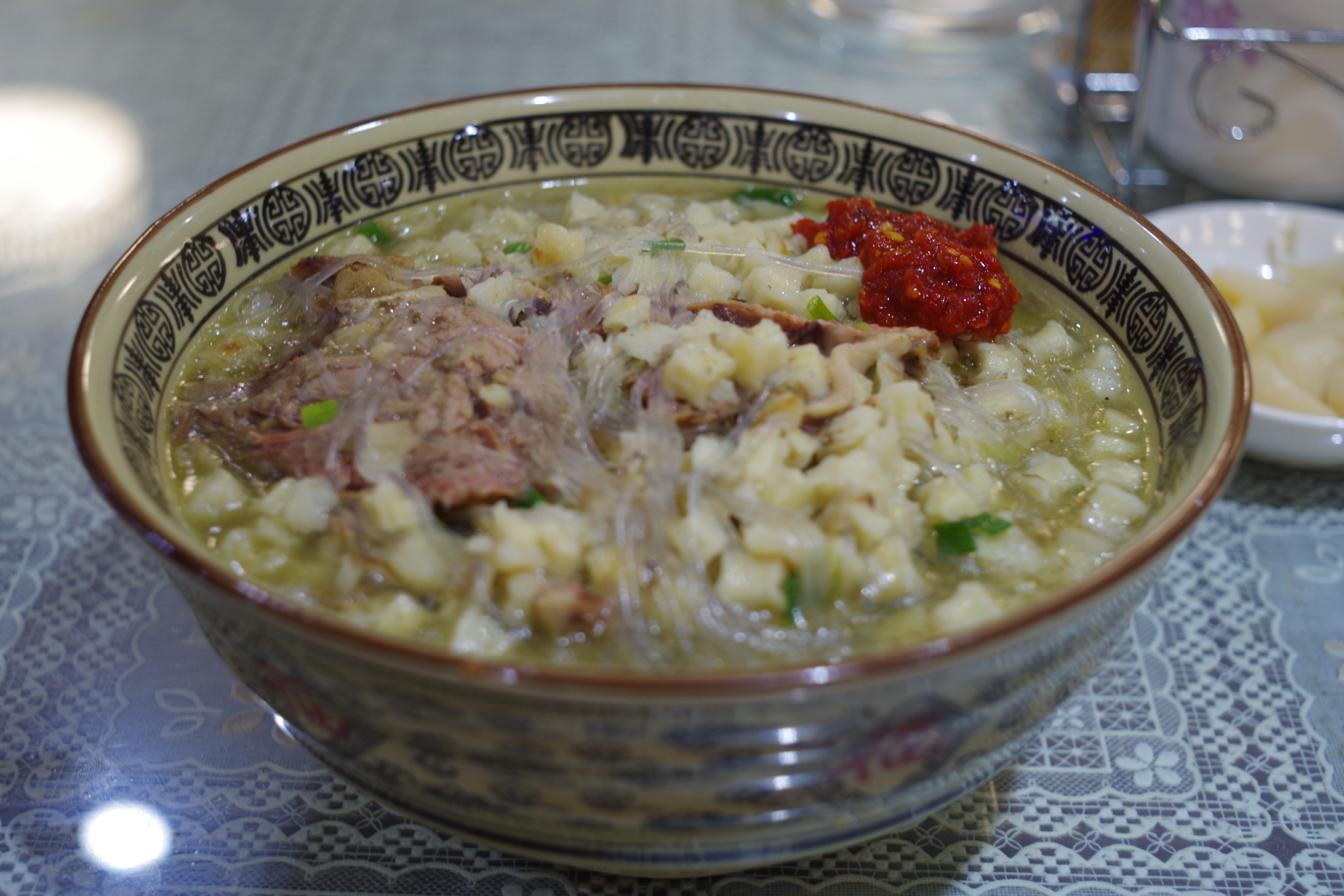
Everything hinges on the broth. Lamb bones, mutton and spices — ginger, star anise, cinnamon, fragrant pepper — are simmered for hours until the liquid turns cloudy, thick and naturally sweet from the bones, with none of the gaminess you might fear. Once you've torn your bread, the kitchen cooks it in that broth with glass noodles, wood-ear fungus and sliced mutton, scatters spring onion and coriander over the top, and brings it back steaming, with sweet pickled garlic (糖蒜) and chilli paste alongside. One giant bowl, and you'll be full long after it goes cold.
Yangrou paomo isn't just meat and liquid — every element has a job. Know them and the meal gets a lot more fun.
1
It looks like a thick, pale disc, baked hard and dry — and it's meant to be that firm so it can soak in hot broth without dissolving. The dough is deliberately part-cooked (半生半熟); torn small and simmered, it drinks up the broth while keeping a satisfying chew rather than turning to porridge. That texture is exactly what sets paomo apart from any ordinary bread soup.
The broth is where you judge a kitchen. A good one simmers lamb bones, mutton and spices — ginger, star anise, cinnamon, fragrant pepper — for hours until it's cloudy, thick and sweet from the bones, never gamey. After you've torn your bread, the cook simmers it in this broth in a wok, seasoning your bowl alone, and brings it back hot. No two famous houses taste the same: the difference is all in the spice blend and how concentrated the broth is.
The original is mutton (羊肉泡馍): a deeper broth with a clear lamb scent, and the version locals love most. If strong lamb isn't your thing, most shops also do a beef version (牛肉泡馍, niurou paomo) that's milder and less aromatic — made identically, just a different meat. For a first taste, go mutton because it's the city's original, but there's no wrong answer. Order to your own palate.
Every bowl arrives with two little side dishes. Sweet pickled garlic (糖蒜, tangsuan) is whole heads of garlic pickled in vinegar and sugar until sweet-sour and crisp-translucent — bite a clove between spoonfuls and it cuts the richness and the lamb aroma beautifully. The red chilli paste (辣酱) is for stirring into the broth a little at a time, to your own heat. Locals treat both as inseparable from the bowl, so don't leave them on the table.
Once you've ordered, the staff bring you a large empty bowl, two rounds of dense flatbread and a table number. Don't panic that there's no soup yet — that's the point. Your job now is to start tearing. Some older houses hand you a tray or gloves to keep it tidy.
This is the heart of the ritual: tear the bread by hand into pieces about the size of a soybean, or smaller. The smaller and more jagged, the better — tiny pieces soak up the broth evenly and cook through at the same rate. Don't rush and leave big chunks; they stay hard in the middle and cook unevenly. As the local saying goes, the cook can tell whether you're a real eater by the way you tear your bread.
Budget about 10–20 minutes per bowl. It sounds long, but this is the best part — you tear and chat with whoever you're with. Locals look forward to this stretch; it's not a chore.
When you're done, take the bowl back to the counter with your table number. The kitchen cooks your bread in the mutton broth, seasoning your bowl alone, adds glass noodles, mutton and fungus, and brings it back. Some places let you choose how soupy you want it: gan pao (干泡), drier with little broth · kou tang (口汤), balanced · shui weicheng (水围城), soupy with plenty of broth. First-timers can't go wrong with kou tang.
One last local habit — don't stir the whole bowl. Work slowly inward from the edge so the bread in the centre stays hot and chewy down to the last bite. Bite the pickled garlic in between, add chilli to taste, and settle in: a bowl this size is an easy, filling meal for one.
From century-old brands to small halal shops in the Muslim Quarter, all confirmed still open.
Ask which yangrou paomo house is the most famous in Xi'an and the answer is usually Lao Sun Jia. It has been going since 1898, in the late Qing dynasty, and over a century later it's recognised as a national time-honoured brand and a holder of intangible-cultural-heritage status. The broth is rich and distinctive, there are several branches around Dong Dajie (East Street), the dining rooms are large and comfortable, and there's a picture menu to help visitors order.
The other great institution sits on the square between the Bell Tower and the Drum Tower, done up in handsome Tang-dynasty style. Its technique for beef-and-mutton paomo was listed as national intangible cultural heritage in 2008 and has been served at state banquets. The location is about as central as Xi'an gets — a short walk from the Bell Tower — which makes it an easy stop between the city's headline sights.
Beyond the big brands, the Muslim Quarter and its back lanes — Beiyuanmen (北院门) and Dapiyuan (大皮院) — are full of small halal paomo shops the locals eat at every day. They're cheaper, and some pour a broth that rivals the famous houses. Honestly, the main drag is touristy; for the real thing, duck into the side lanes where locals walk and look for a shop full of people tearing bread at their tables. That's your sign it's the genuine article.