Home Xi'an Must-Eat Dishes China About
Home  ›  China  ›  Xi'an  ›  Muslim Quarter
China · Xi'an Food Guide · 2026

Xi'an's Muslim Quarter
Where the Locals Actually Eat

Cumin smoke drifting across the lane, the rhythmic chop of a cleaver, lamb hissing over charcoal. The famous main drag behind the Drum Tower is a tourist trap — so this guide walks you into the back lanes where Xi'an really eats, and tells you straight what's worth it and what's overpriced.

Before You Turn In

The Muslim Quarter is more than one street

Picture it: you walk from the Bell Tower, past the Drum Tower, then turn into a street where giant red signs in Chinese characters glow overhead, charcoal smoke hangs in the air, a cleaver thuds against a block in steady rhythm, and the crowd is so dense you simply move with it. This is Beiyuanmen (北院门) — what foreign guides call "Muslim Street" — the image of Xi'an that everyone photographs.

Here's the honest part: that street is the most touristy and most expensive stretch of the quarter. Shopfront rents are brutal, dozens of stalls sell the same handful of things, and some of it is made more for a phone camera than for eating. Xi'an locals don't really graze there. They turn into the back lanes — Dapiyuan (大皮院), Xiyangshi (西羊市) — or walk a few minutes further to Sajinqiao (洒金桥), where the food is roughly half the price and noticeably better.

This guide covers both — the main drag you'll pass through anyway, and the back lanes that are far better value — and tells you which dish to eat where. For the dishes themselves across the whole city, read it alongside our Xi'an must-eat dishes guide.

Lane by Lane, Dish by Dish

Which lane, and what to order

Starting with the main drag you'll pass through, then the lanes where locals eat
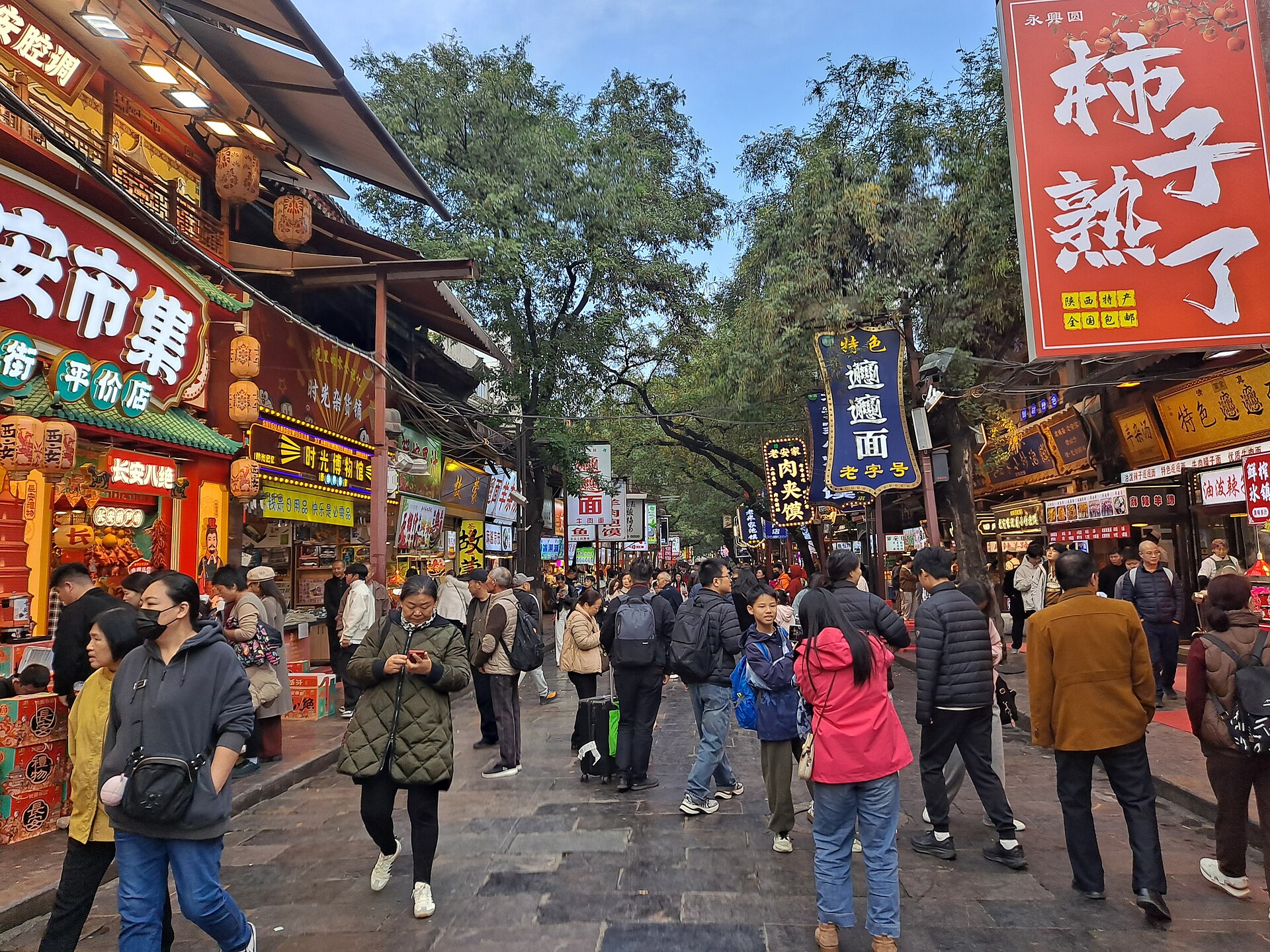
Beiyuanmen Street in Xi'an's Muslim Quarter — red Chinese shop signs, dense crowds, and a 柿子熟了 persimmon-cake banner lining both sides of the lane 1
Touristy — But You'll Pass Through It
Beiyuanmen — The Main Drag
北院门 · Behind the Drum Tower · Metro Lines 2/6, Bell Tower Station

This is the main street everyone means when they say "Muslim Quarter" (回民街) — handsome flagstones, Ming-and-Qing-style facades, red signs blazing down both sides. It's fun to walk, photogenic, and you'll pass through it anyway coming from the Drum Tower. The night atmosphere is the real highlight.

But straight talk: the food here runs 30–50% above the back-lane prices, and many stalls sell the same things. The things genuinely worth eating on this street: big charcoal lamb skewers on red-willow (红柳) branches, grilled fresh in front of you; fried persimmon cakes (黄桂柿子饼) from a stall frying them to order; and soup dumplings at Jia San (贾三灌汤包), the quarter's century-old institution, which has a branch on this street. For the rest — save your appetite for the lanes.
Metro: Lines 2/6, Bell Tower, Exit B · 5–6 min walk
Cost: ¥10–35 per snack (฿50–175) · skewers ¥5–10
Best time: 5–10 pm — lit signs, grills going
Payment: WeChat Pay / Alipay / cash RMB
Heads up: Watch for stalls that scoop and weigh before quoting a price — dried fruit and nut vendors especially. Always ask the price per jin (500g) before they fill the bag. And skip Chinese national holidays unless you enjoy being unable to move.
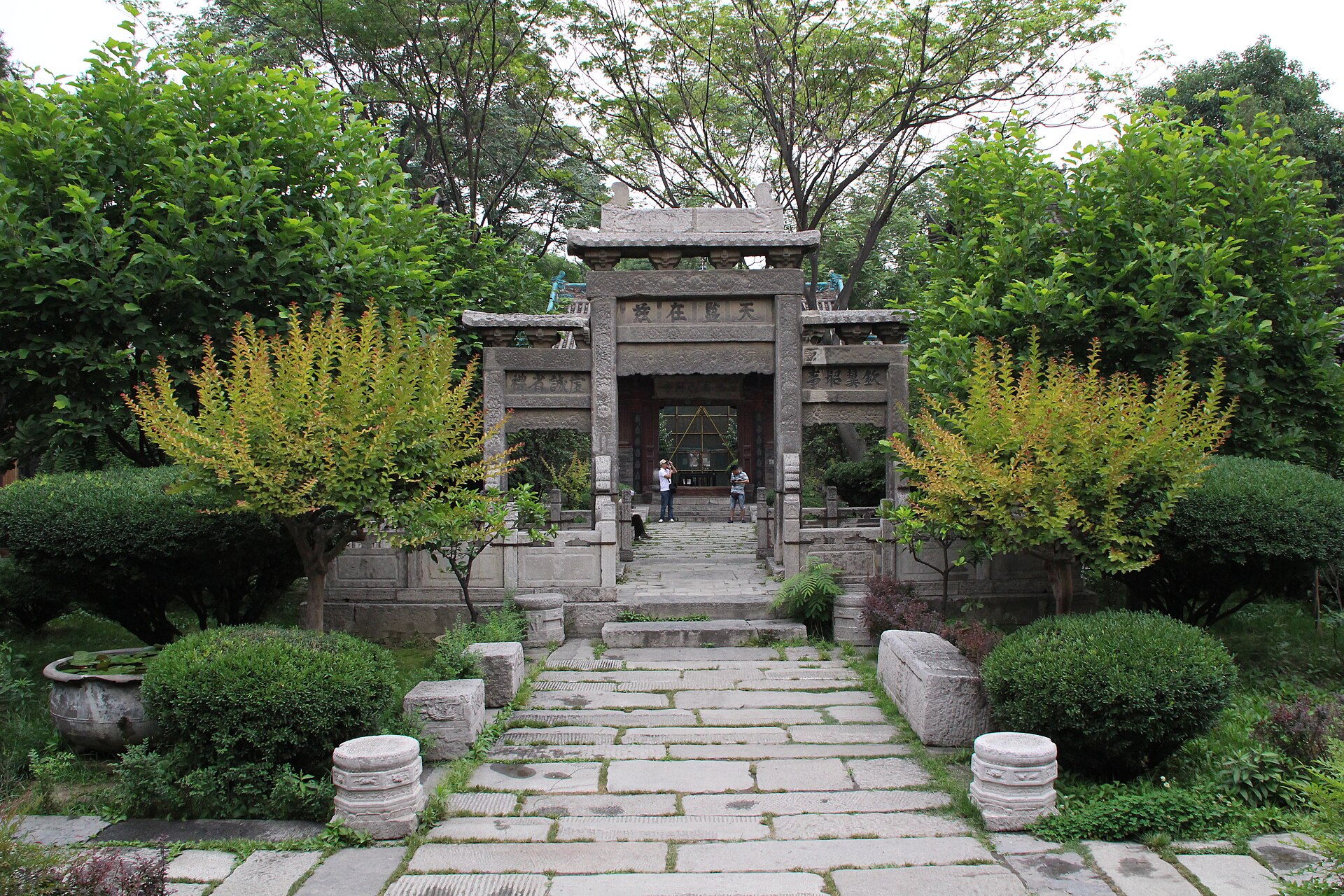
The Chinese garden-style stone gateway of the Great Mosque of Xi'an in Huajue Lane, deep inside the Muslim Quarter, framed by green trees 2
Where Locals Eat · Better Value
Dapiyuan — The Local Lane
大皮院 · Parallel lane to the north · Turn off Beiyuanmen

Turn off the main street into a narrower lane and the mood shifts immediately — quieter, fewer people, but the shops you see are ones the neighbourhood has eaten at for decades. Dapiyuan is the lane Xi'an locals point to as the "real thing," and prices are clearly gentler than the main drag.

What to order here: yangrou paomo (羊肉泡馍), the classic mutton-and-flatbread soup, costs less in these lanes than at the big-name places on the main street; water-basin lamb (水盆羊肉), a clear, restorative mutton broth you sip with flatbread; and homely huihui cai (烩烩菜), mixed vegetables stewed with meatballs. Jia San (贾三), the famous soup-dumpling house, also has a branch around the corner on Xiyangshi — dense filling, soup-rich.

Location: Lane parallel and north of Beiyuanmen · 2–3 min walk
Cost: ¥15–45 per dish (฿75–225) · cheaper than the main drag
Best time: 11 am – 2 pm and 5–9 pm
Payment: WeChat Pay / cash (small stalls often cash-only)
How to spot the good ones: Look for the places full of locals sitting down, not the ones with a staffer out front waving tourists in — that's the tell. Pictured above is the Great Mosque in nearby Huajue Lane; its Chinese-garden architecture is worth a look between bites.
🍲
3
Locals' Breakfast Street · The Real Deal
Sajinqiao — The Locals' Eating Street
洒金桥 · Northwest edge of the quarter · A short walk further

If you have the legs to walk a little further from the tourist street, Sajinqiao is the reward — not an "internet-famous" street, but a decades-old Hui neighbourhood food scene, full of chatter, sizzling woks, and an aroma that gets your stomach going from the top of the alley. Locals eat here for around ¥20 a head (฿100) and leave full.

What to eat: hulatang (胡辣汤), a thick, peppery soup with beef meatballs — a long-running stall like Li Weiyi (李唯一) starts its pot simmering around 4 am, and you sip it with bread as a legendary breakfast; Yang Tianyu's roujiamo (杨天玉), cured beef from local cattle stuffed into a freshly baked bun; Ma Er's beef dumplings (马尔), going 30 years, in an ancestral sour broth; and red-willow lamb skewers come evening.
Location: About 10–15 min walk from the Drum Tower, or a short taxi
Cost: ¥20–40 per person (฿100–200), comfortably full
Best time: 6:30–8:30 am (first pots) and 7–10 pm
Payment: WeChat Pay / cash
Why bother: If you want to eat the way Xi'an locals do rather than the way tourists do, Sajinqiao is the answer — about half the main drag's prices and more honest flavours. Coming for a morning bowl of hulatang and a hot roujiamo is one of the best ways to start a day in Xi'an.
Lamb skewers grilling over glowing red charcoal, smoke rising, red-handled metal skewers lined up in a row — Chinese Muslim street food 4
The Quarter's Nightly Ritual
Lamb Skewers 烤肉 — Cumin and Charcoal
羊肉串 (yángròu chuàn) · Every lane in the quarter · Best after dark

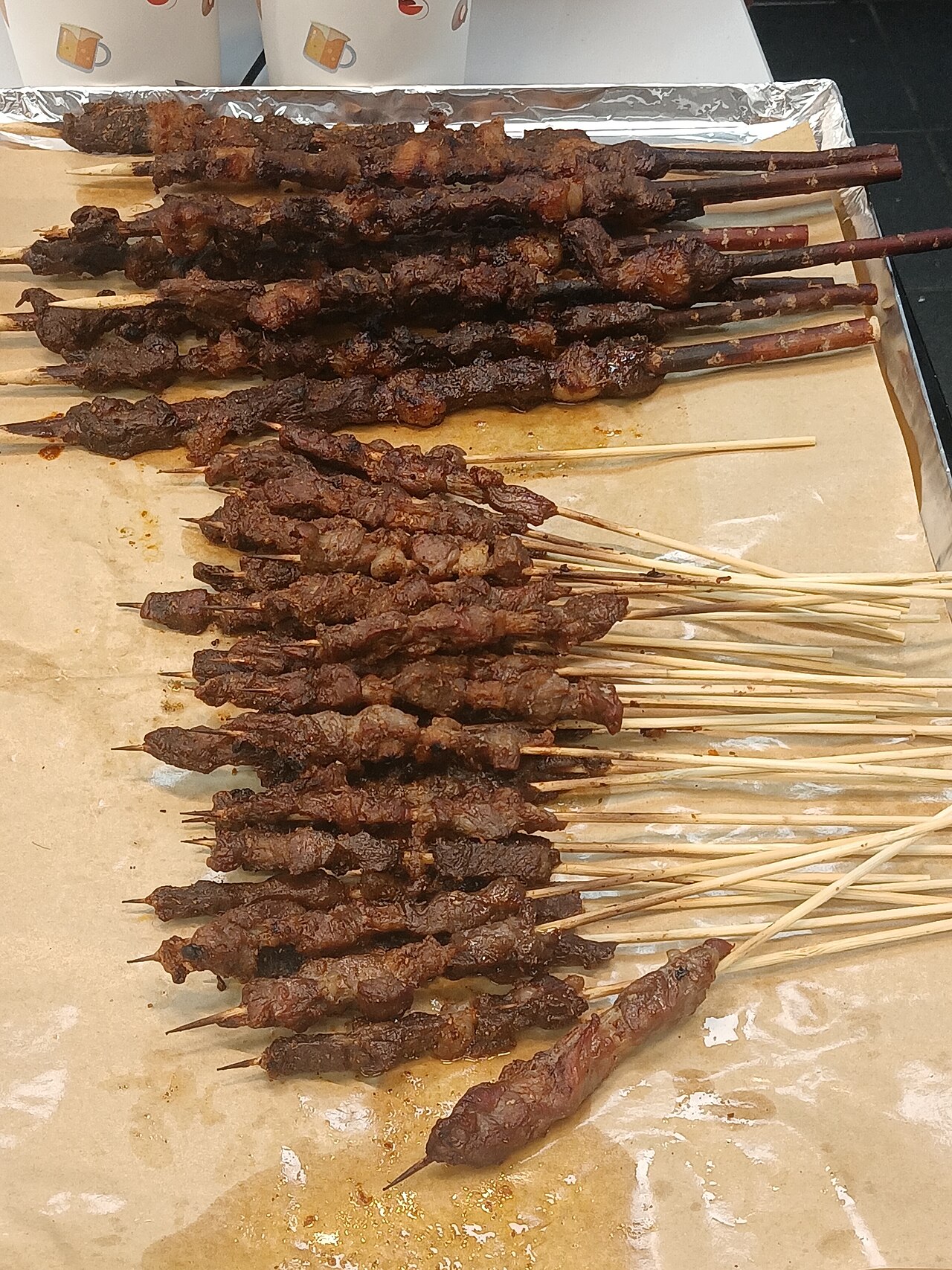
If one smell stands in for the whole Muslim Quarter, it's lamb fat dripping onto coals and hitting cumin and chilli — it drifts across the lanes before you even see the grill. Long charcoal grills are lined wall-to-wall with skewers, the grillers flipping them in a blur and showering them with fistfuls of ground cumin and chilli flakes.

The key move: choose the fat skewers on red-willow (红柳) branches, not the little bamboo ones. The willow — a tamarisk wood — lends a faint woody fragrance to the meat as it roasts, and the chunks are bigger and juicier. They run about ¥5–10 each (฿25–50); five or six make a good graze. Eat them with cold beer or a soft drink, or order a round, thick flatbread (饦饦馍) to tear and eat alongside.
Where: Every lane · Sajinqiao and Dapiyuan are best value
Cost: Small skewer ¥3–5 · big red-willow ¥5–10 (฿25–50)
Best time: After 6 pm, when the grills are fully lit
Payment: WeChat Pay / cash
About this photo: This is Chinese-Muslim (Hui/Uyghur) charcoal lamb skewers, the same style grilled all through the quarter — the cumin, the long charcoal trough, the red-handled metal skewers are exactly what you'll see in Huimin Street.
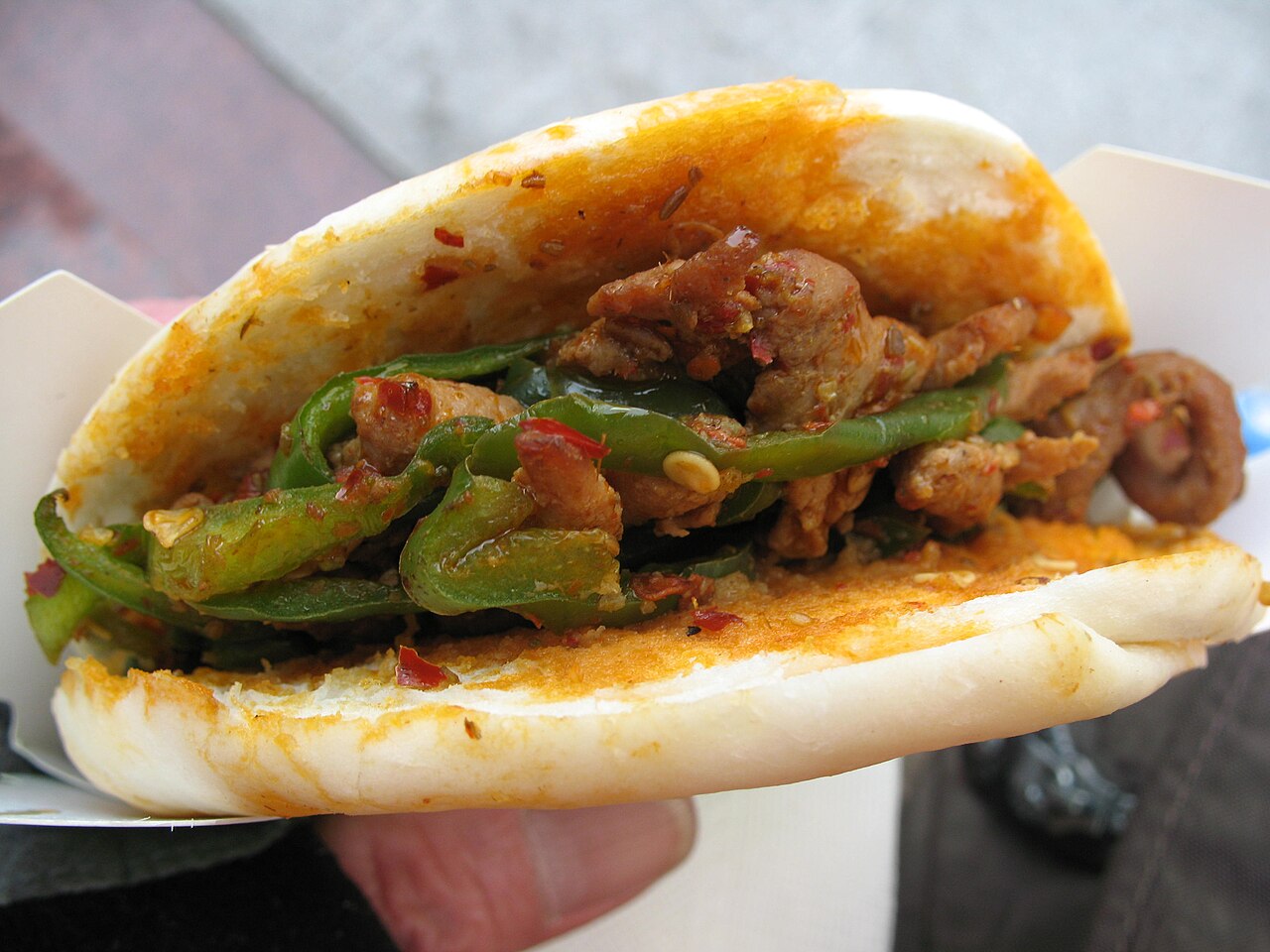
Xi'an roujiamo — a crisp baijimo flatbread bun stuffed with braised meat and green peppers, held in a hand 5
China's Hamburger · One-Handed
Roujiamo 肉夹馍 — Xi'an's Hamburger
肉夹馍 · All over the quarter · Halal version uses beef / lamb

People call it "China's hamburger," but it's far older than any burger — a baked baijimo (白吉馍) bun, crisp outside and soft within, split and stuffed with finely chopped meat braised for hours in an aged master stock. In the Muslim Quarter the version you'll eat is beef or lamb (halal), not the braised pork you get outside the quarter. Some stalls add chopped green chilli for freshness and a mild kick.

How to pick a good one: look for a stall baking the buns fresh in an upright drum oven. If the buns are cold and stacked, walk on — a freshly baked one is crisp and fragrant and you can hear the crunch when you bite. Yang Tianyu's stall (杨天玉) in Sajinqiao is known for a dense, generous filling. For the full story on this dish, see our Xi'an roujiamo guide.
Where: Every lane · Sajinqiao for the densest filling
Cost: ¥8–18 each (฿40–90), depending on the meat
Best time: All day — works as breakfast or a snack
Payment: WeChat Pay / cash
The halal version: In the Muslim Quarter, roujiamo is braised beef or lamb, never pork — different from the classic "腊汁肉" (master-stock pork) you'll find outside the quarter. Both are delicious in their own way.
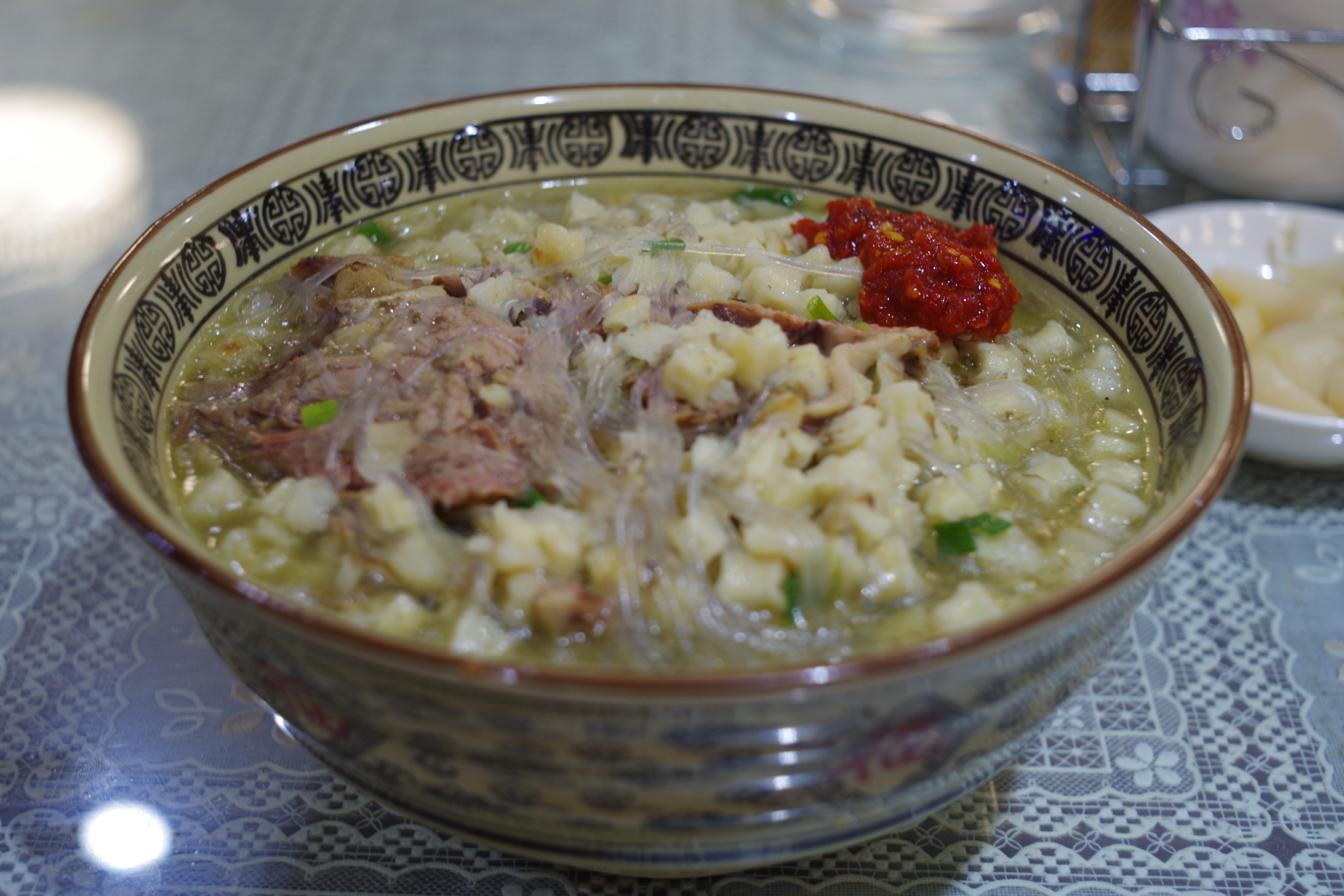
Xi'an yangrou paomo — a blue-and-white bowl of mutton soup with small torn bread pieces, vermicelli, lamb slices and a dab of red chilli 6
The City's Signature · Tear Your Own Bread
Yangrou Paomo 羊肉泡馍 — Mutton Soup, Torn Bread
羊肉泡馍 · Sit-down spots all over · The bread-tearing ritual

This is as close to the heart of Xi'an's food as any single dish — and it comes with a fun "ritual." The restaurant brings you a couple of dense, dry flatbreads (饦饦馍) to tear into small pieces by hand; the smaller you tear them, down to bean-sized bits, the better the soup soaks in. You send the bowl back, the kitchen simmers your bread with a rich mutton broth, vermicelli and sliced lamb, and it returns to you steaming.

Eat it with pickled sweet garlic (糖蒜), pale purple and sweet-sour to cut the richness, and a spoon of chilli paste (辣椒酱). A back lane like Dapiyuan is cheaper than the headline restaurants on the main street. Some people prefer the beef version (牛肉泡馍), which is a touch milder. For the famous institutions like Lao Sun Jia (老孙家) and how to order, see our Xi'an must-eat dishes guide.
Where: Sit-down spots citywide · Dapiyuan for value, big names on the drag
Cost: ¥35–55 per bowl (฿175–275) — a big bowl is a full meal
Best time: Lunch — it's a heavy, filling dish
Payment: WeChat Pay / Alipay / cash
First-timer note: If you'd rather not tear the bread, you can ask the restaurant for "机器掰" (machine-cut) — but tearing it is half the fun. One bowl is huge for one person; if you're two, share a bowl as a first course.
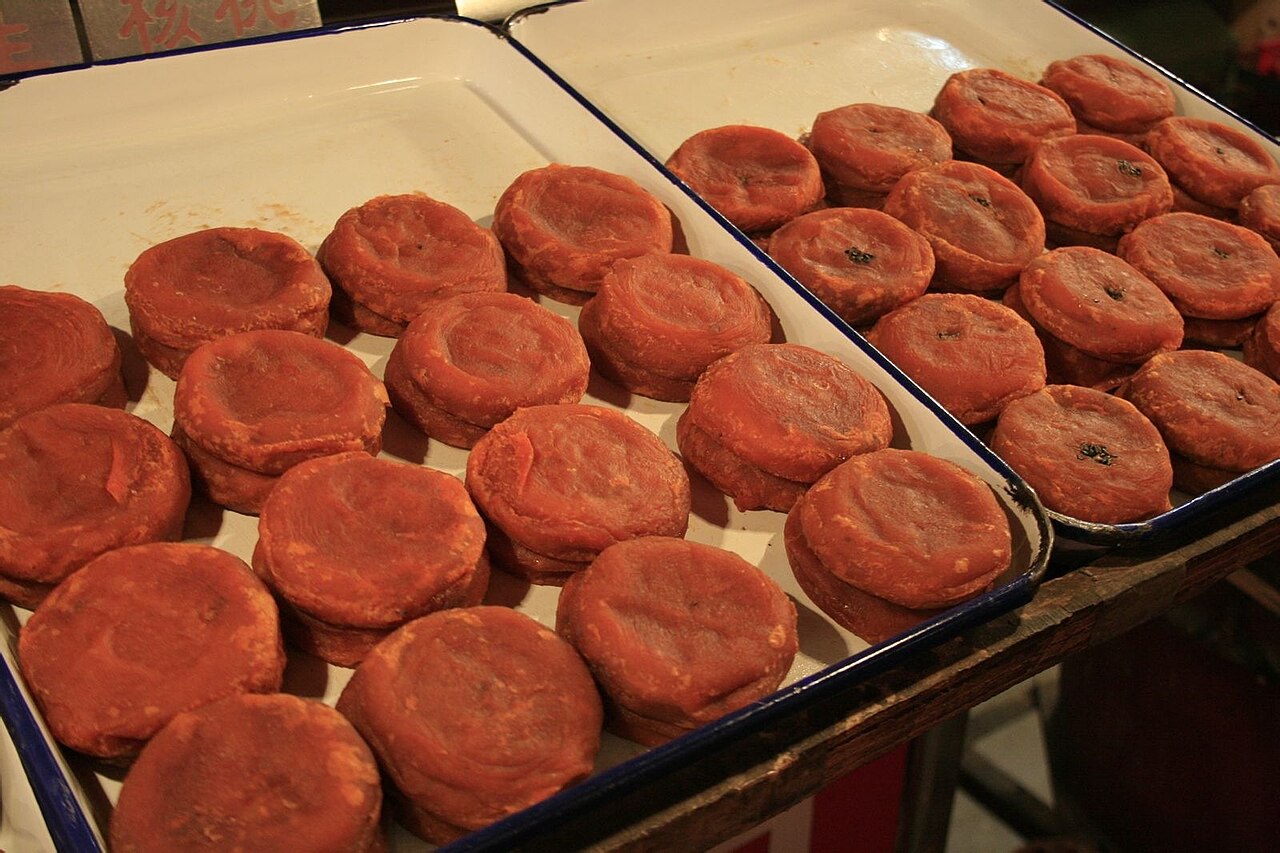
Golden-orange fried persimmon cakes (huanggui shizibing) laid out in white enamel trays at a stall in Xi'an's Muslim Quarter 7
The Quarter's Sweets · Eat on the Move
Persimmon Cakes 黄桂柿子饼 — The Sweet Highlight
黄桂柿子饼 · Sweet stalls throughout · Fried fresh and hot

The dessert that's genuinely Xi'an's own — a dough made from ripe persimmons from the nearby Lintong area, mixed and patted into rounds, stuffed with sweet osmanthus syrup (桂花), sesame or nuts, then fried until the crust is crisp and golden-orange and the inside is soft, chewy and fragrant. Eaten hot off the pan it's the best. About ¥5–8 each (฿25–40).

Other sweets and walking snacks worth seeking out: jinggao (镜糕), glutinous rice steamed in tiny wooden moulds, served on a stick with brown sugar and sesame; zenggao (甑糕), sticky rice layered with dates and red beans, sold as a breakfast and usually gone by afternoon; dried fruit and roasted nuts (干果) — walnuts, apricots, dates, sold by weight (ask the price first!); and cold rose-syrup drinks or sweet almond milk to beat the heat.

Where: Stalls throughout · fried-fresh persimmon beats the stacked ones
Cost: Sweets ¥5–10 each (฿25–50) · dried fruit by weight
Best time: Zenggao in the morning · fried sweets in the evening
Payment: WeChat Pay / cash
A warning on dried fruit: Dried-fruit and nut stalls on the main drag like to scoop into a bag before telling you the price, which usually ends up steep. Ask the price per jin (500g) clearly, and state how much you want first — or buy sealed, price-tagged packs.
🥟
8
Sit-Down Savoury · Refuel
Soup Dumplings, Guantangbao & Other Savouries
灌汤包 · 凉皮 · Jia San (贾三), Xiyangshi

When you've grazed on grilled meat and sweets until you're flagging, sit down for something you eat slowly. Guantangbao (灌汤包) are soup-filled steamed buns; the famous house is Jia San (贾三灌汤包), a long-running quarter institution with branches both on Beiyuanmen and on Xiyangshi (西羊市) — thin skins, dense filling. Lift one carefully, nick a hole, sip the broth before you bite.

Other savouries worth trying: liangpi (凉皮), cool, springy wheat-starch noodles dressed in vinegar, chilli and sesame — a refreshing, meat-free plate that even vegetarians can eat; babao zhou (八宝粥), a sweet, warm eight-treasure porridge; and the clear mutton broth (水盆羊肉) eaten with a round bun. Xiyangshi is the lane that packs in the most old sweet and savoury shops — walk straight on from Dapiyuan.

Where: Jia San on Beiyuanmen + Xiyangshi · liangpi everywhere
Cost: Guantangbao ¥25–40 per basket · liangpi ¥8–15 (฿40–75)
Best time: Mid-afternoon, after the lunch rush eases
Payment: WeChat Pay / Alipay / cash
Tip: Jia San (贾三) is the place Xi'an locals themselves recommend when you ask where to get soup dumplings — it's been going for over a century. The Xiyangshi branch is quieter than the one on the main drag. Liangpi is the safest bet for non-meat-eaters.
Quick Tips

Know before you walk in

🕌
This is the Hui Muslim quarter
Almost every restaurant is halal (清真) — beef and lamb, no pork. Respect the custom: don't bring outside pork or alcohol into the restaurants. For Muslim travellers it's one of the easiest places to eat in all of China.
🔄
Turn into a lane, halve the price
The Beiyuanmen main drag is pricey and tourist-focused. Turn into Dapiyuan or Xiyangshi, or walk to Sajinqiao — same food, about half the price and better made.
⚖️
Ask the dried-fruit price first
Dried-fruit and nut stalls love to scoop and bag before quoting a steep price. Ask the cost per jin (500g) clearly, or buy sealed, price-tagged packs instead.
📱
Set up WeChat Pay before you go
Since 2023, foreign visitors can link a Visa or Mastercard to WeChat Pay or Alipay. Do it before you head out — small stalls often take only QR payments or cash.
🌙
Night is the golden hour
5–10 pm is when the grills fully fire, the signs light the lanes and the air cools. For a local breakfast, Sajinqiao's first pot of hulatang starts around 6:30 am.
🔥
Choose the big red-willow skewers
For lamb skewers, pick the fat ones on red-willow (红柳) branches, not the little bamboo sticks — bigger, juicier chunks with a faint woody fragrance from the wood.
Frequently Asked

Questions people ask before they eat

Is Xi'an's Muslim Quarter a tourist trap?
The main drag — Beiyuanmen (回民街, directly behind the Drum Tower) — is genuinely touristy. Rents are high, stalls sell near-identical snacks, prices run above the rest of the city, and some shops are newer than they look. But the Muslim Quarter is more than that one street. Turn into the back lanes — Dapiyuan (大皮院), Xiyangshi (西羊市) — or walk a little further to Sajinqiao (洒金桥), and you'll find the stalls Xi'an locals actually eat at: roughly half the price and noticeably better.
How much does a meal in the Muslim Quarter cost?
It depends where you walk. On the main Beiyuanmen drag, walking snacks run ¥10–35 each (about ฿50–175) and a lamb skewer is ¥5–10 (฿25–50); grazing your way along comes to roughly ¥60–100 per person (฿300–500). In a back lane like Sajinqiao you can eat well for ¥20–40 per person (฿100–200). A big bowl of yangrou paomo at a sit-down restaurant is around ¥35–55 (฿175–275).
How do I get to the Muslim Quarter, and is it near the Bell and Drum Towers?
Very close. Take Metro Line 2 or Line 6 to Bell Tower Station (钟楼), take Exit B, and walk west past the Drum Tower for about 5–6 minutes to reach the head of Beiyuanmen Street. Alternatively, Line 6 to Guangjijie Station, Exit D1, then walk about 200 metres — this drops you on the more local side. If you're staying near the Bell Tower it's an easy 10–15 minute walk.
Is everything in the Muslim Quarter halal? Can I get pork?
Yes — this is the neighbourhood of the Hui, China's Muslim community, and almost every restaurant is halal (清真), built around beef and lamb with no pork. Respect the custom: don't bring outside pork or alcohol into the restaurants. For Muslim travellers, it's one of the easiest places to eat in all of China, since nearly every stall is halal by default.
What is the best time of day to eat in the Muslim Quarter?
Late afternoon into the evening, roughly 5–10 pm, is the sweet spot — the grills fire up, the signs light the lanes, the air cools, and the whole quarter comes alive. For fewer crowds, go on a weekday and avoid Chinese national holidays (Spring Festival, the Golden Week in early October). For a local breakfast, Sajinqiao's stalls start serving from about 6:30–8:30 am, the first pot of the day.
Is there non-meat food in the Muslim Quarter for vegetarians?
Some, but you'll have to choose carefully. The quarter is built around lamb and beef, but meat-free options exist: liangpi (凉皮, cold wheat noodles in a tangy sauce), fried persimmon cakes (黄桂柿子饼), jinggao (镜糕, sweet steamed glutinous rice) and zenggao (甑糕, sticky rice with dates). Cold rose-syrup drinks, dried fruit and roasted nuts are all meat-free walking snacks. Note that some noodle stalls use animal fat in the dough, so ask first if you're strictly vegetarian.
Klook

Xi'an Muslim Quarter Food Tours
with a local guide who knows every lane

Skip the guesswork and the tourist-trap stalls. A local food tour walks you through the back lanes where Xi'an really eats — roujiamo, cumin lamb skewers, yangrou paomo, and the sweets that don't have English signs — from around ¥150–300 per person (฿750–1,500).

Browse Xi'an Food Tours on Klook →
Wherebest is a Klook affiliate partner — we may earn a commission when you book through our links, at no extra cost to you.