Home Chengdu China Chengdu Hotels About
Home  ›  Asia  ›  China  ›  Chengdu  ›  Chengdu vs Chongqing
🇨🇳 Sichuan Travel Guide · 2026

Chengdu or Chongqing —
which one is right for you?

Two Sichuan siblings with opposite personalities — the laid-back panda city vs the dramatic mountain city. A real comparison before you plan (spoiler: a lot of people do both).

Before you decide

Sister cities that feel nothing alike

Picture the moment you start planning a Sichuan trip and find two cities sitting so close together you cannot tell which one to pick. Chengdu and Chongqing are only about ninety minutes apart by train, and people almost always mention them in the same breath. Both speak the Sichuan dialect, both eat their food hot — and yet the moment you arrive, you feel that they are two completely different moods.

Here is the honest framing: this is not a question of which city is "better." It is a question of what kind of trip you want. Chengdu is the city that asks you to slow down — sip tea, watch pandas, wander old lanes with nowhere to be. Chongqing is the city that makes your eyes go wide — towers stacked up the cliffs, a train running through a building, a riverfront that lights up at night like something out of a science-fiction film.

This article compares both across every dimension that matters — atmosphere, food, getting around — and, crucially, how to do both on one trip. Because when two cities are this close, sometimes the best answer is simply "do both."

Quick verdict

The short answer, before the detail

If you need to decide right now

First time in China / want a relaxed trip / love pandas and teahouses / prefer a flat, walkable city Choose Chengdu — a city that slows you down, with an easy-to-read metro, the Panda Base, face-changing opera, and teahouses where you can sit for a whole afternoon. It is the easiest first city in China.
Want dramatic cityscapes / chasing adventure / can handle heat and serious spice / want a Yangtze cruise Choose Chongqing — a mountain-river city stacked in layers, with Hongya Cave glowing gold at night, a monorail through a tower block, and the original beef-tallow hotpot that hits harder.
Chengdu

The city that asks you to slow down

A giant panda at the Chengdu Research Base of Giant Panda Breeding — the image everyone pictures when they think of Chengdu

Chengdu has something Chongqing cannot give you: a slower pace of life. This is a city where locals nurse a cup of tea all afternoon, play mahjong under the trees, get their ears cleaned in the park, and never seem to be in a hurry. The centre is relatively flat and easy to walk, and a metro of more than fifteen lines covers the whole place — which is exactly why foreign travellers consistently call it the easiest city to start with in China.

The headline reason most people fly in is the Panda Base — get there early to watch the pandas tumbling around and eating bamboo while they are at their most active; by late morning they tend to sleep it off. Beyond that there is Sichuan face-changing opera (川剧变脸), where the masks switch faster than your eye can follow, the old Kuanzhai Alley, Jinli Street, Wuhou Shrine, and the People's Park at the heart of the teahouse tradition.

The food is Chengdu in a different key too — spice that leans aromatic rather than aggressive: mapo tofu, dan dan noodles, Zhong dumplings, twice-cooked pork, and a clear-oil hotpot that is gentler on a first-timer. If you want to soak up Sichuan gradually, Chengdu is the clear answer.

Pros & trade-offs
Easy for first-timers — flat, walkable, simple metro, slow pace
The Panda Base — the best and most accessible place to see pandas in China
Teahouse culture — sip tea, watch the card games, lose a whole afternoon guilt-free
Face-changing opera, Kuanzhai Alley and Jinli Street — classic old Sichuan
A base for day trips to Leshan, Mount Qingcheng and Dujiangyan
Skies are often grey and overcast year-round (Chengdu rarely sees much sun)
Less photogenic than Chongqing — the charm is in the mood, not the skyline
The city sprawls — some sights mean a long metro ride or a transfer
Golden Week (1–7 Oct) and Spring Festival are extremely crowded, especially the Panda Base
Chengdu highlights · do not miss

What makes Chengdu, Chengdu

🐼
Chengdu Research Base of Giant Panda Breeding
North of the city · go at opening · metro + shuttle

The number-one reason people fly to Chengdu. Arrive at opening (08:00) when the pandas are awake and tearing into the bamboo — by late morning they sleep for hours. Plan the trip and book tickets on our Chengdu Panda Base guide.

Read the guide →
🍵
Teahouse culture + People's Park
City centre · a few yuan a cup · stay all afternoon

The real heart of Chengdu is not a tower or a temple — it is a teahouse in a park. Sip tea, watch the card games, listen to the bamboo creak in the breeze. This is how locals actually live. Read more in our Chengdu teahouse culture guide and People's Park.

Read more →
🏮
Kuanzhai Alley + Jinli Street
Old town · stroll and eat · very photogenic

Two old quarters that bottle up classic Sichuan — timber houses, stone lanes, street snacks and old teahouses. See everything on our Chengdu attractions page, or plan a day out with Chengdu day trips.

See all attractions →
Chongqing

The city that makes your eyes go wide

Chongqing does not compete with Chengdu on comfort — it plays a completely different game. This is a mountain-river city built up in layers. The Yangtze and Jialing rivers meet in the middle, skyscrapers climb the cliffs, roads run over the tops of buildings, and public elevators carry people between the levels of the city. The overall effect is a science-fiction cityscape that somehow became real.

The highlight the whole world knows is Hongya Cave — a stack of eleven storeys of traditional stilted timber houses on the riverside cliff. Around 7:30 in the evening the golden lights come on all at once and it looks like a palace from an animated film. The other viral spot is the Liziba monorail station (李子坝), where the train passes straight through the middle of a residential tower block — genuinely, not a trick of editing. Chongqing is also the launch point for Yangtze River cruises through the famous Three Gorges.

The honest caveats: Chongqing really is steep, there really are a lot of stairs, summers are brutally hot and humid (it is one of China's "furnace" cities), and the beef-tallow hotpot here is meaningfully spicier and richer than Chengdu's. If you come for the energy and for photos that make people ask "where is that?" — Chongqing pays you back in full.

🌃
Chongqing · the cyberpunk cliff-city
Hongya Cave · Liziba monorail · Yangtze cruises (Chongqing does not have a Wherebest guide yet)
Pros & trade-offs
Dramatic topography — a layered mountain city that photographs like a film set
Hongya Cave at night — the golden riverside lights that became the city's signature image
The monorail through a building at Liziba — an urban phenomenon you will not find elsewhere
The capital of hotpot — original beef-tallow broth, rich and fierce, for serious spice lovers
The launch point for Yangtze cruises through the Three Gorges — something Chengdu cannot offer
Steep, with a lot of stairs — tiring on the legs, hard if you have mobility issues or a pushchair
Brutally hot and humid in summer — Jun–Aug is oppressive; avoid it if you struggle with heat
Spicier than Chengdu — first-timers should order a half-spicy, half-mild split pot
A disorienting layout — the "first floor" of one building can be the "eighth" of the next
Chongqing highlights · do not miss

What makes Chongqing, Chongqing

🏙️
Hongya Cave
Jialing riverside · lights on around 19:30 · free to enter

Eleven storeys of traditional timber houses stacked on the cliff. By day it is a shopping-and-snacking warren; after dark the gold lights come on and it looks like a scene from an animated film. The best view is from across the water on Qiansimen Bridge. (Chongqing does not have a dedicated Wherebest guide yet — use this to plan.)

🚆
Liziba monorail through a building
Liziba station, Line 2 · viewing deck below · free

A monorail line that runs straight through the middle of a 19-storey apartment block — real, and famous worldwide. There is a viewing platform below where you can wait to photograph the train sliding into and out of the building. It takes only a few minutes, but it is a shot you will talk about all trip.

🚢
Yangtze cruise · Three Gorges
Departs Chongqing · multi-day · ends near Yichang

Chongqing is the main departure point for Yangtze River cruises through the Three Gorges — a three-to-four-day journey Chengdu simply cannot offer. Good if you want to extend your trip slowly toward eastern China.

Food · hotpot head-to-head

Same Sichuan roots, two different hotpots

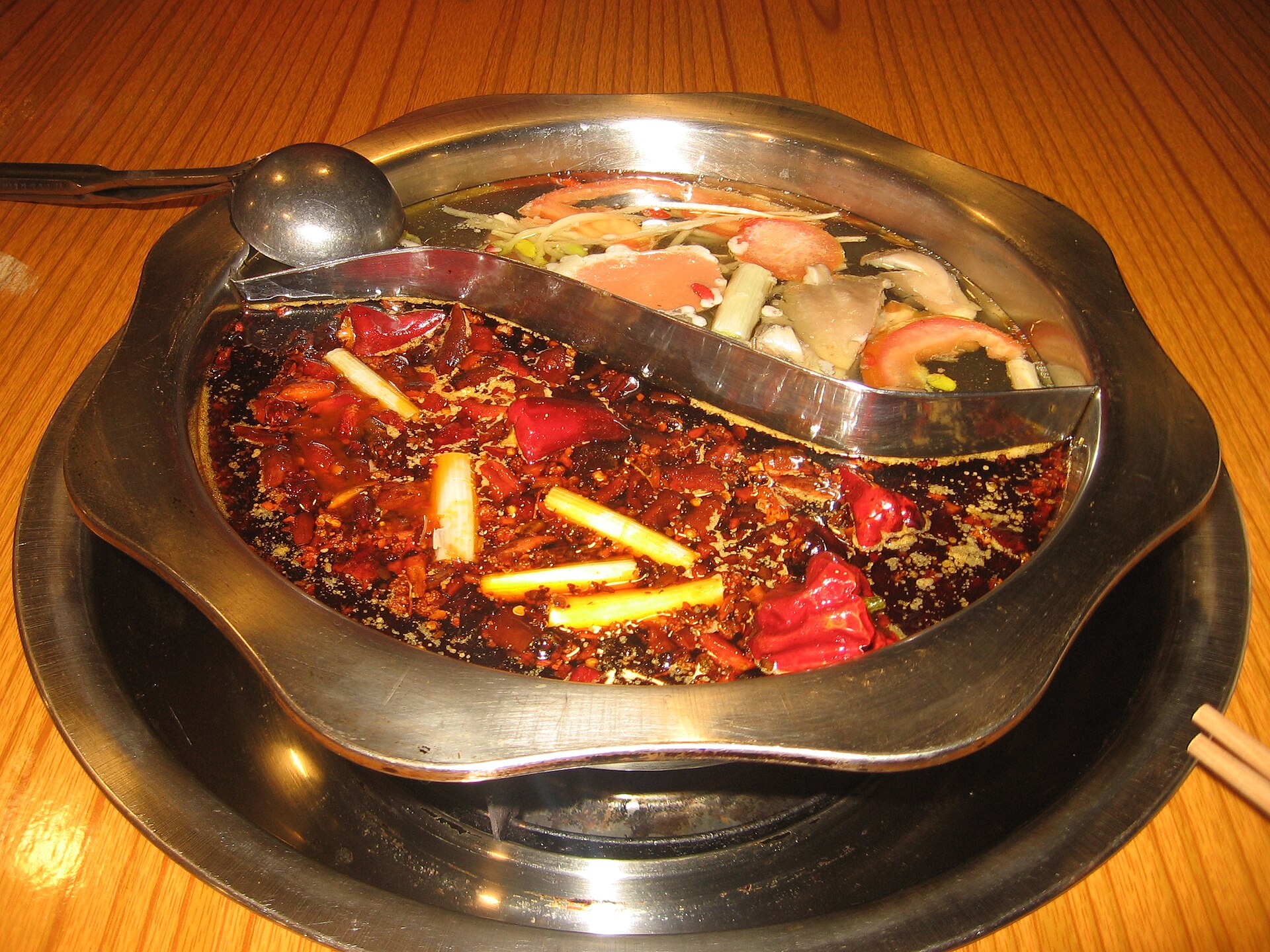
A bubbling red Sichuan hotpot loaded with ingredients — the dish at the heart of both Chengdu and Chongqing

If there is one thing the two cities will argue about forever, it is whose hotpot is the real one. The short answer is: different styles, both delicious.

Chongqing hotpot uses a beef-tallow (牛油) base — rich, oily, heavy, and fierce with chilli and the numbing tingle of Sichuan peppercorn. This is the hardcore original, and Chongqing locals are proud of how mercilessly it burns.

Chengdu hotpot more often uses a clear-oil (清油) base that is more aromatic and easier to handle. A first-timer building up to Sichuan heat will cope far better with Chengdu, and can then test their nerve in Chongqing afterwards.

Both cities let you order a split pot (鸳鸯锅) — one spicy side, one clear broth — in case your group's heat tolerance is uneven. Go deeper on the broths and how to order in our Chengdu hotpot guide, and the full regional spread in our Chengdu food guide.

Side by side

The full comparison, in one table

Factor Chengdu Chongqing
Atmosphere Relaxed and slow — teahouse culture Fast, dramatic — a cyberpunk mountain city
Topography Relatively flat, easy to walk Mountain-river, layered, lots of stairs, city elevators
Highlights Panda Base, face-changing opera, Kuanzhai Alley, Jinli Hongya Cave, Liziba monorail, Yangtze cruise, night views
Hotpot Clear-oil (清油) — aromatic, gentler, easy to handle Beef-tallow (牛油) — rich, fierce, the hardcore original
Getting around 15+ metro lines, easy to read, walkable Metro + elevators + cable car — fun but disorienting
Best for first-timers Very — the easiest first city in China Moderate — fun but more demanding
Climate Overcast year-round, mild temperatures Hot and humid summers (a "furnace" city)
Best for Slow travellers, families, panda lovers, first trip to China Adventurers, photographers, spice and heat lovers, cruise fans
The best answer

Why not do both?

When two cities are only a ninety-minute train apart, picking just one is rarely the best move. Here is how to pair them on a single trip.

🚄
High-speed rail: Chengdu East → Chongqing, about 90 minutes
Trains leave Chengdu East station (成都东) for Chongqing in around 90 minutes, with the fastest services down to roughly an hour. They run very frequently from about 06:40 until late at night — around 60 to 80 a day, sometimes only ten minutes apart. A second-class seat is roughly ¥130–160 (about ฿650–800), and you can book ahead through an app. See how to book and board on our China high-speed rail guide.
1
Start with three days in Chengdu
Day one: the Panda Base early, then an afternoon at People's Park and a teahouse. Day two: a day trip to Leshan or Mount Qingcheng. Day three: Jinli Street, Wuhou Shrine and shopping around Chunxi Road. See the full plan in our 3-day Chengdu itinerary.
2
Take the train on to Chongqing for two or three days
On the morning of day four, take the train to Chongqing, drop your bags and go: Hongya Cave after dark (lights on around 19:30), the Liziba monorail station, and the Qiansimen Bridge viewpoint over the city — plus a Yangtze cruise if you have the time. Chongqing does not have a Wherebest guide yet, but the notes on this page are enough to plan the outline.
3
Fly home from either city (an open-jaw plan)
Both cities have international airports, so you can fly into Chengdu and out of Chongqing (or the reverse) without ever doubling back — saving you half a day. Start your hotel search with our 10 best hotels in Chengdu, and get the bigger picture in our Chengdu first-timer guide.
The decision

Pick this city if you are…

On your first trip to China, or short on time (2–3 days) — choose Chengdu. It is flat, easy to walk and has a simple metro, and the slow pace lets you ease into China. Add the Panda Base and the teahouses and you can see the best of it in just a few days.
A photographer or city person who wants shots that make people ask "where is that?" — choose Chongqing. Hongya Cave at night, the monorail through a tower and the riverside skyline are images Chengdu cannot give you. If you like a city with energy and you are not afraid of stairs, Chongqing is well worth it.
Travelling with young children, older parents, or anyone who cannot walk far — choose Chengdu. It is clearly flatter and easier on the legs, and the Panda Base is a hit with kids. Chongqing's stairs and steep streets can be exhausting.
A serious spice eater, keen to test the original hotpot, or wanting to continue by Yangtze cruise — choose Chongqing. The beef-tallow broth burns without mercy, and Chongqing is the launch point for cruises through the Three Gorges that Chengdu does not offer.
Travelling with 5–6 days or more — do both. Start in Chengdu at an easy pace, then take the 90-minute train to finish on a dramatic note in Chongqing, flying out from whichever city suits. This is the most complete Sichuan trip for anyone who wants to see both sides of the province.
Frequently asked

FAQ · Chengdu vs Chongqing

How far apart are Chengdu and Chongqing, and how do you travel between them?
Much closer than people expect. High-speed trains from Chengdu East station run to Chongqing in about 90 minutes, with the fastest services down to roughly an hour. Trains depart very frequently from early morning until late at night — around 60 to 80 a day, sometimes only ten minutes apart. A second-class seat is roughly ¥130–160 (about ฿650–800). Because the two cities are this close and this well connected, a large share of travellers simply do both on one trip. See how to book in our China high-speed rail guide.
If it is my first time in China, should I choose Chengdu or Chongqing?
For a first trip to China, Chengdu is the gentler place to start. The city is relatively flat and walkable, the metro is easy to follow, the pace is slow, and the pandas and teahouses give you a soft landing. Chongqing is more exciting but also more demanding — the city is stacked in layers on steep mountain terrain, there are a lot of stairs and elevation changes, summers are hot and humid, and the hotpot is spicier. If you want drama and skyline photos, Chongqing repays the effort. If you want to ease in, starting in Chengdu and then taking the short train to Chongqing is the most natural order. See the overview in our Chengdu first-timer guide.
How is Chengdu hotpot different from Chongqing hotpot?
Both are Sichuan hotpot, but with different personalities. Chongqing hotpot uses a beef-tallow (牛油) base — richer, heavier and more intensely spicy, the hardcore original. Chengdu hotpot more often uses a clear-oil (清油) base that is more aromatic and a little gentler, which makes it easier for first-timers. If you are still building up your tolerance for Sichuan heat, many people suggest starting with Chengdu and then testing yourself in Chongqing. Both cities let you order a split pot (鸳鸯锅) with one spicy side and one mild broth. More in our Chengdu hotpot guide.
What does Chongqing have that Chengdu does not?
Chongqing has topography that Chengdu cannot match — a city built up the cliffs where the Yangtze and Jialing rivers meet, with buildings stacked up the slopes, roads running over rooftops, and a monorail that passes straight through an apartment block at Liziba station. Hongya Cave, a complex of stilted timber houses layered on the cliff, lights up in gold around 7:30 pm and looks like a film set. Chongqing is also the main departure point for Yangtze River cruises through the Three Gorges. Chengdu, by contrast, is the place for pandas, Sichuan face-changing opera and teahouse culture.
With 5 to 6 days, how should I do both cities?
The popular plan is three days in Chengdu first (day one: the Panda Base early, then Kuanzhai Alley and People's Park; day two: a day trip to Leshan or Mount Qingcheng; day three: Jinli Street, Wuhou Shrine and shopping around Chunxi Road), then the 90-minute high-speed train to Chongqing for two to three days (Hongya Cave, Liziba monorail station, the Qiansimen Bridge viewpoint, and a Yangtze cruise if you have time). You can fly home from either city — both have international airports — so an open-jaw plan means you never have to double back. See the detailed Chengdu plan in our 3-day Chengdu itinerary.