Home Chengdu China Chengdu Hotels About
Home  ›  China  ›  Chengdu  ›  Chengdu Teahouse Culture
🍵 Chengdu Teahouses · 2026

Chengdu — the city
that teaches you to slow down

Bamboo chairs under the shade trees, a lidded bowl of tea topped up forever, the clack of mahjong tiles over the hum of conversation, ear-cleaners ringing their tuning forks, and locals in no hurry to be anywhere — this is the real heart of the city.

Why the teahouse

The place that explains Chengdu in a single bowl

Picture a city-centre park on an ordinary weekday afternoon. Hundreds of bamboo chairs are scattered under tall trees beside a lake. Retirees have been sitting and chatting since mid-morning. At one cluster of tables a mahjong game rattles along; at another, someone has tipped their head back for a nap with a tea bowl resting by their hand. An ear-cleaner threads between them, ringing a small tuning fork to announce himself. This is Heming Teahouse in People's Park — the heart of the Chengdu way of life that the whole city knows.

Chengdu is widely called the most relaxed city in China, and nowhere captures that better than the teahouse. Locals have a phrase for an afternoon of tea and talk: bai long men zhen (摆龙门阵) — literally "setting up a storytelling circle." You come to chat, to gossip, to chew over the news of the day, and nobody is in a rush to leave. It's been woven into the city's character for centuries.

What makes the Chengdu teahouse special isn't only the tea — it's the whole scene. The lidded bowl called a gaiwan, the long-spout copper kettle a server can pour over your head with pinpoint accuracy, the ear-cleaning you'll find almost nowhere else, and — in certain teahouses — a Sichuan-opera face-changing act so fast your eye can't keep up. Come to Chengdu and skip the teahouse for an afternoon, and you haven't really arrived yet.

The heart of the scene

Heming Teahouse — People's Park

Open since 1923, and still busy every single day
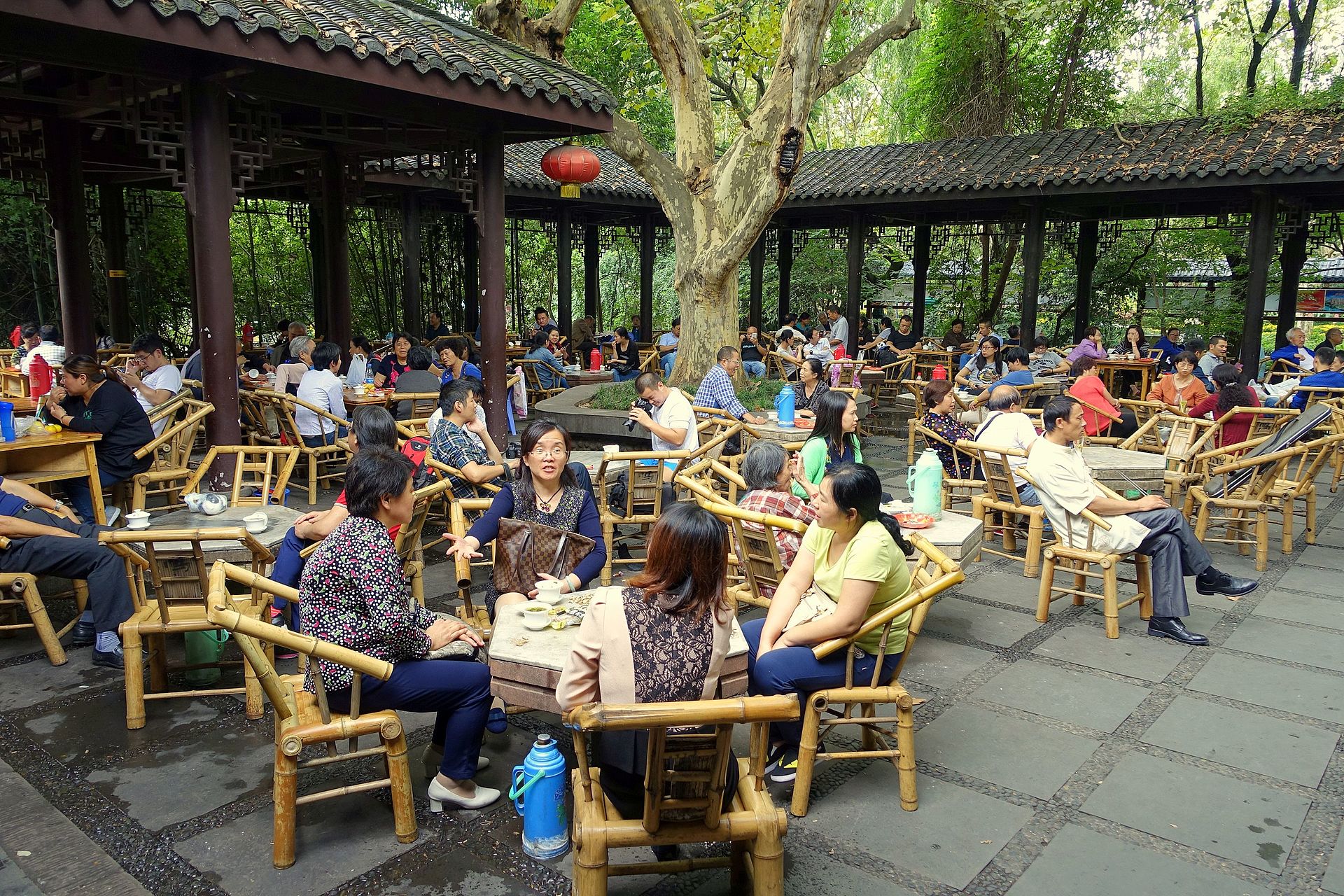
People's Park in Chengdu, home to Heming Teahouse, with its leafy lakeside setting where locals gather to drink tea

Heming Teahouse (鹤鸣茶社) sits inside People's Park (人民公园 Renmin Gongyuan) in central Chengdu, and it's the oldest and most famous open-air teahouse in China. Open since 1923, it has hundreds of bamboo chairs spread along the lakeside under the trees. None of it is staged for tourists — actual Chengdu locals come here every day.

The server brings your tea in a gaiwan. The most popular choice is fragrant jasmine tea (茉莉花茶) from the Mengding or Emei mountain regions — light, floral and easy to drink. When the water in your bowl runs low, a server carrying a long-spout copper kettle comes by to refill it from a distance, sometimes raising the kettle high and arcing the hot water into the bowl with a precision that looks like a performance in itself. The refills are free and endless, all day long.
Getting there: People's Park is right by the People's Park metro station (Line 2); the nearest exit is a few minutes' walk from the teahouse. Entry to the park is free — you only pay for tea once you sit down. Come on a weekday morning (around 9–11 am) for the best atmosphere and the easiest seat.
Life inside the teahouse

What actually happens in a teahouse

Understand each piece first, and the sitting becomes far more fun

🍵1
Gaiwan — the lidded tea bowl
盖碗茶 · heaven, person, earth in one bowl

A gaiwan is the Sichuan-style tea vessel made of three pieces — the lid, the bowl and the saucer. In old Chinese symbolism the lid is heaven, the bowl is the person and the saucer is the earth. To drink, hold the saucer with thumb and middle finger, steady the lid with your index finger, and tilt it slightly ajar so the floating leaves stay out of your mouth. The lid keeps the heat in and your fingers off the hot bowl. It looks simple, but there's a quiet craft to it.

Popular teas: jasmine · maofeng green · chrysanthemum
Price: ¥16–35 (฿80–175), unlimited refills
Tip: empty bowl? tip the lid ajar — the server will top you up
👂2
Ear-cleaning — a Chengdu speciality
掏耳朵 · the vibrating tuning fork

The sight that most surprises visitors is the ear-cleaner, moving through the chairs with a bundle of tiny tools and a tuning fork he taps to make it hum. He works gently with slender picks, then uses a soft feather and the vibrating fork inside the ear for a ticklish, pleasant sensation. Locals consider it a top-tier way to relax — and it's an experience you'll struggle to find anywhere else in the world.

Price: ¥30–100 (฿150–500) per session
Hygiene: good practitioners use sterilised tools — watch before you agree
Note: not for you? just watching is half the fun
🀄3
Mahjong & bai long men zhen
麻将 · 摆龙门阵 · the true sound of the city

The clatter of mahjong tiles is the soundtrack of a Chengdu teahouse. Locals set up games that run for hours, breaking off to "bai long men zhen" — sit and chat, gossip, kick the day's news around with no plan to head home. Some tables talk from morning to dusk. For a Chengdu local, the teahouse isn't just somewhere to drink tea; it's the living room of the whole city.

Atmosphere: lively, easygoing, never formal
Busiest: weekday afternoons · all day at weekends
Etiquette: photos are fine — but ask before shooting a game up close
😌4
The slow life — living Chengdu-style
慢生活 · a city that never rushes

The Sichuan basin has been agriculturally rich since ancient times — its old nickname is the "Land of Heaven" — so people never had to scramble and compete just to get by. A culture of taking things slowly took deep root, and the teahouse is where it shows most clearly: you can sit a whole afternoon on the price of one bowl of tea, with nobody to move you along or hurry you. Doing nothing but sipping tea and watching people pass is the best lesson there is in what Chengdu is about.

Try this: order one bowl of tea, then sit a full two hours
You'll get: a feel for a rhythm unlike any other big Chinese city
The evening highlight

The Sichuan-opera face-changing show

A secret art too fast for the eye — in the teahouses with a live stage

Some Chengdu teahouses come with more than tea — they have a Sichuan-opera stage, and the act everyone waits for is bianlian (变脸), face-changing. A performer wears a brightly coloured mask, then switches it for another in a split second with a flick of the head or a sweep of the hand past the face. Some change a dozen masks in a few minutes. How it's done is a family secret, never revealed to outsiders.

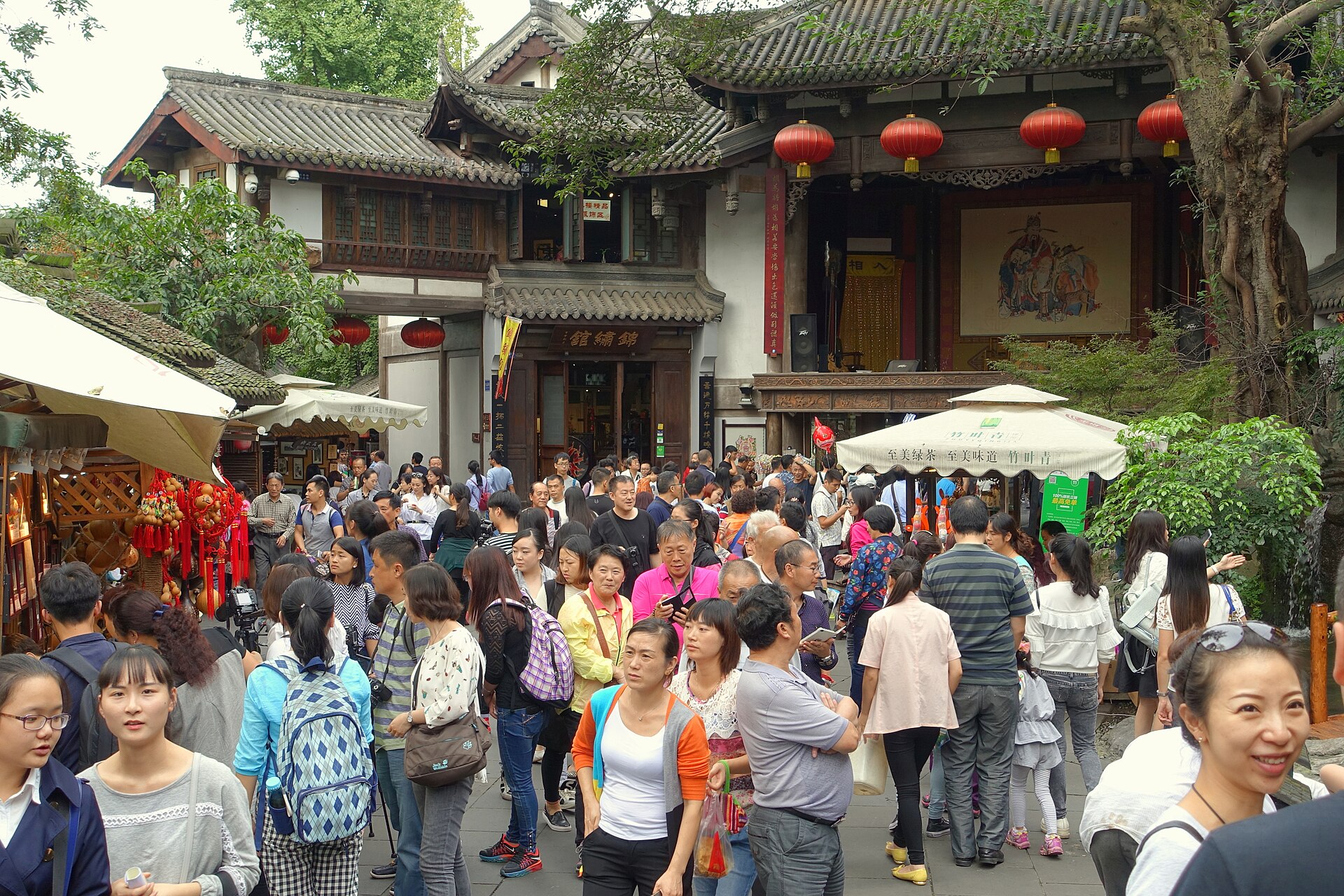
Jinli Ancient Street in Chengdu, a heritage quarter with teahouses and folk performances, lit by red lanterns at dusk

Chengdu's old cultural quarters — like Jinli Ancient Street and Culture Park — are home to several Sichuan-opera theatres.

1
Shufeng Yayun Theatre
蜀风雅韵 · Qintai Road, inside Culture Park · the best-known Sichuan-opera house

Shufeng Yayun is the Sichuan-opera theatre most visitors know. The show brings together a spread of Sichuan folk arts — face-changing, fire-spitting, rod puppetry, shadow play, the rolling-lamp act and live music. It starts around 8 pm and runs about 90 minutes, with tea served throughout; some seats include an ear-cleaning add-on before the curtain. It's the right choice if you want all the headline Sichuan-opera acts in a single evening.

Address: Qintai Road, Qingyang District (inside Culture Park, near Qingyang Palace)
Price: tickets around ¥150–320 (฿750–1,600) depending on seating tier · Time: starts 8 pm · book ahead
2
Shunxing Old Teahouse
顺兴老茶馆 · 3rd floor, Shawan exhibition centre · teahouse + show + Sichuan food

Shunxing is a large teahouse decked out in old-Sichuan period style, with face-changing and Sichuan opera plus a full menu of Sichuan dishes and dim sum to order while you watch. It suits anyone who wants dinner and a show in one place. The décor goes all in, making it a strong pick for a full-on cultural evening.

Address: Shawan Convention & Exhibition Center, 3rd floor, Shawan Road
Price: depends on the food + show package · Time: evening performances · reserve a table ahead
Good to know: front-row seats put you close to the face-changing, and there's a chance a performer comes down to switch masks right in front of you — so if you want a clean video, the front section is worth it. Sichuan opera is sung in dialect; even if you can't follow a word, the spectacle is all in the movement and the colour.
Where to sit

Teahouses worth trying at least once

From the buzzing park teahouse to a century-old dirt-floor room on the edge of town

Heming Teahouse (People's Park)
鹤鸣茶社 · city centre · People's Park metro, Line 2

The first choice for everyone. Open since 1923, bamboo chairs by the lake, a buzzing atmosphere, and the place where actual Chengdu locals come to sit. Tea, ear-cleaning, mahjong and a steady stream of snack vendors. If you only have time for one teahouse, this is it.

Price: ¥16–35 / bowl · Atmosphere: lively, open-air · Best time: weekday mornings, 9–11 am
Guanyinge Teahouse (Pengzhen)
观音阁老茶馆 · suburban Pengzhen · about 1 hr from the centre

If you want a teahouse that looks like it stepped straight out of the past, this is the one. Dirt floor, a coal stove boiling the water, old wooden chairs, more than a century old — a favourite with photographers. Village elders still come every morning, and tea costs around ¥10, cheap enough to surprise you. A time-capsule atmosphere the city centre can't match anymore.

Price: ~¥10 / bowl · Atmosphere: raw, old, time-worn · Best time: early morning, for the light through the doorway
Wenshu Monastery teahouse
文殊院 · Qingyang District · Wenshu Monastery metro, Line 1

The teahouse in the courtyard of Wenshu Monastery — the prettiest and most peaceful Buddhist temple in Chengdu. Ideal if you'd rather sit quietly, away from the bustle of People's Park. Shaded and calm, with bamboo and a faint trace of incense; sip your tea and watch the slow life go by. The vegetarian food around the temple is worth a try too.

Price: ¥28+ / bowl · Atmosphere: calm, shaded · Best time: late morning to afternoon
Daci Temple teahouse / Jinli
大慈寺 · 锦里 · near Taikoo Li & Wuhou Shrine

The teahouse in the courtyard of Daci Temple sits right beside the sleek Taikoo Li shopping district — a striking old-meets-new contrast. Over near Wuhou Shrine, Jinli Ancient Street has period-styled teahouses with occasional folk performances. Both are good for a tea break while you're wandering the old quarters.

Price: ¥30–88 / bowl · Atmosphere: old-meets-new, more tourists · Best time: afternoon to evening
Etiquette & how to drink

Sit in a teahouse like a local

A few small things to know, so you can settle in and blend right in

🫖1
The refill signal
lid ajar = "top me up"

When the water in your bowl runs low and you want a refill, there's no need to call anyone. Just rest the lid ajar against the rim of the saucer, or turn it upside down beside the bowl. A server with a long-spout kettle spots it from across the room and comes over to top you up with hot water. It's a piece of body language that's been used for generations — simple, and rather elegant.

Easy rule: lid on = still drinking · lid off/upturned = refill
💰2
How to pay
WeChat Pay / Alipay mainly

Most teahouses take payment via WeChat Pay or Alipay — some when you order, some when you leave. The price of the tea already includes unlimited hot-water refills; ear-cleaning and snacks from the roving vendors are charged separately. Set up Alipay and link a foreign card before you travel — it's by far the easiest way.

Set up first: see the China payment guide
📷3
Photograph with manners
ask before close-ups

A teahouse is a real space for locals. Wide atmosphere shots are no problem, but for close-ups of faces or a mahjong game, smile and ask first. Most people in Chengdu are warm and happy to oblige — but asking is the courtesy that keeps everyone comfortable. And don't stand in the path of a server carrying a kettle of boiling water.

Avoid: flash in people's faces · blocking the servers' route
🕐4
When to go
weekday mornings = the best atmosphere

The best window is a weekday morning, around 9–11 am: gentle sun, comfortable air, easy seating, and you'll see locals genuinely settling in. Weekend afternoons get very full, especially at Heming, where you may spend a while hunting for a chair. For a Sichuan-opera face-changing show, you'll want an evening slot around 8 pm.

Skip: Saturday–Sunday afternoons at the popular teahouses
People's Park in Chengdu on an afternoon, with bamboo chairs and the teahouse setting where locals sit and chat over tea

People's Park in central Chengdu — walkable from the Chunxi Road and Taikoo Li districts. Staying nearby makes teahouse-hopping easy.

Stay near the centre

Where to sleep for easy teahouse days

Basing yourself in the central districts near People's Park and Chunxi Road keeps the teahouses and the sights within easy walking distance.

Frequently asked

FAQ · what people ask before a Chengdu teahouse visit

How much does it cost to sit in a Chengdu teahouse?
Less than you would expect. At Heming Teahouse in People's Park, a gaiwan of tea with a bamboo chair and unlimited hot-water refills for the whole day runs about ¥16–35 (฿80–175) per person. Better-grade tea or a temple teahouse like Wenshu sits at ¥28–88 (฿140–440). Ear-cleaning is charged separately, roughly ¥30–100. A Sichuan-opera face-changing show at a theatre such as Shufeng Yayun starts around ¥150–320 depending on the seating tier.
What is gaiwan tea and how do you drink it?
A gaiwan is a Sichuan-style lidded tea bowl in three parts — the lid, the bowl and the saucer. In Chinese tradition the lid represents heaven, the bowl represents the person and the saucer represents the earth. To drink it, hold the saucer with your thumb and middle finger, steady the lid with your index finger, and tilt the lid slightly ajar so the floating tea leaves stay out of your mouth. The lid also keeps the heat in. When the bowl is empty, rest the lid against the saucer or turn it upside down on the table — the server spots the signal from across the room and comes to top you up.
Which is the best teahouse in Chengdu?
For a first visit, Heming Teahouse in People's Park is the one to go to — open since 1923, lively, with hundreds of bamboo chairs around a lake. For a genuinely time-worn atmosphere — dirt floor, coal stove, a century old — head out to Pengzhen's Guanyinge Teahouse on the city's edge, where tea costs around ¥10. For a quiet, contemplative sit, the teahouses inside Wenshu Monastery or Daci Temple are best. And to catch a face-changing performance, go to Shufeng Yayun or the Shunxing Old Teahouse.
Is the teahouse ear-cleaning safe, and is it worth trying?
Ear-cleaning is a long-standing Chengdu custom. The practitioner uses a set of small tools, including a tuning fork that vibrates a delicate pick for a pleasantly ticklish sensation. Many people describe it as a uniquely relaxing experience you won't find elsewhere. It costs roughly ¥30–100 (฿150–500) per session. On hygiene, a good practitioner uses sterilised tools — if you're concerned, watch to see that they wipe the tools down before using them on you. And if you'd rather skip it, simply watching it happen is half the fun.
What is face-changing, and where can I see it?
Bianlian (变脸), or face-changing, is a closely guarded secret art of Sichuan opera. Performers switch the brightly coloured masks on their faces in a split second with a flick of the head or a sweep of the hand — too fast to follow with the eye. The technique is passed down within families and kept hidden. You can see it at the Shufeng Yayun theatre (in Culture Park on Qintai Road), where shows start around 8 pm and run about 90 minutes, alongside fire-spitting, puppetry, shadow play and live Sichuan folk music. Another option is the Shunxing Old Teahouse, which pairs the performance with a Sichuan meal.
Why is Chengdu known for its slow way of life?
Chengdu is widely called the most relaxed city in China, and the teahouse is the symbol of that pace. Locals call an afternoon of tea and conversation 'bai long men zhen' (摆龙门阵) — gathering to chat, tell stories, play mahjong or simply nap under the shade trees. The Sichuan basin has been agriculturally rich for centuries, so people never had to live at a frantic pace, and a teahouse culture hundreds of years old became the heart of the city. Spend half a day sitting over a single bowl of tea and you'll understand Chengdu better than you would ticking off ten sights.
Klook · Chengdu tours

Sichuan-opera face-changing tickets & Chengdu tours

Book tickets for a Sichuan-opera face-changing show at a well-known theatre, or a walking tour of the old quarters and teahouses. Reserving ahead beats queuing at the door on the night.

See Chengdu activities on Klook →
Wherebest is a Klook affiliate partner — we may earn a commission when you book through our link, at no extra cost to you.