Home Chengdu China Chengdu Hotels About
Home  ›  China  ›  Chengdu  ›  Attractions
Chengdu Attractions · 2026

What to see in Chengdu
Pandas, old lanes & the slowest city in China

Sichuan's capital runs on a slower clock than the rest of China. Spend the morning watching pandas chew bamboo, the afternoon nursing a single cup of tea in a park, and the evening eating something fiercely spicy down a Qing-dynasty lane. This is a city that makes you slow down — and you end up loving it for exactly that.

Why come here

A city that teaches you to slow down

Chengdu is not in a hurry, and that is the point. Locals have a saying — roughly, "what's the rush?" — and you see it everywhere: retirees playing mahjong over tea all afternoon in People's Park, the smell of hotpot drifting through the Wide & Narrow Alleys, a man walking past a teahouse with metal tools asking if you'd like your ears cleaned. These scenes are hard to find anywhere else in China now, and Chengdu still does them daily.

But the slow pace is only half the story. About 10 km north of the centre is the Chengdu Research Base of Giant Pandas, home to dozens of pandas — the reason many people fly here in the first place. And the city is a gateway to several UNESCO World Heritage Sites: the Leshan Giant Buddha, sacred Mount Emei, and the 2,200-year-old Dujiangyan irrigation system, all easy half-day or full-day trips by high-speed rail. We picked the 10 sights that capture this city best — with honest advice on when to go, what to pay, and what to skip.

Top sights

10 sights worth your time

Ranked by what locals still recommend — not just the photo stops
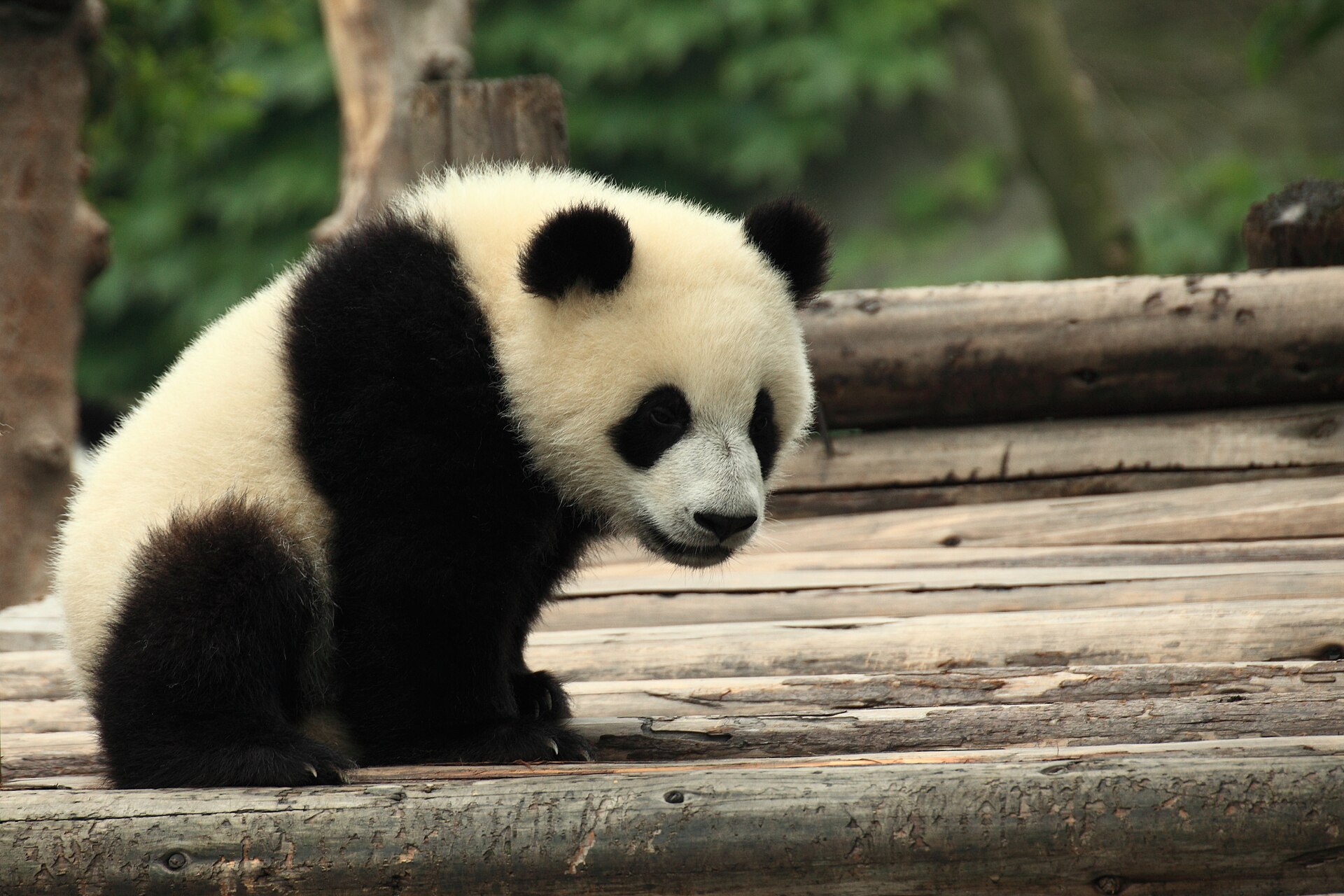
A giant panda clutching and chewing bamboo at the Chengdu Panda Base, surrounded by green bamboo 1
Chengdu Research Base of Giant Pandas
成都大熊猫繁育研究基地 · why many people fly to Chengdu

Picture this: around 8.30 am you're standing at the nursery enclosure, watching a roly-poly cub hug a stalk of bamboo and chew it like there's all the time in the world; another tumbles off a branch, gets up, and carries on as if nothing happened. This is the base at its liveliest, because it's morning feeding time. The base cares for both giant pandas and red pandas across a wide, leafy bamboo park, and you can see most of it in 2.5 to 4 hours. The key is to arrive early — by afternoon the pandas are usually drowsy and tucked away in the shade.
Best time: 8.30–10 am (morning feeding, pandas most active) — base opens 7.30 am (8 am Nov–Feb)
Metro: Line 3 to Panda Avenue (熊猫大道), Exit A, then shuttle bus 408 to the south gate
Ticket: ~¥55 (~฿275) · book ahead via app; daily quota sells out fast on holidays
Don't confuse the two: this in-city base is where you see the pandas; the separate Dujiangyan base (the panda-keeper volunteer programme) is farther out. Book tickets and tours on Klook.
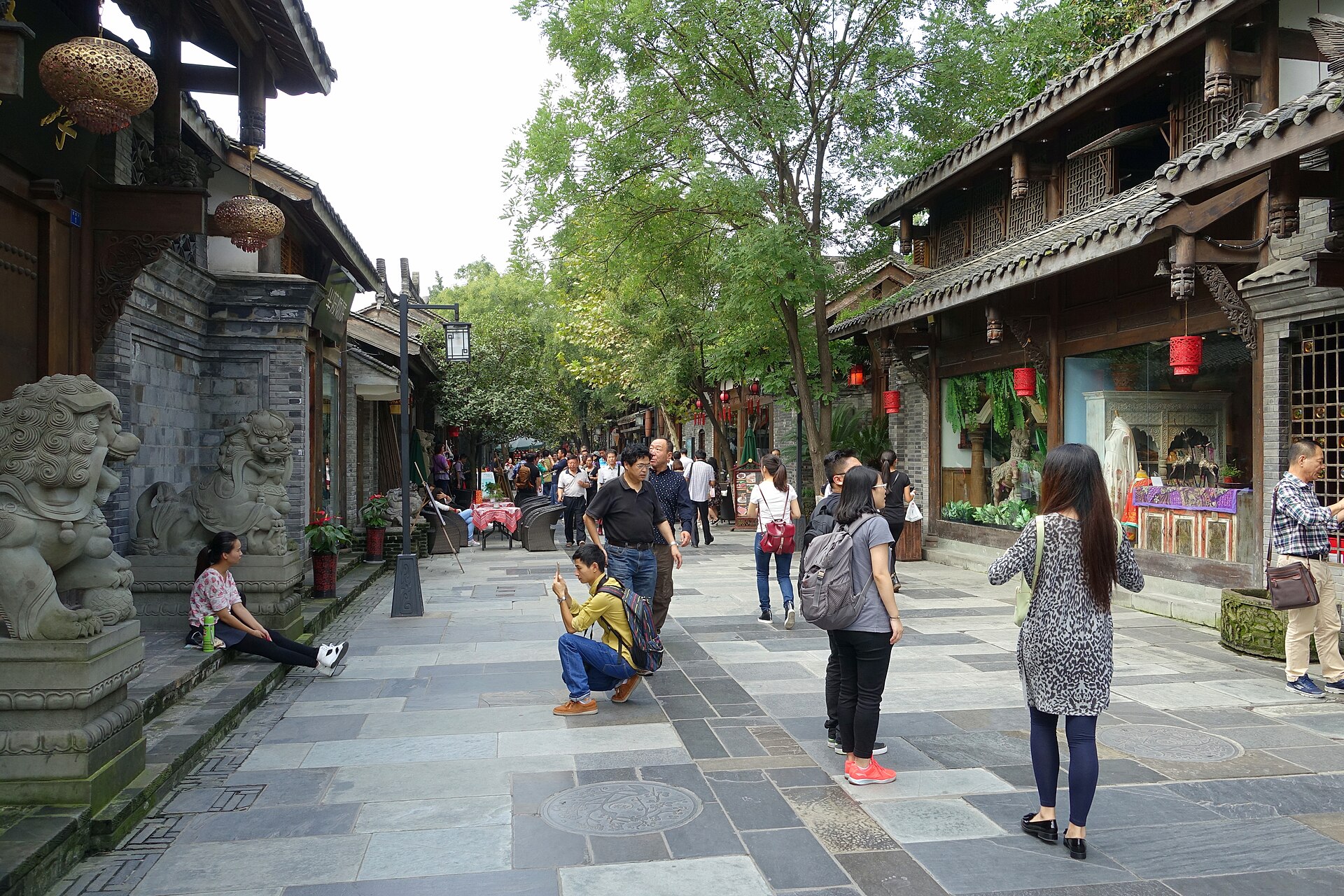
The Wide & Narrow Alleys in Chengdu — restored grey-brick Qing-era lanes with shop signs, red lanterns and strolling visitors 2
Wide & Narrow Alleys (宽窄巷子)
Kuanzhai Xiangzi · restored Qing-dynasty lanes

Kuanzhai Xiangzi is three parallel lanes — the Wide Alley (宽巷子), the Narrow Alley (窄巷子) and the Well Alley (井巷子) — that once housed Manchu bannermen in the Qing dynasty. Today they're restored into a walkable quarter where the grey brickwork still looks old, but the interiors are full of teahouses, Sichuan snack shops, dessert spots and souvenir stalls. It's pleasant by day, but the atmosphere peaks after dark, when the red lanterns come on, the crowds build, and the smell of hotpot drifts from every corner. An hour or two of wandering is about right.
Metro: Line 4 to Kuanzhaixiangzi, Exit B, ~60 m walk; or Line 2 to People's Park, ~400 m
Best time: evening, after 6 pm — lanterns lit, best atmosphere
Free: free to enter · spend as much or as little as you like
What to eat: the lanes are packed with Sichuan street food — see the must-try list in our Chengdu street-food guide →
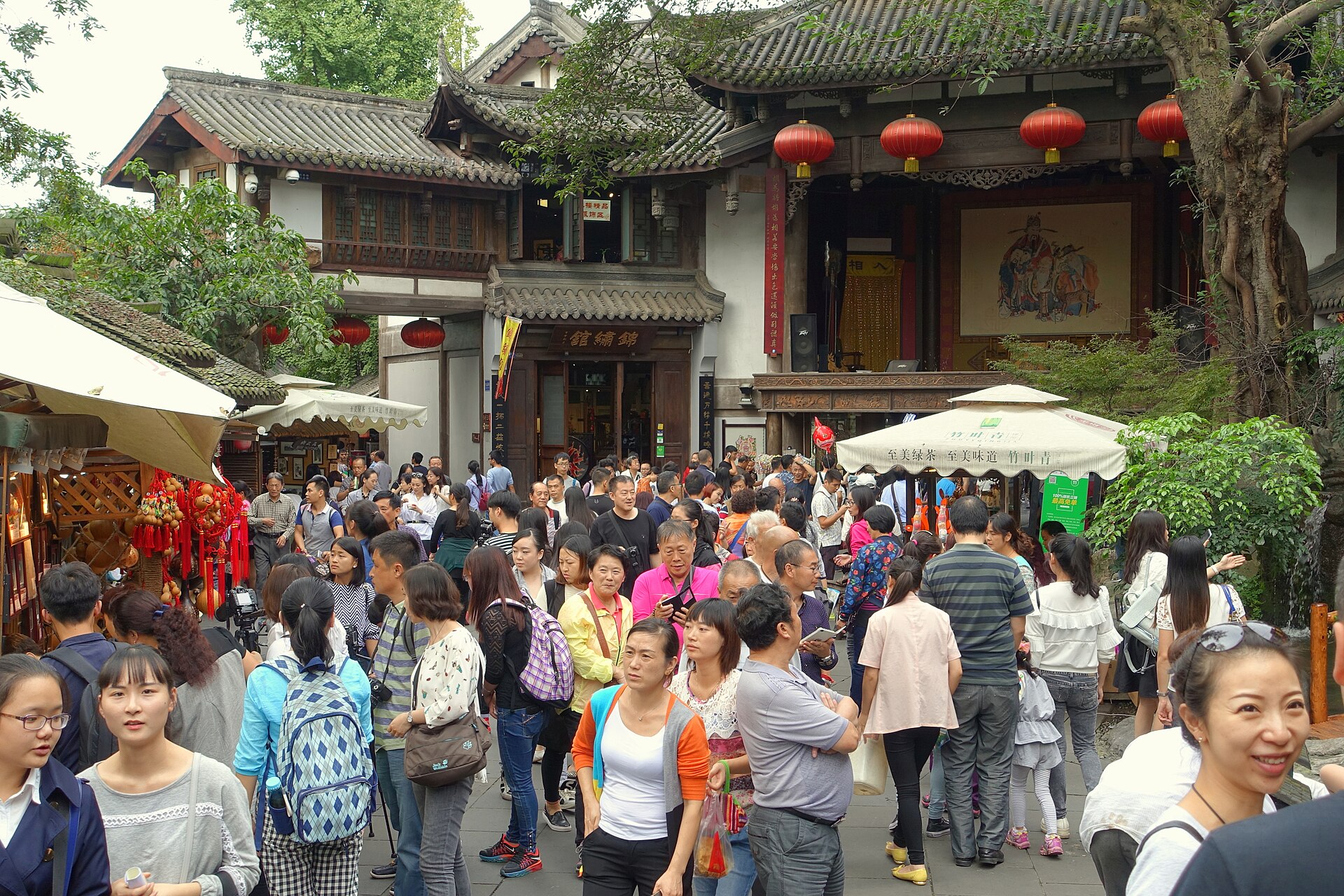
Jinli Ancient Street in Chengdu at night — red lanterns strung the length of the lane, wooden traditional-style shops and busy crowds 3
Jinli Ancient Street (锦里)
Three-Kingdoms snack street · beside Wuhou Shrine

If the Wide & Narrow Alleys are a Qing-dynasty quarter, Jinli is a Three-Kingdoms-themed lane that sits right next to Wuhou Shrine — walk out of the shrine and you're in it. The stone-paved street is lined with wooden, old-style shopfronts selling skewered Sichuan snacks, regional sweets, tea and Three-Kingdoms souvenirs. At night, red lanterns strung the full length of the lane light it up, and it becomes one of the city's favourite photo stops; a small bar street waits at the far end. Jinli is touristy and prices run higher than outside, but the atmosphere makes it worth a stroll.
Metro: Lines 3/5 to Gaoshengqiao, ~10 min walk (right beside Wuhou Shrine)
Best time: evening, after sunset — lanterns at their brightest
Free: free to enter · pairs perfectly with Wuhou Shrine next door
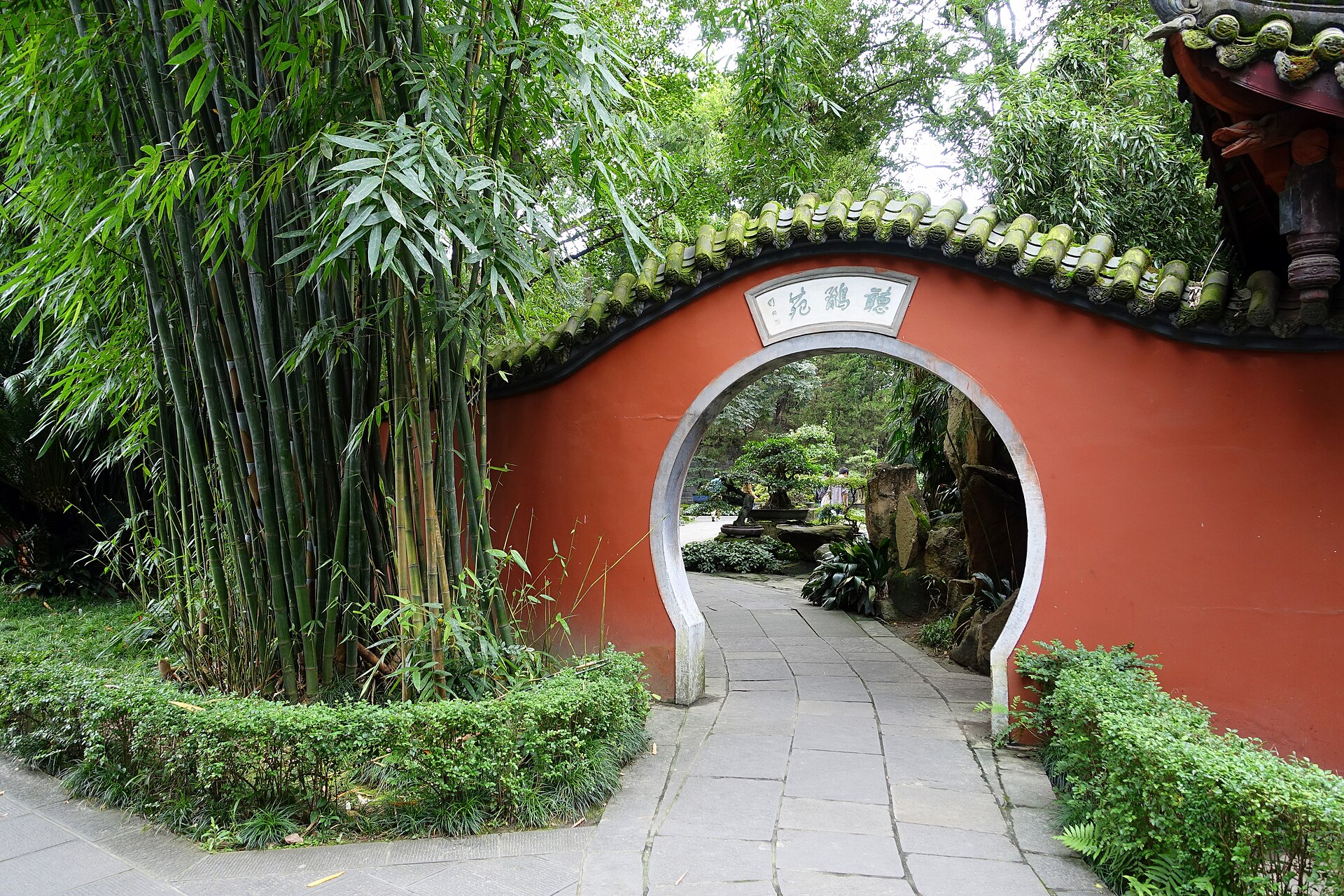
The red-walled bamboo path at Wuhou Shrine in Chengdu, a quiet shaded corridor between rows of bamboo 4
Wuhou Shrine (武侯祠)
Three-Kingdoms memorial · Zhuge Liang & Liu Bei

For anyone who grew up on the Three Kingdoms, this is a legendary place. Wuhou Shrine honours Zhuge Liang (诸葛亮), the brilliant chancellor of the Shu Han kingdom, and shares its grounds with the tomb of Liu Bei (刘备), Shu's founding emperor. You walk past memorial halls, statues of ministers and generals, and old stone steles — and the part everyone photographs is the red-walled corridor that runs between rows of bamboo, so quiet and shaded you forget you're in the middle of a city. Allow 1.5 to 2 hours, then walk straight into Jinli next door.
Metro: Lines 3/5 to Gaoshengqiao, Exit A, ~10 min walk
Ticket: ~¥50 (~฿250) · peak (May–Oct) 8 am–8 pm · low season 8 am–6.30 pm
Tip: pair it with Jinli Ancient Street right beside it — easily one outing
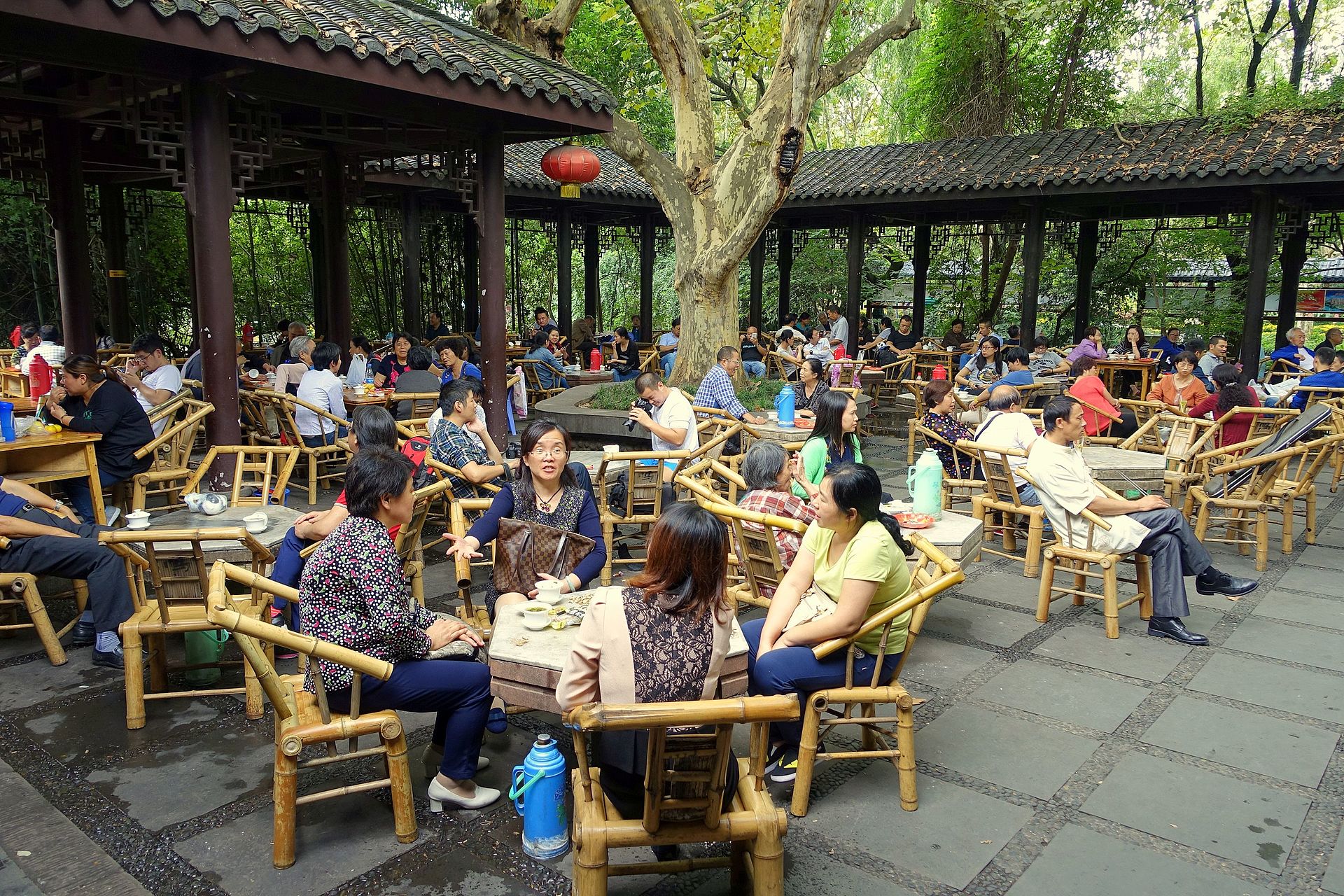
Bamboo tables and chairs by a pond at a teahouse in Chengdu's People's Park, locals sitting and sipping tea in the afternoon 5
People's Park (人民公园)
a window into the "Chengdu pace"

Here's a park that isn't just somewhere to exercise — it's the city's living room. The heart of it is Heming Teahouse (鹤鸣茶社), open for nearly a century: sit on a bamboo chair by the pond, order tea from ¥18 a cup, and refill your hot water all afternoon. A man with metal tongs may wander over and offer to clean your ears (a Chengdu tradition). In one corner is the marriage market (相亲角), where parents post their children's profiles hoping to find them a match; elsewhere there's a martyrs' monument and a boating lake. Come here and you'll understand why people call Chengdu the most relaxed city in China.
Metro: Line 2 to People's Park (人民公园), Exit B, ~5 min walk
Tea: from ¥18 a cup, refills all day · teahouse open ~7 am–10 pm
Free: free to enter the park · you only pay for tea if you sit down
Want to go deeper: teahouse culture is the heart of this city — read our Chengdu teahouse-culture guide →
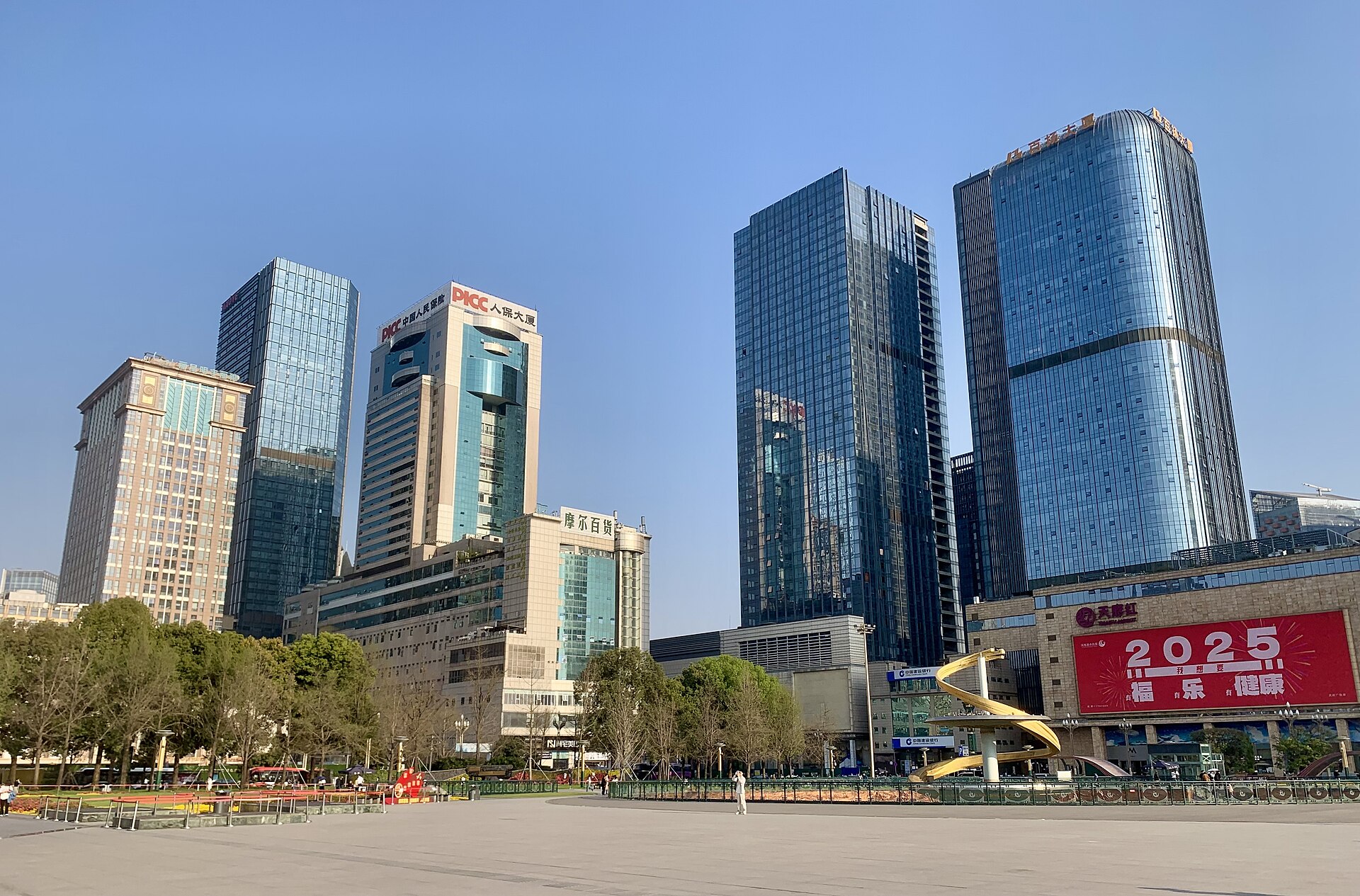
Tianfu Square in Chengdu at dusk — a broad central plaza ringed by modern buildings with city lights coming on 6
Tianfu Square (天府广场)
the point everything else is measured from

Tianfu Square is the spot every distance in Chengdu is measured against — a broad central plaza with a statue of Chairman Mao standing over it. Ringing the square are the Sichuan Science & Technology Museum and the Chengdu Museum, the latter free to enter and genuinely well curated. In the evening there are musical fountains. Most usefully, it's a major metro interchange (Line 1 meets Line 2), which makes it a natural launch pad for the day; from here it's about a 10-minute walk to People's Park.

Metro: Tianfu Square (Lines 1/2) — step out of the station onto the plaza
Around the square: Sichuan Science & Technology Museum · Chengdu Museum (free, closed Mondays)
Free: the plaza is free · musical fountains in the evening (check times before you go)
🛕7
Wenshu Monastery (文殊院)
the city's oldest Buddhist temple — free entry

In a city racing to build towers, Wenshu Monastery stays a calm pocket that seems to float above the clock — the oldest and best-preserved Zen Buddhist temple in Chengdu. There are several prayer halls, bamboo gardens, and the thing locals love most: a teahouse in the grounds where you can sit quietly under the trees all afternoon. The surrounding streets are full of vegetarian restaurants and traditional snacks. Entry is free; allow 1 to 1.5 hours. Come mid-morning, then linger over tea.

Metro: Line 1 to Wenshuyuan (文殊院), Exit K, ~100 m walk
Open: 9 am–5 pm (last entry 4.30 pm)
Free: free to enter · you only pay for tea at the temple teahouse
🏺8
Jinsha Site Museum (金沙遗址博物馆)
a 3,000-year-old civilisation

In 2001, construction workers in Chengdu stumbled on the remains of a roughly 3,000-year-old civilisation — and that discovery became the Jinsha Site Museum, built right over the working excavation. The highlight is the Sun Bird gold disc (太阳神鸟), now a national emblem of Chinese cultural heritage, displayed alongside gold masks, ivory and a wealth of jade objects. It belongs to the same ancient culture as Sanxingdui (the museum of mysterious bronze masks, out of town). Anyone interested in ancient history shouldn't miss it. Allow 2 to 3 hours.
Metro: Line 7 to Jinsha Site Museum, Exit C, ~350 m walk
Ticket: ~¥70 (~฿350) · Tue–Sun 9 am–6 pm (last entry 5 pm, closed Mondays)
Tip: allow 2–3 hrs · if you love the ancient finds, follow up at Sanxingdui (see day trips)
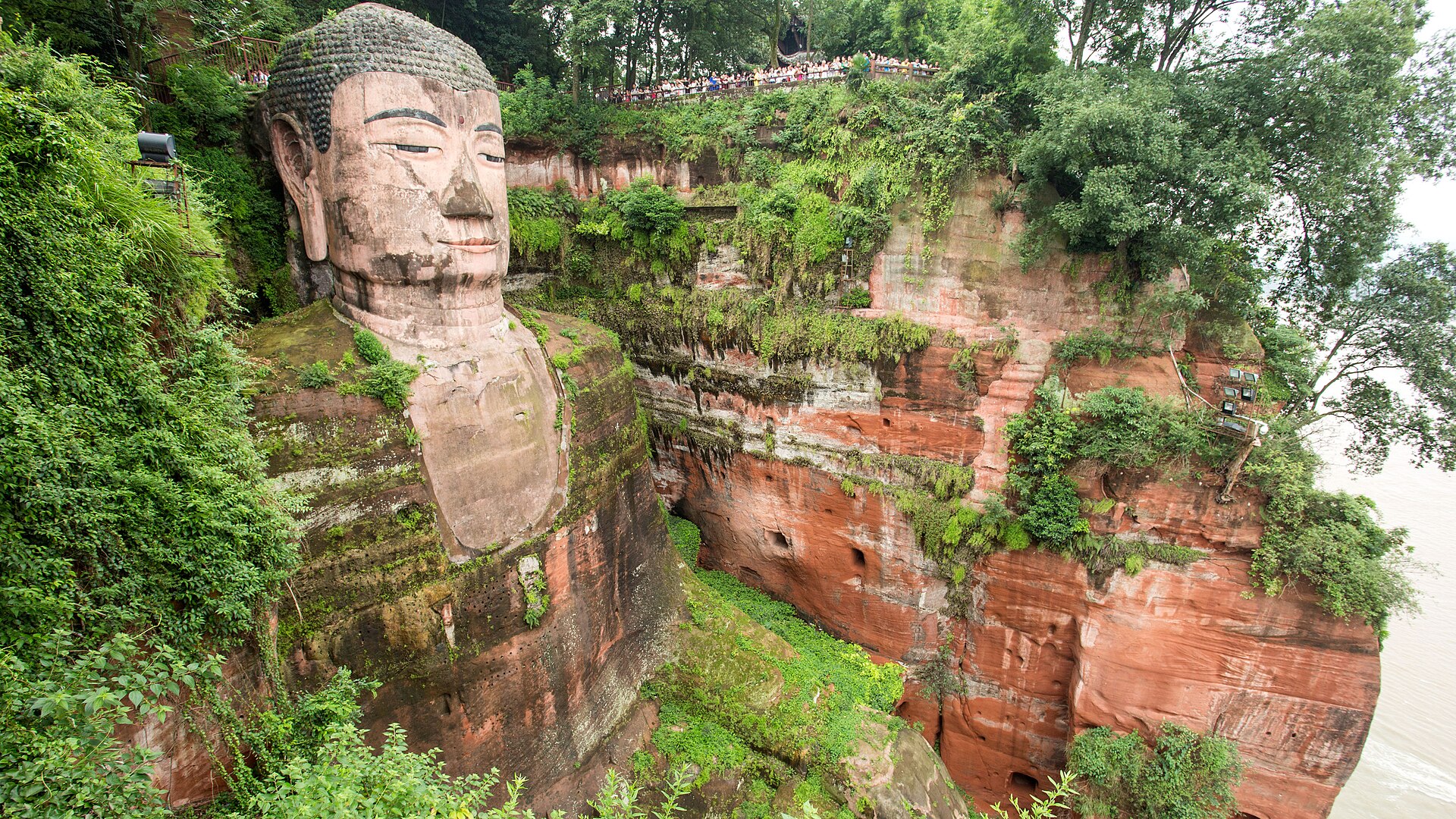
The Leshan Giant Buddha carved into a riverside cliff, its serene face towering over tiny visitors at the foot of the statue 9
Leshan Giant Buddha (乐山大佛)
day trip · UNESCO World Heritage

The Leshan Giant Buddha is the largest stone-carved Buddha in the world, 71 metres tall, cut into a cliff face during the Tang dynasty (begun in 713 CE and over 90 years in the making). It sits at the meeting point of three rivers — carved, the story goes, to calm the dangerous currents. The scale is staggering: a single toenail is bigger than a standing person. There are two ways to see it: descend the 九曲栈道 cliff stairway to the feet (long queues in peak season), or take a river boat for a full head-to-toe view with no queue at all. Half a day is enough, and it pairs with Mount Emei on the same rail line.
Getting there: high-speed rail from Chengdu East/South → Leshan ~1 hr (¥54+), then bus/taxi
Ticket: ~¥80 (~฿400) · open ~7.30 am–6.30 pm (check boat times before you go)
Time: half a day · book trains on Trip.com
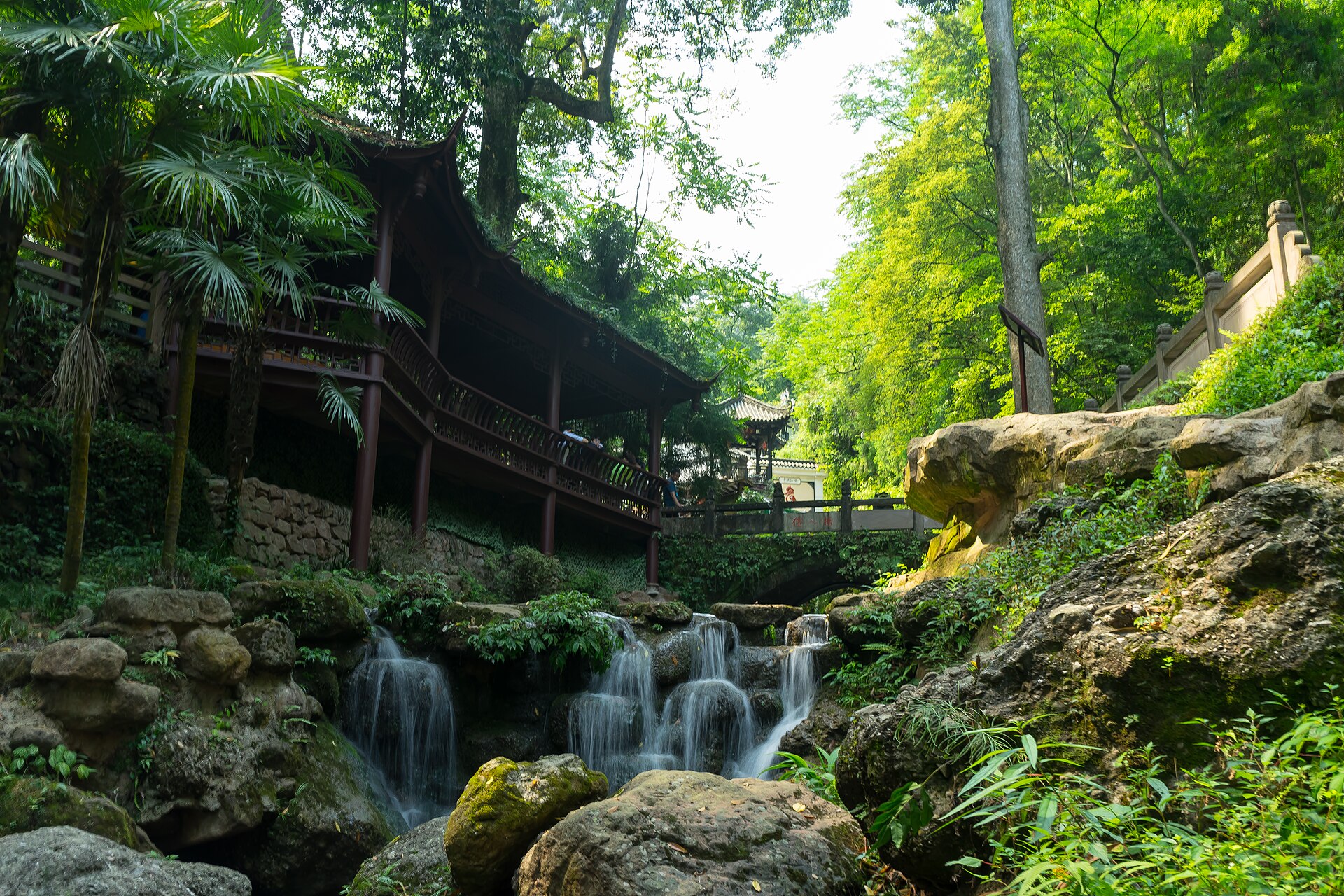
Mount Qingcheng near Chengdu — a wooden Taoist pavilion amid lush green forest and light mist, a calm scene 10
Mount Qingcheng + Dujiangyan
青城山 + 都江堰 · day trip · two UNESCO sites

Two World Heritage Sites close enough to combine in one trip. Mount Qingcheng (青城山) is the birthplace of organised Taoism — a green mountain laced with Taoist pavilions and forest trails, split into the front mountain (前山, easy walking, more temples) and the rear mountain (后山, serious hiking). Dujiangyan (都江堰) is a 2,200-year-old irrigation system that still works today — ancient engineering that turned the Chengdu plain fertile, centred on the "Fish Mouth" (鱼嘴) levee that splits the river and the Anlan rope bridge. High-speed rail from Chengdu takes only about 30 minutes; allow half a day to a full day.

Getting there: high-speed rail from Chengdu → Qingchengshan / Dujiangyan ~30 min (¥10–32)
Ticket: Mount Qingcheng ~¥80 · Dujiangyan ~¥80 (~฿400 each)
Time: half a day to a full day for both
⛰️+
Mount Emei (峨眉山)
a sacred Buddhist mountain · Golden Summit at 3,099 m

If you have a spare day or two, Mount Emei rewards it best — one of China's four sacred Buddhist mountains and a UNESCO World Heritage Site (inscribed together with the Leshan Giant Buddha). The high point is the Golden Summit (金顶) at 3,099 metres, crowned by a gilded statue of the bodhisattva Samantabhadra; on a clear day you may catch a sea of clouds. On the way up live wild Tibetan macaques (watch your bags!), Baoguo Temple, and hot springs. You ascend by bus and cable car. High-speed rail from Chengdu takes about 1.5 hours.

Getting there: high-speed rail Chengdu → Emeishan ~1.5 hrs, then park buses inside the scenic area
Ticket: entry ~¥160 (peak) / ¥110 (off-peak) + Golden Summit cable car ~¥65 up / ¥55 down
Time: 1–2 days · easy to combine with Leshan
Planning trips out of town: Leshan, Mount Emei, Qingcheng, Sanxingdui and more — see our full Chengdu day-trips guide →
Plan your visit

How to fit it all in

The in-city sights are easy to reach by metro; the World Heritage Sites around Chengdu are quick high-speed-rail day trips

Old-town zone — Wuhou Shrine / Jinli / Wide & Narrow Alleys
Days 1–2 · metro Lines 2/3/4/5

Wuhou Shrine and Jinli sit side by side and flow into one outing, while the Wide & Narrow Alleys, People's Park and Tianfu Square are a short walk or quick metro hop apart. You can comfortably string 2–3 of these into a day and finish with street food down an old lane after dark.

Time needed: 1.5–2 days · Metro: Lines 2 / 3 / 4 / 5
Panda + museums zone
Morning of Day 1 · metro Lines 3 / 7

The Panda Base is north of the city and is best as a first-morning activity (pandas are liveliest early). The Jinsha Site Museum and Wenshu Monastery sit to the west and north and pair well with the afternoon of a day you're not heading out of town.

Time needed: half a day to a day · Metro: Line 3 (pandas) / Line 7 (Jinsha)
A slow cup of tea — the real Chengdu pace
Slot into any afternoon · People's Park / Wenshu

Don't rush so much that you skip the tea — it's the thing that sets Chengdu apart. One cup buys you a whole afternoon: watch the mahjong, take the ear-cleaning service (if you're brave). Heming Teahouse in People's Park is the famous one, but the teahouse inside Wenshu Monastery is quieter.

Time needed: 1–2 hrs per visit · From: ¥18 a cup
Day trips out of town
Leshan · Emei · Qingcheng + Dujiangyan · Sanxingdui

High-speed rail puts the World Heritage Sites around Chengdu within easy reach — Leshan ~1 hr · Mount Emei ~1.5 hrs · Qingcheng + Dujiangyan ~30 min · Sanxingdui ~1 hr. All are doable as out-and-back day trips. See the details in our Chengdu day-trips guide →

Time needed: half a day to a day each · Suggested: Days 4–5 if you have time
Frequently asked

FAQ · before you head out

How many days do you need in Chengdu?
Three days cover the city comfortably: Day 1, the Panda Base in the morning plus Wenshu Monastery; Day 2, Wuhou Shrine, Jinli Ancient Street and the Wide & Narrow Alleys; Day 3, tea in People's Park, Tianfu Square and the Jinsha Site Museum. With five days, add a day trip to the Leshan Giant Buddha, Mount Emei, or Mount Qingcheng and Dujiangyan — each takes half a day to a full day. See our day-trips guide →
What time should I arrive at the Chengdu Panda Base?
Go as early as you can. The base opens at 7.30 am (8 am from November to February), and the pandas are most active during morning feeding, roughly 8.30 to 10 am. After midday they tend to get sleepy and retreat indoors. Tickets are about ¥55 (~฿275); book in advance through an app, as the daily quota sells out fast on holidays. Getting there: Metro Line 3 to Panda Avenue (熊猫大道), Exit A, then shuttle bus 408 to the south gate.
Which Chengdu attractions are free to enter?
The main free sights are the Wide & Narrow Alleys, Jinli Ancient Street, People's Park (you only pay for tea if you sit down, from ¥18 a cup), Tianfu Square and Wenshu Monastery. Paid sights include the Panda Base (¥55), Wuhou Shrine (¥50) and the Jinsha Site Museum (¥70). Alternating free and paid sights day by day keeps the budget balanced.
Where can I drink tea the way locals do?
The most famous spot is Heming Teahouse (鹤鸣茶社) inside People's Park, open for nearly a century. Sit on a bamboo chair by the pond, order tea from ¥18 a cup, and the staff refill your hot water all day. You can also try the traditional ear-cleaning service (entirely optional). This unhurried scene is the heart of Chengdu's slow pace — see our teahouse-culture guide →
What day trips can I do from Chengdu?
The three most popular: the Leshan Giant Buddha (about 1 hour by high-speed rail, ¥54+, entry ¥80); Mount Emei (HSR ~1.5 hours, entry ¥160 in peak season plus a cable car to the Golden Summit); and Mount Qingcheng with Dujiangyan (HSR ~30 minutes, each entry around ¥80). All three are UNESCO World Heritage Sites, and Leshan pairs neatly with Mount Emei on the same rail line. See the full day-trips guide →
How easy is it to get around Chengdu by metro?
Very easy. Chengdu's metro has many lines covering almost every attraction, with fares of ¥2–8 per journey. Key stations: Panda Avenue (Line 3) for the Panda Base, plus a shuttle; Gaoshengqiao (Lines 3/5) for Wuhou Shrine and Jinli; People's Park (Line 2) for the park and the Wide & Narrow Alleys; Tianfu Square (Lines 1/2); Wenshuyuan (Line 1) for Wenshu Monastery. Pay with Alipay or WeChat Pay straight at the gate.
Klook · Chengdu tours

Chengdu tours — Panda Base tickets, Leshan–Emei day trips, the Sichuan face-changing show

Book your Panda Base ticket ahead, a full-day tour to the Leshan Giant Buddha and Mount Emei, or a Sichuan-opera face-changing show — reserve on Klook and skip the gamble at the gate.

See Chengdu tours on Klook →
Wherebest is a Klook affiliate partner — we may earn a commission when you book through our links, at no extra cost to you.