Six thousand clay soldiers that have stood at attention for 2,200 years, a city wall you can cycle right around, a Muslim Quarter thick with the smell of grilling lamb, and a fountain dancing in front of a Tang-dynasty pagoda — forty-eight hours is exactly enough to feel the best of Xi'an.
Two days is enough for the Xi'an people talk about — the Terracotta Army, the fully intact ancient city wall, a Muslim Quarter you could eat your way down for a week, and the Big Wild Goose Pagoda lit up at night. There is really only one trick to it: split the days correctly. Spend Day 1 out of the city on a full Terracotta Army trip, and Day 2 entirely inside the walls at an easy pace. Do not try to cram the Terracotta Army and the city centre into the same day — the travel time alone makes it a scramble.
This plan is built for travellers on a short schedule — a weekend, a stop on the way from Beijing or Chengdu by high-speed rail, or a first taste of the city before moving on. The in-city sights are nearly all within walking distance of each other, and the Terracotta Army is reachable on the official ¥7 tourist bus 游5/306 — no tour booking required. What this plan deliberately leaves out is Mount Hua (a full day on its own). If you want that, see the Xi'an day-trips guide, which folds in Mount Hua and the other sights around the city.
On where to stay: book a hotel in the Bell Tower area or near the Muslim Quarter — it sits in the centre of the walled city, puts every Day 2 stop within walking distance, and connects on Metro Line 2 to the railway station for the Terracotta Army bus on Day 1. See the Xi'an city guide for options at every budget.
An early start on the ¥7 bus, Pits 1, 2 and 3 all morning, Huaqing Palace and Mount Li in the afternoon, and a first Muslim Quarter dinner back in town.
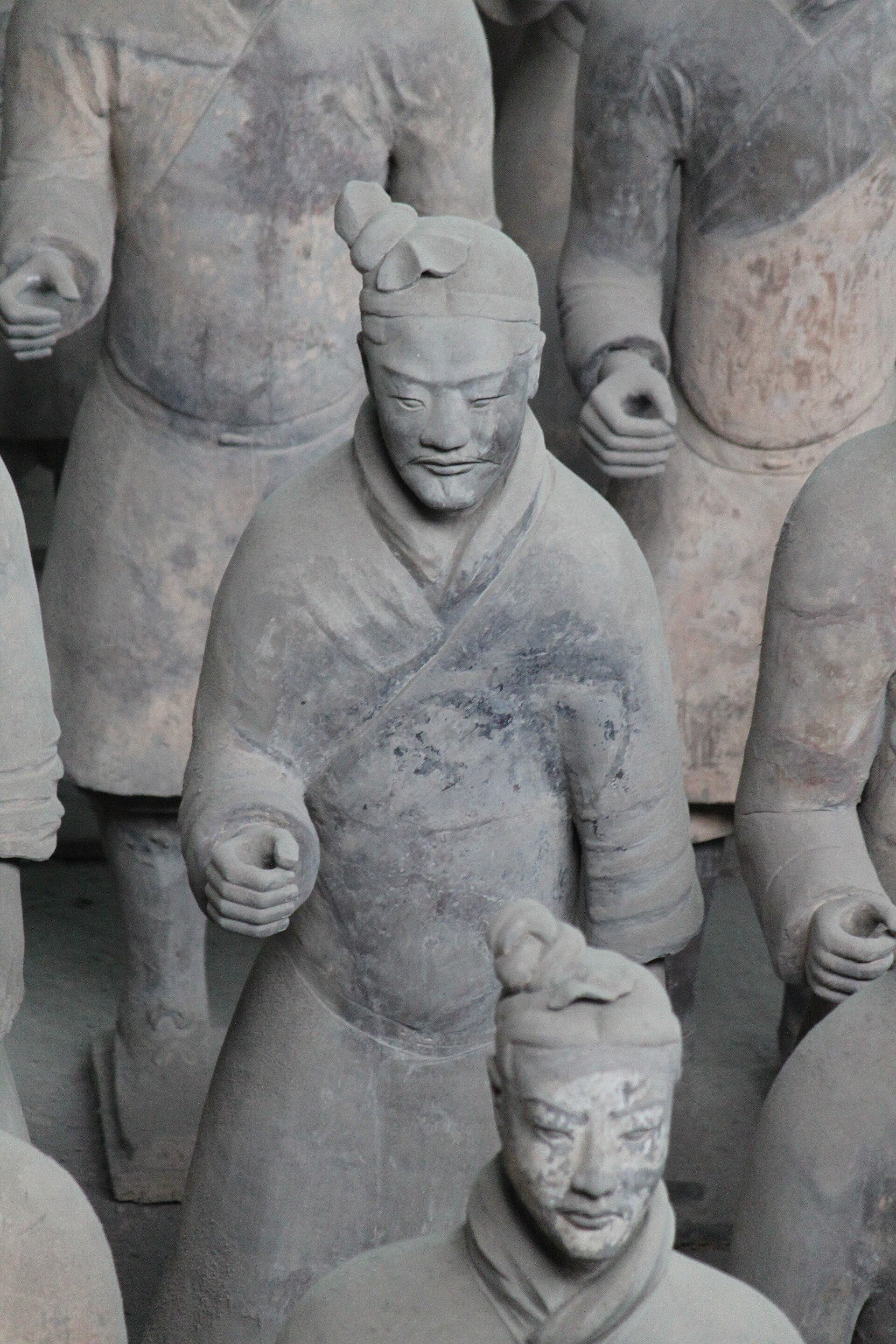
Leave the hotel early — aim to be at Xi'an Railway Station around 8 am. Walk to the East Square and board tourist bus 游5 (route 306); the fare is just ¥7 and the ride takes about an hour to the Terracotta Army. Arriving ahead of the big tour groups means a far calmer first hour.
The Terracotta Army is the tomb guard of China's first emperor, Qin Shi Huang, discovered by farmers digging a well in 1974. Over 6,000 life-sized clay soldiers — no two faces alike — stand in formation inside the excavation pits. Walk them in order: Pit 1 (the largest and most spectacular — save it for last to finish on a high, or hit it first while it is quiet) → Pit 3 (the command post) → Pit 2 (cavalry and archers), then close at the bronze chariot hall. A relaxed 2.5–3 hours is right.
For the return, board the same route 游5/306 at the car park outside the Terracotta Army exit, but get off partway at Huaqing Palace (Huaqing Hot Spring) — it is only about 10 minutes from the Terracotta Army, so it slots neatly into the same day. Grab a simple lunch near the entrance first.
Huaqing Palace is the imperial hot-spring complex at the foot of Mount Li, where Tang Emperor Xuanzong retreated with his consort Yang Guifei — a love story every Chinese visitor knows. Wander the ancient bathing pools, the lotus ponds and the lakeside pavilions. With the energy for it, take the cable car up Mount Li to the spot tied to the 1936 "Xi'an Incident" and the view back over the plain. In the warm season there is an evening outdoor show, "Song of Everlasting Sorrow" (around 8 pm, separate ticket) — worth planning ahead for if it appeals.
Back at the railway station, take Metro Line 2 or walk to the Muslim Quarter (回民街) in the city centre. After a long day, nothing beats grazing the street food in lanes that smell of grilled lamb from end to end. Start light: roujiamo (肉夹馍), the "Chinese burger" of shredded braised meat stuffed into a crisp baked bun, and cumin-dusted lamb skewers grilled over charcoal. Save the big bowl of yangrou paomo for tomorrow.
If you still have it in you, walk over to the nearby Bell Tower — floodlit gold in the evening, and easy to photograph from the surrounding roundabout. Then head back to the hotel and rest up for Day 2.
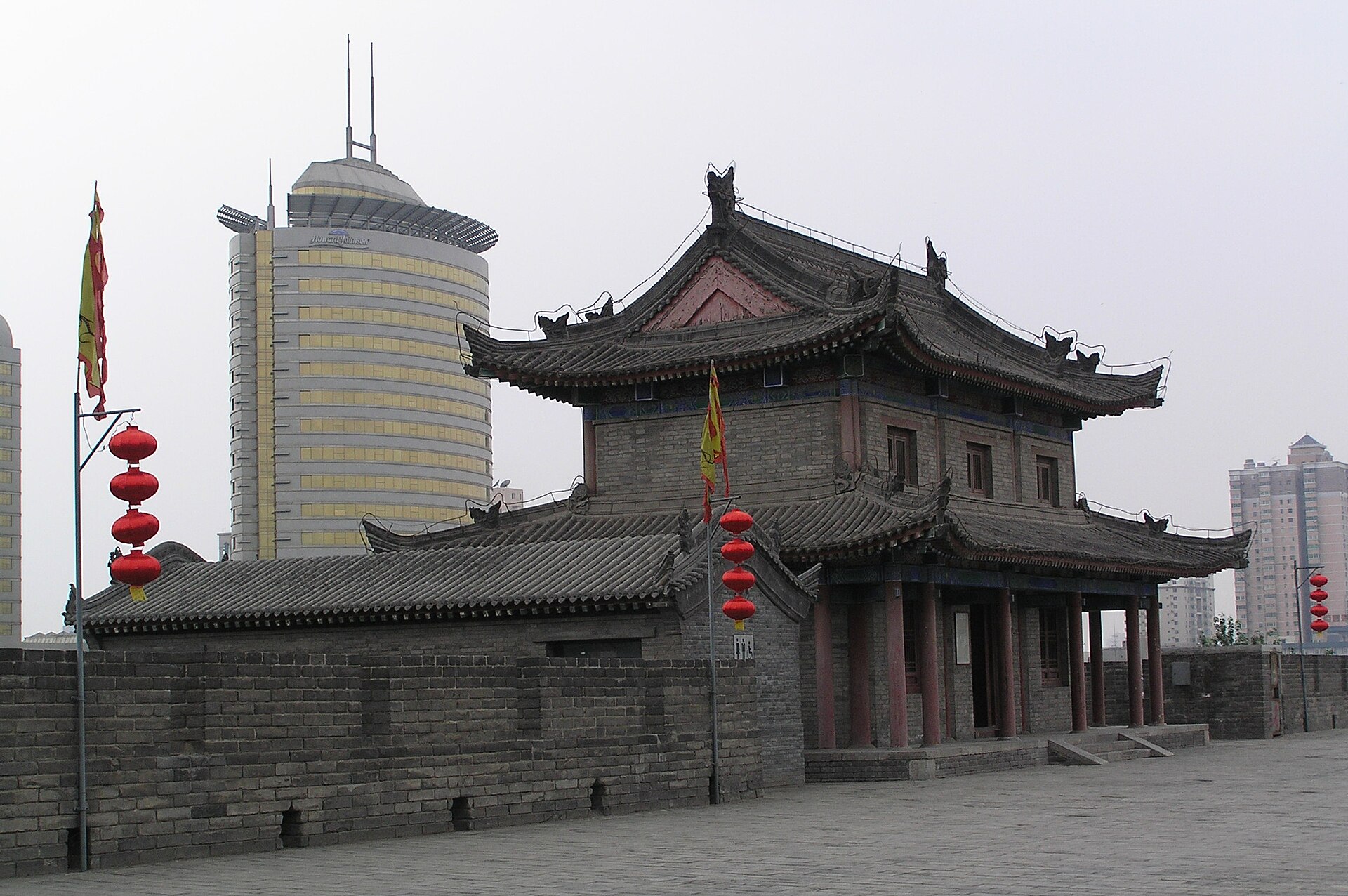
Cycle a 650-year-old wall, the twin Bell and Drum Towers, a proper bowl of yangrou paomo in the Muslim Quarter, and the fountain show at the Big Wild Goose Pagoda to close out the trip.
Start Day 2 the way Xi'an residents are proudest of — up onto the ancient city wall at the South Gate (Yongningmen). Built in 1370 under the Ming dynasty on the foundations of the earlier Tang wall, it stands 12 metres high, wide enough on top for cars to pass, and still runs a complete 13.7-kilometre loop around the old city — the most intact ancient city wall in China.
The best way to take it in is to rent a bike and ride the loop — ¥45 for a single bike or ¥90 for a tandem (3-hour rental, ¥200 deposit). The full 13.7 km takes about 100 minutes if you do not stop much, but you will keep pulling over for the corner watchtowers, the red lanterns and the view down over the old streets. The morning air is cool and easy — the best window before the sun gets strong.
Down from the wall, take Metro Line 2 one stop to the Bell Tower. The Bell Tower (钟楼) sits dead centre of the old city on its own roundabout, built in 1384 — climb it and four avenues fan out in every direction. Across from it stands its twin, the Drum Tower (鼓楼), and you can walk straight under the Drum Tower into the Muslim Quarter.
Lunch is the highlight of the day. The Muslim Quarter (回民街) is the food street of a Hui Muslim community that has lived here for over a thousand years. Order the big bowl — yangrou paomo (羊肉泡馍), a hot mutton soup where you tear flatbread into small pieces into the bowl yourself before the kitchen ladles the broth over it — a ritual Xi'an has practised for centuries. Round it out with biangbiang noodles (belt-wide hand-pulled noodles), liangpi cold noodles and a cup of fresh-pressed pomegranate juice. See the Xi'an food guide and how to eat yangrou paomo.
Walk deeper into the Quarter's lanes and you reach the Great Mosque — an ancient mosque built entirely in the style of a Chinese garden, with no dome in sight, only timber pavilions, ceremonial gateways and quiet courtyards. Entry is ¥30, and it is an oasis in the middle of the market bustle. Allow about 45 minutes.
Take Metro Line 3 or 4 to Dayanta station (Big Wild Goose Pagoda) in the late afternoon. The Big Wild Goose Pagoda (大雁塔) was built in 652 during the Tang dynasty to house the Buddhist scriptures that the monk Xuanzang brought back from India. The seven-storey, 64-metre brick pagoda is a symbol of Xi'an at the height of the Tang golden age — climb it, or simply walk the temple grounds below.
The closing highlight is the musical fountain on the North Square — one of the largest in Asia, free to watch, with evening shows at 7 pm and 9 pm (noon and 4 pm shows too, paused on Tuesdays for maintenance — check before you go). Stand in the centre-front of the square for the best view. The alternative, if you want full Tang-dynasty atmosphere, is to walk on to Datang Everbright City (大唐不夜城) right next door — a long pedestrian street strung with golden light, Tang-style buildings and live street performances, open late. It is a beautiful way to end the trip.
Dinner is easy across the pagoda district and Datang — from street stalls to sit-down restaurants, ¥60–150 per person. Close out Day 2 with Xi'an under lights before heading back to the hotel or on to the high-speed rail.
For this plan, the Bell Tower area or near the Muslim Quarter is the most practical base — central to the walled city, every Day 2 stop on foot, and Metro Line 2 straight to the railway station for the Terracotta Army bus. Mid-range hotels run ¥300–600 per night. A quieter alternative is inside the wall near the South Gate. See the Xi'an city guide.
Metro plus one bus covers every stop. Line 2 runs through the Bell Tower, South Gate and railway station; Lines 3 and 4 reach the Big Wild Goose Pagoda; the Terracotta Army goes by the ¥7 tourist bus 游5/306. Metro fares are ¥2–9 per trip, paid by scanning Alipay or WeChat Pay QR at the gate. All station signs are bilingual.
Set up Alipay (international version, linked to a foreign Visa or Mastercard) before you leave home. Shops, Muslim Quarter food stalls and the bike-rental kiosks mostly take Alipay or WeChat Pay — some do not take cash at all. See the Alipay & WeChat Pay setup guide.
| Category | Budget | Mid-range | Comfortable |
|---|---|---|---|
| Hotel (1 night) | ¥100–200 (hostel / guesthouse) |
¥300–500 (3–4 star) |
¥600–1,500+ (4–5 star) |
| Food (3 meals/day) | ¥70–110 (street food) |
¥120–220 (mix of local & casual) |
¥250–500 (restaurants + cafés) |
| Transport (metro + bus, 2 days) | ¥40–60 (incl. bus 306) |
¥60–90 | ¥150–300 (+ DiDi/taxi) |
| Admission (full 2-day trip) | ¥174 (Terracotta ¥120 + Wall ¥54) |
¥350–420 (+ Huaqing ¥120 + pagoda/towers) |
¥450–600 (+ cable car/bike/show) |
| Total for 2 days (est.) | ¥484–784 (~$67–108 USD) |
¥950–1,530 (~$131–211 USD) |
¥1,850–3,900+ (~$255–538+ USD) |
Exchange rate used: ¥1 ≈ $0.138 USD (~฿5) · Hotel cost counted as 1 night · Prices are estimates and vary by season · The Terracotta Army ticket is the single most expensive item of the trip.