An entire old city still ringed by a 12-metre stone wall that a Ming emperor ordered built in 1370 — and the rare part is that you can go up and walk or cycle the full 13.74 km loop along the top. It is the most complete ancient city wall left in China.
Picture a city of millions — traffic, towers, the usual modern sprawl — with its historic core still enclosed by a wall of dark grey brick as tall as a four-storey building, drawn in a rectangle nearly 14 kilometres around. That is what sets Xi'an apart from almost everywhere else in China. Most of the country's ancient city walls collapsed or were demolished long ago. Xi'an's survives intact, the full loop unbroken, and you can stand on top of it.
The Xi'an City Wall (西安城墙) you see today was built between 1370 and 1378, in the reign of Zhu Yuanzhang, the first emperor of the Ming dynasty, raised on the foundations of the earlier Tang imperial city wall. It stands roughly 12 metres high and 12–14 metres wide across the top (wider still at the base), with a moat, watchtowers and a great fortified gate on each of the four sides. It is widely regarded as the best-preserved and most complete ancient city wall in China.
What makes the wall more than something to photograph from below is that the top is broad enough to cycle the entire circuit. Locals come up here to exercise; visitors rent bikes and ride into the breeze; and after dark the whole length is lit a warm amber, so from the wall you see the old town inside and the modern city outside at the same moment. One visit and you understand why Xi'an served as a Chinese capital across thirteen dynasties.
From cycling the loop to the gate-opening ceremony and the wall after dark.
1
This is the main reason people come to the Xi'an wall — riding a bicycle around the entire city on top of its wall. The largest rental station is at the South Gate: a single bike is ¥45 for 3 hours, a tandem ¥90 for 3 hours, which is more than enough time since the full loop takes around 1.5–2 hours with stops for photos. The surface is old brick and a little uneven, so a relaxed pace is both more enjoyable and safer. There is no shade up top, so bring water and a hat in summer.
The South Gate, Yongningmen — "Gate of Eternal Peace" — is the largest and most complete of the wall's four cardinal gates, built as three nested defensive structures (an archery tower, the main gate tower and an outer barbican wall). It is where most visitors go up, because it sits closest to the city centre and the metro. In the morning it stages a re-enactment of the old city-opening ceremony, with performers in Ming-dynasty dress carrying out the formal welcome that once greeted arrivals at the gate.
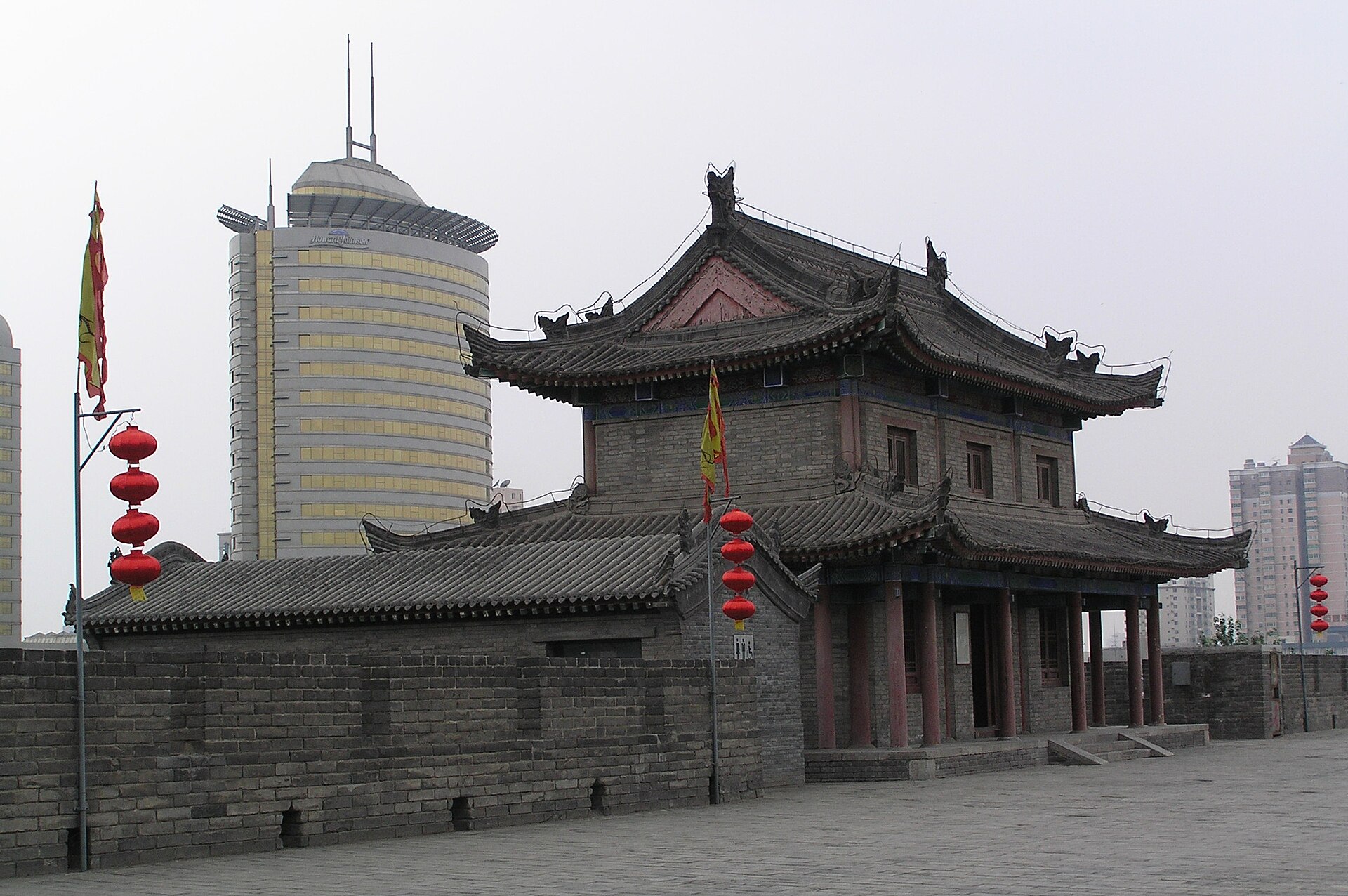
You do not have to cycle the whole thing. If you would rather walk and take in the detail, the stretch from the South Gate towards the West Gate (Anding Gate) is a comfortable length. You pass the ramparts' projecting watchtowers (敌台) set at intervals along the wall, the arrow slits, and views down into an old town that is still a maze of narrow lanes. An easy 30–45 minutes brings you to the next gate, where you can come back down.
The Xi'an wall is at its best after dark. Once the sky goes down, warm amber light washes over the gate towers and the length of the rampart, reflecting in the moat below as a band of gold. The South Gate stays open until 10 pm, so you can go up for a cool evening stroll and the lights. Around the Spring Festival the wall is hung with elaborate lantern displays — the city's big annual event — so if your visit lines up with it, count yourself lucky.
What catches many people off guard is that, standing on the wall, you see two versions of Xi'an at once. Turn inward and there are the grey-tiled roofs of the old houses, the lanes, and the Bell Tower rising at the city's heart. Turn outward and there are modern high-rises and the ring road that traces the wall. The line between old China and new China could hardly be clearer than it is from up here — a single view that explains the city's history better than any plaque.
Everything you actually need, in one place — some figures can change, so confirm on the day.
The Xi'an City Wall has access points at several gates, but the most convenient is the South Gate (Yongningmen): it sits right on the metro and close to the city centre. This is the route we recommend.
If you are staying near the Bell Tower, the South Gate is about 1 km straight south along an easy pedestrian route. Or take Metro Line 2 from Zhonglou (Bell Tower) to Yongningmen — a single stop.
The Muslim Quarter and Drum Tower sit just north of the Bell Tower. Walk down to the South Gate in about 15–20 minutes. Eat your way through the Muslim Quarter's street food at lunch, then walk over to the wall for the afternoon — the timing works neatly.
From Xi'an Railway Station, take Metro Line 4 then change to Line 2 for Yongningmen. From Xianyang Airport, take the Airport Bus or Metro Line 14 into the city and change to Line 2 — both end up at the South Gate.
With a free half-day, string together the heart of the old city: go up at the South Gate and cycle in the afternoon, come down for the Bell and Drum Towers, cut through the Muslim Quarter for street-food dinner, then return to the wall for the night lights. Everything is within a 1–2 km walk.
The wall sits right against the heart of the old city, a few minutes' walk from some of Xi'an's best-known sights and street food — easy to combine in a single day:
Staying inside the city walls — especially near the Bell Tower or the South Gate — puts the wall, the old town and the Muslim Quarter all within walking distance. Here are the hotels we have reviewed: