Home Xi'an China Xi'an Hotels About
Home  ›  Asia  ›  China  ›  Xi'an  ›  Day Trips
Xi'an Day Trips · 2026

Out of the city by morning,
standing on a sacred cliff by afternoon

Xi'an is the gateway to 13 dynasties of Chinese history. The Terracotta Army is an hour away; Mount Hua, one of the Five Great Mountains, is half an hour by high-speed rail. Every trip on this list, you can do before dinner.

Why Xi'an is a great base

One city, the whole sweep of Chinese history

Few cities make you feel as though you are walking through a history textbook quite like Xi'an. This was the eastern terminus of the Silk Road, the imperial capital under 13 dynasties, and within a radius of a few dozen kilometres lie emperors' tombs, Tang dynasty hot-spring palaces, and a temple holding a relic of the Buddha himself. What makes day trips from Xi'an so easy is geography: the Terracotta Army is only an hour away, and Xi'an North station (西安北) delivers you to the foot of Mount Hua in just 30–35 minutes.

The six trips below are the best return on time from Xi'an — from the unmissable Terracotta Army to a quiet ancient village that almost no foreign visitor has heard of. They are ordered by priority rather than distance. Before you go, read our China high-speed rail guide — it covers the 12306 app, how to buy tickets with a foreign passport, and what to do if a train is full.

🚄
Rail Guide
China High-Speed Rail for Visitors — 12306 app, passport tickets, G/D/C train classes explained
Read the rail guide →
6 day trips from Xi'an

Out in the morning, back for dinner

Ordered by priority — the unmissable first, the deep-cuts for longer stays last.
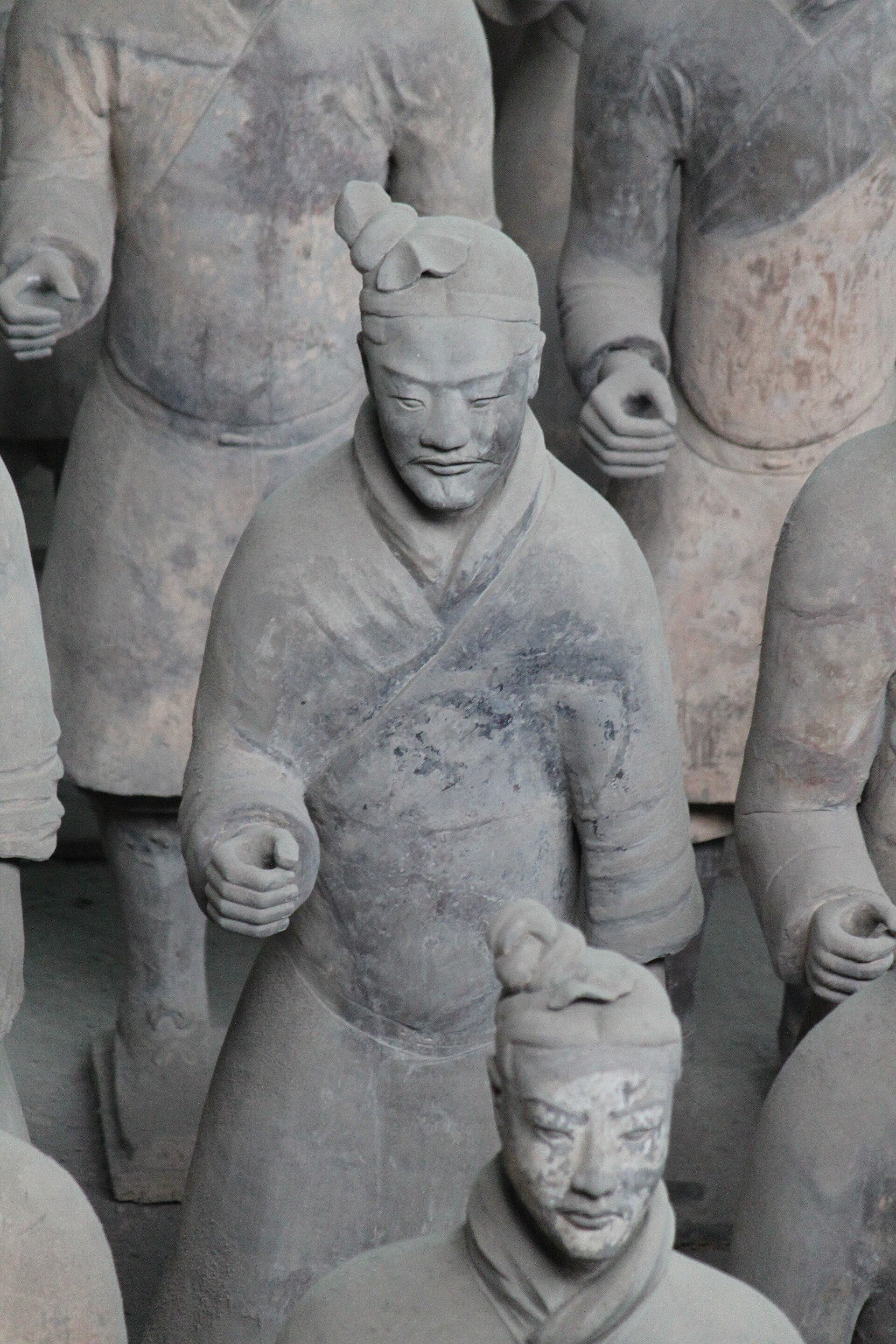
The Terracotta Army in Pit 1, Xi'an — thousands of life-size clay warriors standing in rows in earthen trenches beneath a vast hangar roof 1
Terracotta Army (兵马俑)
UNESCO World Heritage · Qin Shi Huang's mausoleum · at Lintong · the reason people come to Xi'an

If there is one thing you cannot skip in Xi'an, it is the Terracotta Army — roughly 8,000 life-size clay soldiers that the first emperor, Qin Shi Huang, had made to guard his tomb more than 2,200 years ago, every single one with a different face. Farmers digging a well stumbled on them by accident in 1974, and the discovery has become one of the greatest archaeological finds of the century.

The museum is built over three main pits. Pit 1 is the largest and the most overwhelming: rank after rank of soldiers stretching to the far wall beneath a roof the size of a football pitch. Pits 2 and 3 are smaller but let you see the detail up close — officers, kneeling archers, war horses. Allow 3–4 hours, and genuinely consider a guide or an audio guide: without the story, these are figures in the dirt; with it, this is a whole empire's idea of the afterlife. Read the full Terracotta Army guide →
Getting there: Bus 306 (游5) from the East Square of Xi'an Railway Station to Lintong: ~1 hr
Fare: ¥7–8 (~฿40) one way
Entry: ¥120 (~฿600 / ~US$17) low season · ¥150 high season (includes Pits 1/2/3 + Lishan Garden + internal shuttle)
Time needed: Half a day (3–4 hours) · full day if you add Huaqing Palace
Tip: Arrive at the 8.30 am opening — tour groups start flooding in around 10 am and Pit 1 fills fast
Best time: Spring (Mar–May) and autumn (Sep–Nov) for mild weather · Avoid Golden Week (early October) and Spring Festival — the crowds make it genuinely hard to move
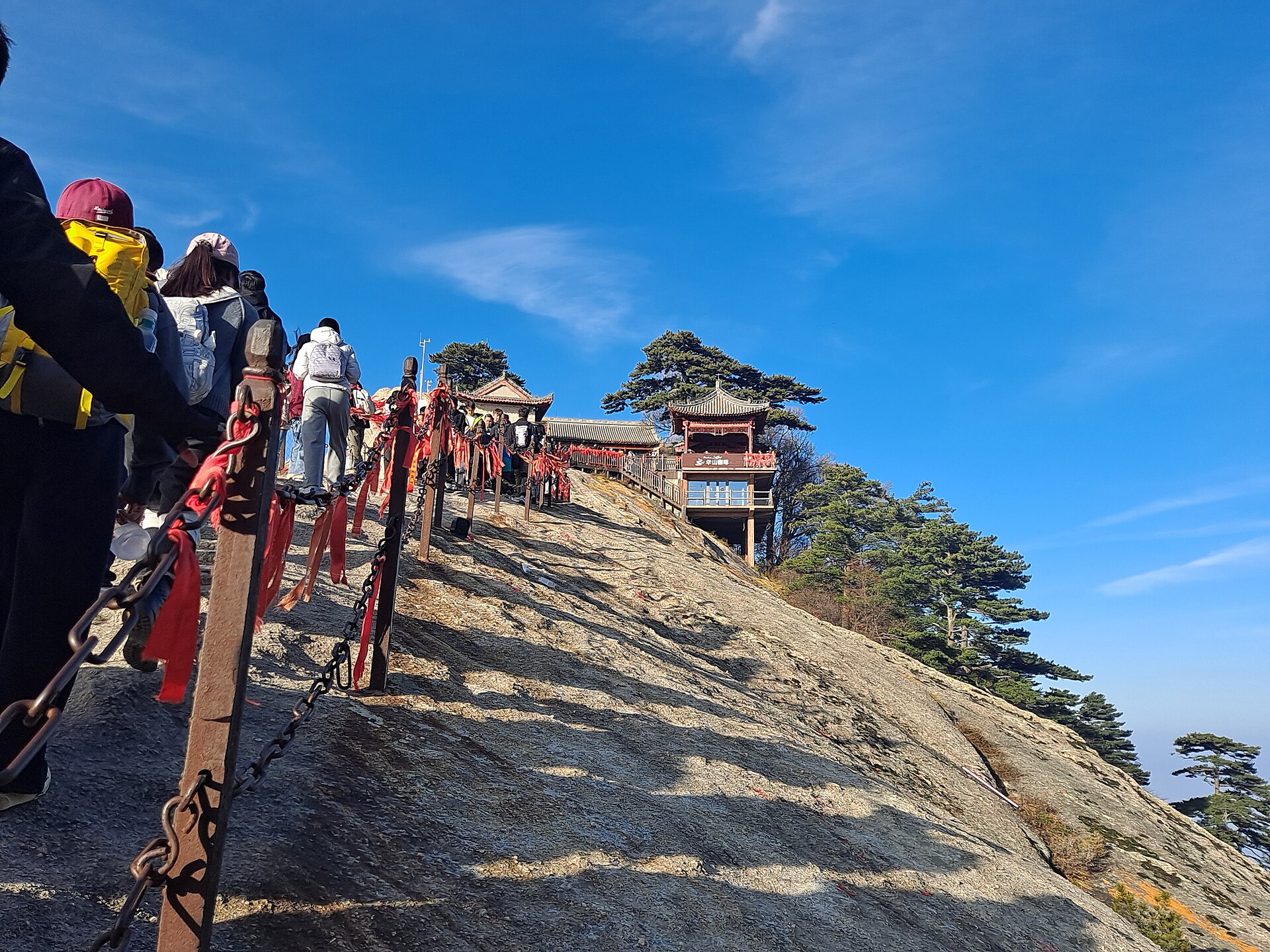
The steep granite peaks of Mount Hua rising above a sea of cloud near Xi'an — sharp ridgelines and clifftop walkways of one of China's Five Great Mountains 2
Mount Hua (华山)
One of the Five Great Mountains · the clifftop plank walk · 30 minutes by high-speed rail

Mount Hua is one of China's Five Great Mountains (五岳) and the one with a reputation for sheer drama. Its granite peaks rise in near-vertical walls, and bolted to one of those walls is the Changkong Plank Walk (长空栈道) — a line of wooden boards no wider than your foot, fixed across a cliff face hundreds of metres above the valley. Thrill-seekers clip into a safety harness and edge along it (it is optional; anyone uneasy with heights can skip it entirely).

The easiest way up is by cable car — there are two lines, North Peak and West Peak. The West Peak line is longer and opens up wider views. The mountain has five peaks linked by ridge trails, and walking the full circuit is a serious day's effort. Note that Mount Hua has no city metro connection — you reach it by high-speed rail from Xi'an North. Read the full Mount Hua guide →
Getting there: G/D train from Xi'an North (西安北) to Huashan North (华山北): 30–35 min, then shuttle bus to the visitor centre 10–15 min
Train fare: From ~¥54 (~฿270 / ~US$7.50) second class, one way
Entry + ascent: Park entry ~¥160 + in-park bus + cable car (bought separately, ~¥80–140 per line)
Time needed: Full day — leave Xi'an early, or stay one night to catch sunrise on a peak
Tip: Wear grippy trainers and bring water and a windproof layer — the peaks are colder and windier than the base
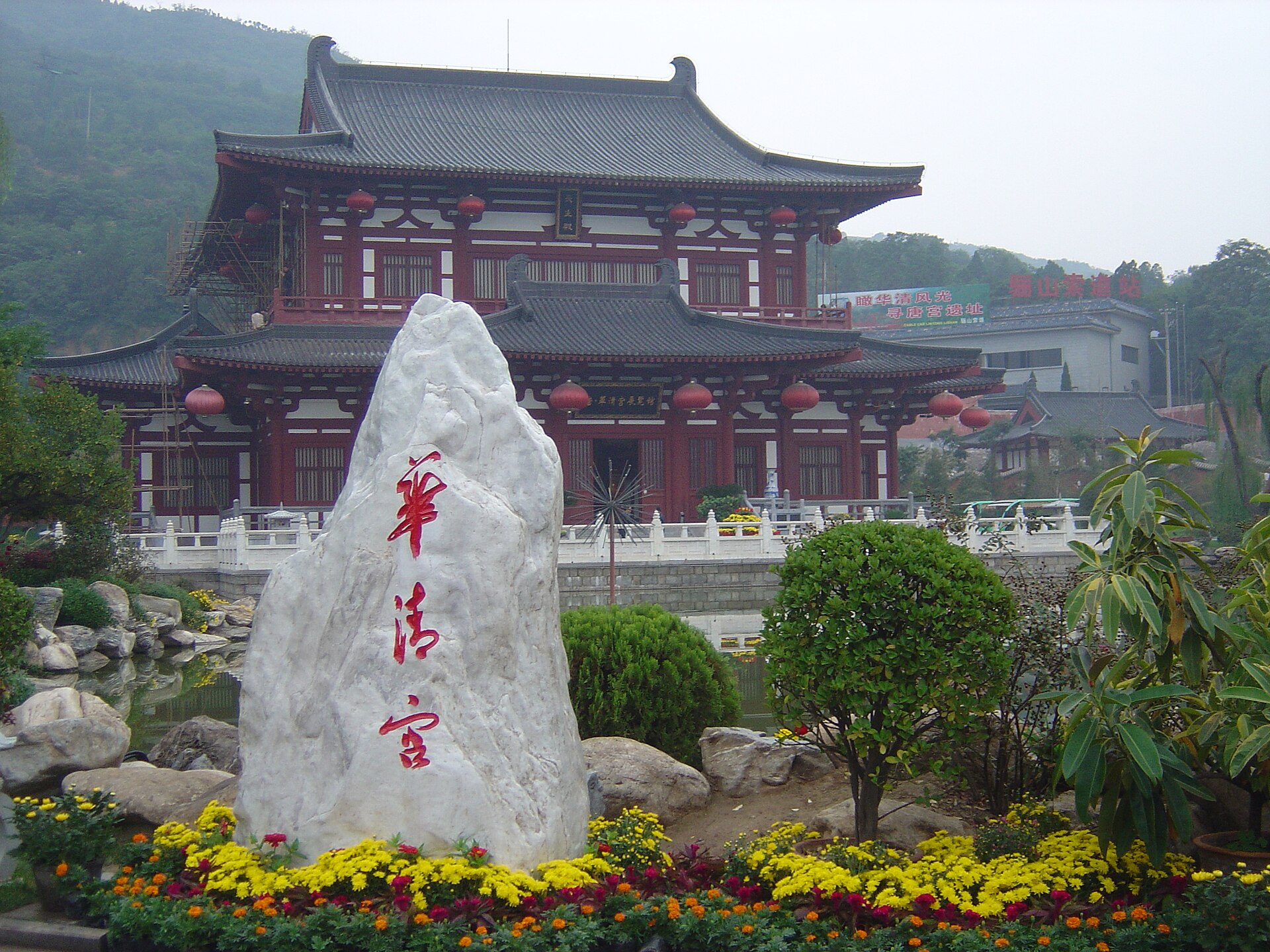
Huaqing Palace beside a still pond reflecting red-and-gold timber pavilions at the foot of Mount Li, Xi'an — the Tang dynasty hot-spring complex 3
Huaqing Palace + Mount Li (华清宫·骊山)
Tang imperial hot springs · the Song of Everlasting Sorrow show · 1936 Xi'an Incident site · at Lintong

Huaqing Palace sits in the same Lintong district as the Terracotta Army, only a few kilometres away, which makes the two a natural pairing for a single day. This was the hot-spring retreat of the Tang court — the place where Emperor Xuanzong and Yang Guifei, one of the four great beauties of ancient China, came to bathe in the mineral pools. Their love story is told in the poem "The Song of Everlasting Sorrow" (长恨歌), now staged as an open-air evening show that uses the real slopes of Mount Li as its backdrop.

Above the palace rises Mount Li (骊山), which you can climb or reach by cable car, and which holds a pivotal moment of modern history: this is where General Zhang Xueliang detained Chiang Kai-shek in 1936 (the Xi'an Incident). The spot where Chiang took cover is still preserved. Paired with the Warriors in the afternoon, it fits the day perfectly. Read the full Huaqing Palace guide →

Getting there: Bus 306 (游5) — the same line as the Terracotta Army; get off at the Huaqing Palace stop en route
Fare: ¥6–7 (~฿35) one way from Xi'an Railway Station
Entry: ~¥120 (~฿600) · the Song of Everlasting Sorrow show is ticketed separately (certain seasons only — check the schedule)
Time needed: 2–3 hours · pairs with the Terracotta Army in one day
Tip: Do the Warriors in the morning and Huaqing in the afternoon — both are on the same bus route
🛕4
Famen Temple (法门寺)
The Buddha's finger-bone relic · Tang dynasty treasures · ~120 km west

Famen Temple is a destination for Buddhists from across the world, because it holds a relic of the Buddha's finger bone — a fragment of finger bone said to be the only one of its kind surviving anywhere. It was found in 1987 beneath a collapsed old pagoda, along with thousands of Tang dynasty treasures buried as offerings: gold, silver and silk. A vast modern pagoda hall now stands over the site, and the relics are shown in an adjoining museum.

Because it lies about 120 km west of Xi'an, the temple suits travellers with a specific interest in Buddhism and history more than those on a tight schedule. If you do go, a guided day tour or the high-speed train is easier than the limited public bus. The relic itself is only put on display at certain times of year — if you want to see the genuine article, always check the viewing schedule before you travel.

Getting there: Tourist bus from the North Square of the Big Wild Goose Pagoda, departing ~8 am, ~2 hr · or G train from Xi'an North to Famen Temple Station (~1 hr) + free shuttle
Fare: Bus ~¥25–37 (~฿125–185) one way
Entry: ~¥100 (~฿500) high season (Mar–Nov) · ¥90 low season
Time needed: Full day — the site itself takes 3–4 hours, plus the long journey
Tip: Public buses run infrequently — if going independently, plan your return carefully, or book a tour with transfers included
🏛️5
Hanyangling (汉阳陵)
The Han emperor's underground museum · glass floors over real pits · near the airport

If the Terracotta Army leaves you crowded out, Hanyangling is the quieter, more surprising alternative. This is the mausoleum of Emperor Jing of the Han dynasty — a different era from Qin Shi Huang. The museum is China's first underground structure of its kind, with clear glass floors that let you walk directly above the real excavation pits, looking down at the clay figures and objects exactly where they were dug up.

The figures here differ from the Terracotta Army in one striking way: they are much smaller, around 60 cm tall, and originally had wooden arms and real fabric clothing (long since perished). But there are vastly more of them, and they include people, livestock — pigs, cattle, sheep, chickens — and everyday objects, reflecting a Han court that believed in carrying ordinary life into the afterlife. The best thing about it is the location: about 20 km north of the city, just a 20-minute drive from Xi'an Xianyang Airport, which makes it an ideal stop on the way to or from a flight.

Getting there: Taxi/private car from the city ~40 min · ~20 min from Xi'an Xianyang Airport · or local bus + Tourist Bus You 4 from the City Library stop
Fare: Local bus ¥2 one way · taxi/car varies by distance
Entry: ~¥70 (~฿350) high season (Mar–Nov) · ¥55 low season
Time needed: 2–3 hours · ideal as an arrival-day or departure-day stop
Tip: The underground museum is cool and requires shoe covers — watch your footing on the glass floor
🏯6
Dangjia Village (党家村)
A remarkably intact Ming–Qing courtyard village · at Hancheng · ~2.5 hr

Dangjia Village is the answer for travellers who want a China that almost no foreign visitor reaches. The village sits near the town of Hancheng, northeast of Xi'an, and is reckoned to be one of the best-preserved Ming and Qing dynasty courtyard villages in China — after nearly 700 years it still has around 123 traditional courtyard homes and more than 20 ancient lanes.

What makes it special is that it is still a living village, not a set built for tourists. Walk into the narrow lanes and you find high brick walls, carved wooden gateways, and stone tablets inscribed with verses meant to teach the family's children, set into the house walls. It is quiet, uncrowded, and small enough to walk in 2–3 hours. Because it lies about 225 km away, this one suits travellers on a longer Xi'an trip who want to escape the crowds and feel rural China at a slower pace.

Getting there: G train Xi'an → Hancheng (~2 hr), then a taxi for the last ~10 km into the village · or bus from Xi'an Bus Station
Fare: Train + taxi ~¥120–160 (~฿600–800) round trip
Entry: ~¥50 (~฿250) per person
Time needed: Full day — the village itself is 2–3 hours, the rest is travel
Tip: Best for visitors with 3–4 days or more in Xi'an — with only 1–2 days, prioritise the Terracotta Army and Mount Hua
Before you leave your hotel

Practical notes for all six trips

Xi'an has two main departure hubs. The first is Xi'an Railway Station (西安站), against the northern city wall — its East Square is where bus 306 (游5) leaves for the Terracotta Army and Huaqing Palace. The second is Xi'an North station (西安北), the high-speed rail hub for Mount Hua and Famen Temple, connected to the city by Metro Line 2. Arrive at least 30 minutes before departure: the stations are large and you pass through security and bag checks.

Booking tickets: For the high-speed rail trips (Mount Hua, Famen Temple, Hancheng), the 12306 app (App Store / Play Store, English interface) is the official platform — register with your passport number first. On weekdays outside holidays, window tickets are usually available on the day with your physical passport. During Golden Week and Spring Festival, trains sell out fast — book one to two weeks ahead.

Paying for things: Most shops, buses and ticket counters accept Alipay or WeChat Pay only. Download Alipay and link a foreign Visa or Mastercard via its international mode before you arrive. Keep some yuan in cash for the small vendors in the ancient villages, where digital payment is less reliable.

Frequently asked

FAQ · Day trips from Xi'an

Terracotta Army or Mount Hua — which should I choose if I only have one day in Xi'an?
If it is your first visit and you have only one day, choose the Terracotta Army. It is the reason most travellers come to Xi'an, and it is easy to reach: bus 306 (游5) from the East Square of Xi'an Railway Station takes about an hour, and you spend 3–4 hours in the museum. You can pair it with Huaqing Palace, right next door, in the same day. Mount Hua is a full day of mountain hiking and cable cars — wonderful if you love the outdoors, but better saved for a separate day if your trip is longer.
How long does the train from Xi'an to Mount Hua take, and what does it cost?
High-speed G and D trains from Xi'an North station (西安北) reach Huashan North station (华山北) in 30–35 minutes. A second-class ticket starts at around ¥54 (about ฿270 / US$7.50) one way. From Huashan North, a shuttle bus runs to the visitor centre in another 10–15 minutes. Buy via the 12306 app or at station windows with your passport. See the full Mount Hua guide.
How much is the Terracotta Army, and can I go independently?
Entry is approximately ¥120 (about ฿600 / US$17) in the low season and ¥150 in the high season, including Pits 1, 2 and 3, Lishan Garden, and the shuttle between them. Going independently is straightforward: take bus 306 (游5) from the East Square of Xi'an Railway Station, ¥7–8, about an hour to the last stop. We strongly recommend a guide or an audio guide — without the story behind them, the warriors are just figures. Read the full Terracotta Army guide.
How do I get to Famen Temple, and how far is it from Xi'an?
Famen Temple (法门寺) is about 120 km west of central Xi'an. There are two practical routes: a tourist bus from the North Square of the Big Wild Goose Pagoda, leaving around 8 am, ¥25–37, taking about two hours; or a high-speed train from Xi'an North to Famen Temple Station (~1 hour) followed by a free shuttle. Entry is approximately ¥100 in the high season. Because of the distance, a guided day tour is often the easier option. The finger-bone relic is displayed only at certain times of year — check before you go.
Can I visit Huaqing Palace and the Terracotta Army on the same day?
Easily. Huaqing Palace (华清宫) is in the same Lintong district as the Terracotta Army, only a few kilometres apart. Most people see the Warriors in the morning and stop at Huaqing in the afternoon for the Tang dynasty hot-spring pools and the 1936 Xi'an Incident site. Entry is around ¥120. If you stay until evening, you can watch the open-air "Song of Everlasting Sorrow" (长恨歌) show — but it runs only in certain seasons, so check the schedule. Details in the Huaqing Palace guide.
How is Hanyangling different from the Terracotta Army?
Hanyangling (汉阳陵) is the tomb of Emperor Jing of the Han dynasty — a different era from Qin Shi Huang, who built the Terracotta Army. Its museum is an underground structure with glass floors that let you walk directly over the real excavation pits. The clay figures here are much smaller (around 60 cm tall) but vastly more numerous, and include people, livestock and everyday objects. It sits about 20 km north of the city, roughly a 20-minute drive from Xi'an Xianyang Airport, which makes it an ideal stop on the way to or from a flight. Entry is ¥70 in the high season.
Klook · Day Trips

Xi'an Day Tours — guided trips to the Terracotta Army, Mount Hua and Famen Temple

Rather skip the bus and train logistics? Klook's guided day trips include transport, an English-speaking guide, and site entry — leaving Xi'an in the morning, back by evening. Especially handy for Famen Temple and Mount Hua, which are harder to reach on your own.

Browse Xi'an Day Trips on Klook →
Wherebest is an affiliate partner of Klook — we may earn a commission when you book through our links, at no extra cost to you.