Tang-dynasty bathing pools, a night spectacular on the mountainside, and the room where Chiang Kai-shek was seized in 1936 — just 10 minutes before the Warriors, and easy to pair into a single day.
Most people fly to Xi'an for the Terracotta Army and never realise that about 6 kilometres before the Warriors — on the very same bus line — sits a palace at the foot of a mountain that holds one of the most famous love stories in Chinese history. That is Huaqing Palace (华清宫), also known as Huaqing Pool, the Tang imperial hot-spring retreat in Lintong District.
This was the winter residence of Emperor Xuanzong of Tang and his consort Yang Guifei, traditionally counted as one of the Four Great Beauties of ancient China. Natural hot springs at the base of Mount Li made the site a royal resort as far back as the Zhou dynasty, but it reached its peak under the Tang in the 8th century — so much so that the poet Bai Juyi wrote "Song of Everlasting Sorrow" (长恨歌), the epic poem recounting the couple's love and its tragic end, which later gave the site's night show its name.
The result is three layers in one place: the Tang romance (Yang Guifei's stone bathing pool, the gardens by the spring), the modern-history layer (the building where Chiang Kai-shek was detained during the Xi'an Incident of 1936), and the landscape layer (Mount Li, with a cable car up to views over Lintong). It is not just a photo stop — it reads far better when you know the story before you arrive.
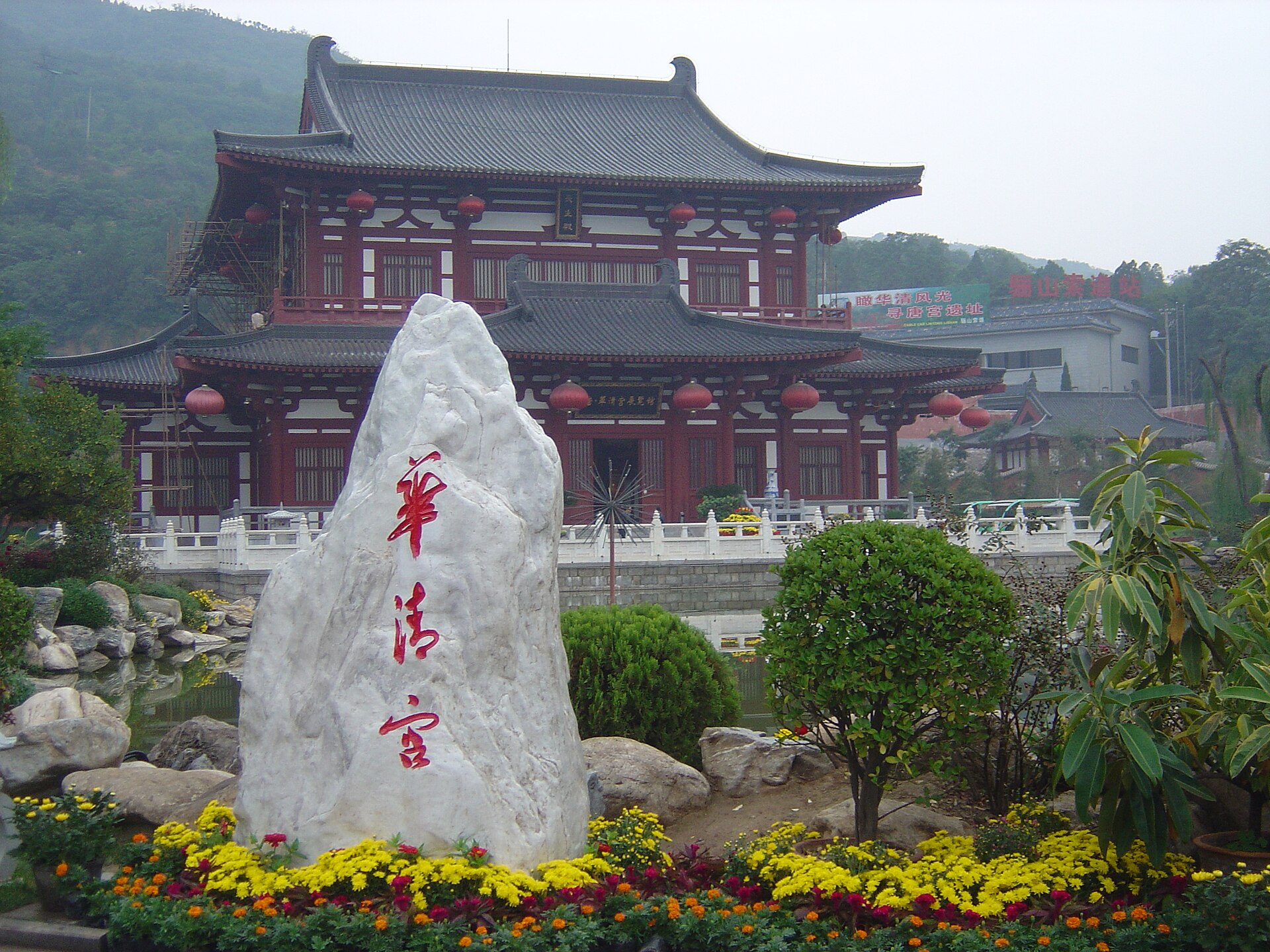
From the front gate inward — the hot-spring pools up to the summit of Mount Li.
The heart of the site is the set of stone pool foundations, more than 1,200 years old, that were excavated below ground in 1982 — including the "Haitang Pool" (shaped like a begonia flower) believed to have been Yang Guifei's, and the larger "Lotus Pool" of Emperor Xuanzong. Hot water from beneath Mount Li was piped in to fill them in Tang times. A protective hall now covers the foundations so you can see the real structures clearly, and the interpretive panels make the whole scene much easier to picture.
An epic-scale production that uses the lake in front of Mount Li as its stage and the mountain itself as the backdrop. A cast of several hundred tells the love story of Emperor Xuanzong and Yang Guifei through light, projection, fire and water effects. Performances run in the evening (around 8:10 pm, with a second show in peak season) — but only during roughly April to October. Check the schedule and book ahead before you go, because winter performances are usually suspended and seats fill quickly in high season.
At the foot of Mount Li stands the Five-Room Hall where Chiang Kai-shek was staying during the Xi'an Incident of December 1936, when the general Zhang Xueliang detained him to force a united front against Japan with the Communists — a turning point in modern Chinese history. The window glass and walls still carry bullet marks from that night, and a pavilion higher on the mountain path marks the spot where Chiang fled. It is included in the Huaqing Palace ticket.
Behind the palace rises Mount Li. You can hike the trails, but most visitors take the Lishan cable car up for views over Lintong and the Guanzhong plain. At the top are a temple, the Xi'an Incident pavilion and wide-angle photo spots. The cable car is charged separately from admission (check the price on site, as it changes periodically). If you are short on time or continuing to the Terracotta Army the same day, many people skip this and do just the lower palace.
Around the hot-spring pools is a royal garden rebuilt in Tang style — red timber halls, sweeping roofs, red lanterns, and a white marble statue of Yang Guifei that is the most photographed spot on site. It is a pleasant, shaded walk, best photographed in the morning before the crowds, and a natural place to pause before catching the same bus on to the Terracotta Army.
This is exactly why Huaqing Palace and the Terracotta Army work better together than apart — Tourist Bus 游5 (306) leaves from the East Square of Xi'an Railway Station, stops at "Huaqing Pool" first, then continues another 10 minutes or so to the Terracotta Army (the terminus). The fare is ¥7 (~฿35) per ride and the trip from the city takes about an hour. Besides the 游5 (306), buses 914 and 915 run a similar route.
The order to aim for: start at Huaqing Palace in the morning (it opens at 9 am, while crowds are still light), do just the lower palace in about 2 hours, then walk back to the same stop and catch the bus onward to the Terracotta Army in the afternoon — returning to the city in the evening. This also helps you dodge the tour groups that tend to mass at the Warriors first thing in the morning.
Huaqing Palace is open 09:00–18:00, with last entry around 17:00. The first hour after opening is the best window for photographing the gardens and pools — soft light, fewer people. If you specifically want to see the "Song of Everlasting Sorrow" night show, the plan is different: you cannot get back to the city in time for it, so most people either stay overnight near Lintong or come back for the show as a separate evening on a day they are not visiting the Warriors.
The prettiest seasons are spring (March–May) and autumn (September–November) — good weather, and they overlap with the show season. Winter is cold and the show is usually suspended.
The "Song of Everlasting Sorrow" is the highlight for many visitors, but three things to know first: one — it runs only during roughly April to October, not all year; two — the show ticket is separate from palace admission, around ¥238–368 per person (~฿1,190–1,840), with VIP zones higher; three — seats sell out quickly in high season and on holidays. Book ahead and check the current performance schedule through Klook or official channels before you build your plan.
Huaqing Palace is in Lintong District, east of Xi'an — the most popular way is the tourist bus that serves both Huaqing Palace and the Terracotta Army.
Lintong has few hotels, so most visitors stay in Xi'an city and make the trip out and back in a day — a base near the railway station or the city wall is the most convenient.